Amplitude describes the maximum displacement of a point on a wave from its equilibrium position, serving as a fundamental metric for quantifying the energy and intensity of oscillations across physics, engineering, acoustics, and quantum mechanics. By measuring how far a wave swings from its resting state—whether it is a sound wave traveling through air, an electromagnetic wave propagating across space, or a quantum probability wave—scientists can determine the magnitude of the disturbance, calculate energy transfer rates, and predict the behavior of dynamic systems in both natural and laboratory environments.
Fundamental Principles of Waves and Oscillations
To understand amplitude in science, one must first examine the basic structure of waves and repetitive motion. A wave is a disturbance that transfers energy through matter or space without permanently displacing the medium itself. Whether dealing with mechanical waves like ripples on a pond and seismic tremors or non-mechanical waves like light and radio transmissions, all sinusoidal waves share common geometric features.
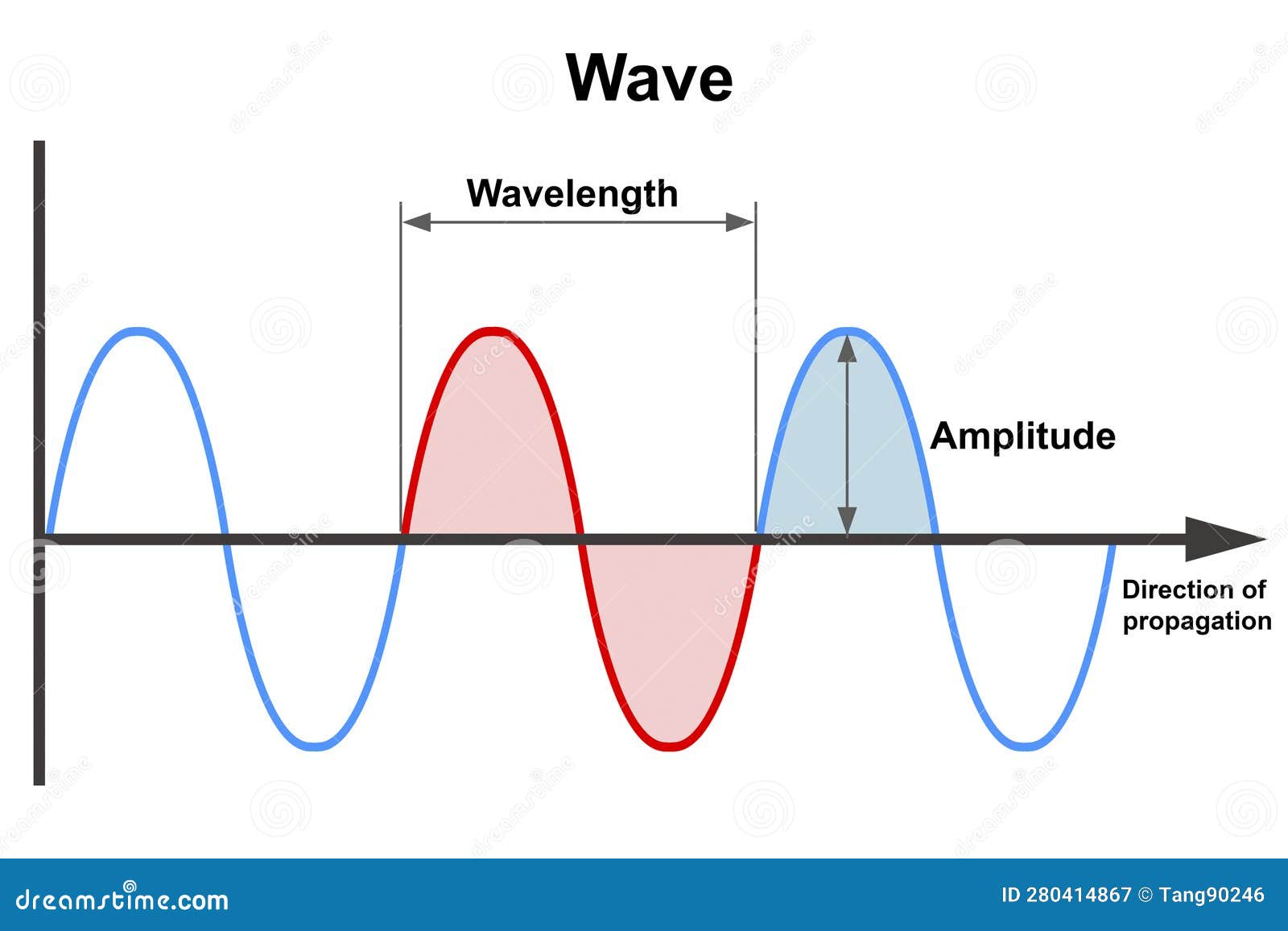
Peak (Crest) /\ / \ Amplitude (A) / \ <-----> -------/------\------------ Equilibrium Position / \ / / \ / \/ Trough
The equilibrium position, or resting point, represents the state of a system in the absence of a wave disturbance. When energy moves through the system, particles or fields oscillate symmetrically above and below this baseline.
Key parameters associated with wave motion include:
- Wavelength ($\lambda$): The spatial distance between identical points on consecutive waves, such as crest-to-crest or trough-to-trough.
- Frequency ($f$): The number of complete wave cycles that pass a given point per second, measured in hertz (Hz).
- Period ($T$): The duration of time required for one complete wave cycle to pass a point ($T = 1/f$).
- Amplitude ($A$): The maximum magnitude of displacement from equilibrium, representing the height of a crest or the depth of a trough.
Unlike frequency and wavelength, which dictate the temporal and spatial pacing of a wave, amplitude dictates its vertical scale. Crucially, in linear media, changing the amplitude of a wave does not alter its velocity, frequency, or wavelength; it changes exclusively the amount of energy carried by the wave.
Mathematical Formulation and Units of Measurement
The mathematical representation of amplitude depends heavily on the specific branch of science and the physical medium under investigation. In general wave mechanics, a simple harmonic progressive wave is expressed mathematically as a function of position ($x$) and time ($t$):
$$y(x, t) = A \sin(kx - \omega t + \phi)$$
Where:
- $y(x, t)$ is the displacement at position $x$ and time $t$.
- $A$ is the amplitude (maximum displacement).
- $k$ is the wave number ($2\pi/\lambda$).
- $\omega$ is the angular frequency ($2\pi f$).
- $\phi$ is the phase angle.
Units Across Disciplines
Because amplitude measures displacement, its units change depending on what is physically oscillating:
| Scientific Field | Physical Quantity Measured | Standard SI Units | Common Alternative Units |
|---|---|---|---|
| Acoustics | Sound pressure fluctuations | Pascals ($\text{Pa}$) | Decibels ($\text{dB}$, logarithmic scale) |
| Mechanics / Seismology | Physical displacement of ground or strings | Meters ($\text{m}$) | Centimeters ($\text{cm}$), millimeters ($\text{mm}$) |
| Electromagnetism | Electric field strength ($E$) or magnetic field ($B$) | Volts per meter ($\text{V/m}$) / Teslas ($\text{T}$) | Microvolts per meter ($\mu\text{V/m}$) |
| Quantum Mechanics | Probability amplitude (wavefunction value) | Dimensionless / $\text{m}^{-3/2}$ | Complex numbers ($\psi$) |
Amplitude and Energy Relationship
One of the most vital principles in wave physics is the direct mathematical relationship between a wave's amplitude and the energy it transmits. The energy ($E$) transported by a mechanical wave is generally proportional to the square of its amplitude ($A^2$):
$$E \propto A^2$$
This quadratic relationship means that if a wave's amplitude is doubled, the energy it delivers increases by a factor of four. If the amplitude triples, the energy increases ninefold. This principle applies across diverse physical systems, from ocean waves battering a shoreline to seismic waves generated by tectonic plate movements.
Intensity and Power
In wave mechanics, intensity ($I$) is defined as the power per unit area carried by a wave. For spherical and planar waves, intensity is directly proportional to the square of the amplitude and the square of the frequency:
$$I \propto f^2 A^2$$
In acoustics, human perception of loudness scales logarithmically with sound pressure amplitude. The decibel scale compresses the vast range of human hearing into manageable numbers by taking the base-10 logarithm of the ratio between a measured sound pressure amplitude and a baseline reference threshold ($20,\mu\text{Pa}$).
Applications of Amplitude Across Scientific Disciplines
The measurement and analysis of wave amplitude are foundational across various technical fields.
Seismology and Earth Sciences
Seismologists rely on amplitude measurements to gauge the power and destructive potential of earthquakes. The Richter magnitude scale and modern moment magnitude scales utilize the maximum amplitude of seismic waves recorded by seismographs. Because wave energy scales quadratically with amplitude, a minor increase in recorded amplitude on a seismogram indicates a massive release of subterranean energy.
Telecommunications and Radio Frequency Engineering
In electronics and communications, amplitude modulation (AM) is a classic technique used to transmit information via carrier waves. By varying the amplitude of a high-frequency carrier signal in proportion to the instantaneous voltage of an audio or data signal, information can be transmitted over vast distances. Conversely, amplitude shift keying (ASK) encodes digital data (1s and 0s) by shifting between distinct amplitude levels.
Quantum Mechanics
In quantum theory, the physical interpretation of amplitude shifts from tangible physical displacement to probability. Max Born’s statistical interpretation of the Schrödinger equation establishes that the absolute square of a quantum wavefunction’s amplitude—known as a probability amplitude—yields the spatial probability density of finding a particle at a given point. While the wavefunction itself is a complex number and cannot be measured directly, its squared amplitude dictates the observable physical reality of subatomic particles.
Common Misconceptions and Technical Cautions
When studying wave phenomena, researchers and students frequently encounter conceptual pitfalls regarding amplitude:
- Confusing Amplitude with Frequency: A common error is assuming high-frequency waves inherently carry more amplitude. Frequency dictates how fast a wave oscillates, whereas amplitude dictates how far it displaces. A high-frequency wave can have a minuscule amplitude, just as a low-frequency ocean swell can possess immense amplitude and destructive energy.
- Ignoring Damping Effects: In real-world systems, energy is constantly lost to friction, heat, and structural resistance. This phenomenon, known as damping, causes wave amplitude to decay exponentially over distance or time. Mathematical models must account for damping coefficients to accurately predict real-world wave behavior.
- Misinterpreting Logarithmic Scales: When examining decibels in acoustics or the Richter scale in seismology, linear jumps in scale numbers represent exponential jumps in raw amplitude and energy. Neglecting this logarithmic conversion leads to severe underestimations of physical forces.
Practical Recommendations for Wave Analysis
When setting up experiments, analyzing signal data, or troubleshooting electronic and acoustic systems, adhere to these operational best practices:
- Calibrate Instrumentation: Ensure that oscilloscopes, seismographs, or hydrophones are properly calibrated against known reference standards to avoid amplitude distortion or clipping.
- Account for Environmental Attenuation: When measuring wave propagation outdoors or through dense matter, factor in geometric spreading and absorption losses that naturally reduce amplitude over distance.
- Check for Signal Clipping: In electronic data acquisition, ensure the input signal amplitude does not exceed the dynamic range of the analog-to-digital converter, which truncates waveform crests and introduces harmonic distortion.
Frequently Asked Questions
What is the difference between amplitude and wavelength?
Amplitude measures the maximum vertical displacement of a wave from its resting position, representing its energy level. Wavelength measures the horizontal spatial distance between two corresponding points on consecutive waves, such as crest to crest, governing the wave's spatial scale rather than its energy.
How does amplitude affect the loudness of sound?
In acoustics, wave amplitude corresponds directly to sound pressure. Higher amplitude sound waves compress and decompress air molecules more forcefully, which the human ear and audio sensors register as greater volume or loudness.
Can amplitude change as a wave travels?
Yes. As waves travel through media, they typically undergo attenuation due to geometric spreading and energy absorption (damping). This causes the amplitude to decrease over distance, even though the frequency and wavelength remain constant.
Is amplitude relevant in quantum mechanics?
Yes, though it takes a specialized form called probability amplitude. The squared absolute value of a quantum wavefunction's amplitude dictates the spatial probability density of locating a particle, linking wave mathematics directly to quantum observation.
Why is wave energy proportional to the square of the amplitude?
The quadratic relationship arises from the mechanical work required to displace a medium against restoring forces (such as tension or elasticity). Because the restoring force typically increases linearly with displacement (Hooke's law), the accumulated potential energy scales with the square of the maximum displacement.
Conclusion
Amplitude in science is far more than a simple measurement of wave height; it is a vital metric that quantifies energy transmission, physical displacement, and probabilistic likelihood across every scientific discipline. By mastering the mathematical definitions, energy relationships, and practical applications of amplitude, researchers can accurately model wave phenomena, optimize signal processing systems, and interpret the fundamental mechanics of the natural world.