Radioactive decay is the spontaneous process by which an unstable atomic nucleus loses energy by emitting radiation in the form of particles or electromagnetic waves. This transformation, governed by the laws of physics, is expressed through nuclear equations that track changes in mass number, atomic number, and energy states to ensure the conservation of matter and charge.
Understanding the Foundation of Nuclear Equations
To master alpha, beta, and gamma decay equations, one must first understand the notation used to describe atoms. In nuclear physics, we represent an element using the symbol $^{A}_{Z}X$. In this format, A represents the mass number (the total number of protons and neutrons), Z represents the atomic number (the number of protons, which determines the element's identity), and X is the chemical symbol.
Nuclear equations are unique because they focus on the nucleus rather than the electrons. In 2026, these equations remain the fundamental language for nuclear medicine, carbon dating, and energy production. The primary rule for balancing these equations is simple but absolute: the sum of the mass numbers (top) and the sum of the atomic numbers (bottom) must be identical on both sides of the reaction arrow. This reflects the conservation of nucleons and electric charge.
Instability in a nucleus usually arises from an imbalance between the strong nuclear force, which holds protons and neutrons together, and the electrostatic repulsion between positively charged protons. When the ratio of neutrons to protons (N/Z ratio) is outside the "valley of stability," the nucleus undergoes radioactive decay to reach a lower, more stable energy state.
Alpha Decay Equations: The Emission of Helium Nuclei
Alpha decay occurs primarily in heavy nuclei, such as those of uranium, radium, and thorium. Because these nuclei are so large, the strong nuclear force struggles to counteract the electromagnetic repulsion between the high number of protons. To regain stability, the nucleus ejects an alpha particle.
The Anatomy of an Alpha Particle
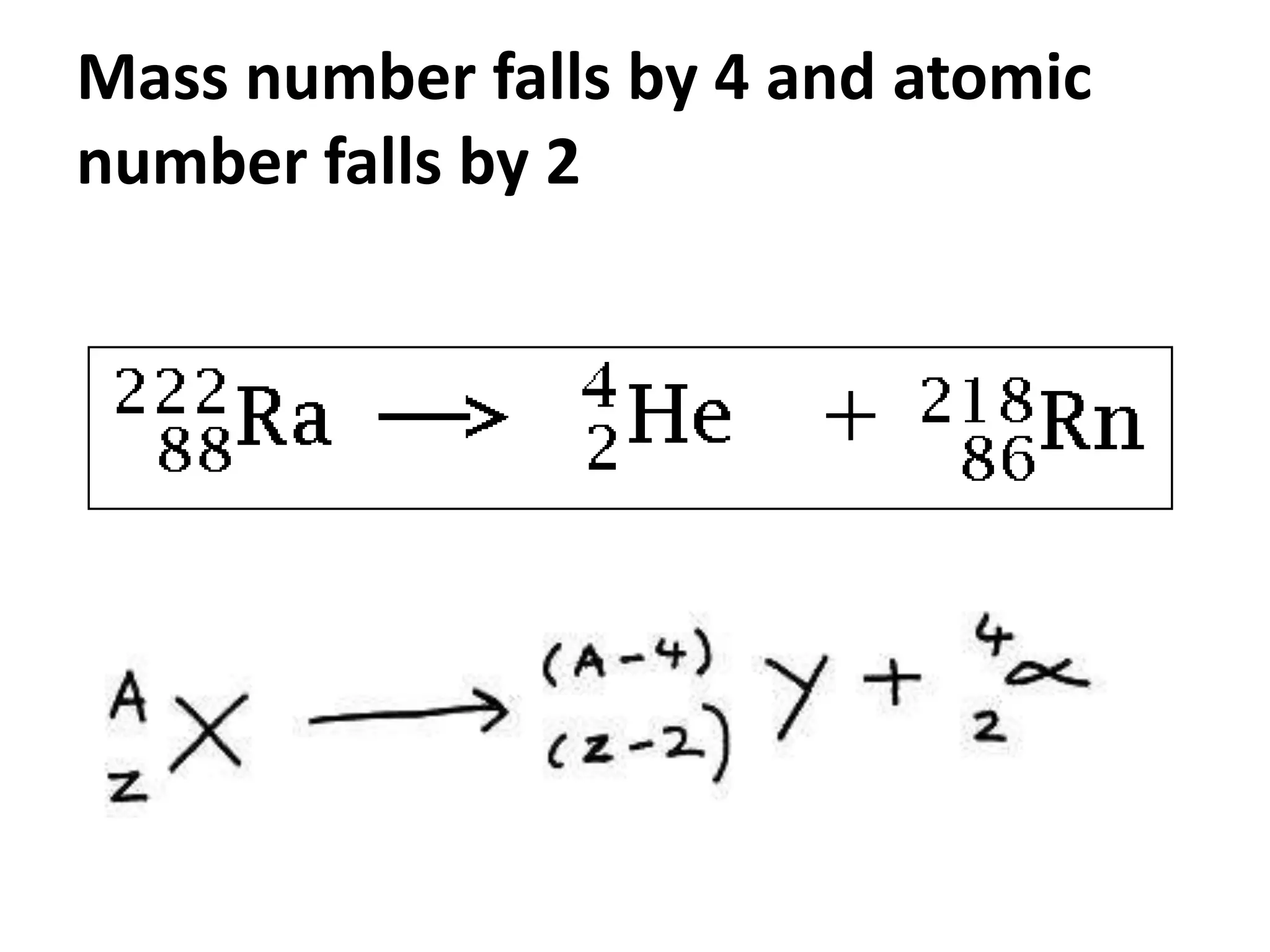
An alpha particle ($\alpha$) is identical to a helium-4 nucleus. It consists of two protons and two neutrons, giving it a mass number of 4 and an atomic number of 2. In an equation, it is written as $^{4}{2}He$ or $^{4}{2}\alpha$. Because it lacks electrons, an alpha particle carries a $+2$ charge.
The General Alpha Decay Formula
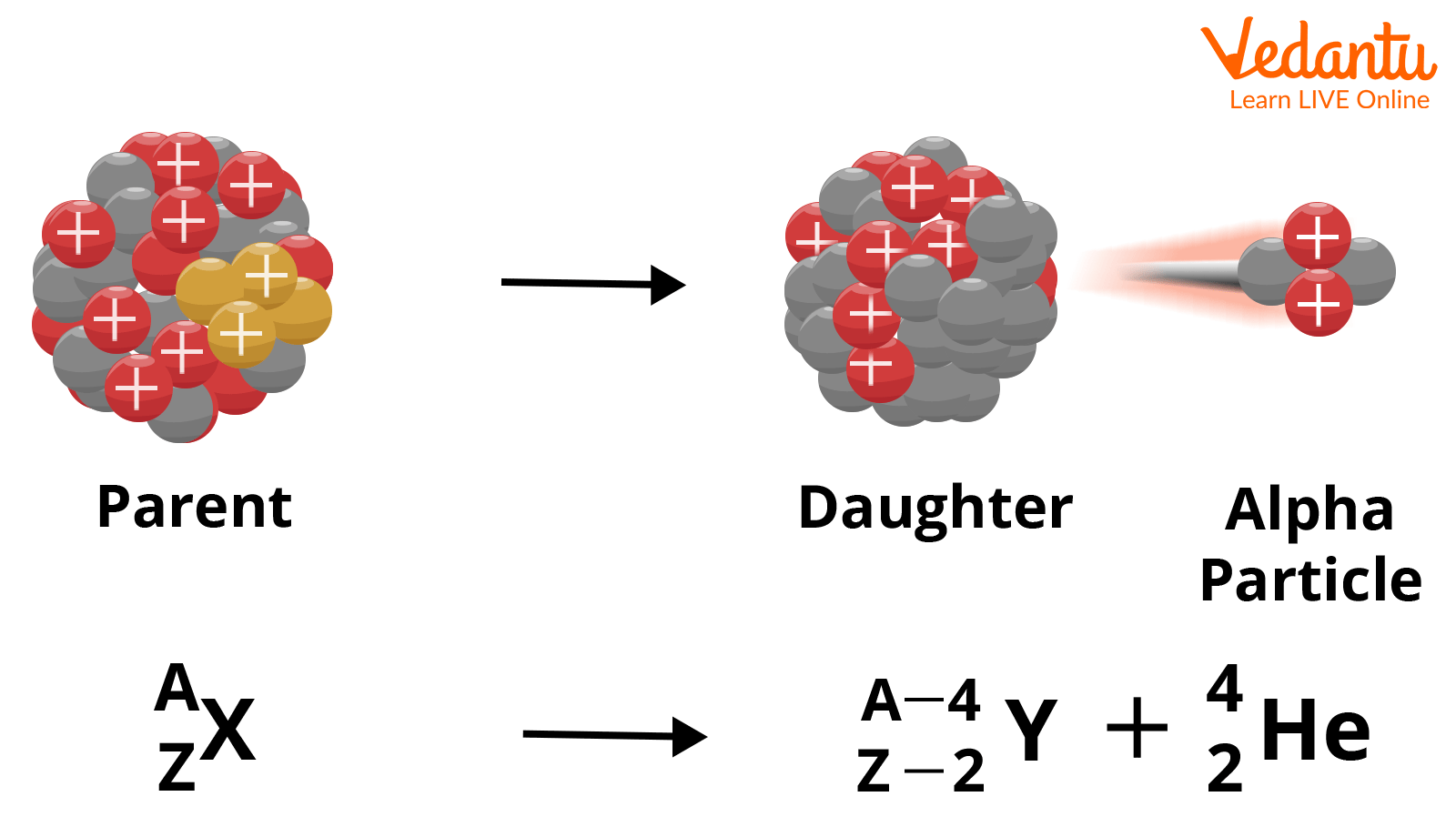
The general equation for alpha decay is: $^{A}{Z}X \rightarrow ^{A-4}{Z-2}Y + ^{4}_{2}He$
In this reaction:
- X is the parent nucleus.
- Y is the daughter nucleus.
- The mass number decreases by 4.
- The atomic number decreases by 2.
Step-by-Step Example: Uranium-238
Consider the decay of Uranium-238, a common isotope used in geological dating.
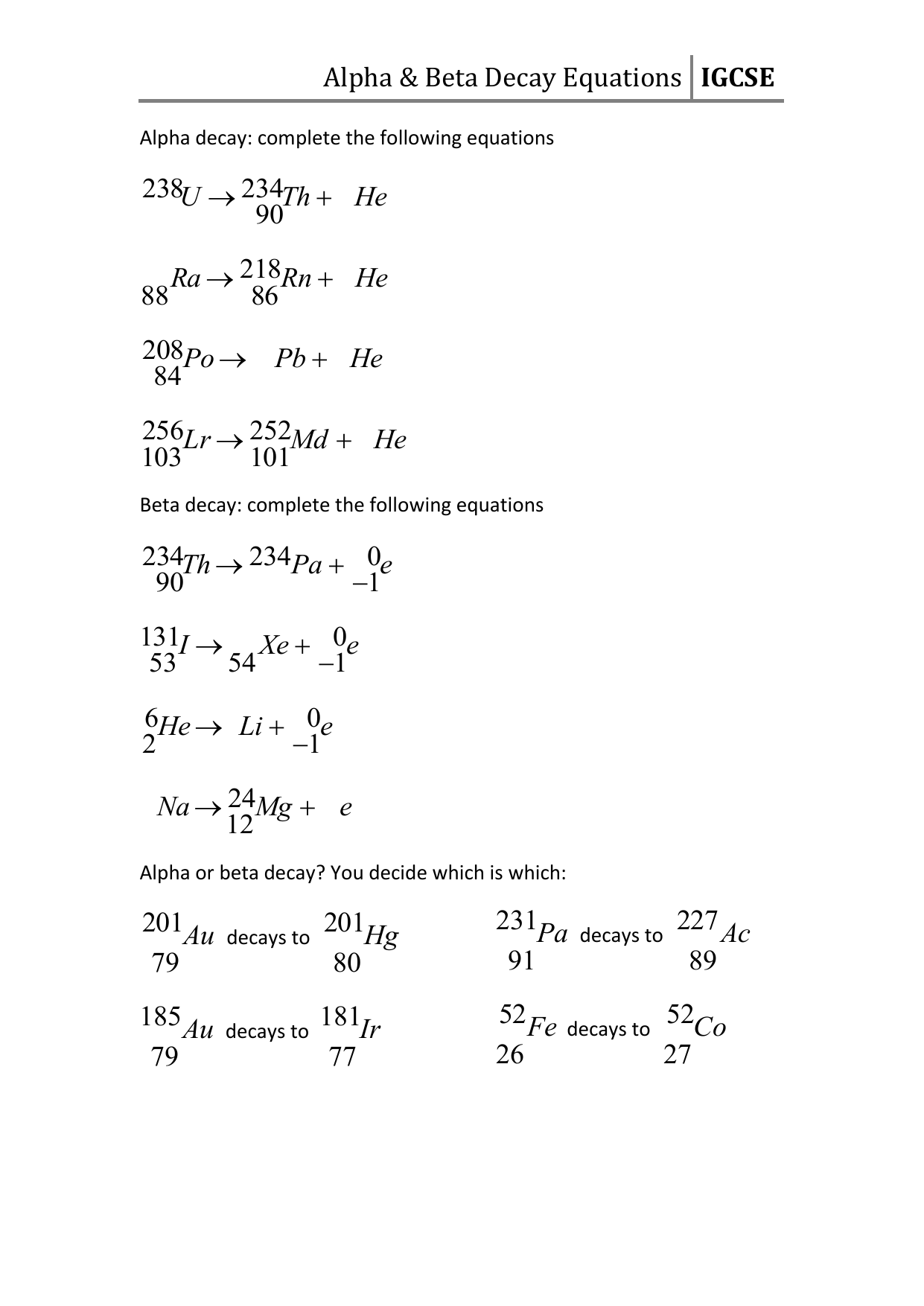
- Start with the parent: $^{238}_{92}U$.
- Apply the alpha rule: Subtract 4 from the mass (238 - 4 = 234) and 2 from the atomic number (92 - 2 = 90).
- Identify the daughter: Look at the periodic table for atomic number 90, which is Thorium (Th).
- The Result: $^{238}{92}U \rightarrow ^{234}{90}Th + ^{4}_{2}He$.
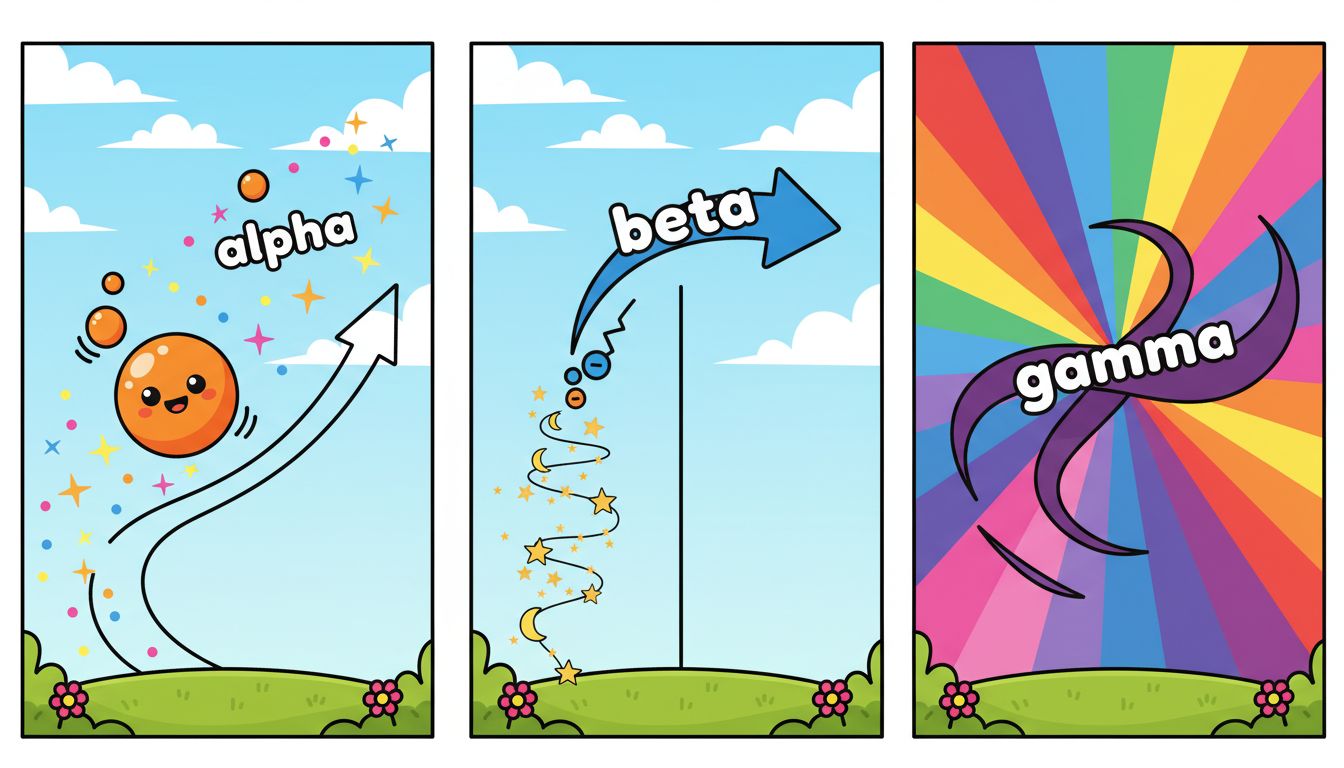
Alpha particles are relatively heavy and slow-moving. They possess high ionizing power but low penetrating power, meaning they can be stopped by a single sheet of paper or the outer layer of human skin. However, if alpha-emitting isotopes are ingested or inhaled, they can cause significant biological damage to internal tissues.
Beta Decay Equations: Balancing Neutrons and Protons
Beta decay is a more complex process involving the weak nuclear force. It occurs when a nucleus has too many neutrons or too many protons to be stable. There are three primary types: Beta-minus ($\beta^-$), Beta-plus ($\beta^+$ or positron emission), and Electron Capture.
Beta-Minus Decay ($\beta^-$)
This occurs when a nucleus is "neutron-rich." To achieve stability, a neutron in the nucleus transforms into a proton, an electron, and an antineutrino. The proton stays in the nucleus, while the electron (the beta particle) and the antineutrino are ejected.
- The Particle: The beta-minus particle is an electron, denoted as $^{0}{-1}e$ or $^{0}{-1}\beta$.
- The Change: The mass number (A) remains the same because a neutron was lost but a proton was gained. The atomic number (Z) increases by 1.
- General Formula: $^{A}{Z}X \rightarrow ^{A}{Z+1}Y + ^{0}_{-1}e + \bar{\nu}_e$ (where $\bar{\nu}_e$ is the antineutrino).
Example: Carbon-14 Decay Carbon-14 is used for radiocarbon dating. $^{14}{6}C \rightarrow ^{14}{7}N + ^{0}_{-1}e + \bar{\nu}_e$ Note that the atomic number increased from 6 to 7, transforming Carbon into Nitrogen.
Beta-Plus Decay ($\beta^+$)
Also known as positron emission, this occurs in "proton-rich" nuclei. A proton transforms into a neutron, a positron (the antimatter counterpart of an electron), and a neutrino.
- The Particle: The positron is denoted as $^{0}{+1}e$ or $^{0}{+1}\beta$.
- The Change: The mass number stays the same, but the atomic number decreases by 1.
- General Formula: ^{A}{Z}X \rightarrow ^{A}{Z-1}Y + ^{0}_{+1}e + \nu_e$ (where $\nu_e$ is the neutrino).
Example: Magnesium-23 Decay $^{23}{12}Mg \rightarrow ^{23}{11}Na + ^{0}_{+1}e + \nu_e$
Electron Capture
Electron capture is an alternative to beta-plus decay. Instead of emitting a positron, the nucleus "captures" an inner-shell electron (usually from the K or L shell). This electron combines with a proton to form a neutron and a neutrino.
- Equation Structure: The electron appears on the left side (reactant side) of the equation.
- General Formula: $^{A}{Z}X + ^{0}{-1}e \rightarrow ^{A}_{Z-1}Y + \nu_e$
Beta particles are much smaller than alpha particles and travel at speeds approaching the speed of light. They can penetrate skin but are stopped by a few millimeters of aluminum or plastic.
Gamma Decay Equations: The Emission of Pure Energy
Unlike alpha and beta decay, gamma decay does not involve the ejection of particles with mass. Instead, it involves the emission of high-energy electromagnetic radiation (photons) called gamma rays ($\gamma$).
Why Gamma Decay Occurs
Gamma decay usually follows an alpha or beta emission. After a nucleus ejects a particle, it is often left in an "excited state" with excess energy. To reach its "ground state" (the most stable energy configuration), it releases that energy as a gamma photon.
The Gamma Decay Formula
Because gamma rays have no mass and no charge ($^{0}{0}\gamma$), the identity of the element does not change. $^{A}{Z}X^* \rightarrow ^{A}{Z}X + ^{0}{0}\gamma$ (The asterisk * denotes the excited state of the nucleus).
Example: Cobalt-60 Cobalt-60 is widely used in 2026 for medical sterilization and cancer radiotherapy. It first undergoes beta-minus decay to form Nickel-60 in an excited state, which then undergoes gamma decay. Step 1: $^{60}{27}Co \rightarrow ^{60}{28}Ni^* + ^{0}{-1}e$ Step 2: $^{60}{28}Ni^* \rightarrow ^{60}{28}Ni + ^{0}{0}\gamma$
Gamma radiation is highly penetrating and requires several inches of lead or several feet of concrete to be effectively shielded. It represents the highest energy end of the electromagnetic spectrum.
Summary Comparison of Decay Types
The following table provides a quick reference for identifying and balancing these three primary forms of radioactive decay.
| Decay Type | Particle/Radiation | Symbol | Change in Mass (A) | Change in Atomic Number (Z) | Penetrating Power |
|---|---|---|---|---|---|
| Alpha ($\alpha$) | Helium Nucleus | $^{4}_{2}He$ | Decreases by 4 | Decreases by 2 | Low (stopped by paper) |
| Beta-Minus ($\beta^-$) | Electron | $^{0}_{-1}e$ | No Change | Increases by 1 | Moderate (stopped by Al) |
| Beta-Plus ($\beta^+$) | Positron | $^{0}_{+1}e$ | No Change | Decreases by 1 | Moderate |
| Gamma ($\gamma$) | Photon | $^{0}_{0}\gamma$ | No Change | No Change | High (stopped by lead) |
| Electron Capture | Captured Electron | $^{0}_{-1}e$ (reactant) | No Change | Decreases by 1 | N/A |
How to Balance Nuclear Equations: A Step-by-Step Guide
Balancing nuclear equations is a critical skill for students in physics and chemistry. In 2026, automated software often handles these for industrial applications, but the manual verification process follows these four steps:
- Identify the Parent Nuclide: Determine the mass number and atomic number of the starting material.
- Determine the Decay Mode: Look for keywords such as "alpha emission," "beta decay," or "positron emission."
- Apply Conservation Laws:
- Conservation of Mass: The sum of the superscripts on the left must equal the sum of the superscripts on the right.
- Conservation of Charge: The sum of the subscripts on the left must equal the sum of the subscripts on the right.
- Identify the Daughter Product: Use the final atomic number (Z) to find the element name on the periodic table. If $Z=0$ or $Z=-1$, it is a particle emission rather than a new element.
Common Pitfall: The Antineutrino
Students often forget to include the neutrino ($\nu_e$) or antineutrino ($\bar{\nu}_e$) in beta decay equations. While these particles have nearly zero mass and no charge, they are essential for the conservation of energy and "lepton number," a fundamental principle in particle physics. In 2026 physics curricula, omitting these is considered a significant error.
Practical Applications in 2026
The ability to calculate and understand these equations has real-world consequences in several fields:
- Nuclear Medicine: Diagnostic tools like PET scans (Positron Emission Tomography) rely entirely on beta-plus decay equations. Clinicians must calculate the half-life and decay products to ensure patient safety and imaging clarity.
- Carbon Dating: Archaeologists use the beta-minus decay of Carbon-14 to Nitrogen-14 to determine the age of organic artifacts.
- Nuclear Power: Fission reactors rely on understanding how heavy nuclei like Uranium-235 decay and split, releasing the binding energy that is converted into electricity.
- Space Exploration: Radioisotope Thermoelectric Generators (RTGs) use the heat from the alpha decay of Plutonium-238 to power spacecraft like the Voyager probes and modern Mars rovers.
FAQs About Radioactive Decay Equations
What is the difference between a chemical equation and a nuclear equation?
A chemical equation involves the rearrangement of electrons and the breaking/forming of chemical bonds; the atoms themselves do not change identity. A nuclear equation involves changes within the nucleus, often resulting in the transmutation of one element into another.
Why does the mass number not change in beta decay?
In beta decay, a nucleon simply changes its flavor (a neutron becomes a proton or vice versa). Since both neutrons and protons have a mass of approximately 1 atomic mass unit (amu), the total number of nucleons—and thus the mass number—remains constant.
Can an atom undergo more than one type of decay?
Yes. Many heavy isotopes undergo a "decay series." For example, Uranium-238 does not become stable after one alpha decay; it goes through a long chain of alpha and beta decays before finally becoming a stable isotope of Lead (Pb-206).
Does gamma decay always happen with alpha or beta decay?
Almost always. It is rare for a nucleus to be in an excited state without having first undergone some form of particle emission or a nuclear reaction. Gamma radiation is the "relief valve" for the excess energy left behind by those changes.
Is an alpha particle really just helium?
It is a helium nucleus. It lacks the two electrons that a neutral helium atom possesses. Therefore, it has a $+2$ charge. Once an alpha particle slows down in the environment, it eventually captures two electrons to become a stable, neutral helium atom.
Final Recommendations for Mastery
To excel in working with alpha, beta, and gamma decay equations, practitioners should focus on memorizing the particle symbols ($^{4}{2}He$ for alpha and $^{0}{-1}e$ for beta) and the conservation rules. For complex problems, always draw a visual representation of the N/Z ratio to predict which decay mode is most likely. If you are preparing for 2026 certification exams in radiologic technology or nuclear physics, practicing the "decay chain" problems—where one equation leads into the next—is the most effective way to ensure a deep understanding of these fundamental nuclear processes.