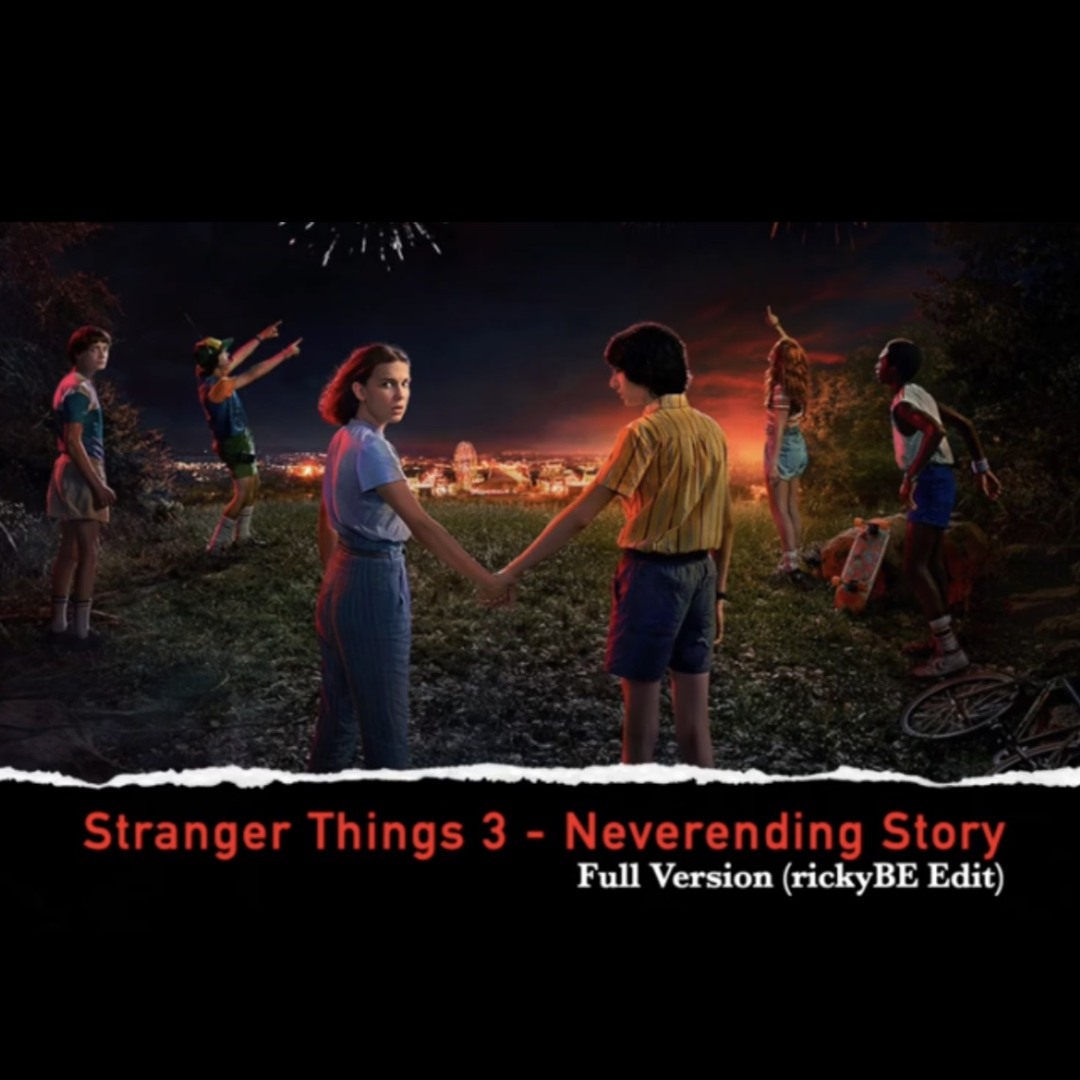
Dustin Henderson and Suzie Bingham perform their famous duet of Limahl's "The NeverEnding Story" theme song during the climax of Stranger Things Season 3, specifically in the final episode, titled "Chapter Eight: The Battle of Starcourt." This unforgettable musical sequence occurs approximately 42 minutes into the episode as Dustin urgently needs Suzie to provide a critical scientific constant—Planck's constant, represented by the variable "Planck's constant P"—to save Jim Hopper, Joyce Byers, and the rest of the crew trapped inside the underground Russian base beneath the Starcourt Mall.
The inclusion of this unexpected showtune stands as one of the most culturally resonant, humorously timed, and widely discussed moments in modern television history. Beyond its immediate narrative utility as a plot device to unlock a secure radio code, the scene encapsulates the nerdy, pop-culture-saturated charm of the 1980s that defines the core ethos of the Duffer Brothers' hit Netflix series.
The Context and Narrative Build-Up to the Musical Number
To fully understand when and why "The NeverEnding Story" appears in Stranger Things, one must examine the high-stakes narrative architecture of Season 3's finale. The episode takes place on Independence Day in 1985. The town of Hawkins, Indiana, is under the covert siege of Soviet military operatives who have built a secret laboratory underneath the newly constructed Starcourt Mall to open a portal to the Upside Down.
The Starcourt Mall Crisis
Inside the subterranean Russian base, Chief of Police Jim Hopper, former journalist Murray Bauman, and Joyce Byers find themselves locked out of the secure vault housing the keys to shutting down the machine. The communications relay is heavily compromised. Above ground, Dustin Henderson, Steve Harrington, Robin Buckley, and Erica Sinclair are fleeing the Mind Flayer's physical manifestation inside the mall itself, while maintaining radio contact with Dustin’s makeshift, highly powerful ham radio tower dubbed "Cerebro."
Cerebro and the Mystery of Suzie-Poo
Earlier in the season, Dustin spent weeks boasting to his skeptical friends about his genius, beautiful girlfriend named Suzie, whom he met at Camp Know Where in Utah. While the older kids initially believed Suzie to be an elaborate fabrication invented to save face after Dustin's return from summer camp, the climax proves her existence beyond a shadow of a doubt. When Dustin contacts Cerebro to request the numeric value for Planck’s constant, Suzie answers—but she refuses to yield the vital scientific data until Dustin performs a romantic duet with her over the open airwaves.
Scene Breakdown: The Exact Timeline of the Duet
The performance itself is a masterclass in comedic timing, leveraging the breathless tension of a life-or-death situation against the wholesome innocence of two teenage science camp sweethearts.
| Stage of the Scene | Narrative Action | Character Involvement |
|---|---|---|
| Initial Contact | Dustin reaches Suzie via Cerebro; she demands romance before cooperating. | Dustin Henderson, Suzie Bingham |
| Peer Pressure | Steve, Robin, and Erica listen in disbelief as Dustin's life-saving mission stalls for a song. | Steve Harrington, Robin Buckley, Erica Sinclair |
| The Performance | Dustin and Suzie sing Limahl's "The NeverEnding Story" a cappella over the radio. | Dustin Henderson, Suzie Bingham |
| The Resolution | Suzie provides Planck’s constant ($h = 6.626 \times 10^{-34}$), allowing Hopper and Joyce to proceed. | Entire core cast |
As the haunting, synth-heavy melody of Giorgio Moroder and Limahl's 1984 pop track begins, the camera cuts between Dustin standing atop his high hill with Cerebro, Suzie in her Mormon household in Utah singing into her pink telephone, and the baffled reactions of Steve and the gang hiding from Soviet guards in the mall. The juxtaposition of lethal danger with unadulterated musical theater creates an immediate tonal shift that leaves audiences both bewildered and thoroughly entertained.
Cultural Impact and Reception of the Scene
The placement of "The NeverEnding Story" in Stranger Things triggered a massive cultural resurgence for the original 1984 film adaptation and its theme song. Originally performed by Limahl (former lead singer of Kajagoogoo) with music composed by Giorgio Moroder, the song had enjoyed modest nostalgic status until the summer of 2019.
Following the release of Season 3, Netflix reported skyrocketing streaming metrics for the track. According to Spotify, global streams of "The NeverEnding Story" surged by more than 800% within days of the episode airing. YouTube views for the original music video climbed exponentially as younger viewers discovered the fantasy film directed by Wolfgang Petersen, based on Michael Ende's classic 1979 fantasy novel.
Why the Scene Resonates with Viewers
- Character Authenticity: The sequence reinforces Dustin's unapologetic nerdiness. He does not hide his affection or his quirky interests, making his relationship with Suzie feel genuine despite its sudden introduction.
- Tonal Relief: The Duffer Brothers expertly use humor to puncture extreme tension. Just as viewers brace for potential tragedy in the Russian base, the narrative pivots to an endearing, awkward teenage duet.
- Nostalgia Amplification: Pairing a beloved 1980s television phenomenon (Stranger Things) with an iconic 1980s cinematic artifact (The NeverEnding Story) created a recursive loop of generational nostalgia.
Technical and Historical Accuracy in the Scene
While Stranger Things is a work of science fiction featuring interdimensional monsters and secret Soviet installations, the scientific premise anchoring the scene—Planck's constant—is historically and physically grounded, though its application in the script takes creative liberties.
Planck's Constant Explained
In physics, Planck's constant (usually denoted as $h$) is a fundamental physical constant that characterizes the mathematical sizing of packets of energy, or quanta, in quantum mechanics. Its accepted value in standard SI units is approximately $6.62607015 \times 10^{-34}\text{ Joule seconds}$ (or $\text{eV}\cdot\text{s}$).
In the show, Dustin needs the exact decimal expansion of this constant to calculate the code required to deactivate the Soviet laser machine, colloquially referred to as "The Alexei." While real-world cryptographers and physicists do not use Planck's constant as a numerical password for vault doors, its inclusion grounds the scene in the genuine academic passions shared by Dustin and Suzie, who bonded over their mutual love for science and radio technology at Camp Know Where.
Frequently Asked Questions
What episode of Stranger Things features "The NeverEnding Story"?
The song is featured in Season 3, Episode 8, titled "Chapter Eight: The Battle of Starcourt." It occurs during the final third of the episode as the primary storylines converge on the climax at the Starcourt Mall and the underground Russian facility.
Who actually sings "The NeverEnding Story" in the show?
The vocals are performed by Gaten Matarazzo (who plays Dustin Henderson) and Gabriella Pizzolo (who plays Suzie Bingham). Both actors have extensive Broadway theater backgrounds, which explains their impressive vocal control and ability to harmonize seamlessly during the comedic sequence.
Is Limahl's original version used in the episode?
While Limahl's original 1984 recording served as the primary inspiration, the version heard in the show is a newly recorded rendition performed specifically by the actors, designed to fit the impromptu nature of the radio broadcast. The official soundtrack released by Netflix includes this cast recording.
Why did Suzie make Dustin sing before giving him the code?
Suzie was not intentionally sabotaging the mission; rather, she was playfully teasing Dustin after he had been out of contact for weeks during a busy summer. Unaware that the fate of the world hung in the balance, she treated the call with the typical romantic whimsy of a teenage camp romance.
How did the rest of the characters react to the song?
The reaction is mixed and largely comedic. Steve Harrington looks on in sheer disbelief and exhaustion, while Robin listens with amused resignation. Erica, ever the pragmatist, is utterly bewildered by the delay, emphasizing the absurdity of stopping a global crisis for a musical theater number.
Practical Takeaways for Fans
For viewers seeking to revisit this specific moment or explore its cultural footprint, several avenues offer deeper engagement with the franchise and its musical heritage:
- Re-watch Season 3, Episode 8: To experience the scene in its full narrative context, queue up the final twenty minutes of the third season finale on Netflix.
- Listen to the Official Soundtracks: The Stranger Things: Soundtrack from the Netflix Original Series, Season 3 includes the cast recording, while the original 1984 track by Limahl remains widely available across major digital streaming platforms.
- Explore the Source Material: Fans interested in the broader fantasy context of the song can read Michael Ende's 1979 novel The Neverending Story (Die unendliche Geschichte) or watch the 1984 film adaptation.