The 2020 Hyundai Santa Fe Hybrid represents a significant milestone in the South Korean automaker's electrification strategy, combining a spacious midsize crossover platform with a gasoline-electric powertrain. Designed to bridge the gap between traditional internal combustion engine vehicles and fully electric options, this hybrid variant introduced enhanced fuel efficiency, a refined driving dynamic, and advanced technology features to a highly competitive family SUV segment.
Introduction to the 2020 Hyundai Santa Fe Hybrid
The automotive landscape shifted dramatically toward electrification around the turn of the decade, prompting manufacturers to introduce hybrid variants of their most popular nameplates. For the Santa Fe line, the introduction of a hybrid powertrain addressed consumer demand for lower emissions and reduced fuel consumption without sacrificing the utility, towing capacity, or interior volume expected from a midsize family crossover.
Understanding the 2020 Hyundai Santa Fe Hybrid requires a close examination of its rollout timeline and regional availability. While the fourth-generation Santa Fe debuted globally for the 2019 model year, the hybrid and plug-in hybrid variants experienced staggered international releases. In certain global markets, the hybrid model officially joined the lineup for the 2020 or 2021 model years, leveraging a dedicated turbocharged hybrid system designed to optimize both power delivery and fuel economy. This review examines the engineering, performance, interior packaging, and long-term ownership considerations associated with this electrified crossover.
Powertrain Engineering and Technical Specifications
At the heart of the 2020 Hyundai Santa Fe Hybrid is an advanced powertrain architecture that pairs a conventional internal combustion engine with an electric motor and a lithium-ion polymer battery pack. This section breaks down the mechanical components that define the vehicle's performance characteristics.
The Smartstream Turbocharged Hybrid System
Unlike many competing midsize crossovers that relied on naturally aspirated engines paired with hybrid systems, Hyundai opted for a 1.6-liter turbocharged four-cylinder engine from its "Smartstream" family, designated the 1.6 T-GDi. This engine utilizes advanced continuous variable valve duration (CVVD) technology, which optimizes valve open and close duration to balance performance and efficiency dynamically.
- Internal Combustion Engine: 1.6-liter turbocharged inline-4 GDi engine.
- Electric Motor: Permanent magnet synchronous motor powered by a lithium-ion polymer battery.
- Transmission: Specially tuned 6-speed automatic transmission designed for hybrid applications, replacing the continuously variable transmissions (CVTs) favored by some competitors.
- Drivetrain Options: Available with both front-wheel drive (FWD) and Hyundai’s HTRAC All-Wheel-Drive (AWD) system.
The integration of a turbocharger with the electric motor ensures that low-end torque delivery is immediate, mitigating the sluggish throttle response sometimes associated with traditional hybrid vehicles. The total system output typically rates around 226 horsepower and 258 lb-ft of torque, providing robust acceleration for passing maneuvers and highway cruising.
Fuel Economy and Efficiency Metrics
The primary motivation for selecting a hybrid powertrain is fuel efficiency. The 2020 Hyundai Santa Fe Hybrid delivers substantial improvements over its non-hybrid counterpart, particularly in urban driving environments where regenerative braking captures kinetic energy that would otherwise be lost as heat.
| Metric / Parameter | Front-Wheel Drive (FWD) | HTRAC All-Wheel Drive (AWD) |
|---|---|---|
| EPA City Estimate (approx.) | 36 mpg | 33 mpg |
| EPA Highway Estimate (approx.) | 31 mpg | 30 mpg |
| EPA Combined Estimate (approx.) | 34 mpg | 32 mpg |
| Battery Capacity | 1.49 kWh | 1.49 kWh |
| Fuel Tank Capacity | 17.7 gallons | 17.7 gallons |
Note: Actual fuel economy figures vary based on driving habits, weather conditions, payload, and vehicle maintenance.
Exterior Styling and Aerodynamic Enhancements
The exterior design of the 2020 Hyundai Santa Fe Hybrid largely mirrors its non-hybrid sibling, featuring the brand's signature cascading grille, composite lighting architecture with separated LED daytime running lights and headlights, and a muscular stance. However, subtle aerodynamic refinements distinguish the hybrid model to maximize efficiency.
Aerodynamic Optimizations
To reduce drag coefficients—a critical factor in maximizing highway fuel economy—the Santa Fe Hybrid incorporates specialized design cues:
- Active Grille Shutters: These shutters open and close automatically depending on engine cooling requirements and vehicle speed, minimizing aerodynamic drag when maximum cooling is unnecessary.
- Aero-Optimized Alloy Wheels: Wheel designs are engineered to smooth airflow along the vehicle's flanks while maintaining brake cooling capabilities.
- Underbody Panelling: Smooth covers beneath the chassis reduce turbulence as air passes under the vehicle.
Interior Comfort, Packaging, and Cargo Capacity
One of the historical compromises of hybrid vehicle ownership has been the intrusion of large battery packs into passenger and cargo space. Hyundai engineered the Santa Fe Hybrid's platform to house the compact lithium-ion battery beneath the second-row floor, preserving cabin integrity.
Passenger Accommodations and Materials
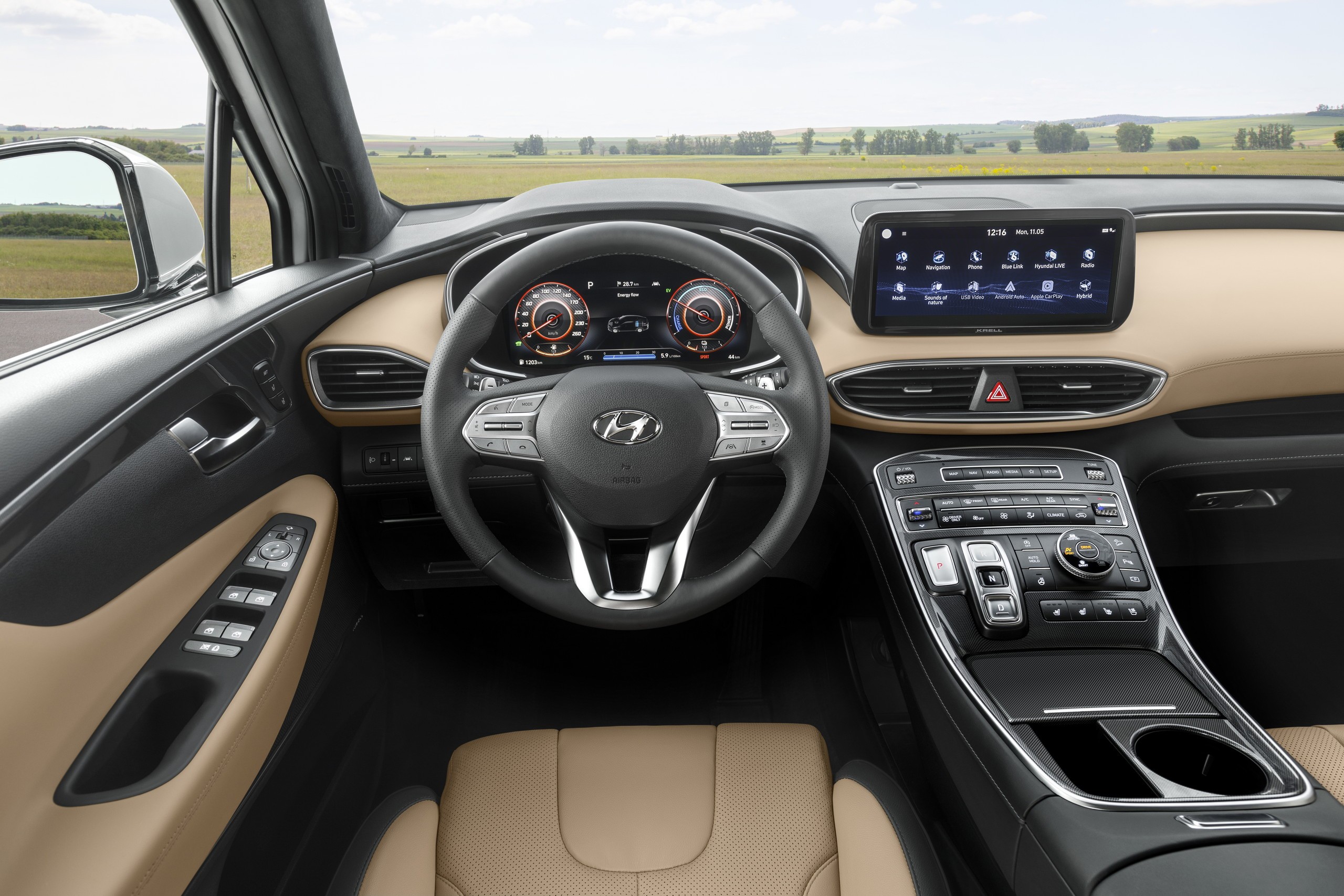
The cabin of the 2020 model offers a contemporary layout with supportive seating, durable materials, and intuitive ergonomics. Higher trim levels feature leather seating surfaces, panoramic sunroofs, and ambient lighting.
- Headroom and Legroom: Front and rear passengers enjoy generous dimensions, with second-row seats offering sliding and reclining functionality.
- Noise, Vibration, and Harshness (NVH): Acoustic laminated glass and extensive sound deadening ensure a quiet cabin environment, allowing the seamless transition between electric-only propulsion and gasoline engine activation to go largely unnoticed.
Cargo Utility
Cargo capacity remains a strong suit for the Santa Fe Hybrid. With the rear seats upright, the vehicle provides ample luggage room behind the second row. Folding the 60/40 split-folding rear seats flat yields a cavernous loading floor suitable for bulky items, sporting equipment, or luggage for long road trips. Unlike some plug-in hybrid electric vehicles (PHEVs) or third-row variants, the standard two-row hybrid configuration avoids compromises in rear floor depth.
Infotainment, Connectivity, and Safety Technology
Technology integration is a cornerstone of the 2020 Hyundai Santa Fe Hybrid, offering a comprehensive suite of infotainment and advanced driver-assistance systems (ADAS) grouped under the Hyundai SmartSense umbrella.
Infotainment System
Depending on the trim level, the vehicle features either a standard touchscreen or a larger high-definition display.
- Connectivity: Apple CarPlay and Android Auto integration come standard, allowing seamless smartphone mirroring.
- Audio Systems: Available premium audio systems deliver crisp sound reproduction throughout the cabin.
- Driver Information: A digital instrument cluster provides real-time hybrid system data, energy flow monitoring, and navigation prompts.
Hyundai SmartSense Safety Suite
Safety equipment is robust across all trims, incorporating active preventative measures designed to mitigate or avoid collisions:
- Forward Collision-Avoidance Assist (FCA): Detects vehicles and pedestrians ahead, applying emergency braking if the driver fails to react.
- Blind-Spot Collision-Avoidance Assist (BCA): Monitors adjacent lanes and can apply corrective steering or braking if an unsafe lane change is initiated.
- Lane Keeping Assist (LKA) and Lane Following Assist (LFA): Helps center the vehicle within its lane markings using camera-based detection.
- Smart Cruise Control (SCC) with Stop & Go: Maintains a safe following distance from the vehicle ahead in fluctuating traffic conditions.
- Rear Cross-Traffic Collision-Avoidance Assist (RCCA): Alerts drivers to approaching cross-traffic when reversing out of parking spaces.
Driving Dynamics and On-Road Performance
Behind the wheel, the 2020 Hyundai Santa Fe Hybrid delivers a composed, predictable driving experience tailored toward comfort and efficiency rather than aggressive track performance.
Ride and Handling
The independent multi-link rear suspension absorbs road imperfections effectively, providing a supple ride over broken pavement while maintaining body control through sweeping corners. The weighting of the electric power steering is light at low speeds for effortless parking maneuvers and firms up predictably at highway speeds.
Powertrain Transitions
The transition between electric motor operation and gasoline engine engagement is smooth. The 6-speed automatic transmission avoids the "rubber band" sensation and drone often criticized in hybrids utilizing CVTs. Drivers can monitor power distribution in real-time through the instrument cluster display, observing how regenerative braking replenishes the battery during deceleration.
Ownership Costs, Maintenance, and Reliability
Evaluating a used or established hybrid vehicle requires looking beyond the initial purchase price to encompass long-term operating costs, maintenance schedules, and component durability.
Maintenance Considerations
Hybrids generally exhibit lower brake pad wear compared to traditional gasoline vehicles due to regenerative braking systems capturing deceleration energy. Routine maintenance largely mirrors conventional vehicles, involving regular oil changes, coolant checks, and tire rotations.
Warranty Coverage
Hyundai’s warranty structure has historically provided strong consumer reassurance. Original purchasers benefit from a comprehensive limited warranty and a separate powertrain warranty. Crucially, federal regulations and manufacturer policies typically cover hybrid-specific components—including the lithium-ion battery pack, inverter, and hybrid control unit—for an extended period, mitigating concerns regarding long-term battery degradation.
Frequently Asked Questions
Does the 2020 Hyundai Santa Fe Hybrid require a charging station?
No. The 2020 Hyundai Santa Fe Hybrid is a traditional hybrid electric vehicle (HEV), meaning it self-charges via the internal combustion engine and regenerative braking. It cannot be plugged into an external power source.
What is the difference between the hybrid and non-hybrid 2020 Santa Fe?
The hybrid model pairs a 1.6-liter turbocharged engine with an electric motor and a 6-speed automatic transmission, yielding significantly higher city and highway fuel economy ratings compared to the standard naturally aspirated 2.4-liter or turbocharged 2.0-liter gasoline engines found in non-hybrid variants.
Can the 2020 Hyundai Santa Fe Hybrid tow a trailer?
Yes, the vehicle is equipped for light towing duties, though towing capacities vary depending on whether the vehicle is configured with front-wheel drive or all-wheel drive, as well as whether the trailer is equipped with brakes. Owners should consult the official owner's manual for exact tongue weight and towing limits.
How reliable is the hybrid battery system?
Lithium-ion polymer batteries used in modern Hyundai hybrids are engineered to last the lifespan of the vehicle under normal operating conditions. They are supported by manufacturer warranties that cover premature capacity loss or mechanical failure.
Does the hybrid model sacrifice cargo or passenger space?
No. Hyundai engineered the packaging of the 2020 Santa Fe Hybrid to position the battery pack beneath the floorboards, ensuring that passenger legroom, headroom, and cargo volume remain virtually identical to non-hybrid models.
Conclusion and Final Recommendation
The 2020 Hyundai Santa Fe Hybrid stands out as a well-rounded, efficient, and technologically equipped midsize crossover. By pairing a responsive turbocharged hybrid powertrain with a spacious, feature-rich interior and comprehensive safety provisions, Hyundai addressed the core needs of family-oriented buyers seeking reduced fuel expenditures. For prospective buyers evaluating the pre-owned market or examining established hybrid utility vehicles, the 2020 Santa Fe Hybrid offers a compelling balance of economy, utility, and everyday drivability.