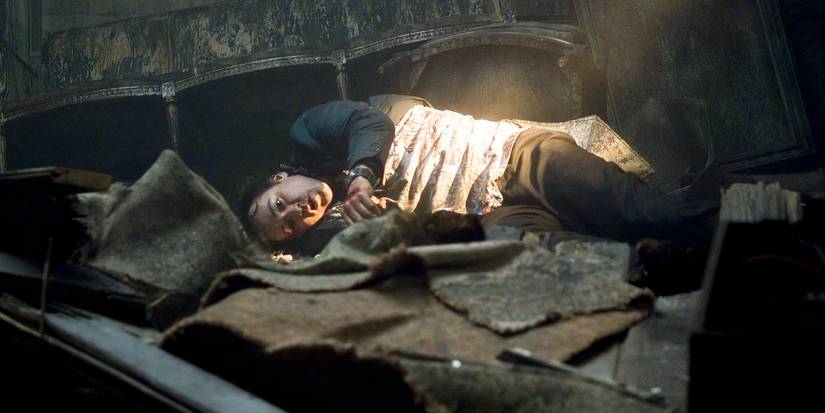
The 2007 film 1408 remains a landmark in psychological horror, marking a significant peak in Stephen King adaptations that prioritize atmosphere over gore. While its cultural footprint shifted during the 2010s as franchise horror dominated, the film's reputation has seen a massive resurgence leading into 2026, driven by a newfound appreciation for its isolated, character-driven narrative and its exploration of grief.
The Rise of 1408: A New Breed of Psychological Horror
When 1408 was released in the summer of 2007, the horror landscape was dominated by the "torture porn" sub-genre, led by the Saw and Hostel franchises. Director Mikael Håfström, working from a screenplay by Matt Greenberg, Scott Alexander, and Larry Karaszewski, took a radically different approach. By adapting Stephen King’s short story from the collection Everything's Eventual, the production team aimed to capture the "chamber piece" intensity of a man trapped not just in a room, but in his own psyche.
The rise of 1408 can be attributed to three primary factors: the performance of John Cusack, the masterful use of a single location, and its commercial timing. John Cusack’s portrayal of Mike Enslin, a cynical author who deconstructs paranormal myths to cope with the loss of his daughter, provided an emotional anchor that was rare in mid-2000s horror. Samuel L. Jackson’s supporting role as Gerald Olin, the manager of the Dolphin Hotel, added a layer of gravitas and myth-building that expanded the film's scope beyond its physical walls.
Financially, the film was a massive success. Produced on a modest budget of approximately $25 million, it went on to gross over $133 million worldwide. According to Box Office Mojo, it stood out as one of the most profitable King adaptations of its decade. Critics praised the film for its "old-school" scares, relying on practical effects, shifting set geometry, and sound design rather than an over-reliance on CGI.
The Mechanics of the Room: Why 1408 Worked
The "Rise" of the film was also a technical achievement. The production design of Room 1408 was intended to be "aggressively bland" initially, a standard high-end hotel room that slowly warps into a surrealist nightmare. The film utilizes the concept of the "uncanny"—taking the familiar and making it slightly wrong—to build tension.
Key psychological elements included:
- The 60-Minute Countdown: The use of the digital clock counting down created a literal "ticking clock" scenario, a classic suspense trope that forced the protagonist into frantic action.
- The Five Stages of Grief: Many film analysts have noted that Enslin’s journey through the room mirrors the stages of grief: denial (it’s a hoax), anger (attacking the walls), bargaining (trying to leave), depression (the visions of his daughter), and finally, acceptance.
- Isolation: By removing secondary characters for the majority of the runtime, the film forced the audience to experience Enslin’s claustrophobia and burgeoning insanity firsthand.
The Decline: The Shift to Franchise Horror and the "Streaming Era"
Following its 2007 peak, 1408 entered what can be described as a period of "decline" in terms of cultural visibility. This was not a commentary on the film's quality, but rather a reflection of the changing tides in the horror industry during the 2010s.
The release of Paranormal Activity (2009) and the subsequent rise of the Conjuring Universe shifted audience interests toward supernatural franchises with interconnected lore. 1408, as a self-contained, character-focused story with a definitive (albeit varied) ending, didn't fit the new "Cinematic Universe" model. Furthermore, the 2010s saw a massive wave of new Stephen King adaptations, such as the blockbuster IT (2017) and Doctor Sleep (2019), which naturally pushed older titles out of the immediate spotlight.
During this period, 1408 became a staple of cable television and early streaming platforms. While it maintained a "cult" following, it was often overshadowed by the "Elevated Horror" movement (films like Hereditary or The Witch). The "Decline" phase was characterized by the film being categorized as a "hidden gem" rather than a primary pillar of the genre. However, this period of relative quiet allowed for a deep-seated appreciation to grow among horror purists who valued its unique blend of surrealism and emotional weight.
Comparing the Versions: The Multiple Endings
One of the reasons 1408 has remained a topic of intense discussion—and a key driver of its 2026 resurgence—is the existence of four distinct endings. These variations have led to "Mandela Effect" style debates among fans and have kept the film's community active.
| Ending Version | Outcome for Mike Enslin | Emotional Tone | Primary Distribution |
|---|---|---|---|
| Theatrical Ending | Survives; proves his experience to his wife via a tape recording. | Hopeful / Chilling | Standard DVD / Original Theatrical Run |
| Director's Cut | Dies in the fire; seen as a ghost in the room. | Tragic / Definitive | Blu-ray / Special Editions |
| Alternate Ending #1 | Dies; his editor receives the manuscript from the hotel. | Cynical | International Releases |
| Alternate Ending #2 | Survives; moves back to New York, but the "room" is still with him. | Ambiguous | Select Digital Versions |
The Director's Cut is often cited by director Mikael Håfström as his preferred vision, as it aligns more closely with the bleakness of King's original prose. However, the Theatrical Ending is the one that solidified the film's commercial success, offering a rare moment of catharsis for an audience that had spent 90 minutes in a psychological pressure cooker.
The Legacy in 2026: Why it Remains a Masterclass
As of 2026, 1408 is undergoing a significant critical re-evaluation. Modern audiences, perhaps exhausted by the endless "jump-scare" cycles of the late 2010s, have returned to the film for its sophisticated storytelling. The "Next Chapter" of 1408 isn't necessarily a direct sequel, but rather its influence on a new generation of filmmakers.
The film's influence is visible in current "liminal space" horror and the "Backrooms" internet phenomenon, which both rely on the idea of an ordinary environment becoming an infinite, malevolent trap. 1408 was a pioneer in this regard, using the architecture of a hotel to represent a fractured mind.
Furthermore, the 20th-anniversary discussions (approaching in 2027) have sparked rumors of a high-definition 4K restoration and potential "legacy" content from the original cast. In the current 2026 market, psychological thrillers that prioritize atmosphere over "shared universes" are seeing a box-office comeback, positioning 1408 as a precursor to the modern "prestige horror" movement.
The Next Chapter: Potential Remakes, Sequels, or Reimagining
In 2026, the question of "what's next" for the 1408 property is at the forefront of horror discourse. While Stephen King stories are frequently remade (e.g., Carrie, Pet Sematary), 1408 presents a unique challenge. Its success was so deeply tied to the specific chemistry between Cusack and Jackson that a standard remake faces high hurdles.
There are three primary paths for the "Next Chapter":
- The Anthology Approach: Many fans have suggested a limited series or anthology titled The Dolphin Hotel, where each episode focuses on a different room or a different era of Room 1408. This would allow for the expansion of the "Olin" character lore and the history of the 56 deaths that occurred in the room.
- The Virtual Reality (VR) Experience: Given the film's focus on shifting reality and environmental horror, 1408 is a prime candidate for a VR reimagining. In 2026, VR technology has reached a point where the "hallucinogenic" quality of the room could be fully realized for an immersive audience.
- The "Legacy Sequel": Following the trend of films like Halloween (2018), a sequel could follow a new protagonist—perhaps the daughter of a previous victim—investigating the now-closed (or reopened) Dolphin Hotel.
Regardless of which path is taken, the "Next Chapter" of 1408 is already being written by its continued relevance in the horror canon. It remains the gold standard for how to adapt a short, focused King story into a feature-length experience without losing the essence of the source material.
Frequently Asked Questions
Is the movie 1408 based on a true story?
No, 1408 is not based on a specific true story, though Stephen King was inspired by real-world accounts of haunted hotels. Specifically, King has mentioned the exploits of parapsychologist Christopher Chacon, who investigated the Hotel del Coronado in California. King’s story serves as a cautionary tale against the hubris of "ghost hunters" who believe they can quantify the paranormal.
Why is the room number 1408?
The number 1408 is a classic example of Stephen King’s use of numerology. The digits 1+4+0+8 add up to 13. Furthermore, the room is located on the 14th floor, but as Gerald Olin explains, the hotel skips the 13th floor, meaning the 14th floor is technically the 13th. This reinforces the theme of "bad luck" and the supernatural nature of the space.
Which ending of 1408 is considered "canon"?
There is no single "canon" ending, as the film was intentionally released with different conclusions to suit different markets and artistic visions. However, the Theatrical Ending is the most widely recognized by general audiences, while the Director’s Cut is considered the definitive version by the film's creators. Most fans of the original Stephen King story prefer the Director's Cut for its tonal consistency with King's darker themes.
Is there a sequel to 1408 in development?
As of 2026, there is no officially greenlit sequel to 1408. However, production companies associated with Stephen King’s properties have frequently discussed the potential for an anthology series based on the "Dolphin Hotel." The film's enduring popularity on streaming platforms makes it a high-value IP for future development.
What does the "We've Only Just Begun" song mean in the movie?
The use of The Carpenters' "We've Only Just Begun" is a psychological tool used by the room to taunt Mike Enslin. It serves as a cruel irony; while the song is traditionally played at weddings to signify a new beginning, in the context of the room, it signifies that Enslin's torture is only starting. The contrast between the cheerful melody and the horrific events is a classic horror technique used to induce unease.
Final Recommendation: How to Experience 1408 Today
For those looking to revisit or experience 1408 for the first time in 2026, the recommended approach is to seek out the Two-Disc Collector’s Edition or the 4K Ultimate Restoration (if available in your region). These versions typically include both the Theatrical and Director's Cut endings.
To fully appreciate the film’s "Rise" and why it hasn't truly "Declined" in quality, viewers should:
- Watch the Theatrical Cut first: This provides the intended narrative arc that captured audiences in 2007.
- Read the Stephen King short story: Comparing the 20-page story to the 100-minute film highlights the incredible job the screenwriters did in expanding the lore.
- Use a high-quality sound system: The audio engineering in 1408 is just as important as the visuals for creating the sense of "Environmental Malice."
1408 stands as a testament to the fact that horror doesn't need a masked killer or a massive CGI monster to be terrifying—it only needs a room, a history, and a man forced to face himself.