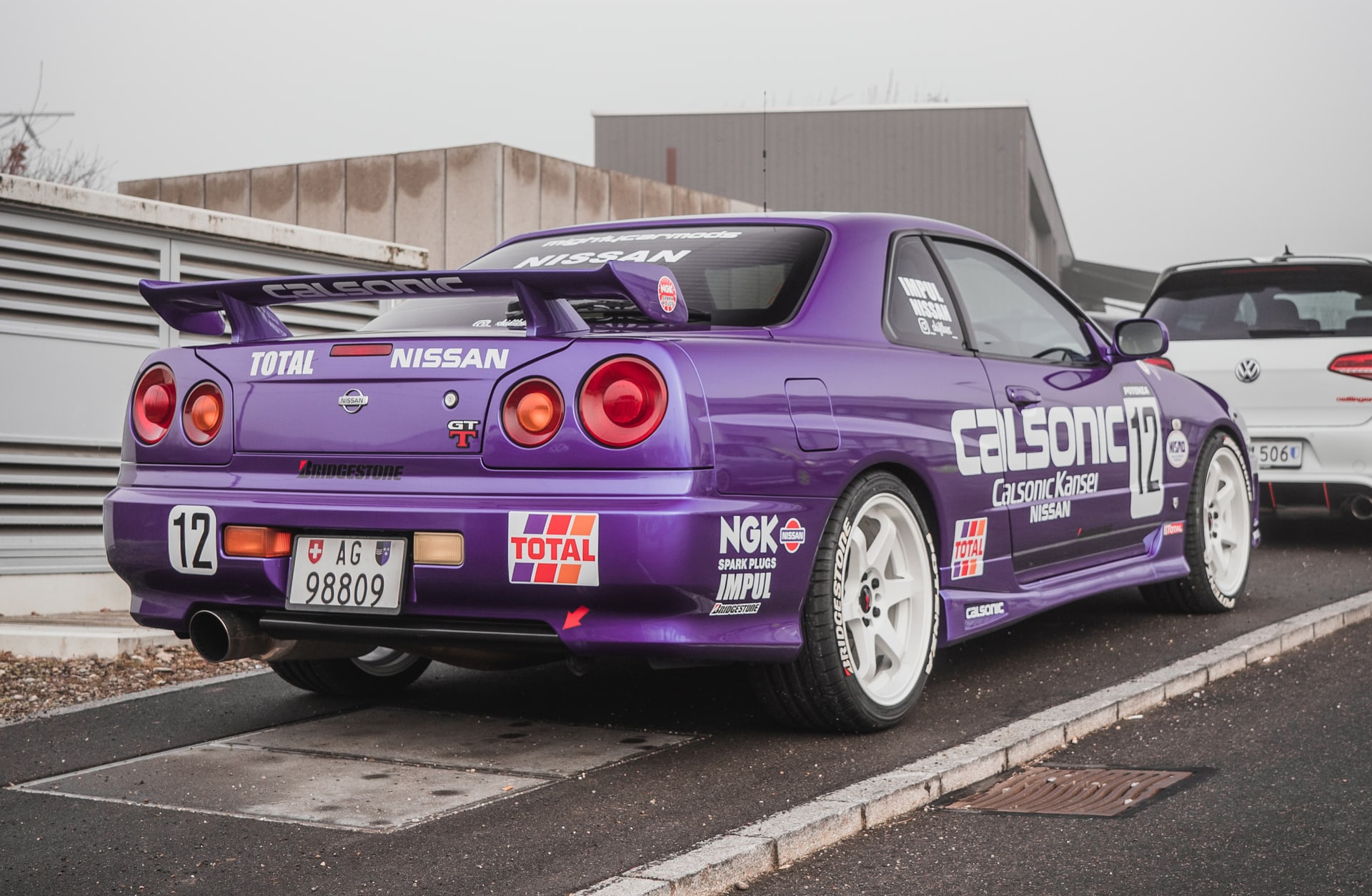
The primary reason the Nissan Skyline R34 is considered "illegal" in the United States is that it does not comply with the Federal Motor Vehicle Safety Standards (FMVSS) mandated by the National Highway Traffic Safety Administration (NHTSA) and the Environmental Protection Agency (EPA) for the vehicle's original manufacturing era. Because the model was never officially crash-tested or certified for the U.S. market by Nissan, it fails to meet the specific safety and emissions requirements necessary for legal road registration under the Imported Vehicle Safety Compliance Act of 1988.
The Regulatory Framework: FMVSS and the 25-Year Rule
To understand the legal status of the R34, one must first understand the Import Vehicle Safety Compliance Act of 1988. This legislation was enacted to prevent non-compliant vehicles from flooding the U.S. market, ensuring that every car driven on American roads meets established safety benchmarks—such as side-impact protection, airbag standards, and lighting requirements.
When a manufacturer like Nissan produces a vehicle for a foreign market, such as Japan, they build that car to satisfy the regulatory standards of that specific country. The Nissan Skyline GT-R (R34), produced between 1999 and 2002, was engineered for Japanese regulations. These standards are fundamentally different from the U.S. FMVSS, which are strictly enforced by the Department of Transportation (DOT).
The "illegal" status essentially boils down to a lack of certification. A vehicle is considered illegal for road use if it has not been issued a "conformance" status. Without a manufacturer's certification label stating that the vehicle complies with all applicable U.S. safety standards, the car cannot be registered for road use.
The Environmental Protection Agency (EPA) Role
Safety is only half of the equation; the EPA also plays a decisive role. Vehicles imported into the U.S. must meet the Clean Air Act requirements. An R34 engine, in its original configuration, does not have the documented emissions testing results required by the EPA. Even if an owner were to modify the exhaust or catalytic converter system, the vehicle would still lack the official "Certificate of Conformity" issued by the manufacturer for the U.S. market.
For many years, the only way to legally bring such a vehicle into the country was to undergo a rigorous process through a Registered Importer (RI). This process requires the vehicle to be brought up to U.S. standards, a task that often involves extensive structural modifications, changing lighting fixtures, and installing equipment that the factory never intended for that specific chassis. Because the R34 is a complex, high-performance vehicle, the cost of this modification process is often prohibitive, effectively rendering the car "illegal" for the average collector until the age-based exemption is reached.
Understanding the 25-Year Exemption
The Import Vehicle Safety Compliance Act includes a critical provision: vehicles that are at least 25 years old are exempt from FMVSS requirements. This is colloquially known as the "25-year rule." The logic behind this statute is that vehicles of this age are considered "classics" or "collector items," and their usage is expected to be limited compared to daily commuters.
Under this exemption, the vehicle is also typically exempt from EPA emissions requirements, as it is viewed as a collector’s vehicle rather than a modern passenger car. Once a vehicle hits its 25th anniversary of production (based on the specific month of manufacture), the owner can legally import it into the U.S. and register it for street use, provided it passes state-level inspection and title requirements.
For the R34, the calendar is the ultimate judge. Given that the R34 generation spanned from 1999 to 2002, different production months are currently reaching or will soon reach their 25-year eligibility status. This is why the conversation around the R34's legality is constantly evolving—the car is slowly transitioning from "illegal" to "exempt" on a rolling basis.
The Consequences of Illegal Importation
Many enthusiasts are tempted to circumvent these rules by importing vehicles under false pretenses, such as registering them as "off-road use only" or attempting to title them in states with more lenient inspection processes. These actions are high-risk.
The U.S. Customs and Border Protection (CBP) maintains strict oversight of vehicle imports. If a vehicle is discovered to be in the country illegally, federal authorities have the legal mandate to seize and destroy it. There are numerous recorded instances of the government crushing vehicles that were imported without proper federalization. Furthermore, attempting to register an non-compliant vehicle through fraudulent documentation can lead to severe fines and criminal liability.
The legality of a vehicle is not just about the car itself; it is about the compliance paperwork that accompanies it. A VIN (Vehicle Identification Number) that does not match the NHTSA’s list of approved vehicles is an automatic red flag at any port of entry.
Technical Hurdles to Compliance
Why can't owners simply modify an R34 to make it legal? The technical hurdles are substantial. To make an R34 fully compliant, the following areas must be addressed:
- Crash Testing: The R34 was never crash-tested in the U.S. To prove compliance, one would theoretically need to destroy several R34 chassis in impact tests to satisfy the DOT, which is economically non-viable.
- Emissions Equipment: The original fuel system and exhaust components must be replaced with parts that meet U.S. standards. This often disrupts the vehicle's fine-tuned performance.
- Lighting and Glass: U.S. regulations dictate specific lens patterns and glass markings that differ from the JDM (Japanese Domestic Market) specification. Replacing these parts alters the vehicle's aesthetic and historical integrity.
- Structural Requirements: U.S. safety rules include specific requirements for door beams, bumper reinforcement, and airbag deployment logic that would require invasive welding and electrical work.
Comparison of Import Categories
The following table summarizes the status of imported vehicles in the U.S. and the regulatory barriers involved.
| Status | Requirement | Regulatory Burden |
|---|---|---|
| Non-Compliant | None | Prohibited for road use; risk of seizure. |
| Registered Importer | Significant modification | Extremely expensive; requires certified shop. |
| 25-Year Exemption | Documented age | Only requires proof of manufacture date. |
| Show or Display | Limited driving (<2,500 miles/yr) | Strict usage limits; hard to obtain approval. |
The "Show or Display" Exception
Some owners have pursued the "Show or Display" exemption, which allows for the importation of vehicles that are of historical or technological significance but do not meet safety standards. However, this is not a general permission to drive the car as a daily commuter.
The NHTSA restricts vehicles under "Show or Display" to limited mileage—typically fewer than 2,500 miles per year. The owner must prove that the vehicle is significant (e.g., a limited-edition model) and must be prepared to have it inspected or monitored by the government. This is not a "legalization" of the car in the traditional sense, but rather a specialized exception to the importation ban.
Future Outlook and Ownership
As of 2026, the earliest models of the Nissan Skyline R34 are entering the zone of eligibility. For prospective owners, the best course of action is to wait for the specific production date of a desired unit to cross the 25-year threshold.
When purchasing a vehicle, always verify the import documentation. This includes the CBP Form 7501 (Entry Summary), which is the primary document proving the vehicle entered the country legally. If a seller cannot provide the entry documentation, it is highly likely the vehicle was smuggled or improperly imported.
If you are currently looking at an R34, consider these steps:
- Check the VIN: Verify the production date to ensure it is at least 25 years old.
- Verify Customs Entry: Ensure the car has the correct CBP documentation.
- State Compliance: Contact your local DMV to understand state-specific requirements, as even federally legal cars must still meet state safety and emissions laws.
- Professional Inspection: Hire an expert in JDM imports to authenticate the vehicle's history and ensure it hasn't been subjected to "VIN swapping," a common practice where a chassis is illegally retitled.
The legal landscape surrounding the R34 is a byproduct of the U.S. government’s commitment to standardized safety. While the frustration of enthusiasts is understandable, the 25-year rule provides a clear, albeit time-dependent, pathway to legal ownership. Patience is the only way to ensure the long-term security of your investment in a Japanese automotive icon.
Frequently Asked Questions
Why can't I just register a non-compliant R34 in a state that doesn't check emissions? State registration does not override federal law. While a state DMV might issue a title, that does not make the vehicle federally compliant. If federal authorities discover the vehicle is non-compliant, it can still be seized, regardless of the state license plate.
Is the "25-year rule" based on the model year or the manufacture date? It is based on the specific month and year of manufacture. You must look at the manufacturer’s sticker or the VIN plate to determine the exact date. You cannot import a "1999" model if it was produced in a month that hasn't reached its 25-year mark yet.
Does an R34 "Show or Display" permit ever expire? No, but the usage restrictions remain in place for the life of the permit. You are legally bound to the mileage limit and the requirement to keep the vehicle in a state that allows for inspection.
Are there any other ways to make an R34 legal? Only by fully "federalizing" the car through a registered importer, which is often more expensive than the car itself, or by waiting for the 25-year exemption. There are no "loopholes" that allow a standard, non-compliant car to be street-legal without meeting these criteria.
Can I drive an R34 if I am in the U.S. on a temporary visa? Generally, no. Non-residents who import a vehicle must export it within one year. They cannot sell the vehicle or leave it in the U.S. beyond the allotted timeframe, and it cannot be permanently registered.