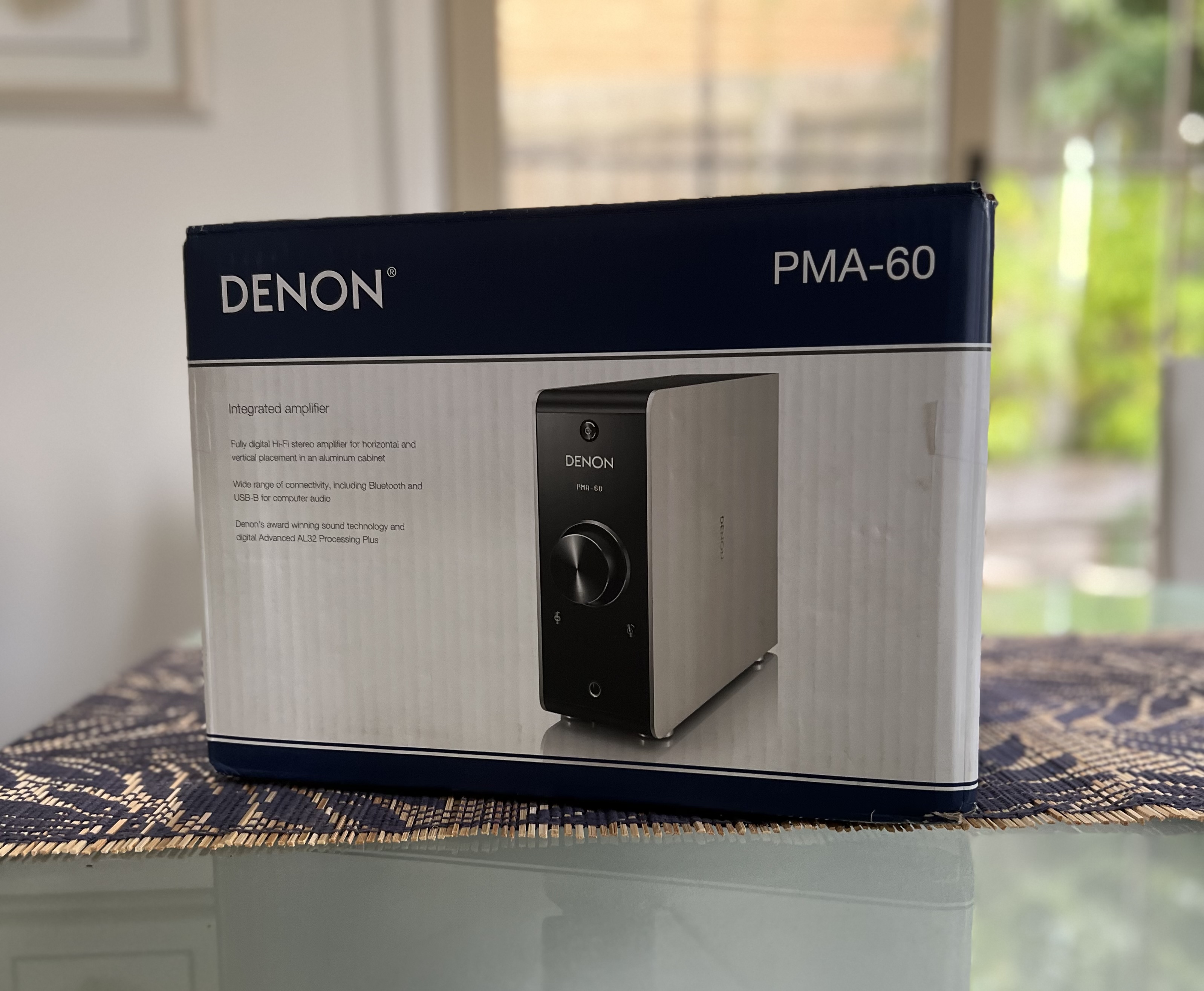
The Denon PMA-60 is a compact, stylish integrated stereo amplifier that combines traditional amplification architecture with modern high-resolution digital-to-analog conversion and Bluetooth connectivity. Designed for desktop setups, small listening spaces, and minimalist living rooms, it delivers 50 watts per channel into 4 ohms via Class D amplification technology, making it a versatile hub for digital sources, personal audio, and compact loudspeaker systems.
Identity and Scope of the Denon PMA-60
The Denon PMA-60 occupies a specific niche in the consumer audio market: the premium, space-saving desktop and bookshelf amplifier category. Released as part of Denon’s Design Series, it targets audio enthusiasts who want high-fidelity sound without the massive footprint of traditional component-sized receivers.
When evaluating an amplifier of this class, it is important to understand its target environment. It is built for small-to-medium rooms, near-field listening setups, and modern digital lifestyles where physical media players share space with computers, smartphones, and streaming devices. Rather than competing with massive multi-channel home theater receivers or behemoth high-end monoblocks, the PMA-60 focuses on refining digital audio paths, maximizing thermal efficiency, and offering flexible physical placement options.
Design Philosophy and Industrial Build Quality
One of the most striking aspects of the PMA-60 is its physical construction. Denon housed the internal circuitry in a chassis that blends aluminum plates with a resilient resin finish. This combination not only provides robust electromagnetic shielding to protect sensitive audio signals from outside interference but also gives the unit a sophisticated, contemporary aesthetic.
A defining mechanical feature of the PMA-60 is its versatility in placement. The unit can be positioned either horizontally—the traditional method for audio components—or vertically, thanks to included screw-in feet and a clever orientation-sensing OLED display. When you flip the amplifier on its side, the text and VU-meter graphics on the screen automatically adjust to remain upright. This adaptability makes it an exceptional choice for crowded office desks, bookshelves, or tight entertainment centers where horizontal space is at a premium.
Core Features and Technical Specifications
To evaluate the Denon PMA-60 fairly, one must examine its internal architecture, power handling capabilities, and connectivity suite. While its footprint is small, its feature set bridges the gap between old-school stereo playback and contemporary high-resolution digital audio formats.
Amplification and Power Output
At the heart of the PMA-60 is a proprietary Class D amplifier stage utilizing Qualcomm DDFA (Direct Digital Feedback Amplifier) technology. Class D amplification is chosen here for its high efficiency and minimal heat generation, which is crucial for a chassis of this size.
- Power Output: Delivers 50 watts per channel into 4 ohms (or approximately 25 to 30 watts into 8 ohms).
- Driver Compatibility: Easily drives bookshelf speakers and efficient floorstanders in small or medium listening rooms.
- Distortion Management: The DDFA architecture uses a high-speed digital feedback loop to correct errors inherent in digital-to-analog and switching processes, resulting in exceptionally low harmonic distortion and a wide signal-to-noise ratio.
Digital and Analog Connectivity
The PMA-60 leans heavily into digital connectivity, acknowledging that many users source their music from computers, television sets, and digital transports rather than traditional CD decks or tuners.
- USB-DAC Input: Features a type-B USB port on the rear panel capable of accepting high-resolution PCM audio files up to 32-bit/384-kHz, as well as DSD files up to 11.2MHz (Quad-DSD). This makes it an ideal direct companion for Windows and macOS computers.
- Optical and Coaxial Inputs: Includes two optical digital inputs and one coaxial digital input, allowing seamless integration with televisions, network streamers, or game consoles.
- Analog Inputs: Offers a single set of gold-plated stereo RCA analog inputs for legacy components such as turntable phono stages (with an external preamp) or tape decks.
- Subwoofer Output: Features a dedicated mono pre-out for connecting an active subwoofer, enabling users to easily build a 2.1-channel stereo system with extended bass response.
Wireless Streaming and Headphone Performance
Modern convenience is addressed through integrated Bluetooth connectivity, complete with support for Qualcomm aptX Low Latency and NFC (Near Field Communication) pairing. Users can stream music directly from smartphones or tablets with minimal latency and high fidelity.
For personal listening, the front panel houses a dedicated 6.35mm headphone jack driven by a dedicated headphone amplifier circuit. This circuit features an adjustable gain setting (Low, Mid, High) to accommodate everything from sensitive in-ear monitors to high-impedance audiophile over-ear headphones.
| Specification Feature | Denon PMA-60 Detail |
|---|---|
| Amplifier Type | Class D with Qualcomm DDFA |
| Power Output | 50W + 50W (4 ohms, 1 kHz, T.H.D. 0.7%) |
| Digital Inputs | 2x Optical, 1x Coaxial, 1x USB-B |
| Analog Inputs | 1x Stereo RCA |
| Outputs | Speaker terminals, Subwoofer pre-out, 6.35mm Headphone jack |
| USB Audio Support | PCM up to 32-bit/384-kHz, DSD up to 11.2MHz |
| Wireless Connectivity | Bluetooth with aptX Low Latency and NFC |
| Chassis Dimensions | 200 x 86 x 258 mm (Horizontal orientation) |
Practical Performance and Sound Quality
Technical specifications only tell half the story. In practical everyday use, how does the Denon PMA-60 perform across various music genres and source components?
Resolution and Detail Retrieval
When fed high-resolution audio files via the USB-DAC input, the PMA-60 exhibits a remarkably clean and transparent presentation. The noise floor is exceptionally low, allowing subtle details such as room reverberations, bow-on-string textures, and vocal nuances to emerge clearly. Instrument separation is precise, preventing complex orchestral passages or dense rock mixes from sounding congested.
Tonal Balance and Dynamic Range
The amplifier maintains a neutral tonal signature. It does not artificially boost the bass or add warm coloration to the midrange, faithfully reproducing whatever signal is fed into it. While its 50-watt output (into 4 ohms) requires careful matching with reasonably efficient speakers, it punches above its weight class in dynamic capability. Fast transient responses—such as sharp drum snaps or sudden piano chords—are handled with crisp authority and zero perceived lag.
Bluetooth and Everyday Usability
Wireless streaming via Bluetooth is reliable and stable within standard room ranges. The inclusion of aptX Low Latency ensures that when users watch video content or play games with audio routed through the amplifier, lip-sync issues are virtually eliminated. The front-panel OLED display provides clear feedback on the active input, volume level, and sampling frequency, ensuring intuitive operation even from a distance using the included ergonomic remote control.
Comprehensive Comparison: PMA-60 vs. Alternatives
When shopping in the compact integrated amplifier market, buyers typically weigh the PMA-60 against similar desktop-oriented audio components. Understanding how it compares to rival devices helps clarify its value proposition.
Denon PMA-60 vs. Traditional Full-Size Integrated Amplifiers
Traditional entry-level integrated amplifiers from brands like Yamaha or NAD offer significantly higher power ratings (often 80 to 100 watts per channel) and accommodate multiple analog sources, including built-in phono stages. However, they lack the ultra-compact footprint, vertical mounting options, and high-resolution USB-DAC capabilities of the PMA-60. Buyers with limited desk space or desktop-centric workflows will find the PMA-60 far more practical, whereas those with large listening rooms and multiple analog components are better served by traditional full-size units.
Denon PMA-60 vs. Budget Chi-Fi Class D Mini-Amps
The market is flooded with ultra-cheap miniature Class D amplifiers powered by Texas Instruments or STMicroelectronics chips. While these budget amps cost a fraction of the PMA-60, they frequently suffer from inferior build quality, loose binding posts, lack of proper digital isolation, and inconsistent power delivery. The PMA-60 justifies its higher price point through superior Japanese industrial design, robust multi-layer circuit board layouts, advanced DDFA error-correction algorithms, and comprehensive safety protections.
Operational Limitations and Common Mistakes
To get the best possible experience from the Denon PMA-60, users must be aware of its physical and electrical limitations. Avoiding common setup mistakes prevents hardware strain and ensures optimal sonic results.
Speaker Matching Constraints
Because the PMA-60 is rated at 50 watts per channel into 4 ohms (and slightly less into 8 ohms), it is not designed to drive power-hungry, low-sensitivity floorstanding loudspeakers in large living spaces. Pairing this amplifier with speakers that have a sensitivity rating below 85 dB or complex impedance dips can cause the internal protection circuitry to trip under high volume levels. Stick to quality bookshelf speakers or highly sensitive desktop monitors (87 dB or higher) for optimal performance.
Cable Management and Placement
Although the chassis is shielded, running USB cables directly parallel to unshielded AC power cords can occasionally introduce digital noise into the system. Users should ensure clean cable routing, keeping digital data cables separate from high-voltage power lines. Furthermore, when operating the unit in its vertical position, ensure that the ventilation slots remain unobstructed to prevent thermal buildup.
Frequently Asked Questions
Does the Denon PMA-60 have a built-in phono preamp for turntables?
No, the PMA-60 does not feature a dedicated phono input. It includes a single set of standard analog line-level RCA inputs. If you want to connect a turntable, you must use a turntable with a built-in phono preamplifier or connect an external standalone phono stage between the turntable and the amplifier.
Can I connect the PMA-60 directly to my computer?
Yes. The rear panel includes a standard USB Type-B port. By connecting the amplifier to a Windows or macOS computer using a USB cable, the PMA-60 functions as an external high-resolution sound card (USB-DAC), bypassing your computer's internal audio circuitry for superior sound quality.
What kind of speakers work best with this amplifier?
Bookshelf speakers and compact floorstanding speakers with an impedance of 4 to 8 ohms and a sensitivity rating of 87 dB or higher are ideal. Avoid large, demanding multi-driver loudspeakers that require high current amplification to perform correctly.
Is the display orientation adjustable for vertical placement?
Yes. The PMA-60 features a built-in orientation sensor. When you place the unit on its side using the included side feet and screws, the OLED screen automatically rotates its graphics to match the vertical orientation.
How do I update the firmware or drivers for USB audio?
For Windows users, specific USB Audio Class 2.0 drivers provided by Denon must be downloaded and installed on your computer to enable playback of high-resolution PCM and DSD files. macOS and Linux systems support USB Audio Class 2.0 natively without requiring additional driver installations.
Conclusion and Recommendations
The Denon PMA-60 stands out as a refined, highly capable audio hub for modern listeners who prioritize space efficiency, digital connectivity, and high fidelity. By packing advanced Class D amplification, high-resolution USB-DAC functionality, and flexible placement options into a stylish chassis, it successfully bridges the gap between lifestyle audio and traditional component performance.
If you are setting up a high-quality desktop listening station, a secondary bedroom system, or a minimalist living room stereo paired with efficient bookshelf speakers, the PMA-60 is an exceptional choice. Ensure your loudspeakers are appropriately matched for its power output, and you will be rewarded with a clean, detailed, and engaging musical presentation.