ARK: Genesis Part 1 is the fourth expansion pack for ARK: Survival Evolved, introducing a mission-based simulation across five distinct biomes. As of 2026, it remains a cornerstone of the ARK narrative, offering unique taming mechanics, the HLN-A companion, and a departure from the traditional open-world survival loop found in previous maps.
The Genesis Part 1 expansion represents a significant pivot in the ARK: Survival Evolved lifecycle. Unlike the seamless open worlds of The Island or Ragnarok, Genesis Part 1 takes place within a massive, fractured simulation. This simulation is divided into five geographically isolated biomes, each presenting its own extreme environmental challenges and unique "X-variant" creatures. To progress, players must interact with HLN-A (Human Learning Neural Aid), a floating robotic companion that provides lore, facilitates a new mission system, and manages a dedicated currency called Hexagons.
The Simulation Structure and the Role of HLN-A
The most immediate change players notice in Genesis Part 1 is the lack of a traditional map-wide traversal. Instead of flying across a single landmass, players must use HLN-A to teleport between five separate mini-maps or "biomes." This structure was designed to create a sense of isolation and high-stakes survival, as each biome functions as a self-contained ecosystem with its own hazards.
HLN-A is not merely a cosmetic addition; she is the central hub for the player's experience. She provides a constant stream of dialogue that explains the lore of the simulation and the overarching story of the "Genesis Colony Ship." More importantly, she acts as a mobile store. By completing missions or finding "Glitch" collectibles, players earn Hexagons. These can be traded through HLN-A's interface for essential resources like Wood, Hide, and Rare Flowers, or high-tier items like Tek Replicators and loot crates. This system allows players to survive in harsh biomes where specific resources might be naturally scarce.
Deep Dive into the Five Simulation Biomes
The environmental design of Genesis Part 1 is built around extremes. Each biome features a unique set of "X-Creatures," which are colorful, more powerful versions of existing dinos that possess higher damage resistance and level caps when found in the wild.
The Bog Biome
The Bog is often the starting point for survivors, though its title as an "Easy" biome is somewhat misleading. It is a dense, swampy jungle characterized by massive trees and a permanent greenish haze.
- Hazards: The primary dangers are Swarms (insect clouds that require torches or fire to disperse) and the local wildlife, which includes Sarcos, Kaprosuchus, and the new Bloodstalker.
- Unique Resources: Rare mushrooms and flowers are abundant, but the thick canopy makes navigation difficult.
- X-Creatures: You will find X-Parasaurs and X-Raptors here, providing a colorful twist on classic tames.
The Arctic Biome
A frozen wasteland of towering mountains and deep snowdrifts. Survival here requires high Fortitude or high-quality fur armor to combat the "Freezing" status effect.
- Hazards: Frequent blizzards reduce visibility to near zero and can quickly drain a player's health. Avalanches are a localized environmental threat.
- Key Fauna: The Arctic is home to the Ferox, a creature that transforms from a small, cute shoulder pet into a giant, aggressive beast when fed Element.
- X-Creatures: X-Yutyrannus and X-Rexes roam the mountain peaks, making this a prime location for high-level combat tames.
The Ocean Biome
Unlike the open seas of The Island, the Genesis Ocean consists of vast "Ocean Pillars" and deep-sea trenches. It introduces "Vacuum Compartments," which are pre-built underwater structures that allow players to breathe without specialized gear.
- Hazards: The biome is dominated by giant sea life and the terrifying Leedsichthys. Decompression sickness is not a mechanic, but the sheer depth makes oxygen management a constant concern.
- Key Fauna: The Megachelon (a giant turtle) and the Basilosaurus are the stars here. The Megachelon can act as a mobile base, with players building structures directly on its shell.
The Volcanic Biome
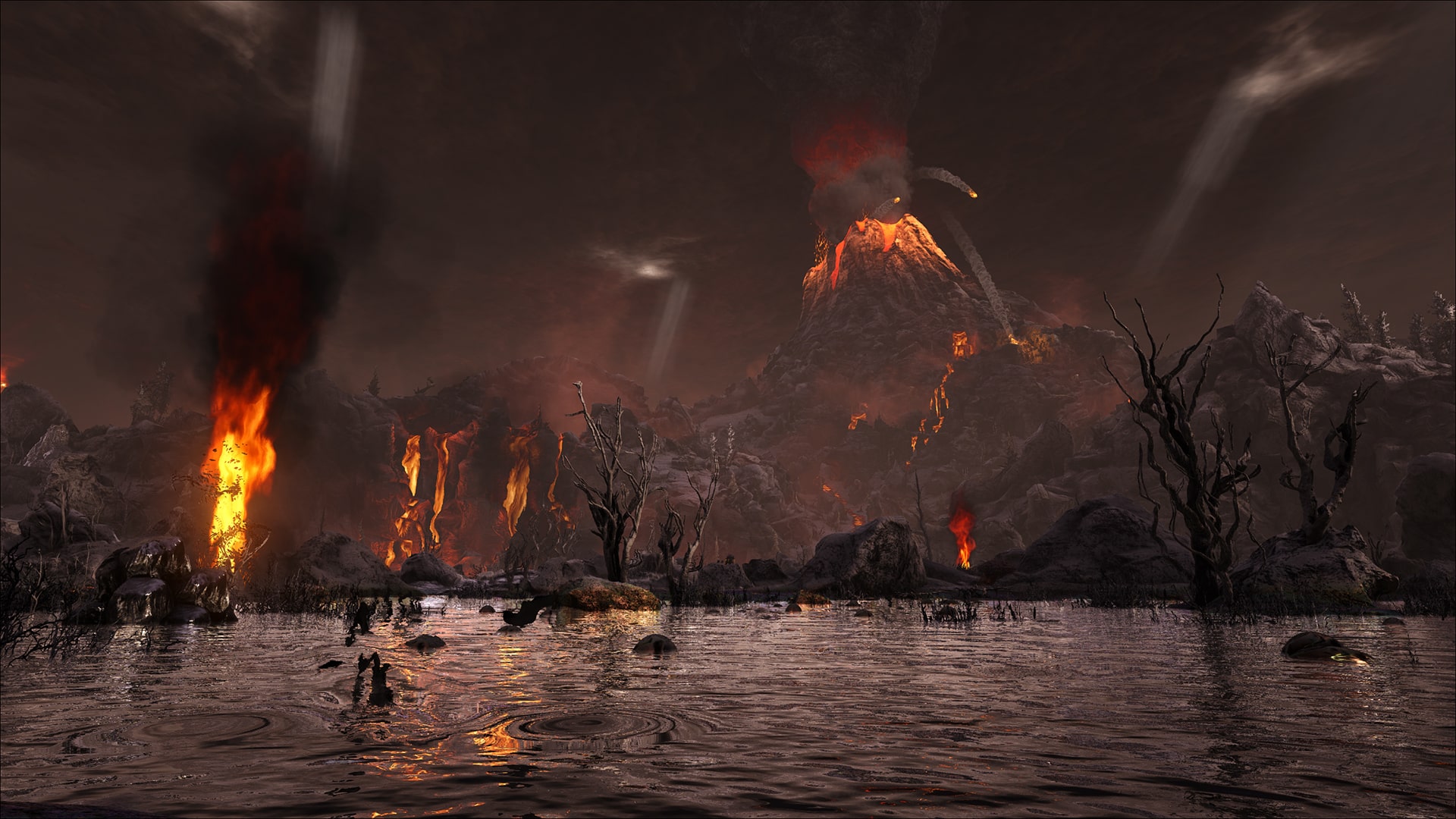
An incredibly hostile environment filled with lava flows, sulfur vents, and extreme heat.
- Hazards: Frequent volcanic eruptions rain down fireballs, which can destroy structures and kill players instantly if they are caught in the open.
- Key Fauna: This is the exclusive home of the Magmasaur. These creatures act as mobile forges, smelting ores in their inventory while they consume sulfur and metal. They are essential for late-game resource processing.
The Lunar Biome
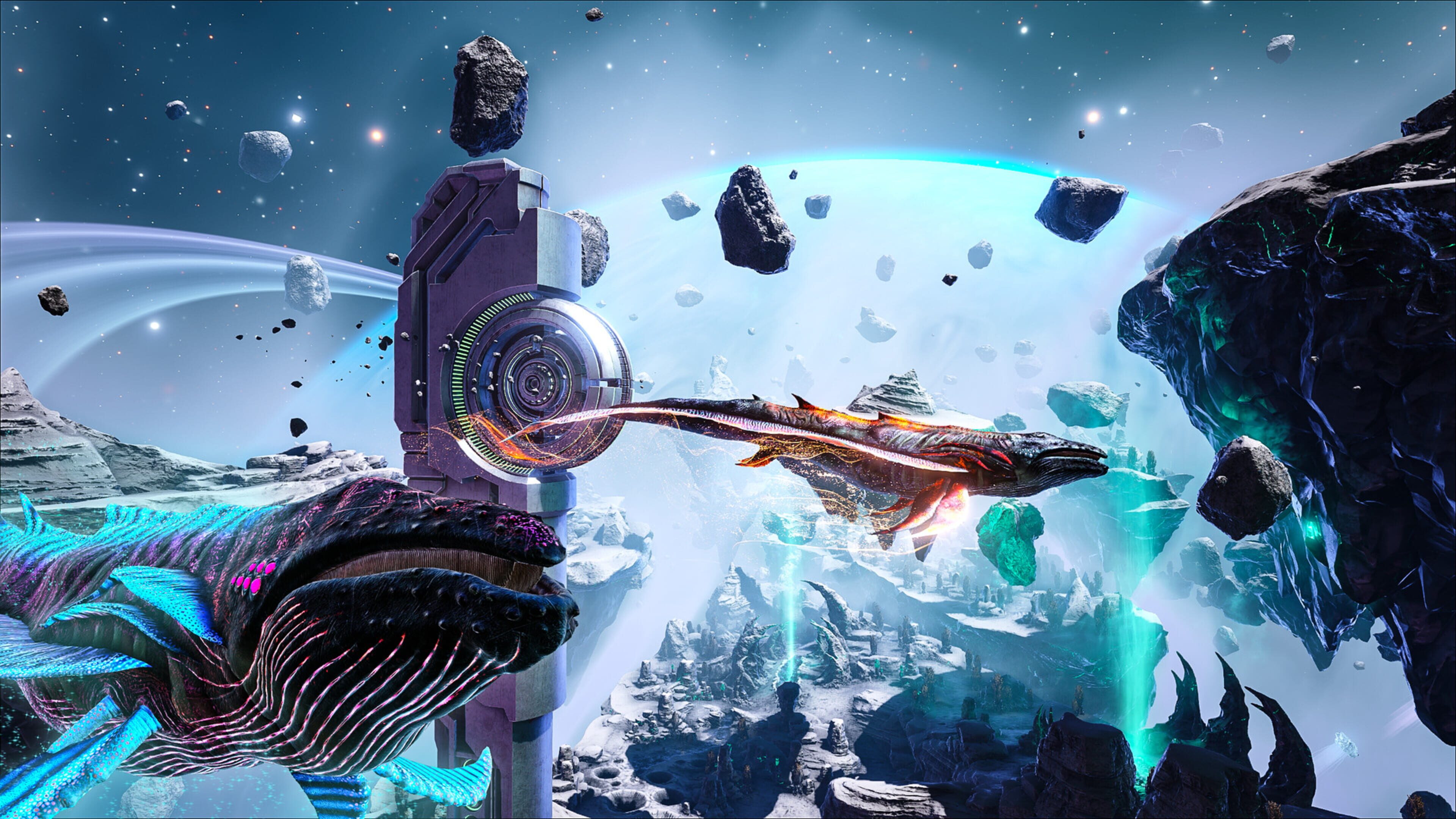
Perhaps the most unique environment in any ARK expansion, the Lunar biome features low gravity, no atmosphere, and high radiation.
- Hazards: Players must manage their oxygen levels constantly or wear Tek suits. The low gravity allows for massive leaps, but the lack of an atmosphere means heat is not dissipated, leading to extreme temperatures in the sun and freezing cold in the shade.
- Key Fauna: The Astrocetus (Space Whale) can be found floating through the debris. It is a massive, late-game tame that can be equipped with a Tek saddle to act as a bomber.
The Mission System and Hexagon Economy
Genesis Part 1 replaced the traditional "find a loot drop" mechanic with a structured Mission System. There are over 100 missions available across the five biomes, categorized by difficulty: Gamma, Beta, and Alpha.
Mission Types
- Hunt Missions: Players track a powerful creature through the biome and engage it in a final boss-style arena.
- Race Missions: Using specific tames (like the Bloodstalker or Proptodon), players navigate a checkpoint-based course as quickly as possible.
- Gauntlet Missions: Survivors are stripped of their gear and placed in a simulation arena where they must survive waves of enemies using provided weapons.
- Escort Missions: Players must protect a vulnerable NPC or creature as it moves from one point to another.
Completing these missions is the only way to earn high-tier blueprints and gear in Genesis Part 1. Furthermore, missions are a prerequisite for the final boss encounter. As of 2026, the mission requirements for the Corrupted Master Controller remain consistent: players must complete a specific number of unique missions to gain entry to the final arena.
| Biome | Key Creature | Primary Hazard | Best Utility |
|---|---|---|---|
| Bog | Bloodstalker | Insect Swarms | Fire (Torches/Flamethrowers) |
| Arctic | Ferox | Extreme Cold | Fur Armor / Otters |
| Ocean | Megachelon | Drowning / Megalodons | SCUBA Gear / Vacuum Cubes |
| Volcanic | Magmasaur | Eruptions / Heat | Ghillie Suit / Water Jars |
| Lunar | Astrocetus | Radiation / No Oxygen | Tek Suit / Oxygen Tanks |
Unique Creatures of Genesis Part 1
The expansion introduced several "headline" creatures that fundamentally changed how players interact with the world.
Bloodstalker
Found in the Bog, the Bloodstalker is a spider-like creature that players do not tame through standard sedation. Instead, the player must allow the Bloodstalker to pull them into the trees and consume "Blood Packs" from their inventory. Once tamed, the Bloodstalker provides unparalleled mobility, allowing players to swing through trees like a certain web-slinging superhero and walk on water.
Ferox
The Ferox is a small, fox-like creature found in the Arctic. It is a "passive tame" until you give it Element. Once it consumes Element, it transforms into a massive, muscular monster capable of throwing rocks and leaping great distances. However, players must be careful; the Ferox has an "addiction" mechanic where it becomes harder to control the more Element it consumes.
Megachelon
The Megachelon is a gargantuan turtle found in the Ocean. It is tamed by leading a swarm of "Microbe Swarms" to it and protecting it while it absorbs them. Once tamed, it serves as a mobile platform for bases. It also produces a constant supply of oxygen around its shell, allowing players to build fully functioning underwater outposts without the need for Tek generators.
Magmasaur
The Magmasaur is the "Giga" of the Volcanic biome. It is a large, lizard-like creature that can consume stone and metal to fire searing projectiles. Its most valuable trait is its ability to smelt metal in its inventory, though it requires a high temperature (provided by the Volcanic biome or a nearby lava source) to do so efficiently.
The Final Encounter: Corrupted Master Controller
The narrative of Genesis Part 1 culminates in a battle against the Corrupted Master Controller, an avatar of the rogue AI overseeing the simulation. This is a multi-phase fight that takes place in a specialized arena called the "System Root."
Unlike traditional boss fights where players simply bring their strongest Rexes, the Master Controller fight requires players to collect "Data Fragments" while under heavy fire from waves of corrupted avatars. Only after enough data is collected can the Master Controller's shield be lowered for a damage phase. This fight tests a player's ability to multitask, manage movement, and prioritize targets, making it one of the more technically demanding encounters in the franchise.
Access, Requirements, and Platform Availability
As of 2026, ARK: Genesis Part 1 is available as part of the Genesis Season Pass or as a standalone purchase on several platforms. It is important to distinguish between the original ARK: Survival Evolved version and the ARK: Survival Ascended (ASA) version.
- ARK: Survival Evolved (ASE): The legacy version is available on PC (Steam/Epic), PlayStation 4/5, Xbox One, and Xbox Series X|S. The requirements are modest by 2026 standards, requiring roughly 20-30GB of additional storage space on top of the base game.
- ARK: Survival Ascended (ASA): This Unreal Engine 5 remake includes Genesis Part 1 with significantly upgraded visuals, improved AI pathing, and integrated mod support. Players should ensure their hardware meets the higher GPU requirements of ASA before purchasing the expansion.
- Pricing: The Genesis Season Pass typically retails for approximately $29.99 to $34.99 USD, though it is frequently included in "Ultimate Survivor" bundles or on-sale during seasonal events.
For official updates and technical support, players should refer to the Studio Wildcard website or the official ARK Wiki.
Frequently Asked Questions
Can I use flying tames in Genesis Part 1?
By default, flying tames (like Pteranodons or Argentavis) are disabled for riding in the Genesis Part 1 simulation biomes. This was a deliberate design choice by Studio Wildcard to force players to use the new movement mechanics, such as the Bloodstalker's webs or the Ferox's leaps. However, server administrators can enable flying in the settings by using the ForceAllowCaveFlyers=True command, though this may bypass intended gameplay challenges.
How do I get Element in Genesis Part 1?
Unlike previous maps where Element is primarily obtained by defeating bosses, Genesis Part 1 provides several ways to acquire it. Players can purchase Element Shards directly from HLN-A using Hexagons. Additionally, "Element Shard" nodes can be found in the Lunar biome and within certain caves in the Volcanic biome. These shards can be crafted into full Element at a Tek Replicator.
What are "X-Creatures" and why are they important?
X-Creatures are special variants found only in the Genesis simulation. They have distinct, vibrant skin patterns and are 3x more resistant to damage while in the wild. Once tamed, they have a 5% damage increase and slightly less health than their standard counterparts, but they have a higher maximum level cap. This makes them highly sought after for breeding programs and high-level boss fights.
Can I play Genesis Part 1 solo?
Yes, Genesis Part 1 is fully playable in single-player or on private servers. However, the mission system and the final boss fight are significantly more difficult for a solo player, especially on "Alpha" difficulty. Players working alone should focus on taming high-level Magmasaurs and Bloodstalkers early to handle the environmental hazards and combat requirements of the missions.
Do I need to finish Genesis Part 1 to play Part 2?
Chronologically, the story of Genesis Part 1 leads directly into Genesis Part 2. While you can technically skip Part 1 and start playing Part 2 immediately, you will miss significant lore context provided by HLN-A. Furthermore, the Hexagon system and some of the creatures tamed in Part 1 are extremely helpful when transitioning to the much larger world of Part 2.
Next Steps for New Survivors
If you are just beginning your journey into the simulation in 2026, your first priority should be reaching the Bog Biome and locating a source of metal and hide. Focus on completing easy "Gamma" missions to accumulate Hexagons, which you should spend on basic tools and armor through HLN-A. Once you have established a small base, aim to tame a Bloodstalker; its mobility will make exploring the other, more hazardous biomes significantly safer. Always keep a close eye on your Hexagon balance, as it acts as your ultimate safety net for resources when the environment turns against you.