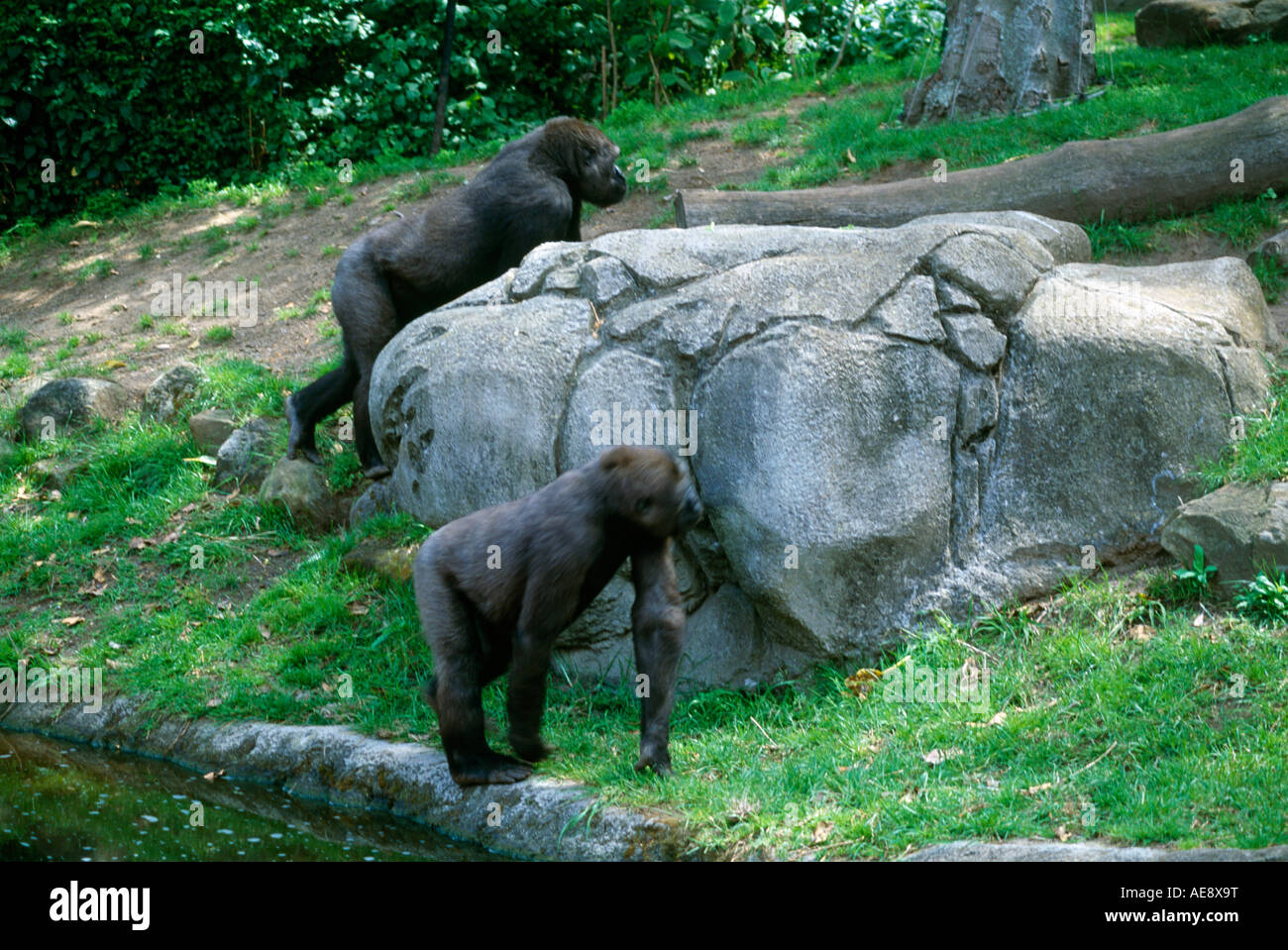
No, there are no wild gorillas in Australia. Gorillas are native exclusively to the tropical rainforests and lowland swamps of central and equatorial Africa. Australia's unique and isolated evolutionary history means that its native mammal fauna is dominated by marsupials and monotremes rather than large placental primates. Consequently, the only places to observe gorillas in Australia are within specialized zoological facilities that maintain strict captive management programs.
Understanding why gorillas do not inhabit Australia requires a deep dive into biogeography, evolutionary history, climate compatibility, and zoological management. While Australia features vast expanses of dense bushland, open eucalyptus forests, and tropical rainforests in the northeast, these ecosystems evolved entirely independently of the African continent. This comprehensive examination explores the biogeographical realities, captive populations, historical context, and ecological comparisons that define wildlife distribution in Australia.
Biogeographical Isolation and Evolutionary History
To understand why there are no gorillas in Australia, one must examine the process of continental drift and mammalian evolution. Millions of years ago, the supercontinent of Gondwana began to break apart. Australia separated from Antarctica and drifted northward, remaining largely isolated from other landmasses for tens of millions of years.
During this prolonged period of geographic isolation, Australian fauna evolved along a distinct evolutionary trajectory. While placental mammals—including primates, rodents, carnivores, and ungulates—flourished, diversified, and eventually gave rise to apes and hominids across Africa, Asia, and the Americas, Australia's mammalian fauna remained overwhelmingly marsupial. Marsupials, such as kangaroos, koalas, wombats, and the extinct thylacine, filled ecological niches that placental mammals occupied elsewhere in the world.
Primates require specific climatic conditions, continuous forest canopies, and particular food sources that evolved in parallel with their biology. Because Australia separated from the rest of Gondwana before primates evolved, and because its subsequent isolation prevented natural migration from Asia across oceanic barriers (beyond certain volant species like bats and some rodents), no native monkeys or apes ever established themselves on the Australian continent.
Natural Habitat Requirements of Gorillas
Gorillas are highly specialized primates with strict environmental and dietary requirements. Examining their natural habitat reveals why Australia's native environments—even the tropical north—do not naturally support them.
Wild gorillas inhabit the dense, humid lowland and montane tropical forests of Central Africa. Their geographic range spans countries such as Rwanda, Uganda, the Democratic Republic of the Congo, Cameroon, the Central African Republic, and Gabon. These regions provide several critical survival factors:
- Continuous Canopy and Dense Understory: Gorillas require dense vegetation for foraging, nesting, and protection from elements and predators.
- Abundant Year-Round Forage: Their diet consists primarily of foliage, stems, pith, roots, fruit, and occasionally insects. They consume vast quantities of plant matter daily, necessitating rich, biodiverse forest floors.
- Specific Climatic Conditions: African gorilla habitats experience consistent tropical temperatures and high humidity, with distinct wet and dry seasons that dictate food availability and movement patterns.
While tropical rainforests in Queensland, Australia, share some superficial climatic similarities with African rainforests, their botanical composition is fundamentally different. Australian rainforests are dominated by flora families such as Myrtaceae (e.g., eucalypts and melaleucas) and ancient lineages like Araucariaceae, which evolved alongside marsupial herbivores and endemic avian species. The nutritional profile, seasonal fruiting patterns, and structural canopy of Australian rainforests do not match the specific evolutionary adaptations of African lowland or mountain gorillas (Gorilla beringei and Gorilla gorilla).
Gorillas in Australian Zoos
Although no wild gorillas exist in Australia, the species can be seen in a controlled zoological setting. As of 2026, select major Australian zoos participate in international breeding and conservation programs designed to maintain insurance populations of critically endangered species.
The most prominent home for gorillas in Australia is Taronga Zoo in Sydney, New South Wales. Taronga houses a troop of western lowland gorillas (Gorilla gorilla gorilla). Over the decades, Taronga Zoo has successfully contributed to the global Regional Census and Plan (RCP) for gorillas, even celebrating successful births within its specialized exhibit environment.
| Zoological Facility | Location | Species Maintained | Conservation Role |
|---|---|---|---|
| Taronga Zoo | Sydney, New South Wales | Western Lowland Gorilla | Regional breeding program, public education, research |
| Melbourne Zoo | Melbourne, Victoria | Historically housed gorillas; current focus shifted | Past participation in regional breeding networks |
These facilities invest heavily in replicating the complex social structures, dietary needs, and environmental enrichment required by gorillas. Exhibits feature climbing structures, deep substrate for foraging, heated indoor quarters to manage cooler southern Australian winters, and expansive viewing glass that allows visitors to observe natural behaviors without causing undue stress to the troop.
Australian Native Wildlife Often Confused with Primates
Travelers and foreign visitors unfamiliar with Australian fauna sometimes inquire about large forest-dwelling mammals, occasionally mistaking other creatures for primates or assuming unrecorded wildlife populations exist in remote bushland. However, Australia completely lacks non-human primates in the wild.
The largest native land mammals in Australia are macropods, such as the red kangaroo (Osphranter rufus) and the eastern grey kangaroo (Macropus giganteus). In dense rainforest environments, observers might encounter tree-kangaroos (genus Dendrolagus). Tree-kangaroos are arboreal marsupials that have evolved muscular limbs and long tails for climbing trees in the tropical rainforests of Far North Queensland and New Guinea. While their arboreal lifestyle and rounded bodies can occasionally lead to brief visual confusion for inexperienced observers, they are marsupials completely unrelated to apes.
Similarly, Australia has no native monkeys, lemurs, or prosimians. Stories or urban legends regarding escaped or wild-breeding primate populations in the Australian bush are thoroughly unfounded; strict biosecurity laws and the inability of tropical primates to survive unmanaged through Australian droughts, bushfires, and temperate winters preclude any possibility of feral establishment.
Conservation Status and Global Protection
Because the discussion of gorillas naturally intersects with conservation biology, it is vital to understand their actual global status. Both species of gorilla—the western gorilla and the eastern gorilla—are listed as Critically Endangered by the International Union for Conservation of Nature (IUCN).
Their wild populations face severe threats across Central Africa, including:
- Habitat Loss and Fragmentation: Deforestation driven by agriculture, logging, and mining.
- Poaching: Illegal hunting for the bushmeat trade and the capture of infants for the illegal pet trade.
- Disease: Susceptibility to human pathogens, including the Ebola virus, which has devastated certain wild populations.
- Civil Conflict: Political instability in regions overlapping their native range, complicating conservation enforcement.
Australian zoos do not merely display these animals for entertainment; they actively fund field conservation initiatives, participate in scientific research regarding primate health and behavior, and educate the public on how international consumer habits impact central African ecosystems.
Frequently Asked Questions
Are there any monkeys native to Australia?
No, Australia has no native monkeys or any other non-human primates. The continent's evolutionary history diverged from placental mammals long before primates evolved. All native Australian land mammals are marsupials or monotremes.
Can you see gorillas anywhere in Australia?
Yes, you can see western lowland gorillas at Taronga Zoo in Sydney. These animals are part of a carefully managed international conservation and breeding program designed to safeguard the species against extinction in the wild.
Why didn't gorillas evolve in Australia?
Gorillas evolved in Africa from ancestral primate stock. Because Australia separated from the ancient supercontinent of Gondwana before primates existed, and remained geographically isolated by deep ocean trenches, primates never reached the continent through natural migration.
Are there dangerous large animals in Australian rainforests?
While Australian rainforests do not house large predatory placental mammals like tigers or bears, they do host dangerous animals such as saltwater crocodiles, cassowaries, venomous snakes, and stinging plants. However, none of these are primates or pose a threat similar to large apes.
How do Australian zoos keep gorillas healthy in a different climate?
Zoos construct climate-controlled indoor habitats and specialized outdoor enclosures that mimic natural forest environments. Zookeepers monitor daily temperatures, adjust diets to match seasonal nutritional requirements, and provide complex behavioral enrichment to ensure physical and psychological well-being.
Conclusion and Visitor Guidance
In summary, Australia is entirely devoid of wild gorillas, and no natural populations of non-human primates exist anywhere on the continent due to ancient biogeographical isolation. For those interested in observing gorillas firsthand while in Australia, a visit to Taronga Zoo in Sydney provides an opportunity to view a managed troop of western lowland gorillas. Visitors looking to experience Australia's native fauna should instead focus on its unique marsupial biodiversity, exploring national parks and reputable wildlife sanctuaries dedicated to native conservation.