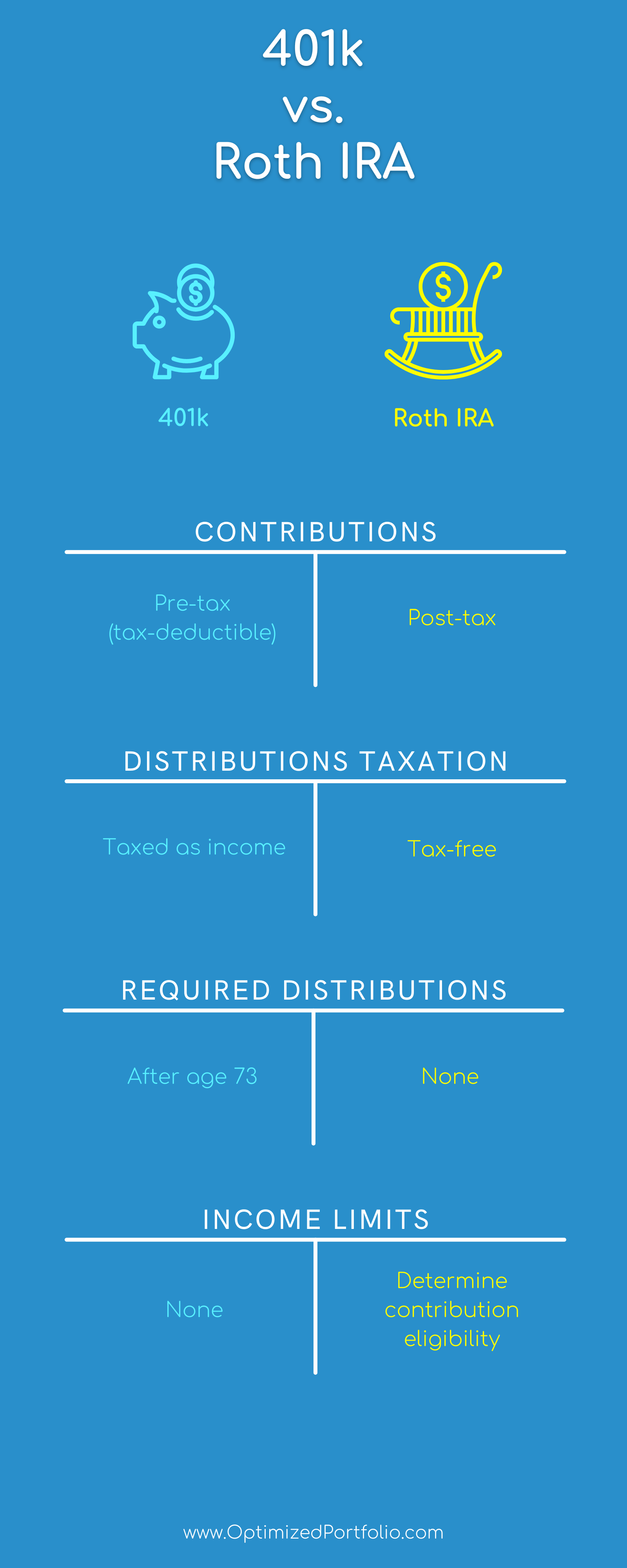
While the 401k remains a staple of American retirement planning, it is often not the most efficient vehicle for maximizing long-term wealth. For investors seeking greater flexibility, lower fees, and superior tax advantages, the Roth IRA, Health Savings Account (HSA), and Taxable Brokerage Accounts currently stand as more robust alternatives for wealth accumulation.
For decades, the 401k has been marketed as the gold standard of retirement savings. However, as we navigate the financial landscape of 2026, many high-earners and savvy investors are realizing that the 401k’s restrictive nature—characterized by limited investment options, high administrative fees, and potential "tax bombs" in retirement—can actually hinder wealth growth. While the employer match should never be ignored, relying solely on a 401k often means leaving significant money on the table.
To build true wealth, one must look toward vehicles that offer greater control and diverse tax treatments. This guide explores the most effective alternatives to the 401k, analyzing how they perform in the current economic environment.
The Limitations of the Traditional 401k
Before exploring alternatives, it is essential to understand why a 401k might be suboptimal for your specific goals. The primary drawback of a traditional 401k is tax deferred is not tax-free. Every dollar you contribute today, along with all the growth it earns, will be taxed as ordinary income when you withdraw it in the future.
In 2026, with the sunsetting of various provisions from the Tax Cuts and Jobs Act (TCJA), many investors are facing higher effective tax rates than they did a decade ago. If you believe your tax bracket will be higher in retirement—or that national tax rates will rise to address federal deficits—the traditional 401k loses its primary appeal.
Furthermore, 401k plans are notorious for limited investment menus. Most plans restrict you to a handful of mutual funds or target-date funds, many of which carry high expense ratios. According to data from the Financial Industry Regulatory Authority (FINRA), these fees can erode up to 30% of an account's potential value over a 30-year career. Lastly, the lack of liquidity before age 59½ (without facing a 10% penalty) makes the 401k a poor choice for those pursuing early financial independence.
1. The Roth IRA: The King of Tax-Free Growth
The Roth IRA is arguably the most powerful alternative for individual investors. Unlike the 401k, you contribute "after-tax" dollars, meaning you receive no tax break today. However, the trade-off is immense: your money grows tax-free, and qualified withdrawals in retirement are completely exempt from federal income tax.
Greater Investment Flexibility
One of the most significant advantages of a Roth IRA over a 401k is the freedom of choice. While a 401k limits you to a pre-selected list of funds, a Roth IRA at a major brokerage allows you to invest in almost any individual stock, Exchange-Traded Fund (ETF), REIT, or even options. This allows you to tilt your portfolio toward high-growth sectors or low-cost index funds that are often unavailable in employer-sponsored plans.
Liquidity and Penalty-Free Access
The Roth IRA offers a level of liquidity that 401ks cannot match. You can withdraw your contributions (the principal) at any time, for any reason, without taxes or penalties. This makes the Roth IRA a viable "back-up" emergency fund. While you should avoid raiding your retirement savings, knowing the capital is accessible provides a psychological and strategic advantage for wealth builders.
No Required Minimum Distributions (RMDs)
In 2026, managing RMDs is a major concern for retirees with large traditional 401k balances. The IRS forces you to take money out of a traditional 401k starting at age 73 or 75, regardless of whether you need the cash. This can push you into a higher tax bracket and increase your Medicare premiums. The Roth IRA has no RMDs for the original owner, allowing your wealth to compound indefinitely or be passed on to heirs tax-free.
2. The Health Savings Account (HSA): The "Stealth IRA"
Often overlooked as a simple way to pay for doctor visits, the HSA is actually the most tax-advantaged account in the U.S. tax code. It offers a triple tax advantage that no 401k can replicate:
- Contributions are tax-deductible (or pre-tax via payroll).
- The money grows tax-deferred.
- Withdrawals are tax-free when used for qualified medical expenses.
The Long-Term Wealth Strategy
The secret to using an HSA for wealth building is to not use it for medical bills in the short term. If you can afford to pay for healthcare out of pocket, you can leave your HSA contributions invested in the stock market. Because there is no time limit on when you must reimburse yourself, you can save your receipts for decades.
By the time you reach age 65, the HSA functions similarly to a traditional 401k for non-medical withdrawals (taxed at ordinary income rates), but it remains tax-free for any medical expenses. Given that the Internal Revenue Service (IRS) sets annual contribution limits that have trended upward, a disciplined investor can build a six-figure "medical war chest" that doubles as a retirement fund.
3. Taxable Brokerage Accounts: Maximum Control and Liquidity
If you have already maxed out your tax-advantaged options, or if you value absolute control, a standard taxable brokerage account is a superior tool for growing wealth compared to contributing "unmatched" dollars to a 401k.
Favorable Tax Rates
While 401k withdrawals are taxed at ordinary income rates (which can be as high as 37% or more), long-term capital gains in a brokerage account are taxed at 0%, 15%, or 20%, depending on your income level. For many investors, the long-term capital gains rate is significantly lower than their income tax bracket.
Tax-Loss Harvesting
A taxable account allows for a strategy called tax-loss harvesting. This involves selling an investment that is at a loss to offset gains in other areas of your portfolio, potentially reducing your taxable income by up to $3,000 per year. This active tax management is impossible within the "black box" of a 401k.
No "Golden Handcuffs"
A brokerage account has no contribution limits and no age restrictions for withdrawals. If you want to retire at age 45, your brokerage account is your primary bridge to get you there. You aren't tied to the IRS's definition of "retirement age," giving you the ultimate form of wealth: the freedom of time.
4. Real Estate: Leverage and Depreciation
For those looking to grow wealth outside the stock market, residential or commercial real estate offers advantages that no paper asset can match. Real estate allows for leverage—using the bank's money to acquire an asset. If you put 20% down on a $500,000 property and it appreciates by 5%, you have made a 25% return on your invested cash.
The Power of Depreciation
Real estate investors benefit from "phantom losses" through depreciation. The IRS allows you to deduct the value of the building over 27.5 years, which often cancels out the taxable income produced by the rent. This allows you to collect cash flow while reporting a loss on your tax return. Furthermore, using a 1031 Exchange allows you to defer capital gains taxes indefinitely by rolling the proceeds of a sale into a new property.
Comparison of Wealth-Building Vehicles (2026 Data)
| Feature | Traditional 401k | Roth IRA | HSA | Taxable Brokerage |
|---|---|---|---|---|
| Tax Break Now | Yes (Pre-tax) | No | Yes | No |
| Tax-Free Growth | No (Deferred) | Yes | Yes | No (Capital Gains) |
| Withdrawal Age | 59.5 (Penalties apply) | Contributions Any Time | Any Time (for health) | Any Time |
| Investment Choice | Limited Menu | Unlimited | Varies (usually broad) | Unlimited |
| Employer Match | Common | None | Occasionally | None |
| 2026 Contribution Limit | $23,500* | $7,000* | $4,300 (Self)* | Unlimited |
*Note: Limits are based on 2026 projections and inflation adjustments provided by the Social Security Administration and IRS guidelines.
When the 401k is Still Necessary: The Match
It is important to clarify that "better" does not always mean "instead of." The single most effective wealth-building event for most employees is the 401k employer match. If your employer matches 50% of your contributions up to 6% of your salary, that is an immediate 50% return on your investment. No Roth IRA or real estate deal can guaranteed that.
The optimal strategy for most investors in 2026 is a "waterfall" method:
- Contribute to your 401k only up to the point of the maximum employer match.
- Max out your HSA to capture the triple tax advantage.
- Max out your Roth IRA (or Backdoor Roth if income exceeds limits).
- Return to the 401k if you have more to save, or pivot to a Taxable Brokerage for liquidity.
The Self-Employed Alternative: Solo 401k and SEP IRA
If you are a business owner or a freelancer, the "standard" 401k is definitely not your best option. A Solo 401k allows you to contribute as both the employer and the employee, leading to much higher contribution limits (often exceeding $69,000 depending on income).
Alternatively, a SEP IRA offers a simplified way to contribute up to 25% of your net earnings. For high-earning consultants in 2026, these vehicles allow for massive tax deductions while maintaining full control over the investment selection at a brokerage of their choice.
Common Mistakes to Avoid
When moving away from a 401k-centric strategy, investors often fall into several traps:
- High Turnover in Taxable Accounts: Frequent trading in a brokerage account triggers short-term capital gains, which are taxed at higher ordinary income rates. Use a "Buy and Hold" strategy for taxable assets.
- Neglecting the HSA Investment: Many people leave their HSA in a cash account earning 0.1% interest. You must manually opt to invest those funds into the market for the wealth-building aspect to work.
- Ignoring the Backdoor Roth: If your income is too high for a direct Roth IRA contribution, many assume they are ineligible. The "Backdoor" Roth strategy remains a legal and effective way for high earners to access tax-free growth.
Frequently Asked Questions
Is it ever smart to stop contributing to a 401k entirely?
Only if your plan has exceptionally high fees (above 1.5% annually) and offers no employer match. Even then, the tax-deferred growth of a 401k is usually better than a taxable account if you have no other tax-advantaged space left. However, you should prioritize the Roth IRA and HSA first if no match is present.
Can I have both a 401k and a Roth IRA?
Yes. In fact, for most wealth builders, having both is the ideal scenario. This creates "tax diversification," allowing you to pull money from different buckets in retirement to stay in the lowest possible tax bracket.
What is the "Rule of 55" for 401ks?
The Rule of 55 is a specific exception that allows you to withdraw funds from your current 401k without penalty if you leave your job in or after the year you turn 55. This is one of the few areas where a 401k has a liquidity advantage over a Roth IRA (which requires age 59.5 for earnings access) or a Traditional IRA.
Are there income limits for these alternatives?
Yes. Roth IRAs have phase-out limits. In 2026, single filers earning over a certain threshold (typically adjusted for inflation around $150k-$165k) cannot contribute directly. However, taxable brokerage accounts and HSAs (provided you have a High Deductible Health Plan) have no income caps for participation.
How does inflation affect my 401k vs. Real Estate?
401ks are comprised of paper assets (stocks/调bonds). While stocks generally hedge against inflation, real estate is a "hard asset." Inflation often drives up both property values and rents, while simultaneously devaluing the "real" cost of your fixed-rate mortgage debt, making real estate a superior inflation hedge for many.
Strategic Recommendation
For the average investor in 2026, the best path to wealth is not a single account, but a diversified tax strategy.
Start by securing your employer’s 401k match—it is the only "guaranteed" return in finance. Once that is secured, pivot your focus to the HSA for its unmatched tax efficiency, followed by the Roth IRA for its tax-free growth and flexibility. If you are an aggressive wealth builder or plan to retire early, direct your remaining surplus into a Taxable Brokerage Account. This approach ensures that you aren't just saving money, but you are optimizing every dollar against the eroding forces of taxes, fees, and inflation.