Another term for accounts payable is trade payables. In many financial contexts, it is also referred to as trade creditors, bills payable, or simply payables. While these terms represent a company's short-term obligations to pay suppliers for goods or services, they are formally categorized under current liabilities on a balance sheet.
Accounts payable (AP) serves as a cornerstone of corporate accounting and liquidity management. As of 2026, the terminology and processes surrounding these obligations have become increasingly integrated with digital procurement systems, yet the fundamental accounting principles remain constant. Understanding the nuances between these terms is essential for accurate financial reporting and effective cash flow management.
Defining the Synonyms of Accounts Payable
While "accounts payable" is the most prevalent term in North American accounting (US GAAP), various industries and geographic regions utilize alternative phrasing. Each term carries a slightly different connotation depending on the specific nature of the debt and the regulatory framework in use.
Trade Payables
The term trade payables is the most common technical synonym for accounts payable. While the two are often used interchangeably, "trade payables" specifically refers to the money owed to vendors for inventory-related goods—those items that are directly used in the production of the company’s products or are intended for resale. In contrast, "accounts payable" can sometimes be a broader umbrella that includes non-trade obligations like office supplies or utilities.
Trade Creditors
In the United Kingdom, Australia, and many countries following International Financial Reporting Standards (IFRS), the term trade creditors is the standard equivalent. This term emphasizes the relationship from the perspective of the entity to whom the money is owed. If you are reviewing a balance sheet for a European corporation in 2026, you will almost certainly see "trade creditors" listed where a US company would list "accounts payable."
Current Liabilities
From a broad classification standpoint, accounts payable is a subset of current liabilities. Current liabilities encompass all debts a company is obligated to pay within one year or one operating cycle. While "current liabilities" is not a direct synonym—as it also includes short-term loans, accrued expenses, and taxes—it is the structural home for accounts payable in financial reporting.
Bills Payable
Though less common in modern corporate accounting, bills payable is a term still found in traditional bookkeeping and certain banking contexts. It typically refers to specific promissory notes or formal written promises to pay a specific amount on a specific date, whereas accounts payable usually refers to open-account balances with vendors.
The Distinction Between Trade and Non-Trade Payables
To achieve the technical depth required for 2026 financial standards, one must distinguish between trade and non-trade obligations. This distinction is vital for analysts looking to understand a company's core operational efficiency.
- Trade Payables: These are obligations incurred directly from the core business operations. For a smartphone manufacturer, this would include the cost of screens, processors, and assembly services.
- Non-Trade Payables: These are obligations that do not relate to the primary production of goods or services. Examples include a one-time purchase of office furniture, legal fees, or the acquisition of a company vehicle.
Distinguishing these on the general ledger allows management to calculate the Accounts Payable Turnover Ratio specifically for operational costs, providing a clearer picture of how efficiently the company is managing its primary supply chain debts.
The Procure-to-Pay (P2P) Lifecycle
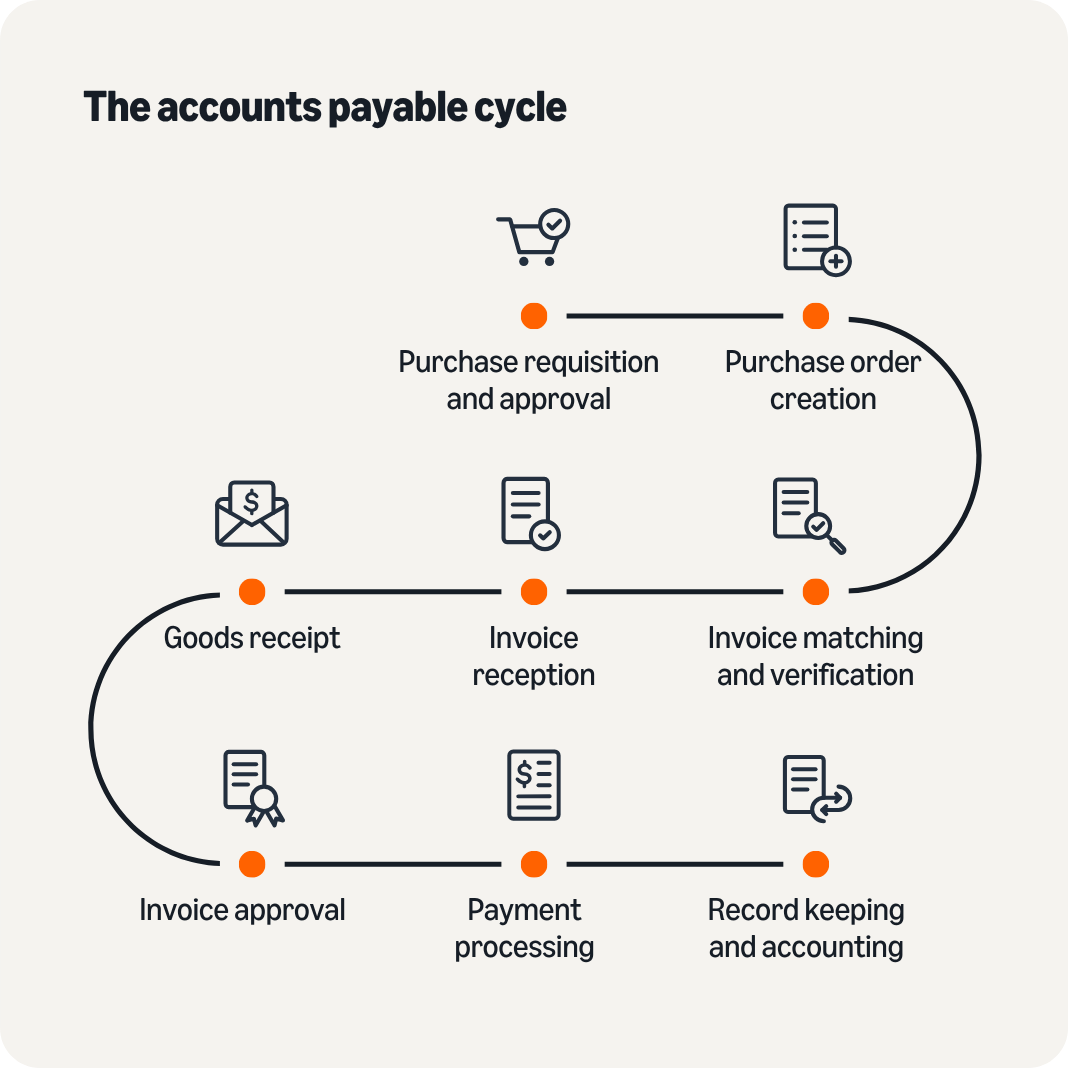
Understanding another term for accounts payable requires understanding the process that creates it. In 2026, this is widely known as the Procure-to-Pay (P2P) cycle. This end-to-end process covers everything from the initial request for goods to the final disbursement of funds.
1. Purchase Requisition and Order
The cycle begins when a department identifies a need and issues a purchase requisition. Once approved, a formal Purchase Order (PO) is sent to the vendor. The PO is a legally binding contract that specifies the items, quantities, and agreed-upon prices. At this stage, no liability exists on the balance sheet.
2. Receiving and Inspection
When the goods arrive, the receiving department generates a receiving report. This document is critical because it confirms that the company has physically taken possession of the assets. Under accrual accounting, the liability often begins to accrue at the point of title transfer, even if the invoice has not yet been processed.
3. Invoice Processing
The vendor sends an invoice (the "bill"). In modern 2026 accounting environments, these are almost exclusively electronic. The accounts payable department then performs what is known as a three-way match.
4. The Three-Way Match
The three-way match is a vital internal control. The AP team compares:
- The Purchase Order (what was ordered).
- The Receiving Report (what was delivered).
- The Vendor Invoice (what is being charged).
If these three documents align within established tolerances, the invoice is approved for payment and officially recorded as an "account payable" in the general ledger.
Accounting Standards and Reporting (US GAAP vs. IFRS)
The terminology used for payables is heavily influenced by the accounting standards a company follows. As of 2026, while there has been significant convergence between the Financial Accounting Standards Board (FASB) in the US and the International Accounting Standards Board (IASB), nomenclature differences persist.
- US GAAP: Primarily uses the term "Accounts Payable." The focus is on the nature of the account as an "account" on the ledger that is "payable" to others.
- IFRS: Prefers "Trade and Other Payables." This categorization is often more granular, explicitly separating trade-related debts from other miscellaneous short-term obligations on the face of the balance sheet.
For a deeper look at these standards, the Financial Accounting Standards Board (FASB) provides comprehensive updates on reporting requirements for liabilities.
Comparison of Accounts Payable Terminology
The following table summarizes the various terms used to describe accounts payable, their primary usage contexts, and their specific nuances.
| Term | Context/Region | Nuance |
|---|---|---|
| Accounts Payable (AP) | US GAAP / North America | Generic term for all short-term vendor obligations. |
| Trade Payables | Technical Accounting | Specifically refers to inventory and core production debts. |
| Trade Creditors | IFRS / UK / Australia | Focuses on the entity to whom the debt is owed. |
| Bills Payable | Banking / Promissory Notes | Often implies a formal, written promise to pay. |
| Current Liabilities | Financial Statements | The broad category where all AP is reported. |
| Vouchers Payable | Internal Control Systems | Refers to an approved internal document authorizing payment. |
Why Accurate Terminology and Management Matter
Managing "payables"—by whatever name—is a delicate balancing act. It is not merely about paying bills; it is about strategic capital management.
Impact on Cash Flow and Liquidity
Accounts payable represents a form of interest-free financing. By maximizing the time between receiving goods and paying for them (within agreed terms), a company can use that cash for other operational needs. This is measured by the Days Payable Outstanding (DPO). A higher DPO indicates that a company is taking longer to pay its bills, which can improve cash position but may strain vendor relationships.
Vendor Relationship Management (VRM)
Consistently referring to these obligations as "trade payables" and managing them professionally ensures that suppliers remain willing to offer favorable credit terms. In 2026, where supply chain resilience is paramount, the AP department is often seen as a strategic partner in maintaining these vital external links.
The Risk of Fraud
Regardless of the term used, this area of the balance sheet is highly susceptible to fraud, such as "billing schemes" or "ghost vendors." Robust internal controls, such as the aforementioned three-way match and strict segregation of duties, are essential to protect the company's assets.
The Role of Automation in 2026 Accounts Payable
By 2026, the manual entry of "accounts payable" has largely become a thing of the past for mid-to-large enterprises. AP Automation software uses Artificial Intelligence (AI) and Optical Character Recognition (OCR) to read invoices, match them to purchase orders, and flag discrepancies automatically.
This shift has changed the role of the AP clerk to that of an AP Analyst. Instead of data entry, these professionals focus on exception handling, identifying trends in "trade payables," and negotiating better payment terms with "trade creditors." The Association for Financial Professionals (AFP) offers extensive resources on how technology is reshaping these roles.
Common Pitfalls in AP Classification
Even seasoned accountants can make errors in how they categorize these short-term debts. One common mistake is failing to distinguish between an accrued expense and an account payable.
- Accounts Payable: The company has received an invoice from a vendor.
- Accrued Expense: The company has incurred the expense (e.g., employee wages or interest) but has not yet received an invoice or made a payment.
Mixing these up can lead to inaccuracies in the aging schedule, which is the report used to track how long various "bills payable" have been outstanding.
Frequently Asked Questions
Is "Accounts Payable" considered an asset or a liability?
Accounts payable is a current liability. It represents an obligation or a debt that the company must settle within a short period, usually 30 to 90 days. Because it is a "future sacrifice of economic benefits," it sits on the right side of the accounting equation (Assets = Liabilities + Equity).
What is the difference between Accounts Payable and Trade Payables?
While often used as synonyms, the difference lies in scope. Accounts payable is a broad term that covers all short-term debts to creditors. Trade payables specifically refers to debts incurred for goods that are part of the company's core inventory or production process.
Why do UK companies use the term "Trade Creditors"?
UK companies follow accounting traditions and standards (like FRS 102) that focus on the relationship with the "creditor" (the person to whom money is owed). It is functionally identical to accounts payable but reflects a different linguistic and regulatory heritage.
Can accounts payable ever be a long-term liability?
No. By definition, if a debt is classified as "accounts payable," it is expected to be paid within the company's operating cycle or one year. If a debt has a payment term longer than one year, it must be reclassified as a long-term note payable or another form of non-current liability.
How does accounts payable affect the Quick Ratio?
The Quick Ratio (or Acid-Test Ratio) is calculated as (Cash + Marketable Securities + Accounts Receivable) divided by Current Liabilities. Since accounts payable is a major component of current liabilities, an increase in payables—without a corresponding increase in liquid assets—will decrease the company's quick ratio, signaling a potential liquidity squeeze.
Practical Recommendation for Business Owners
For business owners and financial managers in 2026, the primary goal should be to maintain a meticulous Aging of Accounts Payable report. This report categorizes your "trade creditors" based on how long their invoices have been outstanding (e.g., 0-30 days, 31-60 days, 61-90 days).
By monitoring this report weekly, you can avoid late fees, take advantage of early payment discounts (like "2/10 net 30"), and ensure that your company's credit reputation remains untarnished. If your "bills payable" are starting to cluster in the 60+ day categories, it is a leading indicator that your cash flow needs immediate attention.