Alaska remains the ultimate frontier for wildlife enthusiasts in 2026, offering a vast, untamed landscape where some of North America's most iconic species thrive. To truly understand the state’s biodiversity, you should know the "Big Five" land mammals—grizzly bears, moose, caribou, Dall sheep, and wolves—alongside its massive marine residents like humpback whales and the elusive predators of the high Arctic, such as the polar bear.
Alaska’s ecosystems are as varied as its geography, ranging from temperate rainforests in the Southeast to the windswept tundra of the North Slope. Because these animals are integral to the state’s culture, economy, and ecological health, knowing how to identify them and interact with them safely is essential for any visitor or resident.
The Iconic "Big Five" Land Mammals of Alaska
The term "Big Five" is frequently used by tour operators and the National Park Service to describe the most sought-after terrestrial sightings in places like Denali National Park. These species represent the raw power and resilience of the subarctic wilderness.
1. The Grizzly and Brown Bear (Ursus arctos)
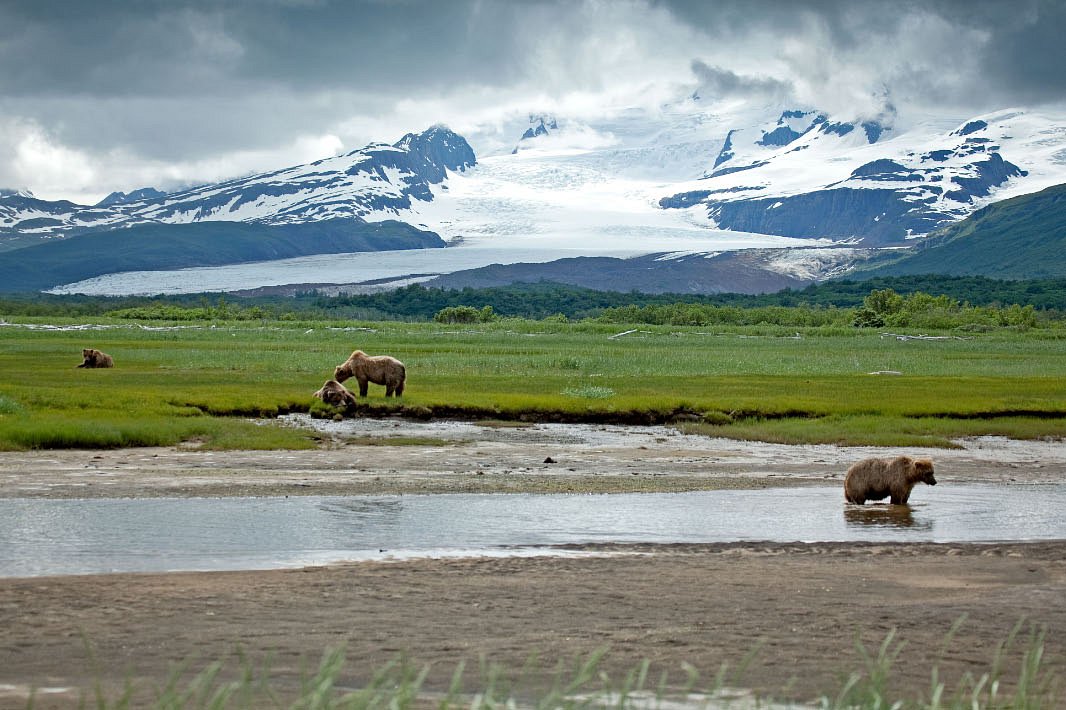
While often used interchangeably, "brown bear" typically refers to the massive individuals found in coastal regions, while "grizzly" describes the smaller, often more aggressive interior bears. As of 2026, Alaska remains home to over 30,000 brown bears, representing nearly 95% of the United States' population.
Coastal brown bears, particularly those in Katmai and Kodiak Island, can weigh over 1,000 pounds thanks to a protein-rich diet of spawning salmon. Interior grizzlies are smaller, often weighing between 400 and 700 pounds, and spend much of their time digging for roots, berries, and ground squirrels. Identifying them involves looking for the prominent shoulder hump—a mass of muscle used for digging—and short, rounded ears.
2. The Alaska-Yukon Moose (Alces alces gigas)
The moose is the largest member of the deer family, and the Alaska-Yukon subspecies is the largest of them all. Bulls can stand seven feet tall at the shoulder and weigh up to 1,600 pounds. They are ubiquitous across the state, often found in willow thickets near riverbeds or even wandering through the suburbs of Anchorage.
Moose are recognizable by their massive palmate antlers (in males), long bulbous noses, and the "bell" or dewlap under their chin. Despite their herbivorous nature, they are statistically more dangerous to humans in Alaska than bears, particularly during the fall rutting season or the spring calving season when cows are fiercely protective.
3. Caribou (Rangifer tarandus)
Alaska is home to approximately 750,000 caribou distributed across 32 recognized herds. Unlike other deer species, both males and females grow antlers, though the bulls' antlers are significantly larger and more complex. Caribou are masters of migration, with some herds traveling thousands of miles annually between their wintering grounds and calving areas on the North Slope.
Their large, concave hooves act as natural snowshoes in the winter and paddles for swimming across wide glacial rivers. For viewers in 2026, the Western Arctic Herd and the Porcupine Herd remain the most significant populations, though their numbers are closely monitored by the Alaska Department of Fish and Game due to shifting climate patterns.
4. Dall Sheep (Ovis dalli)
Easily spotted against the green summer slopes or rocky crags of the Alaska Range and Chugach Mountains, Dall sheep are famous for the massive, curling horns of the rams. These sheep are pure white and inhabit high-altitude alpine ridges where they can escape predators like wolves and bears.
The age of a ram can be determined by counting the "annuli" or growth rings on its horns, much like the rings of a tree. They are extremely sensitive to human presence, so viewing usually requires high-quality binoculars or spotting scopes from a distance to avoid disturbing their grazing patterns.
5. The Gray Wolf (Canis lupus)
The wolf is perhaps the most elusive of the Big Five. Alaska houses an estimated 7,000 to 11,000 wolves. They are highly social animals that live in packs ranging from 2 to over 20 individuals. While their fur is often a mix of gray, black, and white, completely black or white wolves are not uncommon in the northern regions.
Wolves are the apex predators of the Alaskan interior, primarily preying on moose, caribou, and Dall sheep. Seeing a wolf in the wild is a matter of luck and timing, often occurring in the early morning or late evening hours along the park roads in Denali or the expansive river flats of the Yukon.
Marine Mammals: Giants of the Pacific and Arctic Oceans
Alaska’s coastline spans over 6,600 miles (more than the rest of the U.S. combined), providing a habitat for an incredible array of marine life.
Humpback Whales and Orcas
Every summer, humpback whales migrate from Hawaii and Mexico to the nutrient-rich waters of Southeast Alaska and the Gulf of Alaska. They are famous for "bubble-net feeding," a complex, coordinated hunting behavior where a group of whales creates a curtain of bubbles to trap schools of herring.
Orcas (Killer Whales) are also frequently sighted, particularly in Prince William Sound and Resurrection Bay. In 2026, researchers continue to distinguish between "resident" orcas, which eat fish, and "transient" orcas, which hunt other marine mammals like seals and porpoises.
Sea Otters and Pinnipeds
Sea otters are a common sight in coastal areas, often seen floating on their backs in kelp forests. They have the densest fur of any animal on Earth—up to a million hairs per square inch—as they lack a blubber layer to stay warm in the frigid water.
Steller sea lions and harbor seals are also frequently spotted hauled out on ice floes or rocky outcrops. Steller sea lions are the largest of the eared seals, with males weighing up to 2,500 pounds and possessing a thick neck that resembles a lion’s mane.
Unique Species of the High Arctic
The Far North of Alaska hosts animals that have evolved specifically for sub-zero temperatures and the extreme seasonal shifts of the Arctic Circle.
- Polar Bears: Primarily found in the Beaufort and Chukchi Seas, polar bears are the world’s largest land carnivores. They spend most of their lives on sea ice, hunting ringed seals. In late summer and fall, they are often seen near the village of Kaktovik.
- Muskox: These prehistoric-looking survivors of the Pleistocene era are covered in "qiviut," an underwool that is eight times warmer than sheep's wool. They are known for their defensive "circle the wagons" formation when threatened by wolves.
- Arctic Fox: These small foxes have thick fur that changes color with the seasons—pristine white in the winter to blend with the snow, and brownish-gray in the summer to match the tundra.
Comparison of Alaska’s Most Viewed Land Wildlife
The following table provides a quick reference for the primary land mammals you should know, including their typical habitat and the best times for observation during the 2026 season.
| Animal | Scientific Name | Average Weight (Adult) | Primary Habitat | Best Viewing Months |
|---|---|---|---|---|
| Brown Bear | Ursus arctos | 600 - 1,200 lbs | Coastal shorelines / Rivers | July - September |
| Moose | Alces alces | 800 - 1,600 lbs | Forest edges / Wetlands | Year-round |
| Caribou | Rangifer tarandus | 200 - 400 lbs | Open Tundra / Mountains | August - October |
| Dall Sheep | Ovis dalli | 100 - 200 lbs | Alpine Ridges / Cliffs | June - August |
| Gray Wolf | Canis lupus | 80/110 lbs | Boreal Forest / Tundra | Dawn/Dusk Year-round |
| Muskox | Ovibos moschatus | 500 - 800 lbs | Arctic Tundra | March - April / Sept |
Alaska's Avian Residents: Raptors and Waterfowl
Alaska’s birdlife is as impressive as its mammals. The state serves as a critical nesting ground for millions of migratory birds from all seven continents.
The Bald Eagle (Haliaeetus leucocephalus)
While the bald eagle is the national bird of the United States, nowhere is it more concentrated than in Alaska. The Chilkat Bald Eagle Preserve near Haines hosts the world’s largest gathering of bald eagles each autumn, where thousands of birds congregate to feed on a late salmon run. In 2026, populations remain robust, and they are easily identified by their white heads and massive six-foot wingspans.
Puffins: The Parrots of the Sea
Alaska is home to two species of puffins: the Tufted Puffin and the Horned Puffin. These charismatic birds spend their winters at sea and return to coastal cliffs in the summer to nest. The Kenai Fjords National Park and the Pribilof Islands are premier locations for viewing these birds as they dive up to 200 feet deep to catch small fish.
Safety and Ethics: Viewing Alaska’s Wildlife Responsibly
In 2026, the principles of "Leave No Trace" and wildlife safety are more important than ever as tourism to the 49th state continues to grow. Alaska's animals are wild and unpredictable; maintaining a safe distance is the most critical rule of wildlife viewing.
The "Rule of Thumb"
A common guideline used by park rangers is the "rule of thumb." Hold your thumb at arm's length; if it doesn't completely cover the animal you are viewing, you are too close. For bears, a minimum distance of 100 yards is generally required, while for moose and other large mammals, 25 yards is the absolute minimum.
Food Storage and Bear Awareness
Bears have an incredible sense of smell. In 2026, most Alaskan parks and campgrounds require the use of bear-resistant food containers (BRFCs). Never feed any wildlife, as "a fed bear is a dead bear"—meaning animals that become habituated to human food often become aggressive and must be lethally removed by authorities.
Interaction Protocols
- Bears: If you encounter a bear, do not run. Speak in a calm, firm voice and back away slowly. Carry bear spray and know how to use it.
- Moose: If a moose charges, run. Unlike bears, moose can often be outmaneuvered by ducking behind a large tree or solid object. Watch for signs of aggression: ears pinned back and hair standing up on the hump (hackles).
Frequently Asked Questions
What is the best time of year to see wildlife in Alaska?
The peak window for wildlife viewing is between late May and early September. During this time, the "Midnight Sun" provides extended daylight, and the salmon runs draw bears and eagles to the riverbanks. However, specific animals like caribou and moose are more active and visible during their fall migrations and rutting seasons in September.
Where is the best place to see the Big Five?
Denali National Park and Preserve remains the premier destination for spotting the Big Five in a single location. The 92-mile Park Road offers access to the diverse habitats these animals require. For marine wildlife, Kenai Fjords National Park and the Inside Passage are world-class locations.
Are there poisonous snakes or insects in Alaska?
Alaska is famous for being one of the few places in the world with no snakes. However, it does have "the state bird"—the mosquito. In early summer, mosquito populations can be intense, particularly in the interior and on the tundra. There are also no truly "poisonous" insects that pose a fatal threat, though the Giant Water Bug and certain spiders can deliver painful bites.
Can I see polar bears on a standard Alaska cruise?
No. Standard cruises typically stay within the Southeast "Panhandle" or the Gulf of Alaska. Polar bears are located much further north in the Arctic Circle. To see polar bears, you must travel to remote northern communities like Utqiaġvik (Barrow) or Kaktovik via specialized regional flights.
How do I report a rare wildlife sighting?
If you witness unusual wildlife behavior or see a rare species (like a Short-tailed Albatross or a Wood Bison in a new area), you can report it to the Alaska Department of Fish and Game. Documentation through photos or GPS coordinates is highly helpful for state biologists monitoring population health in 2026.
Practical Advice for Your 2026 Wildlife Expedition
To maximize your chances of a successful wildlife viewing experience, invest in high-quality optics. A pair of 8x42 or 10x42 binoculars is the industry standard for Alaskan conditions, providing enough magnification for distant sheep while maintaining a wide enough field of view for moving whales.
Furthermore, always travel with a guide when venturing into the deep backcountry. Professional guides are trained in animal behavior and carry the necessary safety equipment to ensure that your encounter with Alaska’s majestic animals remains a positive, lifelong memory. By respecting the animals' space and their environment, you help ensure that Alaska’s wild heritage remains intact for generations to come.