As of 2026, all 50 U.S. states have enacted workers’ compensation statutes designed to provide medical benefits and wage replacement to employees injured on the job. While the specific provisions, coverage thresholds, and administrative procedures differ by jurisdiction, every state maintains a regulatory framework to manage workplace injury claims and employer liability.
Workers’ compensation serves as the primary social insurance program for the American workforce. Although the federal government manages programs for its own employees and specific industries (such as maritime or coal mining), the vast majority of workers are governed by the specific statutes of the state in which they are employed. Understanding these laws requires looking beyond the simple requirement to carry insurance; it involves analyzing the legal "Grand Bargain," the distinction between monopolistic and competitive markets, and the evolving nature of what constitutes a "workplace" in an era of decentralized labor.
The Evolution of Workers’ Compensation in the United States
The path to universal workers’ compensation in the United States was a multi-decade process. Before these statutes existed, injured workers had to sue their employers under common law to recover damages. This was often an exercise in futility due to the "unholy trinity" of legal defenses available to employers: contributory negligence, the fellow-servant rule, and the assumption of risk. Under these doctrines, if a worker was even slightly at fault, or if a coworker caused the injury, or if the job was inherently dangerous, the employer was generally not liable.
The transition began in the early 20th century. Wisconsin was the first state to pass a constitutionally valid workers' compensation law in 1911. Other states followed rapidly as the industrial revolution increased the frequency of workplace accidents. The final state to join the fold was Mississippi, which did not enact its workers’ compensation statute until 1948.
By 2026, these laws have evolved from simple "accident insurance" into complex systems that address occupational diseases, mental health issues, and long-term vocational rehabilitation. While the core mission remains the same—protecting the worker from financial ruin while protecting the employer from unpredictable litigation—the statutes are constantly being amended to reflect modern medical costs and labor trends.
The "Grand Bargain": The Foundation of Every State Statute
At the heart of all 50 state workers’ compensation statutes is a legal compromise known as the Grand Bargain. This concept is the fundamental trade-off that makes the system functional for both parties involved in the employment contract.
The Employee's Side of the Bargain
Under these statutes, employees give up their right to sue their employer in civil court for negligence following a workplace injury. In exchange, they receive "no-fault" benefits. This means the worker does not need to prove the employer did something wrong to receive medical care and disability payments; they only need to prove the injury occurred in the course and scope of their employment.
The Employer's Side of the Bargain
Employers, in turn, agree to pay for insurance or self-insure to provide these benefits regardless of fault. The primary benefit for the employer is the exclusive remedy provision. This provision dictates that workers' compensation is the only way an employee can recover damages for a work-related injury, effectively shielding the employer from potentially massive jury awards for pain, suffering, or punitive damages.
Exceptions to the Exclusive Remedy
While the Grand Bargain is the standard, state statutes include specific exceptions. In many jurisdictions, if an employer intentionally harms an employee or fails to secure insurance as required by law, the exclusive remedy protection may be waived, allowing the employee to file a traditional personal injury lawsuit.
Statutory Requirements and Coverage Thresholds
Even though all 50 states have these laws, the requirement to purchase a policy is not uniform. State legislatures determine which employers must comply based on several factors, primarily the number of employees.
- Mandatory vs. Voluntary Coverage: Most states require coverage the moment a business hires its first employee. However, some states (such as Alabama or Georgia) have historically used thresholds, requiring insurance only once an employer has three or more employees.
- The Texas Exception: Texas is unique because it is the only state where workers’ compensation is truly elective for most private employers. Employers who opt-out are called "nonsubscribers." However, opting out removes the "exclusive remedy" protection, meaning injured workers in Texas can sue nonsubscribing employers for negligence without the employer being able to use the "unholy trinity" of defenses.
- Excluded Classes: Many state statutes explicitly exclude certain types of workers from mandatory coverage. Common exclusions include domestic workers (nannies or housekeepers), agricultural or farm laborers, and casual laborers whose work is not in the usual course of the employer's business.
- Independent Contractors: A major point of litigation in 2026 remains the classification of workers. Statutory benefits generally only apply to "employees." Independent contractors and "gig economy" workers are often excluded, though many states have updated their statutes to implement stricter "ABC tests" to prevent misclassification.
Navigating System Models: Monopolistic vs. Competitive Markets
How an employer obtains workers’ compensation insurance depends on the state’s statutory model. There are two primary structures used across the 50 states.
Competitive Markets
The majority of states operate under a competitive market system. In these jurisdictions, employers can purchase insurance from private carriers. The state often maintains a "state fund" that acts as an insurer of last resort for high-risk businesses that cannot find coverage in the voluntary market.
Monopolistic States
Four states—North Dakota, Ohio, Washington, and Wyoming—operate under a monopolistic system. In these states, the law requires employers to purchase workers’ compensation insurance exclusively from a state-operated insurance fund. Private insurance companies are prohibited from writing workers’ compensation policies in these jurisdictions, although they may provide "stop-gap" employer liability coverage.
Key Benefits Provided Under State Statutes
While the dollar amounts vary significantly based on state-specific cost-of-living adjustments and legislative caps, every state statute provides four primary categories of benefits:
- Medical Benefits: Coverage for all "reasonable and necessary" medical treatment related to the work injury. This includes surgeries, hospital stays, medications, and physical therapy. Unlike standard health insurance, there are typically no deductibles or co-pays for the injured worker.
- Income Replacement (Indemnity): If a worker cannot perform their job while recovering, they receive disability payments. These are usually calculated as two-thirds (66.67%) of the worker’s average weekly wage, subject to state-mandated minimums and maximums.
- Permanent Disability: If an injury results in a lasting impairment, the statute provides a settlement or ongoing payment based on the severity of the disability. This is often divided into Permanent Partial Disability (PPD) and Permanent Total Disability (PTD).
- Death and Funeral Benefits: If a workplace accident results in a fatality, the statute provides financial support to the surviving spouse and dependents, as well as a stipulated amount for burial expenses.
Comparative Overview of State Workers' Compensation Frameworks
The following table highlights the differences in how various states approach their workers' compensation statutes as of 2026.
| State Type | Representative States | Insurance Source | Key Characteristic |
|---|---|---|---|
| Monopolistic | OH, WA, ND, WY | State-run Fund Only | No private competition; direct state administration. |
| Competitive | CA, NY, IL, FL | Private Carriers or State Fund | Market-driven pricing; multiple options for employers. |
| Elective | Texas | Private / Self-Insured / None | Employers can opt-out but lose legal immunity. |
| Threshold-Based | AL, GA, MS, NC | Private Carriers | Coverage only mandatory after reaching 3-5 employees. |
Common Statutory Exclusions and Limitations
While workers' compensation is a "no-fault" system, it is not a "no-limit" system. Every state statute includes specific conditions under which a claim may be denied, even if the injury happened at work.
Intoxication and Substance Use
If an injury is caused primarily by the employee's intoxication from alcohol or illegal drugs, the claim is generally barred. In 2026, many states have clarified statutes regarding legal cannabis, often allowing denials only if "active impairment" can be proven to be the proximate cause of the accident.
Willful Misconduct and Self-Inflicted Injuries
Injuries that are intentionally self-inflicted are never covered. Similarly, if an employee is injured while engaged in "horseplay" or while violating a strictly enforced safety rule or law, the state commission may deny the claim.
Mental-Mental Claims
A "mental-mental" claim occurs when a psychological injury (like PTSD) is claimed without a physical injury. State statutes vary wildly here. Some states require a physical "trigger" (mental-physical), while others allow claims for purely psychological trauma if the stressor was "extraordinary" compared to normal employment.
The Role of State Workers' Compensation Commissions
Workers' compensation is rarely handled in the standard civil court system. Instead, each state has a dedicated administrative agency, often called a Workers' Compensation Board or Commission.
These agencies are responsible for:
- Adjudicating Disputes: If an insurance carrier denies a claim, the Commission holds hearings before administrative law judges.
- Setting Fee Schedules: To control costs, statutes empower commissions to set the maximum amounts medical providers can charge for specific treatments.
- Monitoring Compliance: Ensuring that every employer who is legally required to have insurance actually maintains a policy.
- Managing Second Injury Funds: Some states maintain funds to encourage the hiring of workers with pre-existing disabilities by covering the "extra" cost if a second injury occurs.
Filing a Claim: Standardized Procedural Steps
Regardless of the state, the process for accessing statutory benefits follows a relatively standard timeline. Failure to adhere to these statutory deadlines can result in a permanent loss of benefits.
- Notice to Employer: The injured worker must notify their supervisor or employer within a specific timeframe—ranging from 24 hours to 30 days depending on the state.
- Medical Examination: In most states, the employer or their insurance carrier has the initial right to choose the treating physician. Some states allow the employee to choose after a certain period.
- Claim Filing: The formal "First Report of Injury" (FROI) is filed with the state commission.
- Acceptance or Denial: The insurance carrier reviews the claim and issues a decision. If denied, the worker has the right to appeal through the state's administrative legal system.
Practical Recommendations for 2026
For employers and employees navigating these 50 different statutory landscapes in 2026, the following actions are recommended:
- Verify Jurisdictional Reach: For companies with remote employees, ensure your workers' compensation policy covers the state where the employee actually works, not just where the headquarters is located.
- Maintain Clear Documentation: Since "course and scope" of employment is the most litigated phrase in workers' compensation, maintaining clear records of work hours and duties is essential.
- Review Statutory Updates: State legislatures frequently adjust maximum weekly benefit amounts and medical fee schedules. Annual audits of insurance coverage are necessary to remain compliant.
- Understand the "No-Fault" Nature: Employees should understand that they do not need to prove their boss was "mean" or "careless" to get help; conversely, employers should realize that providing benefits is not an admission of guilt.
Disclaimer: This article provides general information regarding workers' compensation statutes and does not constitute legal or financial advice. Laws vary by jurisdiction and are subject to legislative change. Consult with a qualified legal professional or insurance expert regarding specific compliance requirements in your state.
Frequently Asked Questions
Do all 50 states require workers' compensation for all businesses?
No. While all 50 states have the statutes, many provide exemptions for very small businesses (e.g., those with fewer than three employees) or for specific types of work like domestic service and seasonal agricultural labor. Texas remains the only state where coverage is elective for most private employers.
Can an employee sue for pain and suffering under workers' compensation?
Generally, no. State statutes are designed to provide defined benefits for medical bills and lost wages. In exchange for this guaranteed support, employees lose the right to seek damages for pain, suffering, or loss of enjoyment of life, which are common in traditional personal injury lawsuits.
What happens if an employer in one of the 50 states fails to carry insurance?
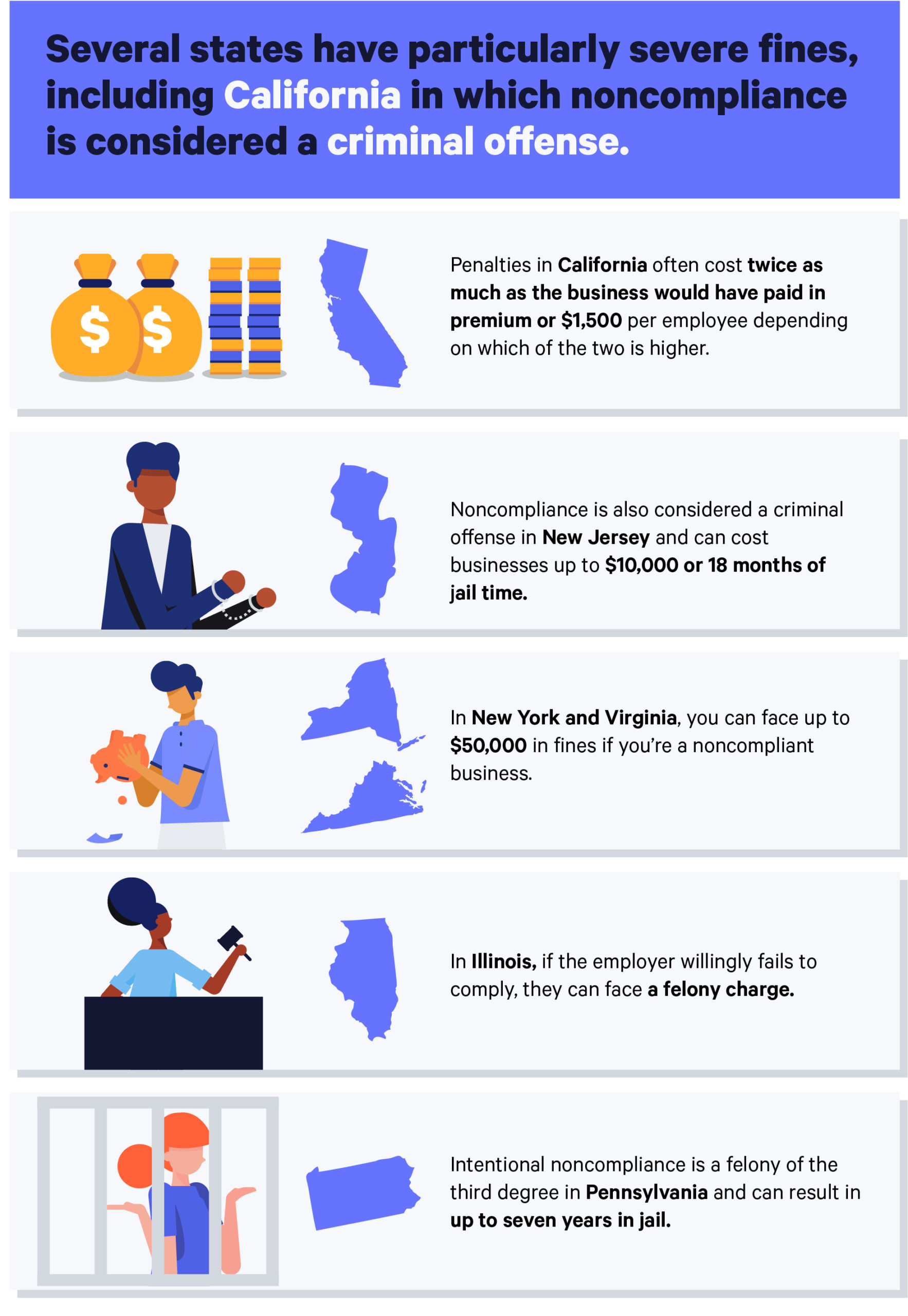
If an employer is legally required to carry insurance but fails to do so, they face severe penalties. These can include heavy fines from the state, stop-work orders that shut down the business, and the loss of "exclusive remedy" protection, meaning an injured worker can sue the employer directly in civil court.
Does workers' compensation cover remote workers?
Yes, in all 50 states, if a remote worker is injured while performing duties in the "course and scope" of their employment, they are eligible for benefits. The challenge in these cases is often proving that the injury was work-related and not a personal household accident.
Are federal employees covered by state workers' compensation statutes?
No. Federal employees, postal workers, and certain specialized industries (like longshoremen or railroad workers) are covered by federal statutes such as the Federal Employees' Compensation Act (FECA) or the Longshore and Harbor Workers' Compensation Act (LHWCA), rather than individual state laws.