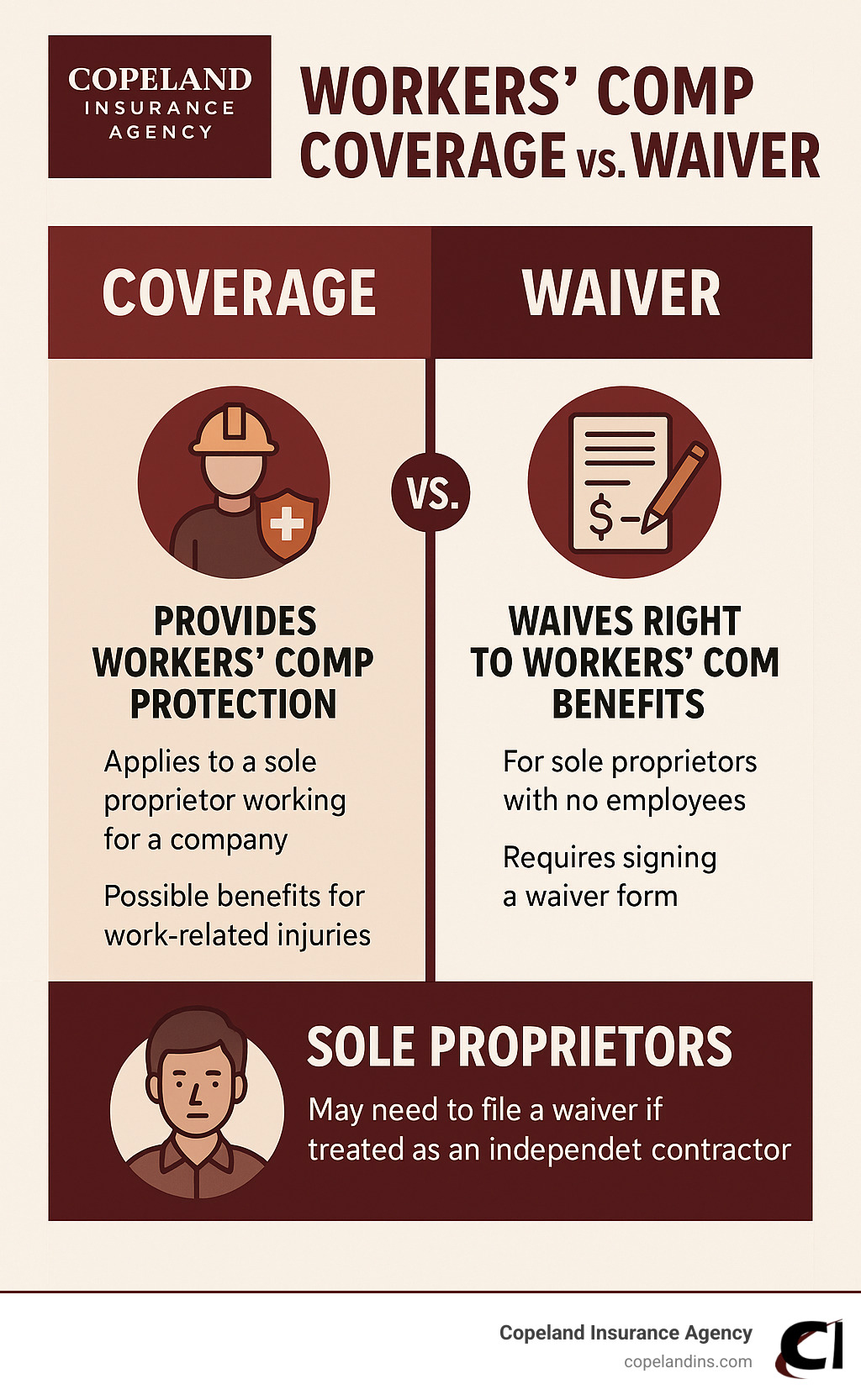
In Kansas, a sole proprietor is not legally required to carry workers' compensation insurance for themselves, as they are not considered employees under the Kansas Workers Compensation Act. To formally document this status for general contractors or clients, sole proprietors often use an affidavit of exempt status or file specific forms with the Kansas Department of Labor (KDOL) to clarify their exclusion from coverage.
The landscape of business insurance in 2026 continues to place significant emphasis on liability management. For a sole proprietor in Kansas, navigating the intersection of state law, insurance carrier requirements, and contractual obligations is essential for securing work, particularly in the construction and logistics industries. This document, often referred to as a "waiver," serves as a critical bridge between a business owner’s right to remain uninsured and a general contractor’s need to avoid being charged for that owner’s potential injury risks.
The Legal Framework: Kansas Workers Compensation Act in 2026
To understand the purpose of a waiver or affidavit, one must first understand the underlying statutes. Under K.S.A. 44-505, the Kansas Workers Compensation Act applies to all public and private entities, but it provides specific exemptions. Generally, any employer with a total gross annual payroll of $20,000 or less is exempt from the Act. However, even if a business exceeds this payroll threshold, the owners themselves (sole proprietors, partners, or certain LLC members) are not automatically covered.
In Kansas, a sole proprietor is viewed as the "employer" and not the "employee." Therefore, by default, the sole proprietor is excluded from the protections—and the costs—of workers' compensation. While this saves on premium costs, it creates a "gap" when that sole proprietor works as a subcontractor for a larger entity. If the sole proprietor is injured on a job site, the general contractor’s insurance carrier might be held liable for those medical costs and lost wages unless there is clear, documented proof of the proprietor’s exempt status.
The Role of the General Contractor and the "Audit Trap"
General contractors (GCs) are frequently the primary drivers behind the request for a workers' compensation waiver or affidavit. When a GC’s insurance company performs its annual premium audit, the auditor looks at all payments made to subcontractors. If a subcontractor (the sole proprietor) cannot produce a certificate of insurance, the auditor assumes the GC was "at risk" for that subcontractor's injuries.
Consequently, the auditor adds the subcontractor’s total labor costs to the GC’s payroll, resulting in a massive, unexpected premium bill for the GC. To prevent this, GCs require sole proprietors to provide a formal affidavit stating that they are exempt from Kansas workers' compensation requirements and that they waive any claim against the GC’s policy.
The Difference Between Election and Waiver
There is often confusion between "electing" coverage and "waiving" it. In Kansas, because you are excluded by default, you do not technically "waive" coverage in the same way an employee might. Instead, you are providing a verification of non-coverage.
Form WC-107: Election of Coverage
If a sole proprietor wants to be covered by workers' compensation—perhaps because their private health insurance excludes work-related injuries—they must file Form WC-107 (Election of Coverage) with the Kansas Department of Labor. This form transitions the proprietor from "exempt" to "covered," allowing them to purchase a policy and receive benefits if injured.
The Affidavit of Exempt Status
Conversely, the "waiver" or "affidavit" is a document used to prove that the proprietor has not filed a WC-107 and does not intend to be covered. In 2026, many insurance carriers provide their own proprietary affidavit forms, but the core elements remain the same: a sworn statement that the individual operates as a sole proprietor, has no employees, and is not required by Kansas law to maintain workers' compensation insurance.
Key Requirements for a Valid Kansas Sole Proprietor Affidavit
For an affidavit to be legally robust and acceptable to an insurance auditor in 2026, it must contain specific information that establishes the legitimacy of the sole proprietorship. Simply stating "I don't have insurance" is rarely sufficient.
- Legal Identity: The affidavit must include the legal name of the individual and any "Doing Business As" (DBA) name.
- Federal Employer Identification Number (FEIN): While some sole proprietors use their Social Security Number, having an FEIN adds a layer of professional legitimacy to the affidavit.
- Nature of the Relationship: The document must explicitly state that the individual is an independent contractor and not an employee of the hiring entity.
- Acknowledgement of Exclusion: The proprietor must acknowledge that they are excluded from the Kansas Workers Compensation Act under K.S.A. 44-505 and that they are responsible for their own medical expenses and disability income in the event of an injury.
- Notarization: To prevent fraud, almost all GCs and insurance carriers require the affidavit to be signed in the presence of a Notary Public. This confirms the identity of the person signing the document.
Comparison of Coverage Status for Kansas Business Owners
The following table outlines the status of different business entities under Kansas law as of 2026 regarding workers' compensation requirements.
| Entity Type | Default Coverage Status | Election Required? | Common Documentation Needed |
|---|---|---|---|
| Sole Proprietor | Excluded | Yes (via WC-107) | Affidavit of Exempt Status |
| Partnership | Excluded | Yes (via WC-107) | Partnership Agreement + Affidavit |
| LLC (Member-Managed) | Excluded | Yes (via WC-107) | Articles of Org + Affidavit |
| Corporation (Officers) | Included | No (Included by default) | Certificate of Insurance |
| Standard Employee | Included | N/A (Mandatory) | Certificate of Insurance |
The "Right to Control" Test in Kansas
A critical aspect of using an affidavit is ensuring that the sole proprietor actually qualifies as an independent contractor. If a Kansas court or the KDOL determines that the hiring entity (the GC) exercises too much control over the sole proprietor, the affidavit may be disregarded, and the proprietor may be deemed a "de facto employee."
In 2026, Kansas continues to apply the Right to Control Test to determine employment status. Factors include:
- Method of Payment: Are you paid by the job (contractor) or by the hour (employee)?
- Equipment and Tools: Do you provide your own tools, or does the GC provide them?
- Schedule: Do you set your own hours, or are they dictated by the hiring entity?
- Service to Others: Do you perform work for multiple clients, or is the GC your only source of income?
If you sign an affidavit of waiver but the GC treats you like an employee, the GC remains legally vulnerable to workers' compensation claims despite the signed document.
Step-by-Step Guide to Completing the Waiver Process
If you are a sole proprietor in Kansas and a client has requested a workers' compensation waiver, follow these steps to ensure compliance.
Step 1: Verify Your Exemption Eligibility
Ensure your business meets the Kansas exemption criteria. If you have any employees (including part-time or seasonal workers) and your annual payroll exceeds $20,000, you must carry workers' compensation insurance. In this scenario, you cannot use a sole proprietor waiver for yourself while leaving your employees uncovered.
Step 2: Obtain the Correct Form
Contact the hiring entity or their insurance broker. Most GCs prefer their specific "Affidavit of Independent Contractor Status" or "Workers Compensation Waiver" form. If they do not provide one, you can draft an affidavit that cites the relevant Kansas statutes.
Step 3: Fill Out the Affidavit Accurately
Complete all sections. Be precise about your business structure. If you are a single-member LLC, ensure you specify that you are the sole member and that the LLC has no other employees.
Step 4: Execute Before a Notary
Do not sign the document until you are in front of a Notary Public. You will need a valid government-issued ID. Once notarized, the document carries the legal weight necessary for insurance audits.
Step 5: Provide a Copy and Retain the Original
Give the notarized copy to the general contractor. Keep the original in your own business records. It is also wise to provide a copy of your Kansas Business Filing (if applicable) to prove your entity is in good standing.
Risks and Disadvantages of Waiving Coverage
While an affidavit of waiver simplifies the administrative burden and reduces costs, it is not without significant risk. Sole proprietors should weigh these factors carefully before deciding to remain uncovered.
- Medical Liability: If you are injured on a job site, your personal health insurance may have a "work-related injury" exclusion. If you have waived workers' comp, you could be left with 100% of the medical bills.
- Lost Wages: Workers' compensation provides disability income. Without it, an injury that prevents you from working could lead to a total loss of household income.
- Legal Costs: While the waiver is intended to protect the GC, it does not prevent you from attempting to sue the GC for negligence if an injury occurs. However, such lawsuits are often more difficult and expensive to win than a standard workers' compensation claim.
- Contractual Limitations: Some high-level projects or government contracts in Kansas may require all participants to have workers' compensation insurance, regardless of their sole proprietor status. In these cases, a waiver will not suffice.
The Role of the Kansas Department of Labor (KDOL)
The Kansas Department of Labor, Division of Workers Compensation, is the governing body for these regulations. While the KDOL does not typically provide a "blanket waiver" form for sole proprietors (as the exemption is automatic by law), they provide the necessary forms for those who wish to elect coverage.
In 2026, the KDOL website remains the primary source for verifying whether a business has opted into the system. General contractors often use the KDOL’s online verification tool to see if a subcontractor has a policy on file or has filed a WC-107. If no record is found, the affidavit becomes the primary evidence of the proprietor’s status.
Frequently Asked Questions
Does a Kansas sole proprietor waiver expire?
Generally, yes. Most insurance carriers and general contractors require a new affidavit for every new project or at the beginning of every new policy year. This ensures that the proprietor’s status (e.g., having no employees) hasn't changed.
Can I use an affidavit if I have one part-time employee?
No. If you have even one employee and your payroll exceeds the $20,000 threshold, you are required to have a workers' compensation policy. The waiver is strictly for individuals who work alone and are not classified as employees.
Is an LLC member treated the same as a sole proprietor in Kansas?
For the purposes of workers' compensation, single-member LLCs and multi-member LLCs are treated similarly to sole proprietors and partners. Members are excluded by default but can elect coverage. An affidavit is typically required to prove this status to GCs.
What happens if I sign the waiver but get injured due to the GC’s negligence?
A workers' compensation waiver generally applies to the "no-fault" workers' comp system. It does not necessarily waive your right to sue for personal injury if the GC was truly negligent (e.g., faulty scaffolding). However, legal advice from a qualified Kansas attorney is essential in these cases.
Does Kansas require a specific state-issued waiver form?
Kansas does not issue an official "waiver" form because the law already excludes sole proprietors. The "affidavit" is a common-law document used to provide proof of that legal exclusion to third parties like insurance companies.
Practical Recommendations
For sole proprietors in Kansas, the best course of action is to maintain a "compliance folder" that includes a current, notarized Affidavit of Exempt Status, your FEIN confirmation from the IRS, and your Kansas business registration. When a general contractor requests a waiver, you can provide these documents immediately to prevent delays in payment or contract approval.
Furthermore, consult with an insurance agent about a "Minimum Premium" workers' compensation policy (often called a "ghost policy"). In some cases, having a policy that covers only you (even if you intend to waive most claims) is the only way to satisfy certain high-value contracts in the Kansas construction industry.