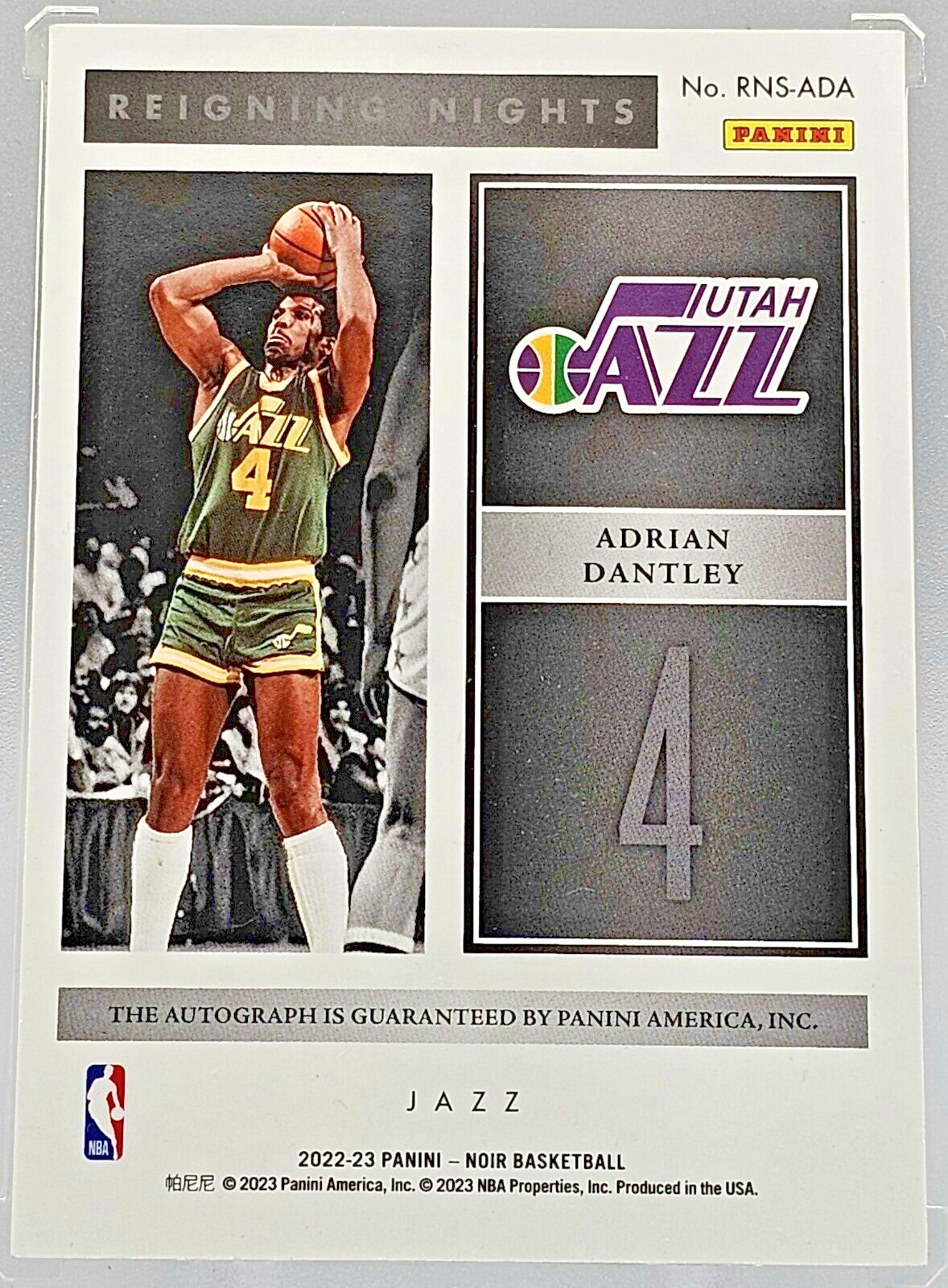
Adrian Dantley’s impact on modern basketball is defined by his pioneering approach to scoring efficiency, the art of drawing fouls, and the use of the low post by non-traditional players. By mastering these elements, "The Teacher" provided an early prototype for the high-usage, high-efficiency superstars that dominate the NBA in 2026.
The Architect of Efficient Volume Scoring
Long before the "efficiency revolution" of the late 2010s and early 2020s, Adrian Dantley was putting up numbers that seemed impossible for a 6'5" small forward. In the current 2026 landscape, where True Shooting percentage (TS%) is a primary metric for evaluating offensive value, Dantley’s career remains a gold standard. During his peak years with the Utah Jazz, Dantley averaged over 30 points per game while shooting better than 55% from the field—a feat that remains nearly unmatched by perimeter players today.
Dantley’s impact on the modern game stems from his rejection of low-percentage shots. While many of his 1980s contemporaries favored mid-range jumpers or flashy transitional play, Dantley focused on high-percentage looks near the rim or at the free-throw line. This "analytical" approach, developed decades before it became league-wide dogma, proved that a player could carry a massive offensive load without compromising the team's overall shooting efficiency.
Modern stars look at Dantley’s shot charts as a blueprint. He rarely settled. If he couldn't get to his preferred spot in the low block or the short corner, he would use his elite footwork to create a lane or force a whistle. This discipline is now taught in every NBA developmental program: the value of a shot is determined by its expected point value, and Dantley was a master at maximizing that math.
The Art of Drawing Fouls: The Original "Free Throw Merchant"
In today's NBA, players like James Harden, Joel Embiid, and Shai Gilgeous-Alexander are often criticized or praised for their ability to generate contact and reach the charity stripe. However, Adrian Dantley was the original master of this craft. He led the league in free throws made and attempted multiple times, often averaging over 10 free throw attempts per game.
Dantley’s impact on modern basketball is most visible in how modern wings use the pump fake and body positioning to "bait" defenders. Dantley didn't just wait for contact; he engineered it. He used a low center of gravity and an incredibly disciplined shoulder-dip to get defenders off balance. Once a defender was in the air, Dantley would initiate contact, ensuring a whistle while still having the strength to finish the play for an "and-one."
The Mechanics of the Dantley Pump Fake
The "Dantley Fake" was not just a head movement; it was a total-body deception. He would hold the ball near his chin, crouch low to suggest a drive, and then rise just enough to lift the defender’s heels. In 2026, this technique is a staple of "foul hunting" or "drawing contact," but Dantley performed it with a level of surgical precision that few have matched. By turning the free-throw line into a primary scoring weapon, he showed that physical strength and basketball IQ could outweigh raw vertical athleticism.
Redefining the "Tweener" and Post-Up Geometry
Before the era of "positionless basketball," players who didn't fit a specific height-to-position ratio were labeled "tweeners" and often struggled to find a home in the league. At 6'5", Dantley was technically a small forward, but he played with the back-to-the-basket density of a center.
Dantley’s impact on modern basketball is seen in how teams now utilize "small-ball" fours or "big" guards in the post. He proved that height is less important than leverage and footwork. He utilized the "short corner" and the "mid-post" to dismantle larger defenders who were too slow for his pivots, and smaller defenders who weren't strong enough to hold their ground.
Creating Mismatches
Modern offensive systems are built on hunting mismatches. When a team switches a smaller guard onto a physical wing, that wing is expected to take them to the block. Dantley was the first player to turn this into a systematic slaughter. He understood the geometry of the court perfectly, knowing exactly where to catch the ball to prevent double teams or how to pass out of them when they arrived. His influence is felt in the post-play of modern stars like Luka Dončić, who use size and pace rather than explosive jumping ability to dominate the paint.
Statistical Comparison: Dantley vs. Modern Efficiency Standards
To understand Dantley's impact, one must look at how his numbers translate to the modern era. The table below compares Dantley’s peak efficiency with modern-day standards for elite scoring wings (based on historical and projected 2026 performance metrics).
| Metric | Adrian Dantley (Peak 1980-1984) | Modern Elite Wing (2024-2026 Avg) | Impact/Significance |
|---|---|---|---|
| Points Per Game | 30.0 - 30.7 | 27.0 - 32.0 | Proven high-volume capability. |
| Field Goal % | 55.9% - 58.0% | 48.0% - 52.0% | Dantley’s efficiency remains superior for a non-center. |
| FT Attempts/G | 10.3 - 12.0 | 8.0 - 10.5 | Dantley set the ceiling for foul generation. |
| True Shooting % | .620 - .652 | .610 - .640 | Dantley was decades ahead of the league average. |
| Usage Rate | 26% - 30% | 30% - 35% | Dantley achieved his numbers with lower usage. |
Data sourced from historical NBA archives and 2026 league analytics profiles.
The "Ball Stopper" Critique and the Usage Rate Evolution
During his career, particularly during his time with the Detroit Pistons and the Utah Jazz, Dantley was often criticized for being a "ball stopper." Critics argued that his methodical post-ups slowed the rhythm of the offense. However, in the context of modern basketball in 2026, this "ball stopping" is now recognized as "high-usage isolation," a legitimate and often necessary strategy in late-game situations.
Dantley’s impact on modern basketball includes the realization that having a "hub" who can guaranteed a high-quality look—even if it takes 10 seconds of back-to-the-basket work—is invaluable. While the "Bad Boys" Pistons eventually traded him for Mark Aguirre to find more "flow," Dantley’s ability to stabilize an offense under pressure is a trait that every modern playoff team seeks in a "closer."
The evolution of the "Usage Rate" metric has retroactively validated Dantley’s style. In the 1980s, his style was an anomaly; today, it is a calculated tactical choice. He showed that an isolation-heavy player could still be a "team" player if their efficiency remained high enough to offset the lack of ball movement.
Professionalism and "The Teacher" Persona
Adrian Dantley was nicknamed "The Teacher" for a reason. His preparation was meticulous. In an era where scouting was less sophisticated than the AI-driven analytics of 2026, Dantley kept detailed mental (and sometimes physical) notes on every defender in the league. He knew which way they leaned, which hand they reached with, and how many fouls they typically picked up in the first half.
This level of professional preparation has become the standard for modern NBA players. The "Dantley approach" to the game—treating every possession as a chess match rather than a physical brawl—is the cornerstone of the longevity we see in modern athletes. His impact is seen in the way players now study film to exploit specific defensive tendencies, a practice Dantley mastered through pure observation and repetition.
Legacy in the Analytics Era
As we look at the game in 2026, Adrian Dantley’s Hall of Fame career (inducted in 2008) serves as a bridge between the physical era of the 70s and 80s and the data-driven era of today. He was a player who "won the numbers" before the numbers were being tracked.
His impact is perhaps most profoundly felt in the front offices of NBA teams. When scouts look for the next great scoring wing, they aren't just looking for 40-inch verticals; they are looking for "Dantley-esque" traits:
- High FTM/FGA (Free Throws Made per Field Goal Attempt).
- Elite footwork in the "dunk-in" spot.
- The ability to shoot over 50% from the field as a primary option.
- Mental toughness to play through physical defenses.
FAQ: Adrian Dantley's Modern Relevance
How did Adrian Dantley score so much without shooting three-pointers?
Dantley played in an era where the three-point line was largely ignored. He maximized his scoring by living in the paint and at the free-throw line. His scoring volume came from his unprecedented efficiency; by shooting nearly 60% from the floor and taking 10+ free throws a game, he could easily reach 30 points on fewer than 20 shots. This "interior dominance" by a wing is a lost art that modern teams are trying to rediscover to counter perimeter-heavy defenses.
Was Adrian Dantley actually a "ball stopper"?
By 1980s standards, yes. He required the ball to be fed to him in the post, where he would work his defender for several seconds. However, by 2026 standards, his "hold time" was not significantly different from modern stars like James Harden or Luka Dončić. The difference is that modern systems surround such players with four shooters, whereas Dantley often operated in a crowded paint.
Why is Adrian Dantley’s efficiency so highly regarded by modern analysts?
Analysts value Dantley because he maintained a True Shooting percentage (TS%) that was often 10-15 points above the league average. In the early 80s, the league average TS% was around .530; Dantley was consistently at .620 or higher. This "relative efficiency" is a key indicator of a player's true offensive impact and places him among the greatest scorers in basketball history.
Which modern NBA player most resembles Adrian Dantley?
While no player is a perfect match, James Harden (in his prime) shares Dantley’s foul-drawing prowess, and players like Jimmy Butler or Kawhi Leonard share his methodical, strength-based approach to mid-post scoring. In terms of footwork and "boring" but effective scoring, Dantley is the spiritual predecessor to the "old man game" style that many wings adopt as they age.
How did Dantley’s height affect his impact on the game?
Dantley proved that "functional strength" and "standing reach" are often more important than listed height. Despite being 6'5", he had broad shoulders and a long wingspan, allowing him to play much bigger. This helped pave the way for the "small-ball" era, demonstrating that a smaller player with the right physical tools and technique could dominate the interior.
Practical Takeaway for Students of the Game
For players and coaches in 2026, studying Adrian Dantley is a lesson in economic scoring. To replicate his impact, focus on the "Three Pillars of the Teacher":
- Leverage over Lift: Use your legs and hips to move defenders rather than trying to jump over them.
- The Whistle as a Weapon: Master the pump fake not just to get a shot off, but to force the defender into a mistake.
- Shot Selection Discipline: Treat every missed shot as a lost opportunity. Prioritize the rim and the line above all else.
Adrian Dantley may have played in a different era, but his mathematical approach to the game makes him one of the most "modern" players to ever step on the court. His legacy is found in every efficient 30-point performance and every strategically drawn foul in the league today.