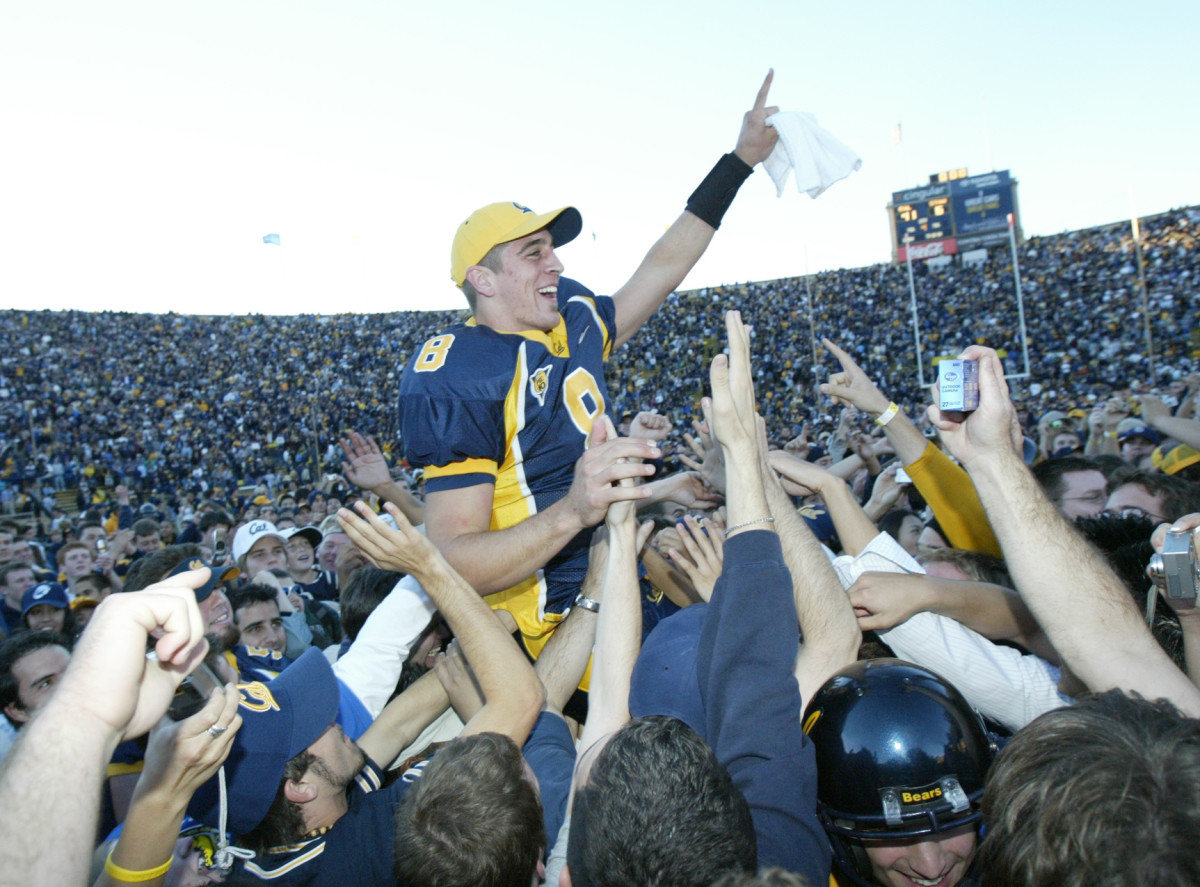
The 2004 California Golden Bears football team featured two future Pro Football Hall of Fame talents on the same offensive unit: quarterback Aaron Rodgers and running back Marshawn Lynch. Under head coach Jeff Tedford, this historic squad achieved a 10-2 record, finished with a top-down national ranking, and laid the groundwork for modern offensive dominance in the Pac-10.
The 2004 California Golden Bears: Program Context and Coaching Landscape
The convergence of Aaron Rodgers and Marshawn Lynch in Berkeley during the 2004 college football season represents one of the most talent-dense rosters in modern collegiate history. When head coach Jeff Tedford took over the California Golden Bears program in 2002, the team was struggling through years of mediocrity. Tedford, renowned for his ability to develop quarterbacks—having previously tutored players like Trent Dilfer, Akili Smith, and Joey Harrington at Oregon and Fresno State—quickly transformed Cal into an offensive powerhouse.
By 2004, the program had built immense momentum following an 8-5 campaign in 2003. The offensive scheme implemented by Tedford and offensive coordinator Jim Michalczyks relied on West Coast principles blended with sophisticated pre-snap motion, precise timing routes, and an aggressive downfield passing game that heavily protected the quarterback while maximizing yards after catch. Into this finely tuned tactical environment stepped two transcendent athletes who would eventually redefine their respective NFL positions: Aaron Rodgers orchestrating the offense from the pocket and a young, dynamic Marshawn Lynch punishing defenders out of the backfield.
This era at Cal was characterized by a cultural shift in Berkeley. For decades, the Golden Bears lived in the shadow of conference heavyweights like USC and UCLA. The 2004 team altered that dynamic, earning national respect, climbing as high as fourth in the Associated Press poll during the autumn, and playing in a high-profile Holiday Bowl against Texas Tech. The team's success was not a fluke; it was engineered by an elite coaching staff that successfully merged two contrasting, generational skill sets onto a single collegiate depth chart.
Aaron Rodgers in 2004: Precision Passing and Record-Setting Efficiency
Aaron Rodgers arrived at Cal in 2002 after a stint at Butte Community College, quickly winning the starting job early in his sophomore year. By the time the 2004 season commenced, Rodgers was a redshirt junior and a polished, highly cerebral signal-caller. His junior campaign remains one of the most statistically efficient seasons in Pac-10 (now Pac-12) history.
During the 2004 season, Rodgers completed 66.1 percent of his passes, throwing for 2,566 yards with 24 touchdowns against just 8 interceptions. His most famous performance that year—and perhaps of his collegiate career—came on September 18, 2004, against the top-ranked USC Trojans led by Matt Leinart and Reggie Bush. In that game, Rodgers set an NCAA record by completing 23 consecutive passes, finishing the night 29-of-34 for 267 yards. Although Cal narrowly lost 23-17 in a game remembered for a controversial clock management sequence and a late-game defensive stand by USC, Rodgers proved he could execute at the absolute highest tier of collegiate athletics.
| Statistic Category | Aaron Rodgers (2004 Season) |
|---|---|
| Completions / Attempts | 209 / 316 |
| Completion Percentage | 66.1% |
| Passing Yards | 2,566 Yards |
| Touchdowns / Interceptions | 24 TDs / 8 INTs |
| Rushing Touchdowns | 3 Rushing TDs |
| Pass Efficiency Rating | 151.7 |
Rodgers' mechanics during this period showcased the lightning-quick release and exceptional base balance that would later become his professional trademarks. Operating out of Tedford’s heavily structured drop-back and play-action schemes, Rodgers demonstrated an advanced grasp of coverage manipulation. He routinely punished linebackers who cheated toward the run game and exploited single-coverage matchups on the perimeter, all while anchoring an offense that averaged over 30 points per game.
Marshawn Lynch in 2004: The Rise of "Beast Mode" in Berkeley
While Aaron Rodgers provided the surgical precision of the passing game, true freshman Marshawn Lynch supplied the raw, kinetic violence of the ground attack. Hailing from Oakland, California, Lynch arrived on campus with immense local fanfare, but few expected a true freshman to carve out such a dominant role immediately in a complex Pac-10 backfield.
In 2004, Lynch shared backfield duties with junior running back J.J. Arrington, who actually led the team and the conference with 2,018 rushing yards. Despite splitting carries, Lynch managed to rush for 628 yards on just 71 carries, averaging an astonishing 8.8 yards per rush while scoring 8 touchdowns on the ground. He also added 147 receiving yards and two receiving touchdowns, proving his utility as a complete, three-down weapon out of the backfield.
| Backfield Contributor | Rushing Attempts | Rushing Yards | Yards Per Carry | Rushing Touchdowns |
|---|---|---|---|---|
| J.J. Arrington (2004) | 279 | 2,018 | 7.2 | 15 |
| Marshawn Lynch (2004) | 71 | 628 | 8.8 | 8 |
Lynch's freshman year was defined by explosive acceleration, extraordinary balance through contact, and an unmatched competitive motor. Even before he coined the moniker "Beast Mode" in the NFL, the traits were entirely visible in Berkeley: the sudden cuts, the punishing stiff arm, and the relentless leg drive after first contact. His presence alongside Arrington gave Cal a terrifying two-headed rushing monster that forced defensive coordinators to completely abandon single-high safety looks, which in turn opened up intermediate passing windows for Aaron Rodgers.
Synergy Between the Run and Pass Game
The coexistence of Rodgers and Lynch created a defensive dilemma that few opponents in 2004 could solve. Defenses facing the Golden Bears were caught in a strategic trap: commit resources to stop J.J. Arrington and the explosive freshman Marshawn Lynch on early downs, and Aaron Rodgers would systematically dismantle the secondary with precise play-action passes. Conversely, drop back into coverage to neutralize Rodgers' arm, and Cal's offensive line—anchored by future NFL linemen—would open gaping running lanes for Lynch to gash the defense for chunk yardage.
This offensive balance propelled Cal to notable victories during the 2004 campaign, including a dominant 45-28 victory over #19 Arizona State and a 38-31 win against Washington. The playbook utilized max-protection looks that allowed Rodgers time to read deep coverage while utilizing Lynch as an emergency checkdown who could turn a short dump-off pass into a 40-yard gain. Their skill sets complemented each other psychologically as well; Rodgers brought a hyper-competitive, detail-oriented leadership style to the huddle, while Lynch brought infectious energy, toughness, and big-play exuberance that energized the sideline.
The 2004 Holiday Bowl and the BCS Controversy
The culmination of the 2004 season for Rodgers, Lynch, and the Cal Golden Bears remains one of the most debated topics in college football history regarding the Bowl Championship Series (BCS). Cal finished the regular season with a 10-1 record, with their only loss coming by six points on the road against powerhouse USC.
As selection Sunday approached, Cal believed they had secured a spot in the prestigious Rose Bowl. However, the BCS selection committee ultimately awarded the final at-large bid to the fourth-ranked University of Texas Longhorns, coached by Mack Brown and led by quarterback Vince Young. Public lobbying by Brown and members of the Texas athletic administration heavily influenced voters and computer rankings down the stretch, pushing Texas into Pasadena while leaving Cal to play in the Holiday Bowl against Texas Tech.
- 2004 PAC-10 STANDINGS & BCS RACE
- USC Trojans (12-0) -> Rose Bowl (National Title Game)
- California Bears (10-2) -> Holiday Bowl vs. Texas Tech
- Arizona State (9-3) -> Sun Bowl vs. Purdue
In the December 30, 2004, Holiday Bowl in San Diego, Cal faced an explosive Texas Tech squad led by head coach Mike Leach and quarterback Sonny Cumbie. The game turned into a wild, high-scoring shootout. Aaron Rodgers played valiantly, completing 23 of 35 passes for 306 yards and three touchdowns, while Marshawn Lynch contributed significantly on special teams and out of the backfield. However, Cal's defense struggled to contain Texas Tech's air-raid attack, resulting in a 45-31 defeat.
Despite the bitter disappointment of the bowl loss and the BCS snub, the 2004 season cemented the program's modern renaissance and showcased a roster overflowing with future Sunday talent.
Transition to the NFL: Draft Paths and Professional Legacies
Following the conclusion of the 2004 college football season, Aaron Rodgers elected to forgo his final year of collegiate eligibility and entered the 2005 NFL Draft. What followed was one of the most infamous draft-day slides in league history. Despite being projected by many analysts as the potential number-one overall pick to the San Francisco 49ers, Rodgers slid all the way to the 24th overall selection, where he was drafted by the Green Bay Packers to eventually succeed Brett Favre. Rodgers went on to capture multiple NFL Most Valuable Player awards and a Super Bowl XLV title, carving out a first-ballot Hall of Fame career.
Marshawn Lynch returned to Cal for two more standout seasons before entering the 2007 NFL Draft, where he was selected 12th overall by the Buffalo Bills. Lynch later found his iconic home with the Seattle Seahawks, where he became a five-time Pro Bowler, a Super Bowl XLVIII champion, and one of the most beloved and culturally influential running backs in football history.
Looking back, the 2004 California Golden Bears team stands as a unique historical anomaly: a single college roster that simultaneously featured two players who would not only reach the absolute pinnacle of professional football but would also leave an indelible, defining mark on the culture and mechanics of the modern NFL game.
Frequently Asked Questions
Did Aaron Rodgers and Marshawn Lynch play together at Cal?
Yes, both Aaron Rodgers and Marshawn Lynch played on the 2004 California Golden Bears football team. Rodgers was the starting junior quarterback, while Lynch was a dynamic true freshman running back who shared backfield duties with star rusher J.J. Arrington.
What was Cal's record during the 2004 college football season?
The California Golden Bears finished the 2004 regular season with a 10-1 record, with their sole loss coming against the undefeated national champion USC Trojans. They finished the year 10-2 overall after losing to Texas Tech in the Holiday Bowl.
Why didn't Cal play in the Rose Bowl in 2004?
Despite finishing with a 10-1 record and a top-five ranking, Cal was controversially left out of the Rose Bowl in favor of the University of Texas. Texas athletic officials and coaches successfully lobbied voters during the final weeks of the season, securing the BCS at-large bid for the Longhorns.
How did Marshawn Lynch perform as a freshman in 2004?
As a true freshman, Marshawn Lynch rushed for 628 yards on 71 carries—an incredible 8.8 yards per carry average—and scored 8 rushing touchdowns while serving as the primary backup and change-of-pace runner behind 2,000-yard rusher J.J. Arrington.
Where was Aaron Rodgers drafted after leaving Cal?
Aaron Rodgers was selected in the first round of the 2005 NFL Draft with the 24th overall pick by the Green Bay Packers, where he sat behind Brett Favre for three seasons before taking over as the starting quarterback in 2008.