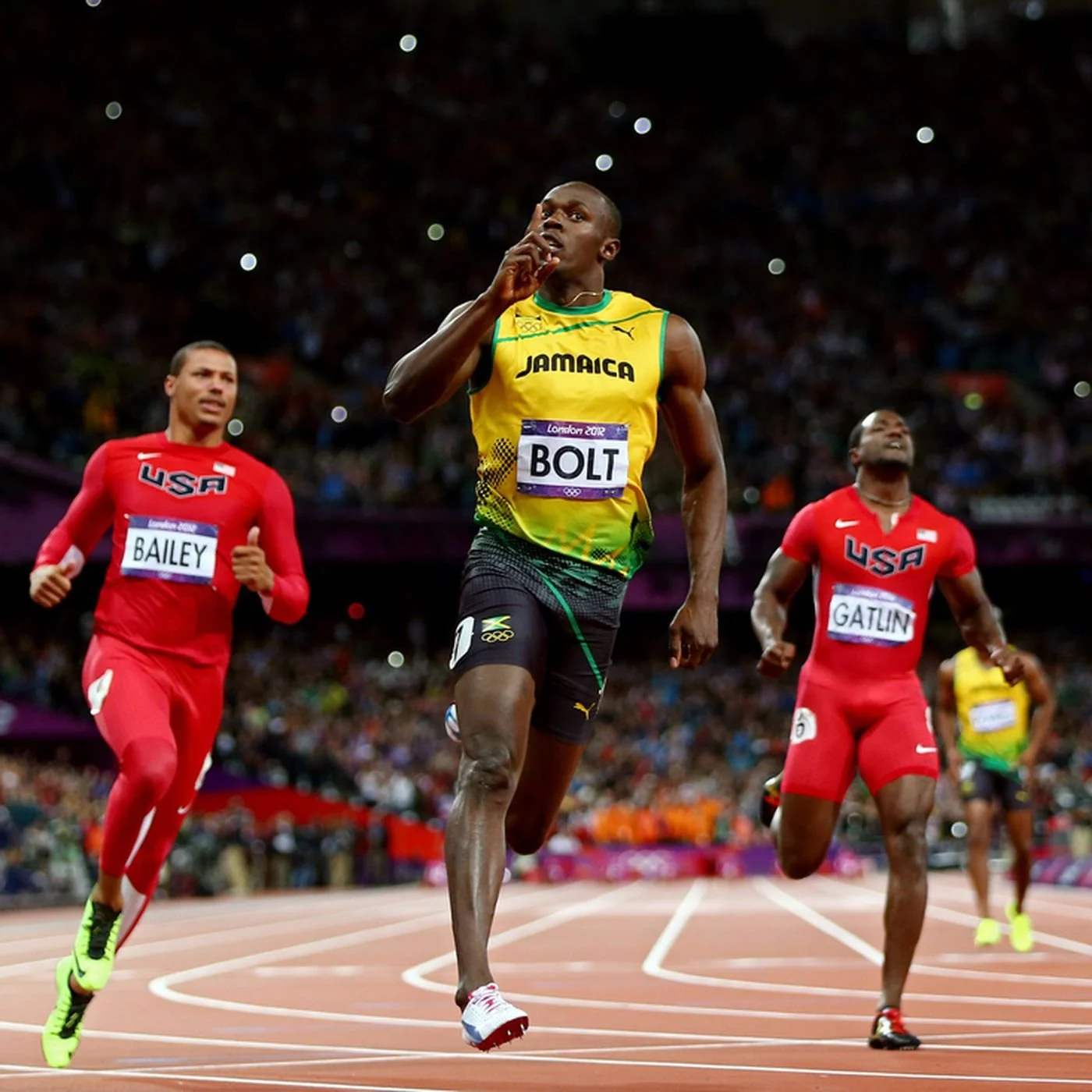
On August 16, 2009, Usain Bolt set the definitive world record of 9.58 seconds in the 100-meter dash at the World Athletics Championships in Berlin. This monumental performance surpassed his own previous record of 9.69 seconds, representing the largest margin of improvement in the event's history since electronic timing began.
The Context of the 9.58-Second Milestone
The 100-meter dash is the blue-riband event of track and field, a pure test of human explosive power, speed, and efficiency. By the time the summer of 2009 arrived, the world was still reeling from Usain Bolt’s performance at the 2008 Beijing Olympics. There, he had clocked 9.69 seconds while famously slowing down to celebrate before crossing the finish line. Experts and fans alike spent the intervening year wondering exactly how fast the Jamaican sprinter could go if he ran "through the tape."
The stage for the record was the Olympiastadion in Berlin during the 12th IAAF (now World Athletics) World Championships. Unlike the humid conditions of Beijing, Berlin offered a crisp evening with a track surface renowned for its energy return. The competition was also fiercer; American sprinter Tyson Gay was in the form of his life, having run a wind-aided 9.75 earlier that season. This pressure was essential, as it forced Bolt to maintain his maximum velocity for a longer duration than he had in Beijing.
When the gun fired for the final, Bolt’s reaction time was 0.146 seconds—not the fastest in the field, but more than sufficient for a man of his stature. By the 30-meter mark, his massive stride had already propelled him ahead of the field. He covered the distance between 60 and 80 meters in a staggering 1.63 seconds. As he crossed the line, the clock stopped at 9.58, a number that fundamentally changed our understanding of human potential.
Technical Breakdown: The Anatomy of a World Record
To understand how 9.58 seconds was possible, one must look at the specific 10-meter splits. Sprinting is not a constant-velocity activity; it is a phase-based discipline consisting of the start, acceleration, maximum velocity, and speed maintenance.
Split Times and Velocity
The 9.58-second run is often cited in sports science journals because of the sheer consistency of Bolt’s acceleration. Most sprinters reach their top speed around 50 or 60 meters and then begin a gradual deceleration. Bolt, however, managed to hold his peak velocity for a significantly longer window.
| Distance Interval (m) | Split Time (s) | Cumulative Time (s) | Velocity (m/s) |
|---|---|---|---|
| 0–10 | 1.89 | 1.89 | 5.29 |
| 10–20 | 0.99 | 2.88 | 10.10 |
| 20–30 | 0.90 | 3.78 | 11.11 |
| 30–40 | 0.86 | 4.64 | 11.63 |
| 40–50 | 0.83 | 5.47 | 12.05 |
| 50–60 | 0.82 | 6.29 | 12.20 |
| 60–70 | 0.81 | 7.10 | 12.35 |
| 70–80 | 0.82 | 7.92 | 12.20 |
| 80–90 | 0.83 | 8.75 | 12.05 |
| 90–100 | 0.83 | 9.58 | 12.05 |
The data reveals that Bolt hit his peak speed between 60 and 70 meters, reaching approximately 44.72 km/h (27.78 mph). What makes this record particularly resilient is the final 20 meters. Even as fatigue began to set in, Bolt only decelerated by 0.02 seconds in his split times, showing an unprecedented level of speed endurance.
Biomechanical Advantages: The Bolt Profile
Usain Bolt’s physical architecture was traditionally considered "wrong" for a 100-meter sprinter. At 6'5" (1.95m), he was significantly taller than the historical average for elite sprinters. Tall athletes often struggle with the "drive phase"—the first 30 meters where the body must stay low to overcome inertia.
Stride Length vs. Stride Frequency
The formula for speed is simple: Stride Length × Stride Frequency. Most elite sprinters take between 44 and 46 steps to cover 100 meters. Because of his height and the leverage provided by his long limbs, Bolt completed the 9.58-second race in just 41 strides. This meant that while his rivals were moving their legs faster (higher frequency), Bolt was covering more ground with every contact. On average, his stride length was 2.44 meters.
Fast-Twitch Muscle Composition
Beyond the external levers, Bolt’s success was rooted in his neuromuscular system. High-level sprinting requires a high percentage of Type IIx muscle fibers, which provide the explosive force necessary for rapid ground contact. Bolt’s ability to generate immense ground reaction forces—estimated at nearly five times his body weight—allowed him to spend less time on the ground (contact time) and more time in the air (flight phase), which is where speed is actually maintained.
Environmental and External Factors
While Bolt’s physiology was the primary driver, several external factors aligned in Berlin to facilitate the 9.58-second record.
Wind Assistance: The wind gauge recorded a tailwind of +0.9 m/s. Under the rules of World Athletics, any wind up to +2.0 m/s is considered legal for record purposes. While +0.9 m/s is helpful, it is well below the limit. Had the wind been a full +2.0 m/s, some statistical models suggest Bolt could have run as fast as 9.53 or 9.54 seconds.
Track Technology: The track at the Berlin Olympiastadion featured a Regupol surface. Unlike the traditional red clay or early synthetic tracks, this blue surface was designed for maximum energy return. The "stiffness" of the track ensures that minimal energy is lost when the sprinter's foot strikes the ground, acting almost like a springboard.
Footwear: In 2009, Bolt wore Puma Street Yaam spikes. While these did not have the carbon-plated technology prevalent in 2026, they were designed specifically for his gait, providing a rigid sole plate that allowed for optimal power transfer. The evolution of "super spikes" in recent years has made Bolt’s 2009 record seem even more impressive, as he achieved it without the advanced foam and plate technology used by modern athletes.
The Evolution of the 100-Meter World Record
To appreciate the magnitude of 9.58, one must look at the history of the record. For decades, the 100-meter record was broken by hundredths of a second.
- Jim Hines (1968): 9.95 seconds. This was the first sub-10-second electronic time, set at the high altitude of Mexico City.
- Carl Lewis (1991): 9.86 seconds. This was a major jump that many thought would stand for a decade.
- Maurice Greene (1999): 9.79 seconds. Greene was the first to really push the boundaries of the late 20th century.
- Asafa Powell (2005-2008): 9.77 and then 9.74 seconds. Powell ushered in the era of Jamaican dominance.
- Usain Bolt (2008-2009): 9.72, 9.69, and finally 9.58.
Bolt’s reduction of the record from 9.74 to 9.58 in just over a year is a statistical anomaly. In most sporting disciplines, progress is incremental. Bolt’s 0.11-second improvement from Beijing to Berlin is the largest single "jump" in the history of the electronic record.
Why 9.58 Still Stands in 2026
As of 2026, the 9.58-second mark remains the gold standard of athletics. Several factors contribute to its longevity. First, the rare combination of height and fast-twitch efficiency found in Bolt is a genetic outlier. Most tall athletes are steered toward basketball or volleyball; finding a 6'5" individual with the coordination to sprint at an elite level is rare.
Second, the psychological barrier is immense. For years, the 9.70-second mark was seen as a wall. Bolt didn't just climb the wall; he demolished it. Current sprinters in the 2020s, such as Noah Lyles and Kishane Thompson, have pushed into the 9.7s and low 9.8s consistently, but the gap between 9.79 and 9.58 is vast in sprinting terms—it represents roughly two meters of distance on the track.
Furthermore, the strictness of modern anti-doping regulations and the precision of start-time sensors (which penalize anything faster than a 0.100-second reaction) ensure that every record attempt is scrutinized. Bolt’s record was set during an era of high-intensity rivalry that pushed him to his absolute limit.
The Training and Discipline Behind the Time
It is a common misconception that Usain Bolt succeeded on raw talent alone. The 9.58 record was the result of a grueling training cycle under coach Glen Mills. Mills focused on correcting Bolt’s tendency to "rock" his head and shoulders, which wasted energy.
Training for a 9.58-second run involved:
- Maximum Velocity Sessions: Running 60 to 90 meters at 95% intensity to teach the nervous system to handle extreme speeds.
- Weight Training: Focusing on "power-to-weight" ratio rather than bulk. Exercises like cleans, snatches, and heavy squats were foundational.
- Core Stability: To maintain the 2.44-meter stride length without collapsing, Bolt required an incredibly strong core to keep his pelvis stable at high velocities.
- Technical Drills: Thousands of repetitions of the "A-skip" and "B-skip" to ensure the foot landed directly under the center of mass, reducing braking forces.
Comparison of Elite 100m Times
The following table compares Bolt’s 9.58 with other historic and contemporary performances to provide a sense of scale.
| Athlete | Time (s) | Year | Location | Wind (m/s) |
|---|---|---|---|---|
| Usain Bolt | 9.58 | 2009 | Berlin, GER | +0.9 |
| Usain Bolt | 9.63 | 2012 | London, UK | +1.5 |
| Tyson Gay | 9.69 | 2009 | Shanghai, CHN | +2.0 |
| Yohan Blake | 9.69 | 2012 | Lausanne, SUI | -0.1 |
| Asafa Powell | 9.72 | 2008 | Lausanne, SUI | +0.2 |
| Justin Gatlin | 9.74 | 2015 | Doha, QAT | +0.9 |
| Noah Lyles | 9.79 | 2024 | Paris, FRA | +1.0 |
Tyson Gay’s 9.69 and Yohan Blake’s 9.69 are the closest anyone has ever come to the record. It is worth noting that Gay ran his 9.69 with the maximum legal wind (+2.0), whereas Bolt’s 9.58 had less than half that assistance.
Common Misconceptions About the 9.58 Record
Was the 9.58 wind-aided?
It was wind-assisted, but legally so. In athletics, any wind under 2.0 meters per second is valid. The +0.9 m/s wind in Berlin was modest. If the wind had been a "dead calm" (0.0 m/s), the time likely would have been around 9.62 seconds—still a world record.
Did Bolt slow down at the end?
Unlike his 2008 performance in Beijing, Bolt ran hard through the finish line in Berlin. He did glance at the clock just as he crossed, but his biomechanical data shows he did not intentionally decelerate until after the tape.
Is there a "human limit"?
Sports scientists have used various models to predict the ultimate human limit for the 100m. Some studies, such as those from the Stanford University biology department, suggest that based on muscle contraction speeds, a time of 9.48 seconds might be the absolute limit for a human being. Bolt’s 9.58 is remarkably close to what was once thought theoretically impossible.
Frequently Asked Questions
What was Usain Bolt's top speed during the 9.58-second race?
Bolt reached a top speed of 12.35 meters per second, which translates to 44.72 km/h or 27.78 mph. This peak occurred between the 60m and 80m marks.
How many steps did Bolt take in his 9.58 world record?
He took exactly 41 steps. Most elite sprinters require 44 to 46 steps to complete the same distance. His ability to cover more ground per stride was his greatest competitive advantage.
Who came in second place during the 9.58 race?
Tyson Gay of the United States finished second with a time of 9.71 seconds. At the time, this was a national record for the US and the fastest non-winning time in history, illustrating just how much Gay pushed Bolt to achieve the record.
What were the weather conditions in Berlin for the record?
The temperature was approximately 26°C (79°F) with a humidity of 39%. The wind was +0.9 m/s. These were near-ideal conditions for sprinting, as warm air is less dense, offering less resistance.
Has anyone broken the 9.58 record in practice or wind-aided runs?
No. While Justin Gatlin once ran a 9.45 for a Japanese game show, it was achieved with the help of massive industrial fans creating a tailwind of over 20 m/s, making it unofficial and non-representative of actual athletic performance.
Practical Recommendation for Athletics Enthusiasts
To truly appreciate the 9.58-second record, athletes and coaches should study the high-speed film of the Berlin final, specifically focusing on Bolt’s "transition phase" between 30 and 50 meters. This is where he moves from a crouched drive to a full upright sprint without any loss of momentum. For those looking to improve their own speed, the lesson of 9.58 is not necessarily to try and take fewer steps, but to focus on ground force production and postural integrity.
If you are interested in the official historical progression of these times, visiting the World Athletics Museum or their digital archives provides a comprehensive look at the evolution of human speed.