The selection process for the 2026 FIFA World Cup host cities spanned seven years, beginning with the joint North American bid winning host rights in June 2018. FIFA officially confirmed the 11 United States host cities in June 2022 and published the final match schedule in February 2024, leading up to the tournament running from June 11 to July 19, 2026.
The Selection Process: How the 11 US Host Cities Were Chosen
The road to selecting the host venues for the 2026 FIFA World Cup—co-hosted by the United States, Canada, and Mexico—was one of the most rigorous venue evaluation processes in international sports history. Because the 2026 edition expands the tournament field from 32 to 48 national teams, requiring 104 total matches, the infrastructure demands far exceeded those of any previous World Cup.
- [June 2018] United 2026 Bid Selected by FIFA Congress
- [2020–2021] Venue Inspections & Technical Evaluations
- [June 2022] Official 16 Host Cities Revealed (11 US)
- [Feb 2024] FIFA Match Schedule & Final Venue Assignments
- [Late 2025–Early 2026] Ticket Draws & Stadium Modifications
- [June 11 – July 19, 2026] Tournament Execution
The United Bid Foundation (2017–2018)
In April 2017, the soccer governing bodies of the United States, Canada, and Mexico formally launched the United Bid to jointly host the 2026 World Cup. The bid committee initially considered more than 40 North American metropolitan areas, evaluating factors such as existing stadium capacity, transport networks, hotel inventory, and municipal commitment.
By early 2018, the committee narrowed the proposal to a shortlist of 23 candidate host cities (including 17 in the U.S.). On June 13, 2018, during the 68th FIFA Congress in Moscow, the United Bid defeated Morocco's competing bid by a vote of 134 to 65, officially awarding the 2026 World Cup to North America.
Technical Audits and Site Visits (2020–2021)
Following the bid victory, FIFA initiated a thorough venue-selection phase. Although delays occurred due to international travel restrictions in 2020, FIFA’s site inspection team conducted multi-week operational visits throughout late 2021.
Inspectors evaluated candidate venues across primary criteria:
- Pitch Dimensions and Playing Surface: Ability to install natural grass over existing artificial turf and expand sightlines to meet FIFA’s preferred 105 x 68 meter playing surface.
- Airport and Transit Capacity: Proximity of international airports with sufficient gate throughput and direct public transport linking city centers to stadiums.
- Accommodation: Availability of high-density hotel space within a 40-mile radius of match venues and training sites.
- Commercial and Fan Infrastructure: Dedicated space for local FIFA Fan Festivals and broadcast compounds.
The Final Host City Announcement (June 16, 2022)
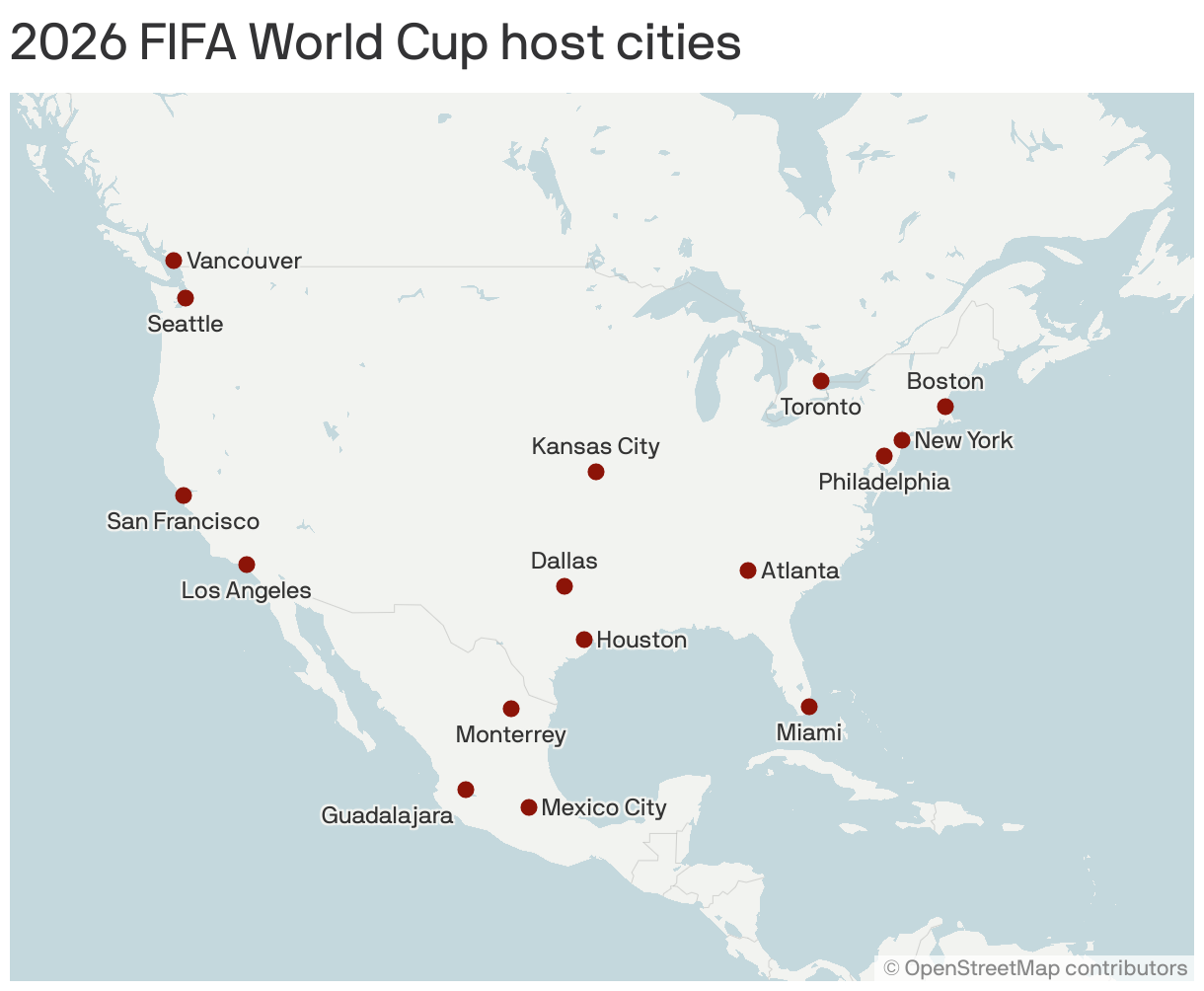
On June 16, 2022, FIFA unveiled the final selection of 16 host cities live from New York City. The announcement designated 11 venues in the United States, 3 in Mexico, and 2 in Canada. Several prominent U.S. candidate regions—including Washington D.C./Baltimore, Orlando, Nashville, and Denver—were excluded based on FIFA's regional balancing and venue design assessments.
Chronological Timeline of Major 2026 World Cup Milestones
Tracking the timeline of decisions reveals how stadium allocations evolved from broad concepts into specific match assignments.
| Date | Milestone |
|---|---|
| April 10, 2017 | Official formation of the United 2026 Joint Bid |
| June 13, 2018 | 68th FIFA Congress awards 2026 hosting rights to North America |
| March 2020 | FIFA delays host city inspection schedule |
| Sep–Nov 2021 | FIFA delegates conduct venue inspections across 22 cities |
| June 16, 2022 | FIFA announces official 16 host cities (11 U.S. venues) |
| February 4, 2024 | Official match schedule revealed; MetLife Stadium chosen for the Final |
| December 2025 | World Cup Final Draw determines team pairings and venue matchups |
| May 2026 | Venues handed over to FIFA; temporary grass pitches installed |
| June 11, 2026 | Opening match at Estadio Azteca (Mexico City) |
| June 12, 2026 | First U.S. match at SoFi Stadium (Los Angeles) |
| July 19, 2026 | World Cup Final at MetLife Stadium (New York/New Jersey) |
June 13, 2018: Host Rights Awarded
The 68th FIFA Congress in Moscow formally grants hosting rights to the United Bid. The original bid proposed hosting 60 matches in the United States, 10 in Mexico, and 10 in Canada, though FIFA later altered this match count when expanding the tournament format.
June 16, 2022: Host Cities Confirmed
FIFA President Gianni Infantino announces the 11 U.S. host venues across three geographic hubs:
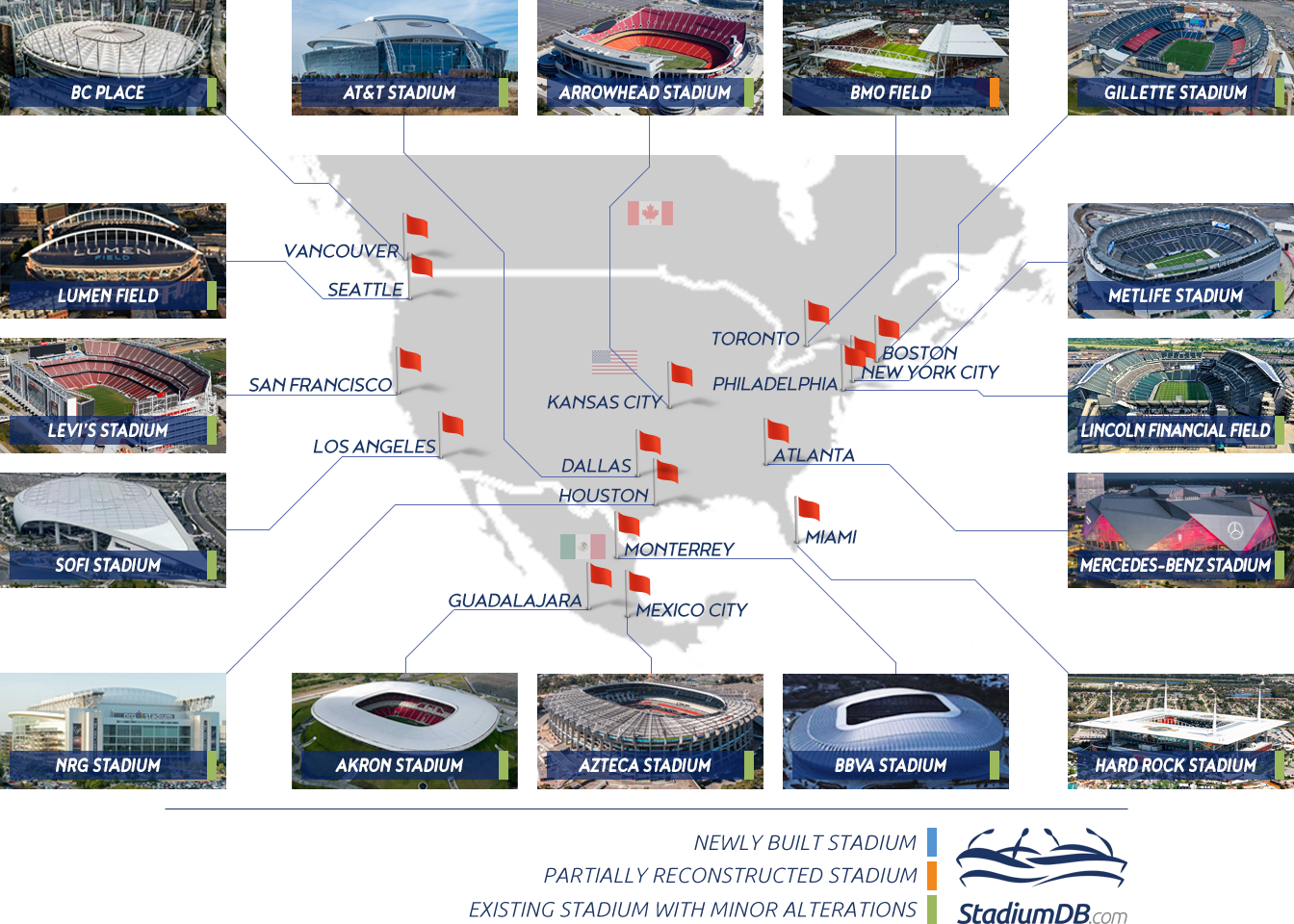
- West: Los Angeles (SoFi Stadium), San Francisco Bay Area (Levi's Stadium), Seattle (Lumen Field).
- Central: Dallas (AT&T Stadium), Houston (NRG Stadium), Kansas City (GEHA Field at Arrowhead Stadium), Atlanta (Mercedes-Benz Stadium).
- East: New York/New Jersey (MetLife Stadium), Philadelphia (Lincoln Financial Field), Boston (Gillette Stadium), Miami (Hard Rock Stadium).
February 4, 2024: Complete Match Schedule and Final Venue Announcement
FIFA releases the match schedule for all 104 fixtures. Under the expanded framework, the U.S. hosts 78 total matches, including every fixture from the quarterfinal stage onward:
- Opening U.S. Match: SoFi Stadium in Inglewood, California on June 12, 2026.
- Final Match: MetLife Stadium in East Rutherford, New Jersey awarded the Final on July 19, 2026.
- Semifinals: AT&T Stadium (Dallas) on July 14, 2026, and Mercedes-Benz Stadium (Atlanta) on July 15, 2026.
- Third-Place Match: Hard Rock Stadium (Miami) on July 18, 2026.
Detailed Profile of the 11 U.S. Host Cities and Venues
Each of the 11 American venues features unique architecture, capacity constraints, and operational adjustments necessary for international soccer compliance.
- West Region
- Seattle (Lumen Field)
- SF Bay Area (Levi's Stadium)
- Los Angeles (SoFi Stadium)
- Central Region
- Dallas (AT&T Stadium)
- Atlanta (Mercedes-Benz)
- Houston (NRG Stadium)
- Kansas City (Arrowhead Stadium)
- East Region
- New York/New Jersey (MetLife Stadium)
- Philadelphia (Lincoln Fin. Field)
- Boston (Gillette Stadium)
- Miami (Hard Rock Stadium)
1. New York / New Jersey – MetLife Stadium
- Location: East Rutherford, New Jersey
- Tournament Capacity: ~82,500
- Key Matches: 5 Group Stage matches, 1 Round of 32, 1 Round of 16, and the 2026 FIFA World Cup Final (July 19).
- Infrastructure Context: MetLife Stadium was selected for the championship match due to its high seating capacity, vast broadcast footprint, and proximity to New York City's international travel hubs. The stadium had to remove lower-tier corner seating to accommodate a standard FIFA field width.
2. Los Angeles – SoFi Stadium
- Location: Inglewood, California
- Tournament Capacity: ~70,000
- Key Matches: 5 Group Stage matches (including the U.S. Men's National Team opener on June 12), 2 Round of 32 matches, and 1 Quarterfinal.
- Infrastructure Context: Built primarily for American football, SoFi Stadium required field modifications. Owner Kroenke Sports & Entertainment conducted pitch-level renovations to widen the floor area, replacing corner seats with turf extenders to install real grass without compromising sightlines.
3. Dallas – AT&T Stadium
- Location: Arlington, Texas
- Tournament Capacity: ~92,000 (modified for World Cup)
- Key Matches: 5 Group Stage matches, 2 Round of 32 matches, 1 Round of 16 match, and 1 Semifinal (July 14).
- Infrastructure Context: AT&T Stadium hosts nine total matches—the most of any single venue in the tournament. Because the stadium features an artificial surface over a concrete floor, stadium operators engineered a specialized growing light and subsurface ventilation system to maintain natural grass indoors during Texas' summer heat.
4. Atlanta – Mercedes-Benz Stadium
- Location: Atlanta, Georgia
- Tournament Capacity: ~75,000
- Key Matches: 5 Group Stage matches, 1 Round of 32, 1 Round of 16, and 1 Semifinal (July 15).
- Infrastructure Context: Mercedes-Benz Stadium features a retractable roof and regular MLS match experience with Atlanta United. The venue transitioned from FieldTurf to a temporary natural grass system built over a raised platform to allow airflow and drainage.
5. Miami – Hard Rock Stadium
- Location: Miami Gardens, Florida
- Tournament Capacity: ~65,000
- Key Matches: 4 Group Stage matches, 1 Round of 32, 1 Quarterfinal, and the Third-Place Match (July 18).
- Infrastructure Context: Hard Rock Stadium has hosted major international friendlies, Copa América fixtures, and Super Bowls. Its existing natural grass field and open-air canopy offer pre-built advantages, requiring minimal structural adaptation relative to indoor domes.
6. Seattle – Lumen Field
- Location: Seattle, Washington
- Tournament Capacity: ~69,000
- Key Matches: 4 Group Stage matches (including USMNT's second group match on June 19), 1 Round of 32, and 1 Round of 16.
- Infrastructure Context: Known for intense crowd acoustics and hosting Seattle Sounders FC, Lumen Field removed its synthetic FieldTurf surface to install a hybrid grass pitch designed to withstand the Pacific Northwest climate.
7. San Francisco Bay Area – Levi's Stadium
- Location: Santa Clara, California
- Tournament Capacity: ~68,500
- Key Matches: 5 Group Stage matches and 1 Round of 32 match.
- Infrastructure Context: Home of the San Francisco 49ers, Levi's Stadium previously hosted Copa América Centenario matches in 2016. Its existing natural grass surface simplifies pitch preparation, though transit updates connecting Santa Clara to downtown San Francisco were implemented to handle fan flows.
8. Houston – NRG Stadium
- Location: Houston, Texas
- Tournament Capacity: ~72,000
- Key Matches: 5 Group Stage matches, 1 Round of 32, and 1 Round of 16 match.
- Infrastructure Context: NRG Stadium’s retractable roof provides climate control during high summer temperatures. The stadium transitioned from its drop-in sod tray system to an integrated grass field approved by FIFA agronomy specialists.
9. Kansas City – GEHA Field at Arrowhead Stadium
- Location: Kansas City, Missouri
- Tournament Capacity: ~73,000
- Key Matches: 4 Group Stage matches, 1 Round of 32, and 1 Quarterfinal.
- Infrastructure Context: Arrowhead Stadium is the oldest venue selected in the U.S. contingent. To comply with FIFA specifications, regional organizers invested in lower-bowl bowl modifications to widen the field dimensions, alongside upgraded hospitality and press boxes.
10. Philadelphia – Lincoln Financial Field
- Location: Philadelphia, Pennsylvania
- Tournament Capacity: ~69,000
- Key Matches: 5 Group Stage matches and 1 Round of 16 match (scheduled for July 4, coinciding with America's Semiquincentennial celebration).
- Infrastructure Context: Lincoln Financial Field has hosted numerous soccer exhibitions since opening in 2003. Its natural grass surface and open corner tunnels made pitch setup straightforward compared to indoor venues.
11. Boston – Gillette Stadium
- Location: Foxborough, Massachusetts
- Tournament Capacity: ~65,000
- Key Matches: 5 Group Stage matches, 1 Round of 32, and 1 Quarterfinal.
- Infrastructure Context: Located southwest of Boston, Gillette Stadium underwent major stadium end-zone upgrades leading into 2026. The venue replaced its synthetic turf with a temporary grass surface and added dedicated express rail transit options from downtown Boston to Foxborough station.
Regional Clustering and Match Distribution System
To reduce cross-continental travel for teams and fans, FIFA designed a regional pod framework dividing the 16 overall venues into three distinct clusters.
- Regional Pod Structure
- West Region
- Vancouver
- Seattle
- SF Bay Area
- Los Angeles
- Central Region
- Guadalajara
- Monterrey
- Mexico City
- Houston
- Dallas
- Kansas City
- Atlanta
- East Region
- Toronto
- Boston
- New York/NJ
- Philadelphia
- Miami
- West Region
Teams drawn into a specific group play their first three matches within a single geographic region. For instance, a team assigned to Group D in the West Region moves between Los Angeles, Seattle, and Vancouver rather than taking 5-hour coast-to-coast flights between group matches.
For official updates on scheduling modifications and city-by-city ticketing procedures, consult FIFA's 2026 Match Schedule Hub.
Summary of U.S. Host Venues, Capacities, and Assigned Match Rounds
The table below presents the verified operational metrics for all 11 U.S. host venues:
| Host City / Region | Stadium Name | Approximate Capacity | Turf Type (Tournament) | Total Matches | Highest Match Round Hosted |
|---|---|---|---|---|---|
| New York / New Jersey | MetLife Stadium | 82,500 | Natural Grass (Temporary) | 8 | World Cup Final |
| Los Angeles | SoFi Stadium | 70,000 | Natural Grass (Temporary) | 8 | Quarterfinal |
| Dallas | AT&T Stadium | 92,000 | Natural Grass (Temporary) | 9 | Semifinal |
| Atlanta | Mercedes-Benz Stadium | 75,000 | Natural Grass (Temporary) | 8 | Semifinal |
| Miami | Hard Rock Stadium | 65,000 | Natural Grass (Permanent) | 7 | Third-Place Match |
| Seattle | Lumen Field | 69,000 | Hybrid Grass (Temporary) | 6 | Round of 16 |
| San Francisco Bay Area | Levi's Stadium | 68,500 | Natural Grass (Permanent) | 6 | Round of 32 |
| Houston | NRG Stadium | 72,000 | Natural Grass (Temporary) | 7 | Round of 16 |
| Kansas City | GEHA Field at Arrowhead | 73,000 | Natural Grass (Permanent) | 6 | Quarterfinal |
| Philadelphia | Lincoln Financial Field | 69,000 | Natural Grass (Permanent) | 6 | Round of 16 |
| Boston | Gillette Stadium | 65,000 | Natural Grass (Temporary) | 7 | Quarterfinal |
Technical & Infrastructure Demands for U.S. Venues
Converting major NFL stadiums to FIFA international standards presented technical and logistical requirements that required multi-year planning.
Grass Pitch Installation Technology
Eight of the 11 U.S. stadiums normally utilize artificial turf or modular sod systems. FIFA mandates natural grass pitches for all World Cup fixtures. To ensure consistency across venues:
- Sub-Pitch Aeration and Heating: Venues like AT&T Stadium and Mercedes-Benz Stadium installed vacuum-powered drainage and ventilation channels underneath temporary sod layers.
- Grow Light Rigging: Domed or partially covered stadiums installed specialized LED grow light rigs to preserve turf quality over six weeks of intense use.
- Pitch Dimensions: FIFA regulations call for a 105m x 68m safety perimeter. Venues such as SoFi Stadium and Arrowhead Stadium executed concrete re-engineering of lower-bowl seating sections to accommodate the wider pitch margins without restricting line-of-sight for fans.
Security and Transportation Logistics
U.S. host cities worked alongside federal agencies, including the Department of Homeland Security (DHS), to designate the 2026 World Cup as a Special Event Assessment Rating (SEAR) Level 1 event—matching the security tier of a Super Bowl or Presidential Inauguration.
Transportation efforts focus on shuttle corridors and dedicated rail transport. For instance, Seattle optimized Link Light Rail service to Lumen Field, while Philadelphia enhanced SEPTA service directly to the South Philadelphia Sports Complex.
Visitor and Fan Logistics: Ticketing and Travel Planning
Attending matches across the 11 U.S. host cities requires navigating regional transit, ticketing windows, and visa rules.
Ticketing Phases
FIFA manages match ticket distribution directly through its online ticketing portal. Tickets are distributed across three main phases:
- Random Selection Draw: Fans apply for specific match numbers or venue packages months in advance.
- First-Come, First-Served Phase: Remaining inventory is sold on a live digital queue system following the Final Draw when match pairings are fixed.
- Last-Minute Sales Phase: Runs throughout the tournament period for remaining tickets and official fan-to-fan resales.
International Travel and U.S. Entry Requirements
Foreign travelers entering the United States for the tournament must hold a valid passport and meet standard entry criteria:
- Visa Waiver Program (ESTA): Citizens of designated Visa Waiver Program countries must apply for authorization via the official U.S. Customs and Border Protection ESTA Portal.
- B1/B2 Visitor Visas: Travelers requiring a traditional visitor visa are encouraged to schedule consular interviews well ahead of travel due to processing times at U.S. embassies worldwide.
Frequently Asked Questions
Which U.S. city hosts the 2026 World Cup Final?
MetLife Stadium in East Rutherford, New Jersey (representing the New York/New Jersey host region) hosts the 2026 World Cup Final on July 19, 2026.
How many total host cities are in the United States?
The United States contains 11 host cities. The remaining 5 host cities in the joint North American tournament are located in Mexico (3) and Canada (2), bringing the total to 16 host venues across the continent.
Which U.S. venue hosts the most matches during the tournament?
AT&T Stadium in Dallas (Arlington), Texas hosts nine total matches, more than any other venue in the 2026 tournament. Its slate includes five Group Stage games, two Round of 32 games, one Round of 16 fixture, and a Semifinal match.
Why were some initial bid cities like Washington D.C. not selected?
FIFA evaluated venues on technical merits, field widening feasibility, stadium capacity, airport transit infrastructure, and commercial capabilities. Washington D.C. merged its bid with Baltimore (proposing M&T Bank Stadium), but FIFA ultimately favored other metropolitan regions that met all venue and training facility specifications.
How do all-turf NFL stadiums accommodate FIFA's grass requirements?
Stadiums with synthetic turf (such as Mercedes-Benz Stadium, Gillette Stadium, and Lumen Field) install temporary real grass systems over advanced sub-layers. These installations feature specialized soil trays, subsurface aeration, and high-intensity grow lights to maintain field health throughout the tournament.
Actionable Next Steps for Fans and Travelers
If you plan to attend matches across the 11 U.S. host cities, keep the following priorities in mind:
- Verify Travel Documents: Ensure your passport has at least six months of validity beyond July 2026. Submit ESTA applications or schedule U.S. B1/B2 visa interviews early.
- Monitor Official Ticket Portals: Create a verified user account on FIFA’s ticketing portal to receive alerts regarding draw registration periods and resale windows.
- Book Accommodation via Transit Hubs: Choose lodging near primary commuter lines (such as Atlanta's MARTA, Seattle's Light Rail, or New Jersey Transit out of NYC Penn Station) to avoid stadium traffic delays on match days.
- Track City Fan Fest Maps: Each host city hosts free-admission FIFA Fan Festivals featuring outdoor match screenings and public transit links directly to local stadium zones.