Airbnb host fees generally range from 3% to 16% of the booking subtotal, depending on the chosen fee structure and host location. Most individual hosts utilize the split-fee model, paying a flat 3% while guests cover a separate service fee. However, professional hosts or those using specific software often utilize the simplified 14–16% host-only fee to provide transparent pricing.
As we navigate through 2026, understanding the fee structures established in 2025 remains critical for accurate financial planning and price optimization. The platform's revenue model is designed to cover 24/7 customer support, marketing, and the technical infrastructure required to manage global short-term rentals. This overview breaks down every cost component a host must consider to maintain profitability and transparency.
Understanding the Two Primary Fee Structures
Airbnb employs two distinct methods for collecting service fees. Choosing between them—or being forced into one based on your location or property type—significantly alters how you calculate your nightly rates and how guests perceive your listing's value.
1. The Split-Fee Model
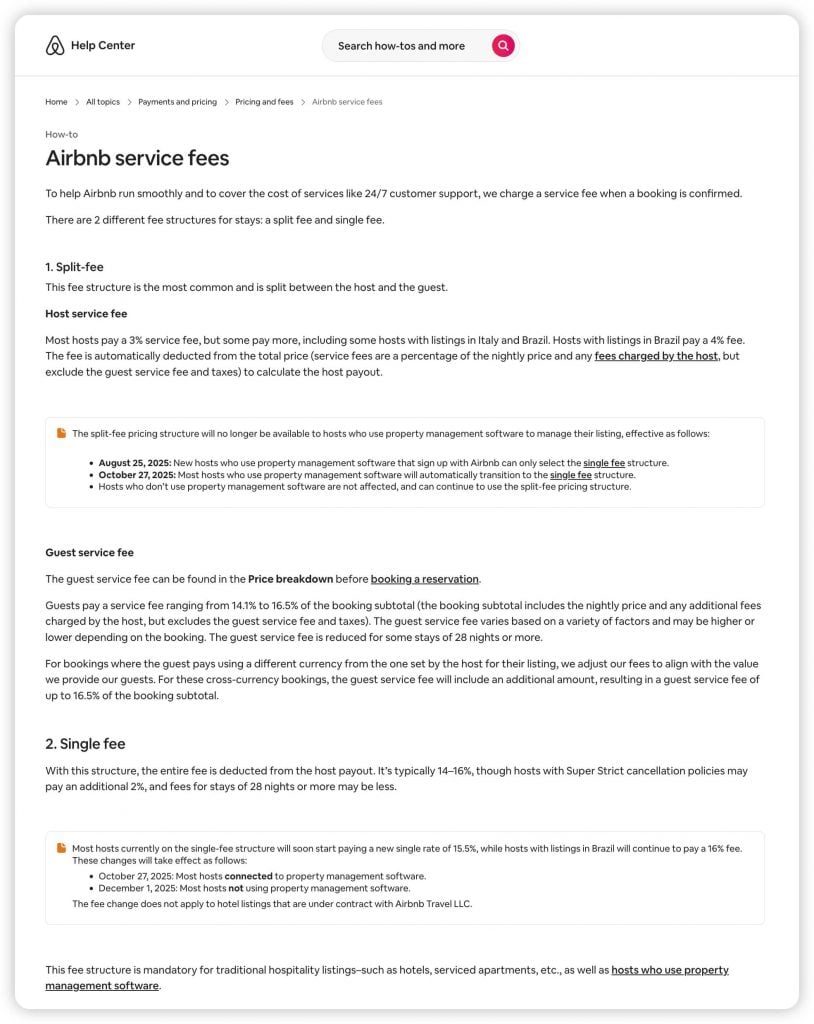
The split-fee model is the traditional arrangement most individual hosts encounter when they first sign up for the platform. In this scenario, the service fee is shared between the host and the guest.
- Host Portion: Usually 3% of the booking subtotal. The subtotal includes your nightly price plus any optional fees you charge, such as cleaning or pet fees, but excludes Airbnb’s guest fees and taxes.
- Guest Portion: Typically around 14.2% of the booking subtotal, though this can vary based on several factors, such as stay length or location.
The primary advantage of the split-fee model is that it allows the host to keep their "sticker price" lower. However, guests see a significant jump in the total cost once they reach the checkout page and see the guest service fee added to the subtotal.
2. The Host-Only (Simplified) Pricing
Simplified pricing, also known as "Host-Only" pricing, removes the guest service fee entirely. Instead, the host pays the entire service fee, which usually ranges from 14% to 16%.
This model is mandatory for:
- Traditional hospitality listings (Hotels, Boutique Hotels, etc.).
- Software-connected hosts (those using a Property Management System or Channel Manager), unless the majority of their listings are in the United States, Canada, Mexico, Uruguay, the Bahamas, Taiwan, or Japan.
- Most hosts located in Europe, the Middle East, and Africa (EMEA).
The strategy behind simplified pricing is transparency. The price a guest sees in search results is exactly what they pay (excluding taxes), which often leads to higher conversion rates as it eliminates "sticker shock" at the final checkout step.
Deep Dive into the 3% Split-Fee Mechanics
While 3% is the standard for the majority of individual hosts in North America and parts of Asia, there are nuances that can push this percentage higher. It is a common misconception that 3% is the absolute ceiling for this model.
Variations and Exceptions
For hosts in Italy, the host service fee is often higher due to local regulatory requirements and tax withholding structures. Furthermore, if you choose a Super Strict cancellation policy, Airbnb typically increases the host service fee to 5% to account for the additional administrative burden and the higher protection offered to the host's revenue.
How the Calculation Works
To visualize this, imagine you list your home for $200 a night for a three-night stay, with a $100 cleaning fee.
- Nightly Total: $600
- Cleaning Fee: $100
- Subtotal: $700
- Host Fee (3%): $21
- Host Payout: $679 (before taxes)
In this scenario, the guest would then pay an additional service fee (roughly 14%) on top of that $700, making their total closer to $798 before occupancy taxes.
The Logic Behind the 15% Host-Only Fee
Many hosts are initially resistant to the 15% fee because it feels like a significant portion of their revenue is being "taken" compared to the 3% model. However, the 15% fee is essentially the 3% host fee and the ~12% guest fee combined into one line item paid by the host.
Competitive Advantages
The simplified pricing model was designed to mirror the pricing structures of other major booking platforms like Booking.com. In 2025, data suggested that listings using simplified pricing saw an average increase in bookings because guests prefer seeing the final price upfront.
When a host switches to simplified pricing, they typically increase their nightly rates by 12% to 14% to cover the new fee. Because the guest is no longer paying their own service fee, the total cost to the guest remains roughly the same, but the host has more control over the final price displayed.
Mandatory Compliance for Professionals
If you use professional hosting tools or API-connected software to manage multiple listings, Airbnb usually mandates the 15% host-only fee. This is because professional property managers often need to ensure their pricing is consistent across multiple platforms (direct booking sites, VRBO, and Airbnb). Managing a split-fee model while trying to maintain price parity across platforms is mathematically difficult.
Geographic Variations and the Impact of VAT
Service fees are not uniform across the globe. Regional laws, specifically regarding Value Added Tax (VAT), significantly influence the final amount deducted from your payout.
VAT on Service Fees
In jurisdictions like the United Kingdom, the European Union, and several countries in Latin America, Airbnb is required to charge VAT on its service fees. It is crucial to understand that VAT is usually charged on the service fee itself, not the total booking amount.
For example, if you are a host in a country with a 20% VAT rate and you are charged a $30 service fee:
- Service Fee: $30
- VAT (20% of $30): $6
- Total Deduction: $36
If you are a VAT-registered business, you may be able to provide Airbnb with your VAT ID, which might result in Airbnb not charging the tax directly, allowing you to account for it through your own tax filings.
Local Tax Collection
In many regions, Airbnb also collects and remits Occupancy Taxes (often called "Tourist Tax" or "Hotel Tax") on behalf of the host. While these are not "host fees" in the sense that they don't come out of your set nightly rate, they are added to the guest's total and appear on the invoice. Hosts should verify whether Airbnb handles this in their specific municipality to avoid double-taxing their guests or failing to meet local tax obligations.
How Cleaning Fees and Add-ons Affect Your Total Payout
A common area of confusion is whether the service fee applies to the entire transaction or just the nightly rate. In 2025 and into 2026, the rule remains: Airbnb charges the service fee on the entire subtotal.
Included Add-ons
The service fee is calculated based on:
- Nightly Rate: Your base price multiplied by the number of nights.
- Cleaning Fee: The one-time fee you charge for turnover.
- Pet Fees: Any additional charge for animal guests.
- Extra Guest Fees: Charges for guests beyond your base occupancy.
Excluded Items
The service fee is not applied to:
- Security Deposits: Since Airbnb moved toward the AirCover model, traditional security deposits are handled differently, but generally, held funds are not "taxed" by the service fee.
- Taxes: Airbnb does not take a percentage of the occupancy taxes collected.
By including the cleaning fee in the subtotal for fee calculation, Airbnb ensures that hosts cannot "game the system" by setting a $1 nightly rate and a $500 cleaning fee to avoid paying the service fee.
Cancellation Fees and Financial Penalties
Fees aren't just limited to successful bookings. Airbnb maintains a strict penalty structure for host-initiated cancellations to maintain platform reliability.
The Cost of Canceling on a Guest
If a host cancels a reservation, Airbnb applies a fee that is deducted from future payouts. As of the standards held through 2025, these fees are tiered based on how close to check-in the cancellation occurs:
- More than 30 days before check-in: The fee is 10% of the reservation amount.
- Between 48 hours and 30 days before check-in: The fee is 25% of the reservation amount.
- Less than 48 hours before check-in (or after check-in): The fee is 50% of the reservation amount for the nights not stayed.
There is a minimum cancellation fee of $50 USD and a maximum of $1,000 USD. These fees are designed to reimburse Airbnb for the cost of finding the guest alternative accommodations and to discourage hosts from canceling for higher-paying "off-platform" offers.
Exceptions to Penalties
Hosts can sometimes avoid these fees if they can prove Extenuating Circumstances (such as a natural disaster or government-mandated travel restrictions) or if they have valid reasons under the "Host Reliability Policy," such as evidence that a guest intends to throw an unauthorized party.
Comparison of 2025/2026 Airbnb Fee Structures
| Feature | Split-Fee Model | Host-Only (Simplified) |
|---|---|---|
| Standard Host Fee | 3% (Standard) | 14% – 16% |
| Standard Guest Fee | ~14.2% | 0% |
| Who pays the bulk? | Guest | Host |
| Mandatory For | Individual/Casual Hosts | Hotels & Software-connected Hosts |
| Best For | Lowering "Search Price" | Price Transparency & Conversion |
| VAT Applicable? | Yes (on the 3% fee) | Yes (on the 14-16% fee) |
| Super Strict Policy | Increases Host fee to 5% | Usually stays within 14-16% range |
Airbnb Experiences Fees
It is important to distinguish between "Stays" and "Experiences." If you are a host who leads tours, classes, or events, the fee structure is entirely different.
The 20% Experience Fee
For Airbnb Experiences, the service fee is typically 20%. This is significantly higher than the stay fee because Airbnb provides additional insurance coverage specifically for experience hosts and handles much more of the marketing and discovery side for these activities.
Unlike stays, there is no "split-fee" option for Experiences. The host pays the full 20%, and the guest sees a transparent price. This fee covers the cost of the platform's specialized Experience support team and the processing of payments across international borders.
Practical Strategies for Managing Host Fees
To maximize your "Take-Home" pay, you must look at these fees as a cost of goods sold (COGS). Successful hosts in 2026 utilize several strategies to mitigate the impact of these deductions.
1. Dynamic Pricing Adjustments
Use dynamic pricing tools to automatically adjust your nightly rate based on demand. When demand is high (e.g., during a local festival), you can easily absorb a 15% fee while still netting more than you would on a low-demand night with a 3% fee.
2. Factoring Fees into the Cleaning Charge
Many hosts forget that the 3% or 15% fee also applies to the cleaning fee. If you pay your cleaners $100, you should actually charge the guest approximately $104 (in the split-fee model) or $118 (in the host-only model) to ensure that after Airbnb's deduction, you still have the full $100 to pay your staff.
3. Leveraging AirCover
Remember that your host fee pays for AirCover for Hosts. This includes $3 million in damage protection and $1 million in liability insurance. When evaluating the "cost" of the 3% or 15% fee, factor in what you would otherwise pay for specialized short-term rental insurance. For many, the Airbnb fee is actually cheaper than independent commercial insurance premiums.
FAQ
Does the Airbnb host fee include credit card processing?
Yes. Unlike some other platforms or direct-booking sites where you must pay a separate 2.9% + $0.30 fee for credit card processing (via Stripe or PayPal), Airbnb’s service fee covers all payment processing costs. This includes the handling of international currency conversions and fraud protection.
Why is my host fee higher than 3% on a split-fee listing?
There are three common reasons:
- VAT: You are being charged Value Added Tax on the service fee based on your local laws.
- Super Strict Policy: You have selected a cancellation policy that carries a 5% fee instead of 3%.
- Local Regulations: Hosts in specific countries, like Italy, may have different fee structures due to local tax withholding requirements.
Are Airbnb fees tax-deductible?
In most jurisdictions, Airbnb service fees are considered a legitimate business expense. When you file your taxes, you typically report the gross amount of rental income (the total the guests paid before fees) and then deduct the Airbnb service fees as a "cost of doing business." Always consult with a tax professional in your specific region.
What happens to the service fee if I refund a guest?
If you issue a refund to a guest for a cancellation or a problem during their stay, Airbnb generally refunds their portion of the service fee. Whether or not you get your host fee back depends on the timing of the refund and the specific cancellation policy applied to the booking. For partial refunds, the service fee is usually recalculated based on the new, lower total.
Can I ask guests to pay the service fee off-platform?
No. Requesting that guests pay Airbnb service fees or any part of the booking subtotal outside of the Airbnb platform is a violation of the Terms of Service. This is known as "fee avoidance" and can lead to the permanent suspension of your account. All financial transactions must stay within the platform to ensure you are covered by AirCover and that the platform remains secure.
Final Recommendation for 2026 Hosts
For hosts looking to scale their business this year, the most effective path is often transitioning to the Simplified (Host-Only) Pricing model. While the 14-16% figure looks daunting on paper, the increased transparency for guests often results in higher search placement and better conversion rates.
Begin by auditing your current payouts: calculate your average net profit per booking after the 3% fee and guest service fees are removed. Then, model what your nightly rate would need to be under the 15% structure to maintain that same net profit. If the resulting "all-in" price is competitive with similar listings in your area, making the switch can simplify your accounting and make your listing more attractive to modern travelers who value price clarity.