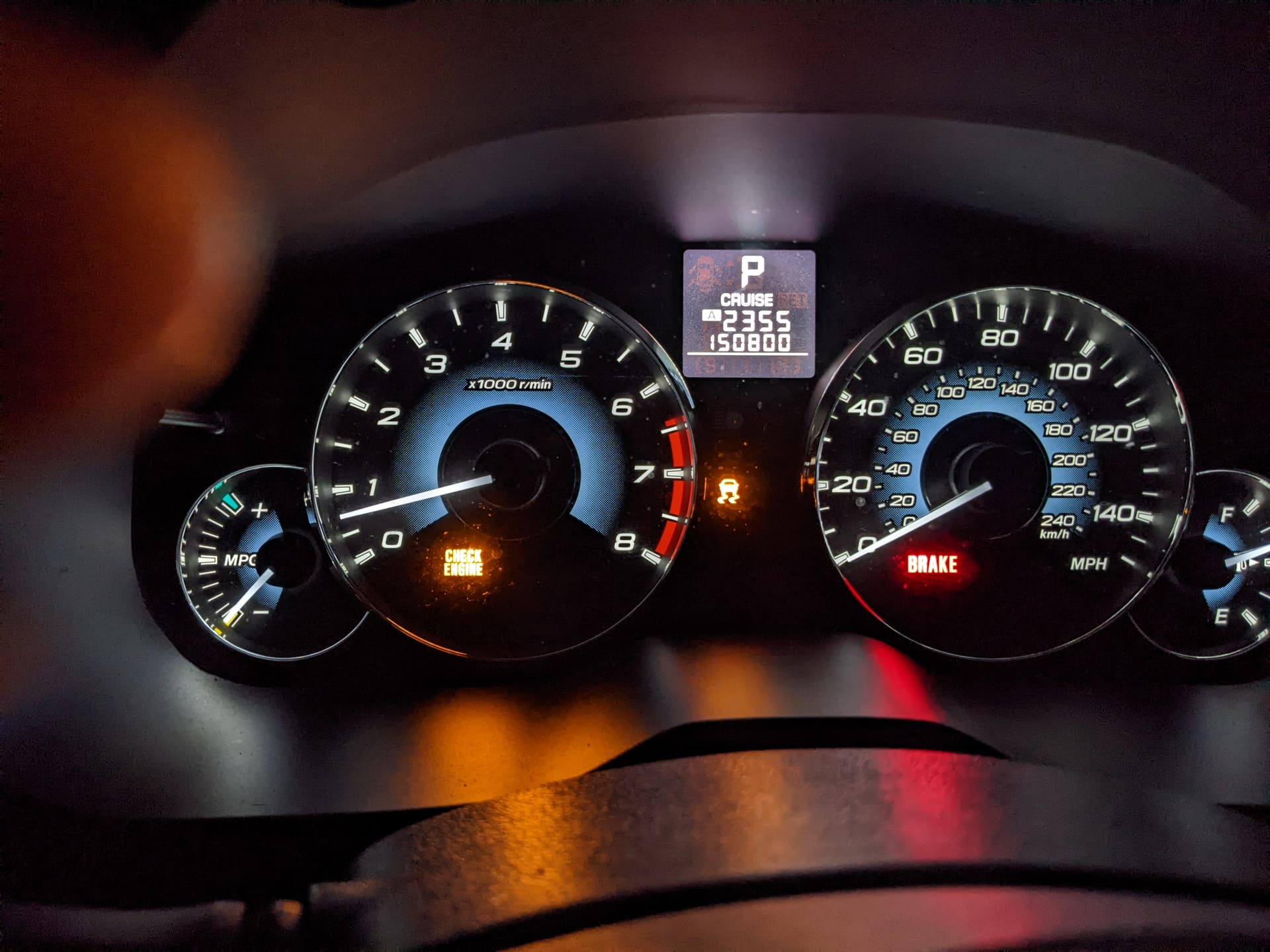
If the AT OIL TEMP light is flashing on your 2013 Subaru Outback, the Transmission Control Module (TCM) has detected an electrical or mechanical fault in the continuously variable transmission (CVT) system. Unlike a solid light indicating overheating, a flashing light signals an active diagnostic trouble code, most commonly caused by a failed valve body solenoid.
What Does the Flashing AT OIL TEMP Light Mean?
The instrument cluster on the fourth-generation (2013) Subaru Outback features an amber or red warning light labeled AT OIL TEMP. Many drivers confuse this indicator with engine oil temperature. In Subaru terminology, "AT" stands for Automatic Transmission. This light monitors the health and operating temperature of the transmission fluid inside the vehicle's automatic transmission or Lineartronic Continuously Variable Transmission (CVT).
Subaru programming separates transmission warnings into two distinct operating states:
- Steady / Solid AT OIL TEMP Light: The transmission fluid has exceeded safe thermal operating limits—typically rising above 266°F (130°C). This condition occurs during heavy towing, aggressive mountain climbing, or severe fluid degradation. If you pull over and idle the engine in Park, the cooling system usually lowers the fluid temperature, causing the light to turn off.
- Flashing / Blinking AT OIL TEMP Light: The TCM has logged an active diagnostic trouble code (DTC). The light flashes to alert the driver that a critical electronic sensor, valve, or hydraulic circuit inside the transmission is operating outside factory parameters. It will continue flashing across drive cycles until the stored trouble code is cleared with an OBD-II diagnostic scanner.
In the 2013 Outback, a flashing AT OIL TEMP light rarely travels alone. Subaru designs its CAN bus vehicle network to trigger companion warning lights when a powertrain fault occurs. Drivers routinely see the Check Engine Light (CEL) illuminate steadily, the Cruise Control light flash continuously (with cruise functionality completely disabled), and the Vehicle Dynamics Control (VDC) / Traction Control light illuminate. This combined display, often referred to as the "Christmas tree dash," is intentional fail-safe programming designed to draw immediate attention to the transmission system.
AT OIL TEMP vs. Engine Oil Warnings: A Vital Distinction
Because the text contains the words "OIL TEMP," motorists frequently check their engine dipstick, add motor oil, or schedule an engine oil change when this light appears. Doing so does not fix the problem and can lead to dangerous overfills.
The 2013 Outback features three separate oil-related monitors on the dashboard:
- Red Oil Pressure Symbol (Oil Can): Indicates a critical loss of engine oil pressure. This is a severe mechanical emergency requiring immediate engine shutdown.
- Yellow Engine Oil Level Symbol (Oil Can over Wavy Line): Signals that the engine oil volume in the crankcase has dropped below safe operational levels (often triggered when oil is roughly one quart low).
- AT OIL TEMP (Lettering): Exclusively monitors the transmission fluid inside the Lineartronic CVT (or the 5-speed automatic transmission on 3.6R models). It has no electronic connection to the engine's crankcase oil.
Primary Causes of a Blinking AT OIL TEMP Light
The 2013 model year represents an important mechanical transition for the Outback. For the 2.5-liter Boxer engine (FB25), Subaru introduced the second-generation Lineartronic CVT, designated internally as the TR580. (The 3.6-liter 6-cylinder models retained the traditional 5EAT 5-speed automatic transmission).
Over thousands of thermal cycles, several specific points of failure produce the flashing warning light.
1. Torque Converter Clutch (TCC) Solenoid Failure
The single most common culprit behind a flashing AT OIL TEMP light on a 2013 Outback is a failed Torque Converter Clutch (TCC) lockup duty solenoid. This electronic solenoid sits mounted inside the CVT valve body, positioned under the top access cover of the transmission.
The TCC solenoid regulates hydraulic line pressure to lock the torque converter at cruising speeds, creating a direct mechanical link between the engine and transmission for maximum fuel efficiency. As the transmission experiences repeated heat cycles over 80,000 to 140,000 miles, the internal copper winding inside the solenoid degrades, develops micro-fractures, or experiences an internal short.
When the TCM commands lockup and measures an out-of-spec electrical resistance—standard resistance is approximately 10 to 13.5 ohms at room temperature—the computer detects an open or shorted circuit, sets a diagnostic trouble code, and begins flashing the AT OIL TEMP light.
2. Secondary Pressure and Shift Control Solenoids
While the TCC solenoid has the highest rate of failure, the valve body houses several other electro-hydraulic solenoids:
- Primary up/down shift duty solenoids
- Secondary pulley pressure control solenoid
- Line pressure control solenoid
- Forward/reverse clutch timing solenoids
Failure in any of these internal electromagnetic actuators triggers an immediate flashing light to protect the CVT belt and variator pulleys from physical clamping-pressure loss.
3. Faulty Transmission Fluid Temperature Sensor
The transmission utilizes an internal temperature sensor submerged in the CVT fluid. If the thermistor degrades, suffers wiring corrosion, or sends erratic voltage spikes to the TCM, the computer flags the signal as irrational. Common codes include P0711 (range/performance), P0712 (circuit low input), and P0713 (circuit high input). Without reliable temperature inputs, the TCM cannot adjust fluid viscosity compensations, forcing the warning light to blink.
4. Low Voltage and Battery Health Issues
Subaru's electronic control modules are sensitive to input voltage fluctuations. A dying 12-volt battery, a failing alternator diode, or corroded battery terminal clamps can cause systemic voltage drops below 10.5 volts during engine cranking. When voltage drops, the TCM registers false solenoid circuit fault codes, initiating the flashing AT OIL TEMP warning upon startup even if the mechanical components inside the transmission are operating properly.
5. Severe Transmission Overheating
Although elevated fluid temperatures normally trigger a solid warning light, sustained thermal breakdown can cause the light to transition to a rapid flash. Severe overheating alters the fluid viscosity, leading to internal hydraulic pressure drop-offs and belt slippage. Once slippage crosses programmed thresholds, the computer flags an operational error code.
Common Diagnostic Trouble Codes (DTCs)
When reading the vehicle using a scan tool capable of interrogating the Transmission Control Module, one or more specific OBD-II diagnostic trouble codes will be present:
- P2763 (Short Circuit in TCC Lockup Duty Solenoid): The TCM detects an abnormally high voltage or low resistance on the lockup solenoid control circuit.
- P2764 (Open Circuit in TCC Lockup Duty Solenoid): The circuit broken internally; the TCM detects zero current flow through the solenoid winding.
- P2762 (TCC Lockup Duty Solenoid Range/Performance): The solenoid functions electronically, but mechanical response times lag behind TCM commands.\n* P0700 (Transmission Control System Malfunction): A generic global code stored in the Engine Control Module (ECM) indicating that the TCM has requested a Check Engine Light illumination.
- P0971 (Secondary Pressure Solenoid Circuit High): High electrical resistance or an open circuit detected on the pulley clamping-pressure circuit.
- P0711 / P0712 / P0713 (Transmission Fluid Temperature Sensor Faults): Signals erratic readings, open circuits, or short circuits in the internal thermal reporting harness.
Can You Drive With the AT OIL TEMP Light Flashing?
Driving with a flashing AT OIL TEMP light is not recommended, though the immediate risk depends on the underlying failure:
- Limp Mode Activation: In many cases, the TCM initiates a fail-safe mode ("limp mode"). To prevent structural damage to the steel drive chain and pulley faces, the computer locks the transmission into a fixed hydraulic ratio, disallows manual paddle-shifting (if equipped), and prevents torque converter lockup.
- Engine Stalling at Low Speeds: If the lockup solenoid fails in a mechanically closed or stuck state, the torque converter cannot disengage when you brake to a halt. The engine may shudder violently and stall out, precisely like stopping a manual transmission car without stepping on the clutch pedal.
- Diminished Fuel Economy and Elevated Heat: When the torque converter cannot achieve lockup, continuous fluid coupling slippage generates extra heat. Driving long distances under these conditions accelerates fluid degradation and places extra thermal strain on the engine's cooling system.
If the light begins flashing while driving, complete your trip carefully, avoid heavy acceleration, stay off steep mountain grades, do not tow cargo, and retrieve the diagnostic codes as soon as possible.
Diagnostic Workflow: Step-by-Step
Diagnosing the precise point of failure requires moving beyond basic code readers to verify electrical and mechanical integrity.
Diagnostic Sequence:
- Scan All Systems (TCM & ECM)
- Evaluate 12V Battery & Charging System
- Check CVT Fluid Level & Fluid Condition
- Perform Valve Body Terminal Resistance Test
- Verify or Replace Valve Body / Solenoid
- Perform TCM Learning Value Reinitialization
Step 1: Scan with a TCM-Capable Diagnostic Tool
Standard, inexpensive OBD-II scanners sold at parts stores often read only generic emissions codes from the ECM (such as P0700). They frequently cannot access the proprietary Subaru TCM protocol. You must use a bi-directional scan tool or diagnostic interface supporting Subaru extended powertrain parameters to retrieve the specific five-digit "P-code" stored within the transmission module.
Step 2: Test the 12-Volt Electrical Foundation
Measure the resting voltage of the car battery with a digital multimeter before turning the ignition key.
- A healthy resting battery reads between 12.5 and 12.8 volts.
- Start the engine and observe cranking voltage; if voltage drops below 9.6 volts during cranking, the battery requires replacement.
- Check system voltage while idling with headlights on; the alternator should supply between 13.8 and 14.4 volts.
Step 3: Inspect Transmission Fluid Condition and Level
Subaru's TR580 CVT features no under-hood dipstick. Checking the fluid requires lifting the vehicle so it is completely level, running the engine until the CVT fluid reaches between 95°F and 113°F (35°C–45°C) as measured via scan tool live data, and removing the transmission check plug located on the left-rear of the transmission case.
- If fluid pours out rapidly before the specified temperature range, the unit was overfilled.
- If no fluid trickles from the inspection hole, the transmission is low on fluid, which can cause erratic hydraulic pressure and solenoid actuation failures.
- Inspect fluid color and odor. Healthy Subaru CVTF-II fluid is clean, clear, and slightly amber-green. Dark, burnt-smelling fluid indicates advanced thermal breakdown and mechanical friction wear.
Step 4: Perform Solenoid Resistance Checks
If a solenoid code like P2763 or P2764 is logged, verify whether the issue resides in the transmission harness or the internal solenoid itself.
Technicians access the primary transmission harness connector located on the top bell-housing of the CVT. By probing the specific terminal pins running to the lockup solenoid against transmission case ground with an ohmmeter:
- A reading between 10.0 and 13.5 ohms suggests the internal coil winding is within standard electrical specifications (though intermittent heat-related opens can still occur).
- A reading showing infinity (OL / Open Loop) or zero ohms confirms a ruptured internal wire or a dead short inside the solenoid.
Comparison of Warning Light States and Common Failures
The following reference table outlines the differences between dashboard behaviors, mechanical causes, diagnostic trouble codes, and typical repair solutions on a 2013 Subaru Outback:
| Warning Indicator Status | Accompanying Lights | Most Probable Root Cause | Relevant DTCs | Typical Resolution |
|---|---|---|---|---|
| Solid AT OIL TEMP | None, or Cruise disabled | Transmission fluid overheating (>266°F / 130°C) | None (Operational State) | Pull over, idle in Park until light extinguishes; inspect CVT cooler lines. |
| Flashing AT OIL TEMP | Check Engine Light, Cruise Flashing, VDC On | Torque Converter Clutch (TCC) Solenoid Open/Short | P2763, P2764, P2762 | Replace transmission valve body assembly or swap individual TCC solenoid. |
| Flashing AT OIL TEMP | Check Engine Light, Cruise Flashing | Secondary Pulley Pressure Solenoid Circuit Failure | P0971, P0967 | Replace valve body assembly; check transmission wire harness connector. |
| Flashing AT OIL TEMP | Check Engine Light, Cruise Flashing | Fluid Temperature Sensor Circuit Open or Grounded | P0711, P0712, P0713 | Replace internal transmission wiring harness / temperature probe module. |
| Flashing AT OIL TEMP | Check Engine Light, Low Battery Symbol | Severe Low Voltage / Bad Alternator Diode | P0700, P0841, U0101 | Test battery cranking load; replace 12V battery or alternator; clear memory. |
| Solid Oil Can Symbol | Engine warning text | Low Engine Oil Pressure (Crankcase) | P0011, P0021 (ECM) | Shut off engine immediately; inspect engine oil level; do not drive. |
Repair Options, Procedures, and Costs
When code diagnostics point to internal valve body solenoid degradation, 2013 Outback owners have three repair routes.
Repair Approaches:
- Option 1: Full OEM Valve Body Replacement (Dealer Recommended)
- Option 2: Remanufactured / Aftermarket Valve Body Assembly
- Option 3: Individual Solenoid Replacement (Independent / DIY)
1. OEM Valve Body Assembly Replacement
For years, Subaru's official technical service protocol did not sell individual solenoids separately through dealer parts counters. Instead, Subaru parts departments supply the entire valve body assembly (part number series 16100-JB / 31706-AA), which comes pre-assembled with all new solenoids, new internal ribbon harnesses, and factory-calibrated pressure sensors.
- Parts Cost: $750 – $1,100 for a genuine Subaru OEM valve body.
- Labor Cost: $350 – $600 (typically 2.5 to 4 hours of shop labor).
- Consumables: 6 to 8 quarts of authentic Subaru CVTF-II fluid ($120 – $180), plus a new access cover O-ring/gasket.
- Total Expected Cost: $1,250 – $1,900.
This route is the most reliable approach because replacing the entire assembly refreshes every solenoid and sensor simultaneously, eliminating the likelihood of a secondary solenoid failing months later.
2. Aftermarket or Remanufactured Valve Body
Several aftermarket transmission specialists remanufacture TR580 valve bodies. These units are disassembled, cleaned, fitted with upgraded internal solenoids designed to withstand higher thermal thresholds, and flow-bench tested.
- Parts Cost: $350 – $600.
- Labor & Fluid Cost: $500 – $750.
- Total Expected Cost: $850 – $1,350.
This option provides a balance between financial savings and assembly-level reliability, provided the remanufacturer offers a verified replacement warranty.
3. Individual Solenoid Replacement
Because the TCC lockup solenoid is almost always the component that burns out, independent parts suppliers and aftermarket vendors sell individual solenoids online.
A skilled DIY mechanic or independent transmission shop can remove the transmission access pan, unbolt the valve body, extract only the failed TCC solenoid, solder or clip in the replacement unit, and reinstall the components without replacing the entire aluminum casting.
- Parts Cost: $40 – $90 for an individual solenoid.
- Fluid Cost: $80 – $140 for replacement CVT fluid.
- DIY Cost: $120 – $250.
- Professional Shop Cost: $500 – $800.
While inexpensive, this approach carries one operational limitation: other factory solenoids remaining on the valve body share the exact same age, mileage, and heat exposure. If the secondary pressure solenoid or line pressure solenoid fails a short time later, the transmission must be disassembled a second time.
Valve Body Replacement: Technical Walkthrough
For owners planning to repair the issue independently or oversee an independent mechanic, the procedure on a 2013 Outback (TR580 CVT) involves specific structural steps:
- Safety and Access: Disconnect the negative battery terminal. Lift the vehicle securely on four jack stands or a commercial hoist.
- Air Intake Removal: On the TR580 transmission, the valve body is top-mounted (unlike the earlier TR690, which utilized a bottom-pan configuration). Remove the engine air filter housing and the rear intake ducting to gain direct visual and physical access to the upper bell-housing of the transmission.
- Clean the Surrounding Area: Dirt, sand, and grit collect on top of the transmission case. Thoroughly spray the top casting with brake cleaner and use compressed air to blast away all debris. Any contamination falling into the exposed CVT cavity during disassembly can permanently damage the steel drive chain and hydraulic valves.
- Remove the Upper Valve Body Cover: Unbolt the steel valve body cover bolts. Gently break the silicone sealant bond and lift off the cover.
- Disconnect the Wiring Harness: Unclip the internal electrical connectors linked to the solenoids and fluid temperature sensor.
- Unbolt the Valve Body: Unbolt the mounting bolts securing the aluminum valve body casting to the main transmission case. Carefully lift the assembly out of the transmission.
- Installation and Sealant: Clean the mating surfaces using plastic scrapers and solvent. Position the new or rebuilt valve body, torque all mounting fasteners in the cross-pattern sequence defined by Subaru (typically 5.9 to 7.0 ft-lbs / 8 to 9.5 Nm), re-attach harness leads, apply ThreeBond 1215 or equivalent anaerobic RTV gasket maker to the access cover, and torque the cover bolts.
- Refill Fluid and Perform Learning Procedure: Pump new Subaru CVTF-II fluid into the fill port until it overflows at proper temperature. Connect a diagnostic scan tool and initiate the AT Learning Value Clear and CVT Relearn Sequence. This process recalibrates the TCM's electronic memory to match the precise hydraulic flow rates and clutch clearances of the new solenoids.
Common Mistakes to Avoid
When confronting a blinking AT OIL TEMP light on a 2013 Outback, vehicle owners and inexperienced technicians frequently make costly missteps:
- Using Generic Multi-Vehicle Automatic Transmission Fluid (ATF): Traditional Dexron/Mercon ATF cannot be used in a Subaru CVT. Standard ATF lacks the specialized frictional modifiers and high-shear anti-slip film required to prevent the steel variator chain from slipping across the smooth steel pulleys. Using conventional ATF can cause chain slippage, gouging the pulleys and necessitating a total transmission replacement. Use only Subaru CVTF-II or verified CVT fluids meeting the Subaru Lineartronic specification.
- Replacing the Whole Transmission Unnecessarily: Many general repair shops lack internal transmission experience and will quote $6,000 to $8,000 to replace the entire CVT assembly when faced with solenoid codes like P2763. In the vast majority of cases, replacing only the valve body solves the problem completely.
- Ignoring the Diagnostic Code: Clearing the diagnostic code by disconnecting the car battery provides only temporary relief. Within 5 to 50 miles, the TCM will run its internal electrical continuity checks during steady cruising, detect the out-of-spec resistance, and trigger the flashing light once more.
- Checking Transmission Fluid While the Engine Is Off: If you open the CVT check plug while the vehicle's engine is not running, several quarts of transmission fluid will drain out immediately. The fluid level can only be accurately inspected while the engine is idling in Park and fluid temperatures are strictly between 95°F and 113°F.
Frequently Asked Questions
Can I drive my 2013 Outback home if the AT OIL TEMP light starts flashing?
Yes, you can generally drive a short distance home or to a nearby repair facility, provided the vehicle shifts smoothly, is not slipping severely, and does not shudder or stall when coming to a complete stop. Avoid aggressive acceleration, avoid steep hills, and drive at moderate speeds. If the car stumbles, hesitates, or smells strongly of burning oil, pull over immediately and call a flatbed tow truck.
Why did my Cruise Control and Traction Control lights turn on at the same time?
Subaru vehicles are engineered to automatically disable cruise control and vehicle dynamics assistance systems whenever an active powertrain diagnostic trouble code is set. Because the TCM cannot guarantee precise torque management during a transmission component failure, the car disables cruise control as a safety precaution, indicating this status by flashing the cruise indicator.
How do I clear the flashing AT OIL TEMP light?
The flashing light cannot be cleared by turning the ignition switch on and off. You must resolve the underlying mechanical or electrical fault (such as replacing the valve body or repairing a broken wire), read and erase the stored fault codes within the TCM using an OBD-II diagnostic scanner, and perform a drive cycle so the TCM completes its diagnostic monitor tests.
Did Subaru extend the warranty for 2013 Outback transmission issues?
Subaru of America previously extended the CVT powertrain warranty to 10 years or 100,000 miles for 2010–2015 model year Legacy and Outback vehicles to cover widespread CVT and valve body concerns. However, eligibility under this specific factory extension has expired based on both the 10-year age limit and typical mileage milestones. Repairs are now the financial responsibility of the vehicle owner, unless covered by a separate third-party vehicle service contract.
What is the difference between TR690 and TR580 CVTs in the 2013 Outback?
The 2013 Outback equipped with the 2.5L 4-cylinder engine utilizes the TR580 CVT, which features an upper-mounted valve body positioned beneath the intake manifold area. The earlier 2010–2012 models used the heavier-duty TR690 CVT, which located the valve body underneath the transmission in a bottom fluid pan. This difference affects labor procedures: replacing a TR580 valve body does not require dropping an underbody transmission pan, making physical removal faster, though space near the firewall is confined.
Recommended Next Steps
If your 2013 Subaru Outback currently exhibits a flashing AT OIL TEMP light, follow this course of action:
- Retrieve the Specific TCM Codes: Visit an independent automotive repair facility specializing in Asian vehicles or purchase an OBD-II scan tool capable of reading Subaru Transmission Control Module data. Obtain the exact active "P-code."
- Evaluate Code P2763 / P2764: If the scanner returns solenoid continuity codes, budget for a valve body replacement. Contact local independent transmission specialists for quotes specifically covering a TR580 CVT Valve Body Replacement rather than a full transmission swap.
- Verify Fluid Authenticity: Ensure any service facility working on your vehicle uses genuine Subaru CVTF-II or a certified equivalent fluid.
- Complete the Adaptation Relearn: Once the repair is complete, confirm the technician performs the TCM Clear Memory and AT Learning calibration before driving the vehicle under load.