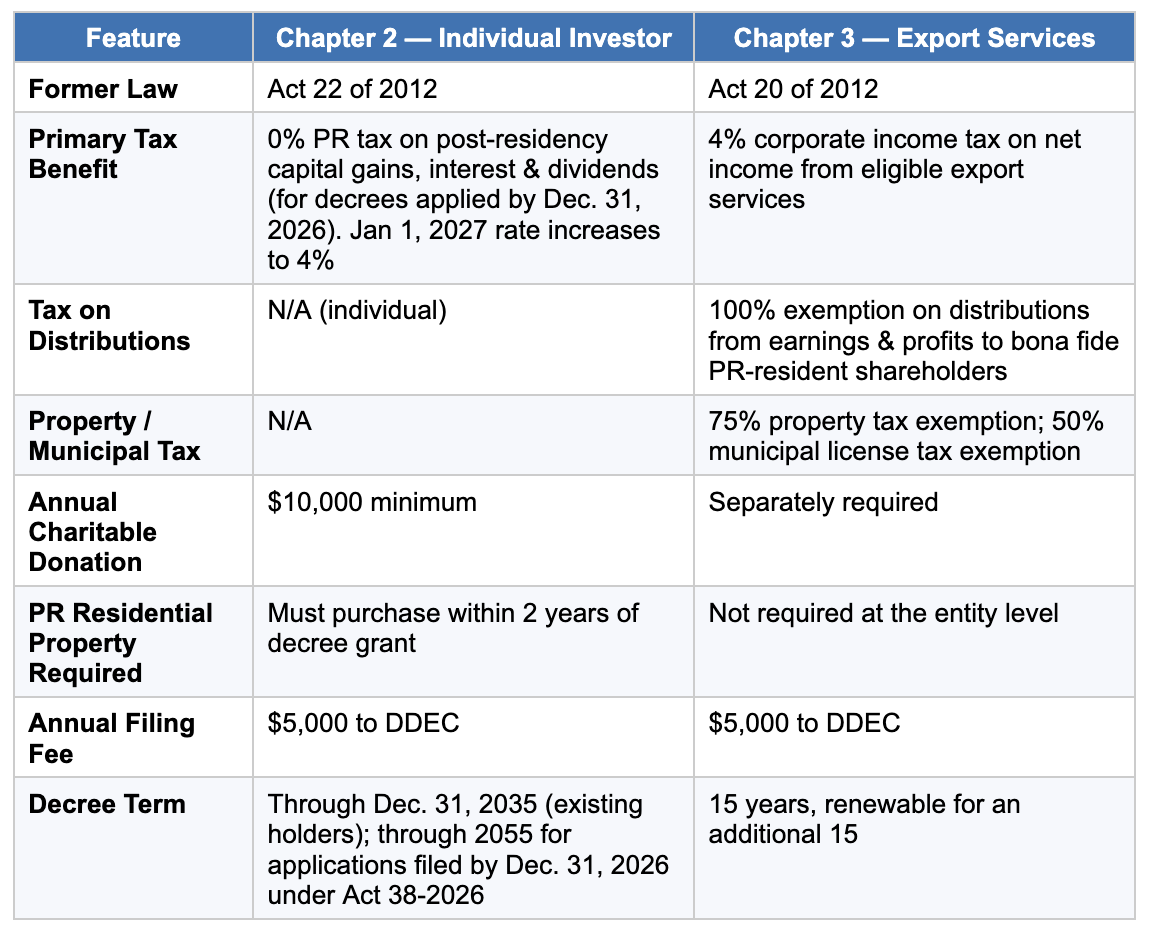
Puerto Rico’s Act 20 and Act 22 tax incentives offer a unique fiscal framework designed to attract service providers and individual investors to the island. By relocating, eligible participants can access a 4% corporate tax rate on exported services and a 0% tax rate on capital gains, dividends, and interest, provided they establish bona fide residency.
For over a decade, Puerto Rico has served as a significant tax jurisdiction for United States citizens looking to optimize their tax liabilities without renouncing their citizenship. While originally passed as standalone laws in 2012, Act 20 (The Export Services Act) and Act 22 (The Individual Investors Act) were consolidated into Act 60, the Puerto Rico Tax Incentives Code, in 2019. Despite this administrative merger, the core benefits of these "decrees" remain the cornerstone of Puerto Rico's economic development strategy in 2026.
The Evolution of Act 20 and Act 22 into Act 60
To understand the current landscape, it is essential to recognize that Act 20 and Act 22 no longer exist as independent legislative acts for new applicants. Instead, they are now organized under Chapter 2 (Individual Investors) and Chapter 3 (Export Services) of Act 60.
For those who obtained their tax decrees prior to 2019, the original terms of Act 20 and Act 22 generally remain in place, as these decrees are considered binding contracts with the Government of Puerto Rico. For new residents and businesses applying in 2026, the rules of Act 60 apply. This consolidation was intended to streamline the application process through the Single Business Portal (SBP) and standardize compliance requirements across different incentive sectors.
The primary appeal remains the same: Puerto Rico is a U.S. territory, yet under Internal Revenue Code (IRC) Section 933, bona fide residents of Puerto Rico are generally exempt from U.S. federal income taxes on income derived from sources within Puerto Rico. This unique status allows for the legal avoidance of federal taxes on specific types of income that would otherwise be taxed at much higher rates on the mainland.
Act 20: The Export Services Incentive
The Export Services incentive (formerly Act 20) is designed to transform Puerto Rico into a global hub for services. It encourages businesses to relocate their operations to the island and provide services to clients located outside of Puerto Rico.
Key Benefits of Act 20
The most significant advantage is the 4% fixed corporate income tax rate on eligible export services. This is a stark contrast to the U.S. federal corporate tax rate. Furthermore:
- 0% Tax on Distributions: Dividends or profit distributions from the export business to the owners are 100% exempt from Puerto Rico income taxes.
- Property Tax Exemptions: Many businesses qualify for a 75% to 100% exemption on municipal and property taxes, depending on the size and nature of the business.
- 60% Exemption on Municipal Taxes: This significantly reduces the local "patente" tax often levied by Puerto Rican municipalities.
Eligible Services
To qualify, the service must be considered an "export." This means the service is performed in Puerto Rico but consumed by entities or individuals outside the island. Common eligible services include:
- Software Development: Coding, cloud services, and IT consulting.
- Financial Services: Asset management, investment banking, and insurance.
- Creative Industries: Marketing, advertising, and digital content production.
- Professional Services: Legal, accounting, and architectural consulting.
- Research and Development: Scientific and clinical trials.
Compliance Requirements
Under the 2026 guidelines, businesses must maintain a physical presence on the island. While earlier versions of the law had varying requirements regarding headcount, most Act 60 export service decrees now require the business to employ at least one full-time employee (which can be the owner) if the business's annual volume exceeds a certain threshold (typically $300,000).
Act 22: The Individual Investors Incentive
The Individual Investors incentive (formerly Act 22) targets high-net-worth individuals who wish to make Puerto Rico their primary home. Unlike Act 20, which focuses on business operations, Act 22 focuses on passive investment income.
Tax Exemptions for Individuals
Individuals who become bona fide residents of Puerto Rico can benefit from:
- 0% Tax on Dividends and Interest: All dividend and interest income earned after becoming a resident is exempt from both Puerto Rico and U.S. federal income taxes.
- 0% Tax on Capital Gains: This applies to both short-term and long-term capital gains realized after the individual becomes a resident. It includes gains from the sale of stocks, bonds, and cryptocurrencies.
The "Accrued Gain" Rule
One of the most critical aspects of Act 22 (and now Act 60 Chapter 2) is how it treats gains that accrued before you moved. If you bought Bitcoin in 2015 for $1,000 and moved to Puerto Rico in 2026 when it is worth $60,000, that $59,000 gain is still subject to U.S. federal taxes when you sell. Only the appreciation that occurs after you establish residency in Puerto Rico is eligible for the 0% rate. However, if you hold the assets for ten years after moving, some fractional exemptions may apply to the pre-move gains under specific Puerto Rican tax rules.
Requirements for Individual Investors
To maintain an Act 22/Act 60 decree in 2026, participants must meet several annual obligations:
- Annual Donation: A mandatory $10,000 annual donation to Puerto Rican non-profits. This is usually split: $5,000 to the Special Account for the Joint Commission on Special Reports from the Comptroller, and $5,000 to a certified 1101.01 non-profit on the island.
- Residential Property Purchase: Within two years of obtaining the decree, the investor must purchase a primary residence in Puerto Rico. This property must be owned solely by the decree holder (or with a spouse) and cannot be rented out; it must be the individual’s actual home.
- Annual Report: Filing an annual report with the Department of Economic Development and Commerce (DDEC) along with a filing fee (currently $5,000).
Establishing Bona Fide Residency
The entire tax strategy hinges on the individual becoming a "Bona Fide Resident" of Puerto Rico as defined by IRS Publication 570. Simply owning a house or having a decree is not enough; the IRS uses three specific tests to determine residency.
1. The Presence Test
You must spend at least 183 days in Puerto Rico during the tax year. There are alternative ways to meet this (such as the "weighted average" over three years), but the 183-day rule is the safest "bright-line" test.
2. The Tax Home Test
You must not have a "tax home" outside of Puerto Rico. A tax home is generally your principal place of business. If you maintain an office in New York and do all your work there, the IRS may argue your tax home is New York, even if you sleep in San Juan.
3. The Closer Connection Test
This is the most subjective test. You must demonstrate that you have a closer connection to Puerto Rico than to the United States or any other country. The IRS looks at:
- Where your family lives.
- Where your cars are registered and where you hold a driver's license.
- Where you are registered to vote.
- Where you keep your personal belongings and "near and dear" items.
- Where you conduct your banking and social activities.
Comparison of Incentives: Act 20 vs. Act 22
The following table summarizes the primary differences between the business-focused and individual-focused incentives as they stand in 2026.
| Feature | Act 20 (Export Services) | Act 22 (Individual Investors) |
|---|---|---|
| Primary Benefit | 4% Corporate Income Tax | 0% Capital Gains, Interest, Dividends |
| Income Source | Services exported from PR | Passive investment income |
| Federal Tax Status | Exempt via IRC 933 (PR source) | Exempt via IRC 933 (PR source) |
| Employee Req. | Typically 1 (owner counts) | None |
| Real Estate Req. | No specific requirement | Must buy home within 2 years |
| Annual Donation | Not mandatory (but encouraged) | $10,000 mandatory |
| Annual Fee | $5,000 to DDEC | $5,000 to DDEC |
| Main Goal | Business operational savings | Personal wealth preservation |
Common Pitfalls and Compliance Risks
Relocating to Puerto Rico for tax purposes is not a "set and forget" strategy. In 2026, the IRS and the Puerto Rico Department of the Treasury (Hacienda) have increased their oversight of decree holders.
The Exit Tax (Section 877A)
While moving to Puerto Rico is not the same as renouncing U.S. citizenship, some wealthy individuals may still face scrutiny regarding "built-in gains." It is vital to consult a tax attorney to ensure that your move does not trigger unintended realization events for your domestic assets.
Source of Income Rules
The 4% rate only applies to income derived from Puerto Rico. If an Act 20 company performs services while the owner is physically in Florida, that income is generally considered U.S.-source income and is taxed at standard federal rates. You must be physically present in Puerto Rico when performing the work for the 4% rate to be defensible.
Failure to File Annual Reports
The DDEC has become increasingly aggressive in revoking decrees for individuals who fail to file their annual reports or pay their annual fees. A revoked decree can lead to retroactive taxation at standard Puerto Rican rates, which can reach up to 33%.
The Strategic Importance of Puerto Rico in 2026
As global tax transparency increases and many traditional "tax havens" face pressure from the OECD, Puerto Rico remains a robust option for U.S. citizens. Because it is part of the U.S. legal system, participants enjoy the protection of U.S. federal courts, the use of the U.S. dollar, and the ability to travel back and forth to the mainland without a passport.
For entrepreneurs, the island provides a burgeoning ecosystem of tech-savvy professionals and a growing infrastructure of co-working spaces and high-speed fiber internet. For investors, the lifestyle—ranging from the historic charm of Old San Juan to the luxury resorts of Dorado—offers a high quality of life that complements the financial incentives.
Frequently Asked Questions
Can I apply for Act 20 if I am a solopreneur?
Yes. Many consultants, writers, and digital marketers operate as "entities of one." Under Act 60, you can incorporate a Puerto Rican entity, apply for the Export Services decree, and act as the sole employee. You will pay yourself a "reasonable salary" (subject to standard PR income tax) and the remaining profit can be taxed at the 4% corporate rate and distributed to you tax-free.
Does Act 22 apply to my 401(k) or IRA?
Generally, no. Distributions from U.S.-based retirement accounts like 401(k)s or IRAs are typically considered U.S.-source income based on where the contributions were made and where the plan is sitused. These distributions remain subject to U.S. federal income tax regardless of your residency in Puerto Rico.
What happens if I move back to the mainland?
If you move back to the U.S. mainland, you lose your bona fide resident status. Any capital gains realized after your move back will be subject to U.S. federal capital gains taxes. However, any gains you realized and "locked in" while you were a resident of Puerto Rico remain tax-free.
Is cryptocurrency covered under Act 22?
Yes, Puerto Rico has explicitly recognized crypto-assets as eligible for the 0% capital gains tax under Act 22/Act 60. This includes gains from the sale of Bitcoin, Ethereum, and other digital assets, as well as NFTs. However, the same "accrued gain" rules apply; gains that occurred before you moved are taxable by the IRS.
Do I still have to file a U.S. tax return?
Most bona fide residents of Puerto Rico still file a U.S. tax return (Form 1040) if they have income from U.S. sources (such as rental property on the mainland or U.S. wages). If your only income is Puerto Rico-sourced, you may only need to file a Puerto Rico return (Form 482) and the IRS Form 8898 to notify them of your residency change.
Final Recommendation
Relocating to Puerto Rico under the Act 20 or Act 22 framework is a powerful wealth-building tool, but it requires strict adherence to residency and compliance rules. Before making the move in 2026, you should perform a comprehensive "tax modeling" analysis to ensure your specific income types qualify. Engaging both a U.S. tax CPA and a Puerto Rico-based tax attorney is essential to navigate the intersection of IRC Section 933 and the Puerto Rico Tax Code.