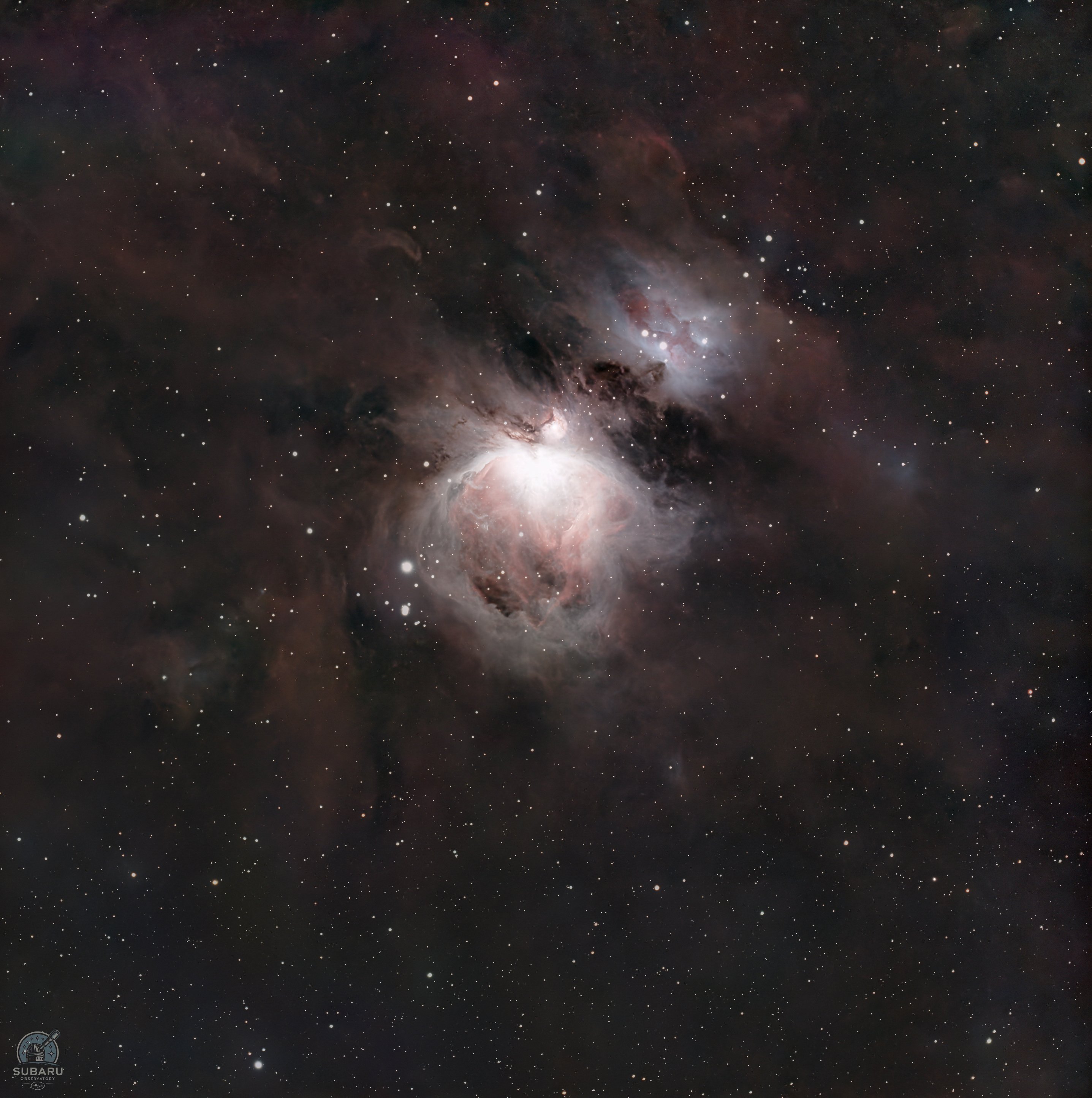
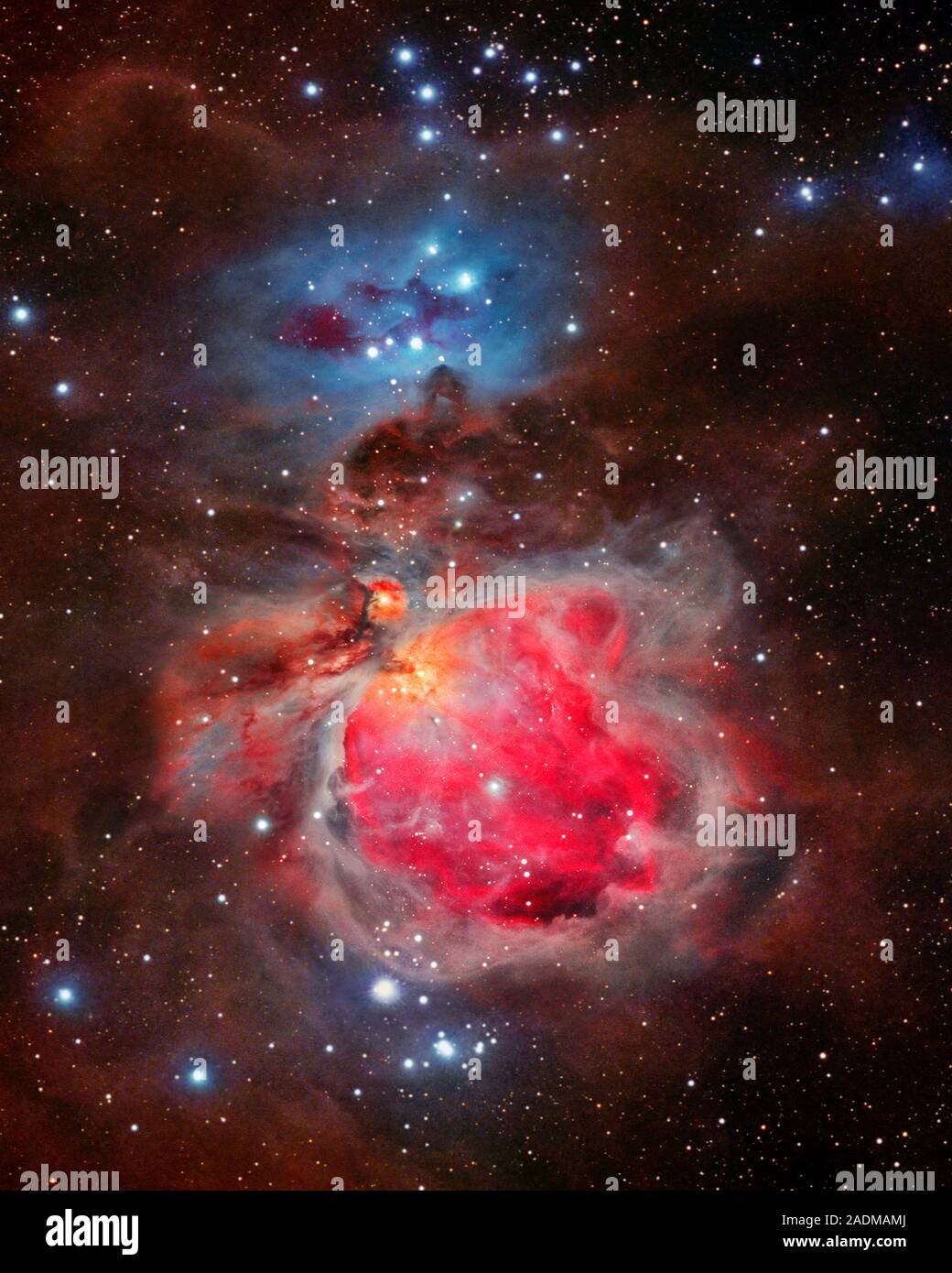
The Orion Nebula, cataloged as Messier 42 (M42) or NGC 1976, is a massive diffuse nebula located approximately 1,344 light-years from Earth in the constellation of Orion. It serves as the closest region of massive star formation to our solar system, offering astronomers an unparalleled laboratory for studying stellar birth.
Understanding M42: The Great Orion Nebula
The Orion Nebula is more than just a beautiful smear of light in the night sky; it is a complex interstellar cloud of gas and dust. Visible to the naked eye even in areas with moderate light pollution, M42 appears as the middle "star" in the Sword of Orion, hanging below the famous three-star Belt. As of 2026, it remains the most photographed and scrutinized deep-sky object in the northern hemisphere, providing a cornerstone for our understanding of how stars and planetary systems evolve.
Scientifically, M42 is classified as an H II region. This means it is a large cloud of partially ionized gas—primarily hydrogen—where star formation has recently taken place. The intense ultraviolet radiation emitted by young, hot stars ionizes the surrounding hydrogen gas, causing it to glow with a characteristic reddish hue. In the case of M42, this process is so energetic that the nebula is visible across vast interstellar distances.
The nebula is part of a much larger structure known as the Orion Molecular Cloud Complex. This vast assembly of gas and dust spans hundreds of light-years and includes other famous residents such as the Horsehead Nebula (Barnard 33), the Flame Nebula (NGC 2024), and M43 (De Mairan's Nebula), which is technically a part of the same cloud separated from M42 by a dark dust lane.
Physical Characteristics and Dimensions
To appreciate the scale of M42, one must look at the sheer physical volume it occupies. While it appears relatively small in a backyard telescope, the nebula spans roughly 24 light-years across. To put this in perspective, a single light-year is approximately 5.88 trillion miles. The distance from our Sun to its nearest stellar neighbor, Proxima Centauri, is only about 4.2 light-years; thus, the Orion Nebula could comfortably fit several dozen such interstellar gaps within its boundaries.
Mass and Density
The nebula contains enough material to birth thousands of stars like our Sun. However, despite its visual brightness, the gas within M42 is incredibly tenuous. The central regions have a density of roughly 10^2 to 10^4 particles per cubic centimeter. For comparison, the air we breathe at sea level contains about 10^19 molecules per cubic centimeter. The nebula's visibility is a result of its enormous depth and the efficiency with which its gas fluoresces under stellar radiation.
Chemical Composition
While hydrogen is the primary constituent, spectroscopy reveals a rich variety of elements. Helium, oxygen, nitrogen, and neon are present in significant quantities. The distinct green glow often seen in older photographs (or through large telescopes) was once thought to be a mystery element called "nebulium." We now know this is actually doubly ionized oxygen ([O III]), which emits light at a specific wavelength (500.7 nanometers) when excited by high-energy photons.
The Birthplace of Stars: Stellar Evolution in M42
The central engine driving the nebula's luminosity is the Trapezium Cluster. This is a tight group of four primary stars—designated A, B, C, and D—that are visible through even modest amateur telescopes. These stars are incredibly young, likely less than 300,000 years old, making them "infants" in cosmic terms compared to our 4.6-billion-year-old Sun.
The Trapezium and Its Influence
The most massive of these, Theta-1 Orionis C, is a blue-main-sequence star with a surface temperature exceeding 30,000 Kelvin. It produces the majority of the ionizing radiation that lights up the entire nebula. The powerful stellar winds from these massive stars are currently carving a "bubble" within the cloud, pushing back the surrounding gas and dust and eventually halting further star formation in their immediate vicinity.
Protoplanetary Disks (Proplyds)
One of the most significant discoveries made within M42—primarily through the work of the Hubble Space Telescope and more recently confirmed by the James Webb Space Telescope (JWST)—is the presence of proplyds. These are disks of gas and dust surrounding newly formed stars, representing the earliest stages of planetary system formation.
As of 2026, research indicates that over 150 of these disks exist within the Orion Nebula. However, their proximity to the Trapezium stars creates a hostile environment. The intense radiation from the massive stars is actively evaporating the gas from these disks, a process known as photoevaporation. This provides a critical look at the "survival of the fittest" for emerging solar systems, showing that many might be stripped of their planet-forming material before planets can fully coalesce.
Historical Observations and Modern Research
The history of M42 is a testament to the evolution of astronomical technology. Curiously, the nebula was not recorded by ancient astronomers like Ptolemy or Al Sufi, who likely mistook it for a single star.
- Nicholas-Claude Fabri de Peiresc (1610): Generally credited with the first telescopic discovery of the nebula.
- Johann Baptist Cysat (1611): An independent discovery by a Jesuit astronomer who compared it to a comet.
- Christiaan Huygens (1656): Published the first detailed drawing of the nebula, including the Trapezium stars.
- Charles Messier (1769): Included it as the 42nd entry in his famous catalog of "comet-like" objects.
- Henry Draper (1880): Took the first photograph of the nebula, marking the beginning of modern deep-sky astrophotography.
The Role of 2026-Era Technology
In the current year 2026, our understanding of M42 has been revolutionized by infrared and radio astronomy. Because the nebula is filled with thick dust, visible light cannot penetrate the densest regions where stars are currently being born. Instruments like the JWST and the Atacama Large Millimeter/submillimeter Array (ALMA) allow scientists to peer through the "dust curtain" to see the protostars and the complex organic molecules—such as methanol and various hydrocarbons—forming within the cold cocoons of the cloud.
Data from the Gaia mission (Data Release 3 and subsequent updates) has also refined our distance measurements and the 3D kinematics of the stars within the cluster, revealing that the Orion Nebula is not a static cloud but a dynamic, swirling mass of gas moving at several kilometers per second.
Structural Components of the Orion Molecular Cloud
The nebula is structured into several distinct features that are often discussed in technical literature:
- The Orion Bar: A prominent ridge of gas and dust that marks the boundary between the ionized H II region and the surrounding neutral molecular cloud. It is a prime location for studying "photodissociation regions" (PDRs).
- The Becklin-Neugebauer (BN) Object: A highly luminous infrared source embedded deep within the cloud, representing a massive star in its very earliest stages of life.
- The Kleinmann-Low (KL) Nebula: A region of intense star formation activity characterized by powerful outflows of gas and complex chemical signatures.
- M43 (De Mairan's Nebula): Often called the "companion" nebula, it is physically part of the same complex but is illuminated by a different star, NU Orionis.
Technical Specifications at a Glance
The following table provides a comparison of M42 with its closest neighbors and key physical parameters.
| Parameter | M42 (Orion Nebula) | M43 (De Mairan's Nebula) | M78 (Reflection Nebula) |
|---|---|---|---|
| Apparent Magnitude | 4.0 (Visible to naked eye) | 9.0 (Requires binoculars) | 8.3 (Requires telescope) |
| Distance (approx.) | 1,344 Light-years | 1,344 Light-years | 1,350 Light-years |
| Physical Diameter | ~24 Light-years | ~2 Light-years | ~4 Light-years |
| Object Type | Emission / H II Region | Emission / Reflection | Reflection Nebula |
| Primary Exciting Star | Theta-1 Orionis C | NU Orionis | HD 38563A / HD 38563B |
| Discovery Year | 1610 (Peiresc) | 1731 (De Mairan) | 1780 (Méchain) |
Observing M42: A Guide for Amateur Astronomers
For those wishing to observe M42 in 2026, the nebula remains one of the most rewarding targets for any equipment level.
Visual Observation
- Naked Eye: From a dark site, M42 looks like a fuzzy star in the center of Orion’s Sword. It is best seen during winter months in the Northern Hemisphere (summer in the Southern Hemisphere).
- Binoculars: 7x50 or 10x50 binoculars reveal the nebula's basic shape and the brightness of the central core.
- Telescopes: A 4-inch (100mm) aperture telescope will easily reveal the four stars of the Trapezium. Larger apertures (8 inches or more) start to show the intricate "wings" of the nebula and the dark dust lane (the "Fish's Mouth") that separates M42 from M43.
Using Filters
To enhance the view, observers often use UHC (Ultra High Contrast) or O III (Oxygen III) filters. These filters block out most light except for the specific wavelengths emitted by the glowing gas. This significantly improves the contrast against a light-polluted sky, making the faint outer tendrils of the nebula much more apparent.
Astrophotography
M42 is the "gold standard" for beginning astrophotographers. Because it is so bright, detailed images can be captured with relatively short exposures. Modern CMOS cameras and stacking software allow even modest setups to capture the pink and purple hues of the hydrogen-alpha emissions, as well as the blue reflection components near the nebula's edges.
Common Misconceptions About M42
One common misconception is that the nebula appears colorful through a telescope. To the human eye, M42 typically appears in shades of grey or slightly greenish-white. This is because the human eye's color-sensing "cones" are not sensitive enough to detect color in low-light conditions; instead, we use "rods," which only see in black and white. Only through large-aperture telescopes (16 inches and up) or long-exposure photography do the vibrant reds and magentas of the hydrogen gas become visible.
Another misconception is that the stars we see in the nebula are the same ones that will eventually form a solar system like ours. While many stars in M42 are Sun-like, the most prominent ones—the Trapezium—are so massive that they will likely end their lives in violent supernova explosions in just a few million years, far too quickly for complex life to evolve on any planets orbiting them.
Summary of Next Actions for Enthusiasts
If you are interested in exploring M42 further, consider these practical steps:
- Locate Orion: Use a star map or mobile app to find the constellation Orion during the evening in late autumn through early spring.
- Visit a Dark Sky Site: To see the full extent of the nebula's "wings," travel away from city lights.
- Check Citizen Science Projects: Organizations like the American Association of Variable Star Observers (AAVSO) or NASA-led initiatives often look for amateur data on young stellar objects within the Orion complex.
- Review JWST Data: Visit the STScI (Space Telescope Science Institute) gallery to view the most recent 2026-era high-resolution infrared images of the Orion Bar and the proplyds.
FAQ
Is the Orion Nebula growing or shrinking?
The nebula is currently expanding. The intense radiation and stellar winds from the Trapezium stars are pushing the gas outward, creating a large cavity in the molecular cloud. Eventually, these forces will disperse the gas entirely, leaving behind a young open cluster of stars, similar to the Pleiades (M45).
Can I see the Orion Nebula in the summer?
In the Northern Hemisphere, Orion is primarily a winter constellation. However, in the very early morning hours of late summer (August and September), Orion begins to rise in the east before dawn. By mid-winter (January), it is high in the sky during the evening.
Why is M42 called a "stellar nursery"?
It is called a nursery because it contains all the "ingredients" for stars: vast amounts of cold molecular hydrogen and dust. Gravity causes pockets of this gas to collapse, heating up until nuclear fusion begins. M42 shows stars at every stage of this process, from collapsing clouds to fully formed suns.
How does M42 differ from M43?
M43 is actually part of the same physical cloud as M42. They appear as two separate objects because a thick, dark lane of non-illuminated dust sits between them. While M42 is lit by the Trapezium stars, M43 is illuminated by a single star called NU Orionis.
What is the "Orion Bar"?
The Orion Bar is a dense, linear feature within M42 where the radiation from the Trapezium stars meets a wall of cold, dense gas. It is a critical region for scientists to study how high-energy light affects the chemistry of interstellar space.