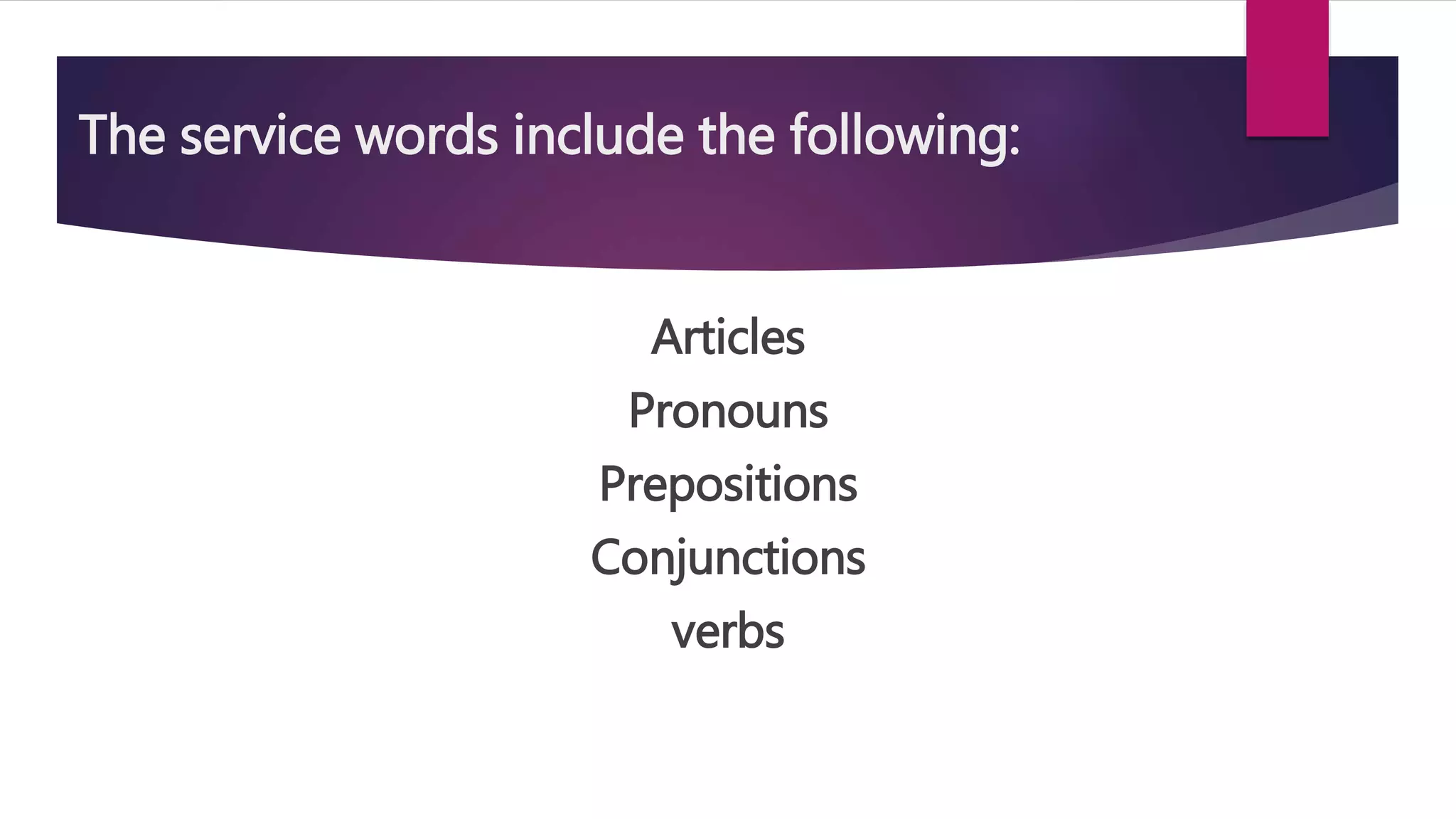
The phrase "a service" functions as a noun phrase consisting of the indefinite article "a" and the noun "service," typically serving as the subject, direct object, or object of a preposition within a sentence. Mastering its usage requires identifying whether the speaker is referring to a singular, non-specific instance of professional assistance, an act of helpfulness, or a specific functional offering provided by an entity.
Defining the Syntactic Role of "A Service"
In English grammar, "a service" acts as a singular count noun phrase. Because it is preceded by the indefinite article "a," it denotes one instance of an entity among many, rather than a specific or previously mentioned service. The way you position this phrase within a sentence determines its function and the clarity of your communication.
Subject Position
When "a service" is the subject of a sentence, it is the entity performing the action or the entity being described by the predicate. Example: "A service that prioritizes customer feedback often retains more long-term clients." In this instance, "a service" is the grammatical subject, and the relative clause "that prioritizes customer feedback" modifies the noun, defining what specific type of service is under discussion.
Object Position
"A service" frequently appears as the direct object of a transitive verb. In this role, it represents the entity receiving the action or the goal of the sentence's subject. Example: "The startup launched a service designed to streamline remote collaboration." Here, the subject "The startup" performs the action of "launching," and the object of that action is "a service." The descriptive phrase that follows clarifies the purpose of that service.
Object of a Preposition
You will often see the phrase following a preposition, which indicates a relationship in time, space, or function. Example: "We are looking for a service at a price that fits our current annual budget." In this case, "a service" acts as the object of the preposition "for," placing the noun in the context of a search or requirement.
Contextual Nuances: When to Use "A Service" vs. "The Service"
The most common point of confusion for writers lies in selecting the correct article. The choice between "a" and "the" fundamentally changes the meaning of the sentence.
- "A Service": Used when the service is indefinite, non-specific, or being introduced for the first time. It implies that the listener or reader does not yet know which service you are discussing.
- "The Service": Used when the service is definite, specific, or has been previously introduced. It implies that both the speaker and the listener have a shared understanding of which specific service is meant.
Comparative Usage Table
| Context | Indefinite ("A Service") | Definite ("The Service") |
|---|---|---|
| Introduction | "We need a service for tax prep." | "The service we hired arrived late." |
| Generality | "A service is often judged by its speed." | "The service at this cafe is excellent." |
| Hypothetical | "If a service fails, contact support." | "The service failed to meet the SLA." |
Practical Applications in Professional Writing
In professional and technical contexts, precision is paramount. Whether you are drafting a service-level agreement (SLA), a project proposal, or a technical manual, how you phrase the service being offered impacts the clarity of your legal and operational expectations.
Using "A Service" in Business Documentation
When writing about product offerings, using "a service" is ideal for describing a category or a potential solution. For instance, in a proposal, you might write: "Our firm provides a service that bridges the gap between legacy hardware and modern cloud integration." This phrasing effectively introduces a solution without committing the reader to a specific, previously agreed-upon technical stack.
Avoiding Ambiguity in Technical Descriptions
If you are describing a complex system, avoid using "a service" if the reader needs to identify which specific component you mean. If your system architecture has a "User Authentication Service," referring to it as "a service" in a troubleshooting guide may cause confusion. Always favor "the service" when the reader is expected to identify a specific part of a system.
Common Grammatical Errors to Avoid
Despite its simplicity, writers often fall into traps when integrating this phrase into more complex sentence structures.
Subject-Verb Agreement
A common error involves misaligning the verb when a prepositional phrase separates the subject from the verb. Incorrect: "A service provided by the companies are too expensive." Correct: "A service provided by the companies is too expensive." Even though the plural "companies" is closer to the verb, the head noun is "service," which is singular. The verb must agree with "service."
Dangling Modifiers
Ensure that the descriptive phrases attached to "a service" logically modify the noun. Incorrect: "By optimizing the codebase, a service was created that runs faster." Correct: "We created a service that runs faster by optimizing the codebase." The second version clearly indicates who created the service, avoiding the ambiguity of the dangling modifier found in the first sentence.
Integrating "A Service" into Complex Sentences
As your writing becomes more sophisticated, you may find yourself using "a service" as part of a list or a compound structure. When listing multiple items, ensure that the use of "a" remains consistent unless the specific items require otherwise.
Example: "We implemented a service for data migration, a service for user authentication, and a service for log management." While this is grammatically correct, it is repetitive. In professional writing, you might condense this to: "We implemented services for data migration, user authentication, and log management."
However, if you must keep the singular focus for clarity—perhaps because each service has a unique billing structure—retaining "a service" before each item is the most accurate way to frame the requirement.
FAQ: Common Questions Regarding Usage
Q: Can "a service" be used to refer to a person? A: In formal English, "a service" almost exclusively refers to a function, activity, or product. If you are referring to a person providing help, it is more accurate to use titles like "a provider," "an agent," or "a professional."
Q: Is it acceptable to start a sentence with "A service"? A: Yes. Starting a sentence with "A service" is perfectly acceptable. It is often used to define a concept or introduce a topic at the beginning of a paragraph. For example: "A service-oriented architecture allows for greater scalability across diverse platforms."
Q: How do I choose between "service" and "a service"? A: Use "service" as an uncountable noun when discussing the general concept (e.g., "Customer service is vital"). Use "a service" when discussing a specific, countable instance or a discrete offering (e.g., "We offer a service that cleans windows").
Q: Does the use of "a" change the formality of the sentence? A: The use of "a" is neutral. It does not inherently make a sentence more or less formal; however, because it is more precise than simply saying "service," it is often preferred in technical and contractual writing to avoid vagueness.
Q: Can "a service" be used in plural form? A: "A" is singular. If you mean multiple, you must use the plural form "services." You cannot say "a services." You would simply say "The provider offers several services."
Next Steps for Clarity
To ensure your writing remains professional and clear, perform a "definite article audit" on your drafts. Scan your documents for every instance of "a service." If you find that the reader needs to know exactly which service you are referring to, change "a" to "the" or provide a specific descriptor (e.g., "the billing service"). If the reference is meant to be generalized or introduced as a new option, keep "a" to maintain the correct tone of introduction. By balancing these choices, you provide your reader with the necessary context to navigate your technical or business documentation without confusion.