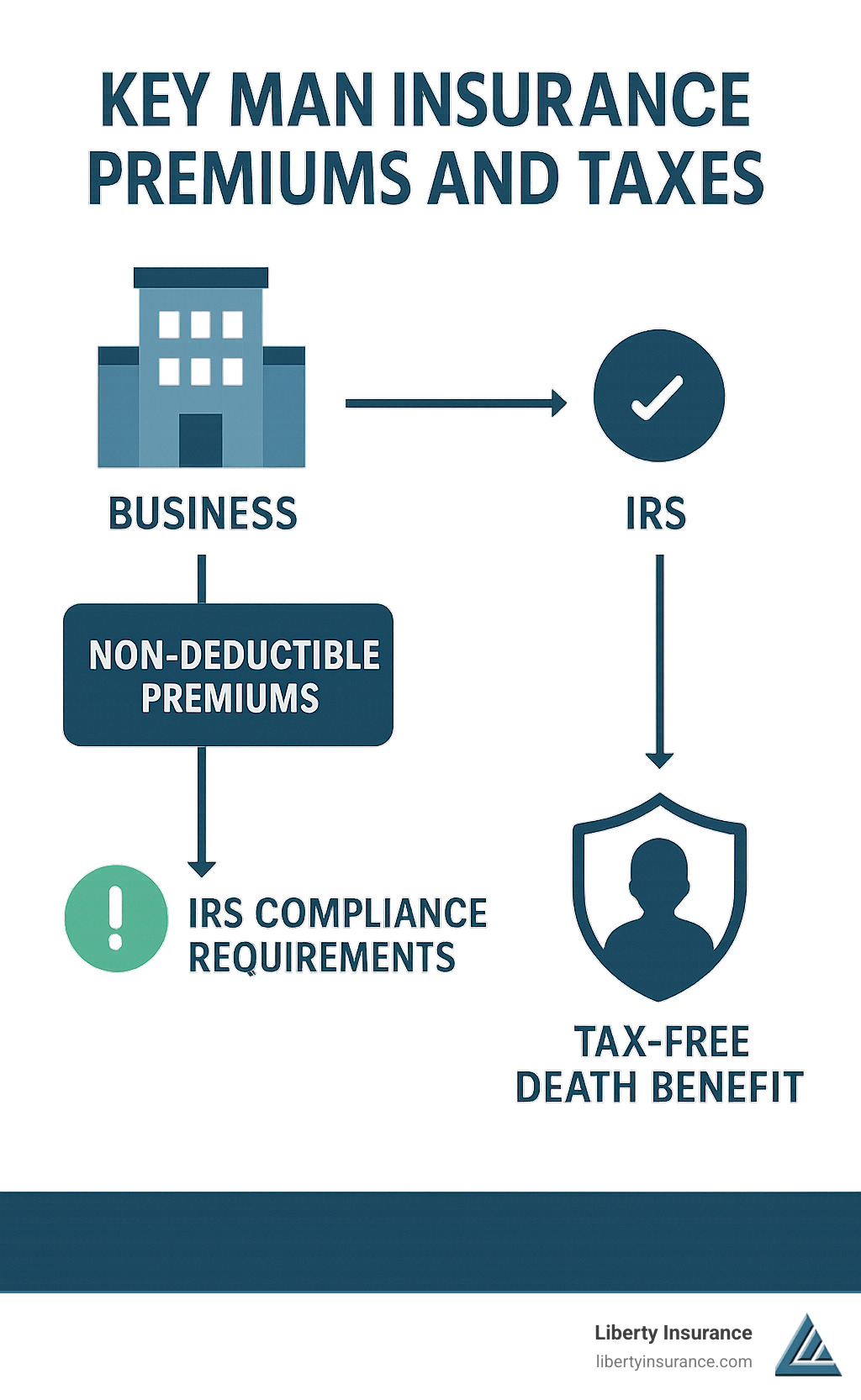
Under current United States federal tax law, key man life insurance premiums are generally not tax-deductible for a corporation. While a corporation is typically the owner and the designated beneficiary of such a policy—intended to provide financial stability upon the death or total disability of a vital employee—the Internal Revenue Service (IRS) categorizes these premiums as a non-deductible business expense. Because the corporation stands to receive the tax-free death benefit, the corresponding premiums are considered a capital investment rather than an ordinary and necessary business expense.
Understanding Key Man Life Insurance
Key man life insurance, often referred to as "key person insurance," is a life insurance policy purchased by a business on the life of an essential employee, officer, or business owner. The primary purpose of this financial instrument is to mitigate the economic risk associated with the loss of a person whose absence would cause a significant downturn in company operations, revenue, or creditworthiness.
For most corporations, the "key" individual is typically someone whose unique skill set, client relationships, or specialized knowledge drives a substantial portion of the company’s success. When such an individual dies, the corporation faces multiple financial stressors, including the cost of finding and training a replacement, the potential loss of revenue during the transition, and the potential impact on creditors or investors who may lose confidence in the company’s stability.
By owning a key man policy, the corporation ensures that it receives a cash infusion in the form of a death benefit if the covered individual passes away. This liquidity can be used to pay off corporate debts, provide for business continuity, or even fund a buyout of the deceased’s interest in the firm, depending on the structure of the underlying shareholder agreements.
The Tax Treatment of Premiums: Why They Are Non-Deductible
The IRS maintains strict regulations regarding the deductibility of life insurance premiums. The fundamental rule, codified under Section 264 of the Internal Revenue Code, specifies that no deduction is allowed for premiums paid on any life insurance policy if the taxpayer is directly or indirectly a beneficiary under the policy.
The Beneficiary Test
Because the corporation is the named beneficiary on a key man policy, it fails the "beneficiary test" for tax deductibility. From the perspective of the IRS, if the corporation were allowed to deduct the premiums as a business expense and simultaneously receive the death benefit tax-free, the corporation would be gaining a "double tax benefit." The tax code is specifically designed to prevent this scenario.
Capital Investment vs. Business Expense
The IRS distinguishes between expenditures that are "ordinary and necessary" for day-to-day operations—such as office rent, utilities, or employee salaries—and those that function as capital investments. Key man insurance is viewed as an asset of the corporation. Just as purchasing a piece of machinery or real estate is not immediately deductible in full as an expense, paying for a policy that creates a cash-value asset or provides a future tax-free payout is classified as a non-deductible capital outlay.
Tax Implications of the Death Benefit
While the premiums are not deductible, there is a significant tax advantage on the other end of the transaction: the death benefit. In most standard corporate-owned life insurance (COLI) arrangements, the death benefit paid to the corporation is generally received income tax-free.
However, this tax-free status is contingent upon compliance with the notice and consent requirements outlined in the Pension Protection Act of 2006. For a corporation to receive the proceeds tax-free, it must:
- Provide written notice to the employee stating that the corporation intends to insure their life and the maximum face amount of the policy.
- Obtain written consent from the employee to be insured.
Failure to secure this documentation can lead to the death benefit being treated as taxable income to the corporation, significantly diminishing the policy's value as a risk-management tool.
Comparison of Tax Treatments
To better understand how different life insurance structures affect corporate taxation, the following table summarizes the general tax treatment of various arrangements.
| Insurance Structure | Premium Deductibility | Taxability of Death Benefit |
|---|---|---|
| Key Man (Corporate Owned) | Not Deductible | Typically Income Tax-Free |
| Group Term Life Insurance | Tax-Deductible | Income Tax-Free |
| Split-Dollar Plan | Varies by Agreement | Varies by Ownership |
| Executive Bonus (Section 162) | Fully Deductible | Income Tax-Free |
Alternative Structures and Strategic Planning
Because premiums for key man insurance are not deductible, many corporations explore alternative ways to provide insurance benefits or protect their interests that might allow for different tax outcomes.
Section 162 Executive Bonus Plans
Under a Section 162 plan, the corporation pays the premiums on a life insurance policy owned by the employee. Because the premium is considered additional compensation to the employee, it is fully deductible by the corporation as a business expense. The employee includes the premium amount in their gross income, but they retain ownership of the policy. This structure is often used as a retention tool for key talent rather than as a mechanism to protect the corporation from the loss of that individual.
Group Term Life Insurance
For employees generally, corporations may offer group term life insurance. Premiums paid by the employer for coverage up to $50,000 per employee are generally deductible by the corporation and are not considered taxable income to the employee. This is a broad-based benefit rather than a specialized key person policy, but it remains a common way for businesses to utilize tax-deductible insurance premiums.
Split-Dollar Life Insurance
In some cases, corporations use split-dollar arrangements, where the corporation and the employee share the costs and the benefits of the policy. The tax treatment of these plans is highly technical and depends on whether the "economic benefit" or "loan" regime applies. These are often used by high-net-worth business owners to move life insurance assets out of their estate while having the corporation fund the policy. Given the complexity, these plans require rigorous legal and accounting oversight.
Common Mistakes and Compliance Requirements
Corporations often make the mistake of assuming that any insurance premium paid for an employee is a deductible expense. Failing to correctly categorize these payments on corporate tax filings can trigger audits or result in penalties if the company improperly claims deductions for key person policies.
- Inaccurate Classification: Ensuring that the policy is clearly identified in the corporate ledger as "Key Person Insurance" rather than "Employee Benefit" helps prevent confusion during tax preparation.
- Missing Consent Forms: As noted, without written consent from the key employee, the tax-free status of the death benefit is jeopardized. This documentation must be kept in the corporate records permanently.
- Ignoring State Law: Beyond federal tax rules, state insurance laws may impose specific requirements for the insurable interest of the corporation in the employee. If the corporation lacks an "insurable interest"—meaning the death of the employee would not cause the company a verifiable financial loss—the policy may be legally void, and the premiums may be considered a waste of corporate assets.
The Role of Professional Guidance
Because tax laws are subject to interpretation and individual corporate structures vary widely, business owners should consult with a tax attorney or a certified public accountant (CPA) before finalizing a key man policy.
A professional can help determine whether the primary goal is protecting corporate liquidity or providing a tax-advantaged benefit to the employee. If the goal is strictly the former, the corporation must accept the reality of non-deductible premiums as a cost of doing business. If the goal is the latter, a Section 162 bonus plan may prove to be a more efficient financial strategy from a tax perspective.
Frequently Asked Questions
Is the cash value buildup in a key man policy taxable?
In a standard corporate-owned life insurance policy, the cash value buildup is generally not subject to current income tax, provided the policy remains in force and is not surrendered. However, if the policy is surrendered for its cash value, any amount received in excess of the "investment in the contract" (the total premiums paid) is typically subject to corporate income tax.
Does the death benefit affect the Alternative Minimum Tax (AMT)?
Under current tax regulations for corporations, the receipt of insurance proceeds can, in specific scenarios, impact the calculation of adjusted current earnings (ACE) for AMT purposes. While the proceeds are generally income tax-free, corporations should verify with their tax advisors whether the receipt of a large death benefit could trigger or increase AMT liability in the year of receipt.
Can I deduct the premiums if I am the sole owner of the corporation?
Even if you are the sole owner, the corporation is treated as a separate legal entity. If the corporation is the owner and beneficiary of the policy, the premiums remain non-deductible. Attempting to deduct them can be viewed as an improper business expense, which may lead to tax complications during an audit.
What happens to the policy if the key employee leaves the company?
The corporation, as the owner, typically has the right to continue the policy, cancel it, or sell it. In many cases, companies include provisions in employment contracts to allow the employee to purchase the policy from the company (a "buy-out") at fair market value if they leave. This is a complex area involving potential "transfer-for-value" rules, which can make the death benefit taxable if not handled correctly.
Is the premium deductible if the employee is also a shareholder?
No. The tax treatment remains focused on the beneficiary of the policy. If the corporation is the beneficiary, the premiums are not deductible, regardless of whether the insured person is a rank-and-file employee, a key manager, or a major shareholder.
Next Actions for Business Owners
If your corporation is considering, or currently holds, a key man life insurance policy, your next steps should be to verify your documentation and tax filings. Ensure you have properly obtained and archived the required employee consent forms as per federal requirements.
Schedule a meeting with your financial controller or corporate tax advisor to review your current insurance portfolio. Evaluate whether your existing policies align with your current business risk profile and whether your classification of these payments as non-deductible expenses is accurately reflected on your corporate tax returns. If you find discrepancies, adjust your financial reporting immediately to maintain compliance with federal tax guidelines.