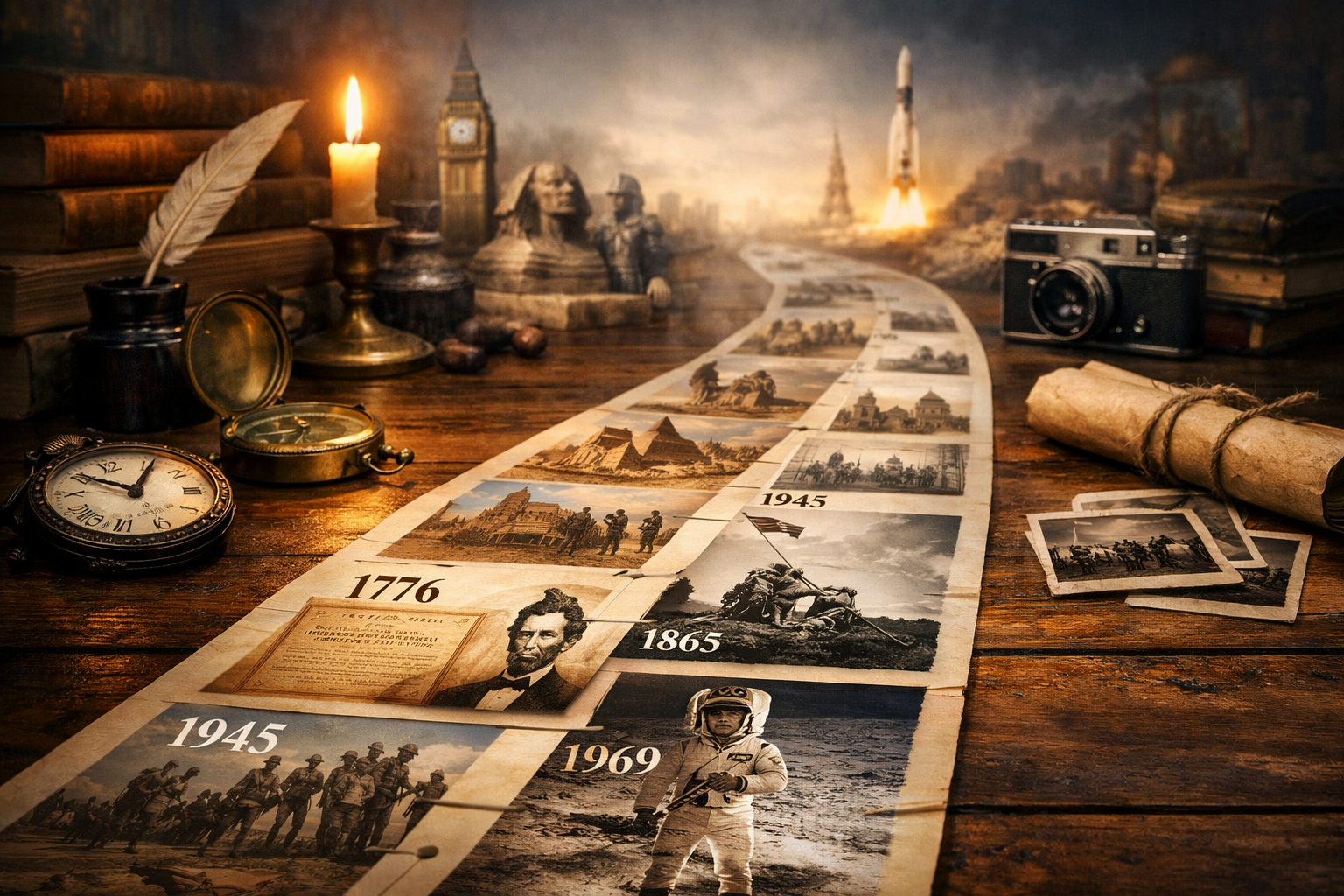
A journey through the technological history timeline reveals how human civilization evolved through the iterative application of knowledge, from the first stone tools 3.3 million years ago to the sophisticated generative AI and quantum systems of 2026. This progression illustrates a consistent drive toward efficiency, connectivity, and the mastery of physical and digital environments.
Defining Technology and the Scope of the Timeline
Before tracing the specific milestones of our technological journey, it is essential to define what constitutes technology. Derived from the Greek words techne (art or craft) and logos (reason) or logia (study), technology is the practical application of knowledge to solve problems or create tools. It is not limited to electronics or modern computing; rather, it encompasses any method, system, or device that extends human capability.
In the context of 2026, we view this timeline as a series of "revolutions" or shifts. Each era provided the prerequisite materials or energy sources for the next. For instance, the metallurgy of the Bronze Age was a necessary precursor to the mechanical engineering of the Industrial Revolution, which in turn provided the precision tools required for the semiconductor industry.
The Foundations of Innovation (3.3 Million BCE – 3500 BCE)
The earliest stage of the technological timeline is characterized by the manipulation of natural materials. The Oldowan toolkit, consisting of the first stone tools, marks the beginning of human-driven technological intervention.
The Mastery of Fire and Materials
The controlled use of fire, occurring roughly 1 million years ago, represents the first major energy revolution. Fire allowed for the cooking of food, leading to brain development, and later enabled the transition to the Neolithic Revolution. During this period (circa 10,000 BCE), humans transitioned from nomadic lifestyles to settled agriculture. This shift necessitated the development of irrigation systems, plows, and the wheel (appearing roughly 3500 BCE in Mesopotamia).
The Rise of Communication
The invention of writing systems, such as Cuneiform and Hieroglyphics, around 3200 BCE, was perhaps the most significant information technology of the ancient world. It allowed for the storage and transmission of knowledge across generations, effectively ending the reliance on oral tradition and creating the first "data storage" systems for trade, law, and history.
The Mechanical and Scientific Awakening (1000 CE – 1750 CE)
As civilizations grew more complex, the focus shifted toward precision and the harnessing of natural forces like wind and water. This era laid the groundwork for the scientific method, which would eventually accelerate technological growth exponentially.
The Printing Press: The First Information Explosion
In 1440, Johannes Gutenberg introduced the movable-type printing press to Europe. This was a pivotal moment in the technological timeline. By automating the reproduction of text, the cost of information plummeted. This democratization of knowledge was the primary catalyst for the Renaissance, the Reformation, and the Scientific Revolution. It allowed scientists like Copernicus and Galileo to share their findings, creating a feedback loop of innovation.
Horology and Navigation
The development of the mechanical clock in the 14th century and later the marine chronometer by John Harrison in the 18th century transformed human perception of time. These technologies were not merely for convenience; they were essential for global navigation and the synchronization of labor, which became critical as the world moved toward industrialization.
The Industrial Revolutions and the Power of Steam (1760 – 1900)
The 18th and 19th centuries witnessed a fundamental shift from human and animal labor to machine-assisted production. This transition, known as the First Industrial Revolution, was powered by the steam engine.
Steam and Steel
James Watt’s improvements to the steam engine (1769) allowed factories to move away from rivers. Steam power soon revolutionized transport through the locomotive and the steamship, effectively shrinking the globe. Concurrent improvements in steel production, such as the Bessemer process (1856), provided the structural material for the modern world’s infrastructure, including skyscrapers and massive bridges.
The Second Industrial Revolution: Electricity and Mass Production
Toward the end of the 19th century, the Second Industrial Revolution introduced electricity, the internal combustion engine, and the telegraph. The telegraph, pioneered by Samuel Morse, was the precursor to the internet—a system that allowed near-instant communication across continents for the first time. The arrival of the incandescent light bulb (Edison/Swan) and the alternating current (AC) systems championed by Nikola Tesla transformed urban life and extended the productive hours of the day.
The Digital Age and the Birth of Modern Computing (1900 – 1990)
The 20th century saw the most rapid technological acceleration in history. The journey shifted from mechanical power to electronic logic.
The Transistor and the Semiconductor Era
In 1947, the invention of the transistor at Bell Labs by Bardeen, Brattain, and Shockley changed everything. By replacing bulky, unreliable vacuum tubes, the transistor allowed for the miniaturization of electronic components. This led directly to the development of the Integrated Circuit (1958) and the Microprocessor (1971).
These developments followed Moore’s Law, the observation that the number of transistors on a microchip doubles approximately every two years. This exponential growth enabled the personal computer revolution of the 1980s, led by companies like IBM, Apple, and Microsoft.
The Internet and the World Wide Web
The final decade of this era saw the transition of the ARPANET (a military communication project) into the public World Wide Web. Proposed by Tim Berners-Lee in 1989, the Web provided a standardized way for computers to share information over the internet. This marked the shift from the Industrial Age to the Information Age, where data became the primary commodity of the global economy.
The Intelligence Revolution: 1990 to 2026
Entering the 21st century, the focus of the technological history timeline moved toward mobility, the cloud, and eventually, the mimicry of human cognition.
The Smartphone and Hyper-connectivity
The launch of the iPhone in 2007 synthesized cellular communication, computing, and internet access into a single handheld device. This "mobile-first" era democratized technology globally, allowing billions of people in developing nations to bypass traditional landline infrastructure and access the global economy directly via mobile banking and commerce.
The AI Inflection Point
By the early 2020s, the focus shifted to Artificial Intelligence (AI). The release of Large Language Models (LLMs) in 2022 and 2023 demonstrated that machines could perform complex reasoning, creative writing, and coding. In our current year of 2026, AI has transitioned from a novelty to a foundational utility.
Current 2026 Status:
- Generative AI: Integrated into almost every professional software suite, automating routine data analysis and content generation.
- Quantum Computing: While still in the scaling phase, 2026 has seen the first commercially viable "quantum-advantage" demonstrations in cryptography and pharmaceutical modeling.
- Energy Technology: Solid-state batteries and small modular nuclear reactors (SMRs) are beginning to decentralize power grids, addressing the massive energy demands of the AI era.
Summary of Key Technological Milestones
The following table categorizes the major shifts in technology and their primary impact on human life.
| Era | Landmark Innovation | Primary Impact |
|---|---|---|
| Prehistoric | Stone Tools / Control of Fire | Survival, diet, and environmental adaptation. |
| Agricultural | The Wheel / Writing | Trade, record-keeping, and sedentary civilization. |
| Renaissance | Printing Press | Democratization of knowledge and scientific progress. |
| Industrial | Steam Engine / Electricity | Transition to machine labor and mass production. |
| Digital | Transistor / Microprocessor | Miniaturization of electronics and personal computing. |
| Connected | The Internet / Smartphone | Global instant communication and information access. |
| Intelligence | Generative AI / Quantum Systems | Automation of cognitive tasks and complex problem solving. |
The Requirements for Future Technological Growth
Maintaining the pace of the technological timeline requires several critical prerequisites. As of 2026, the focus for researchers and governments has shifted toward these foundational needs:
- Sustainable Energy: The massive computational power required for modern AI and blockchain systems necessitates a transition to high-efficiency renewables and next-generation nuclear energy.
- Semiconductor Sovereignty: Nations are increasingly focused on the localized production of high-end chips (sub-2nm processes) to ensure supply chain resilience.
- Ethical Frameworks: As AI agents become autonomous, the "technology" of law and ethics must evolve to manage algorithmic bias and data privacy.
- Human-Machine Interface (HMI): We are seeing a move toward more natural interfaces, including high-fidelity voice interaction and the early stages of neural-link technologies.
Frequently Asked Questions
What was the most significant invention in human history?
While subjective, many historians point to the printing press as the most significant because it enabled the spread of all subsequent scientific and technological ideas. Without the ability to document and share knowledge efficiently, the rapid progress of the Industrial and Digital Revolutions would likely not have occurred.
How has the speed of technological change evolved?
The speed of change has increased exponentially. This phenomenon is often described through the lens of The Law of Accelerating Returns. While it took thousands of years to transition from stone tools to the wheel, the gap between the invention of the computer and the creation of the internet was only a few decades.
Is Moore’s Law still relevant in 2026?
In 2026, traditional silicon-based Moore's Law has reached significant physical limits regarding heat and transistor size. However, the spirit of the law continues through "System-on-a-Chip" (SoC) innovations, 3D stacking of chips, and the transition toward optical and quantum computing components.
What defines the "Intelligence Era" of the 2020s?
The Intelligence Era is defined by the shift from deterministic computing (where a computer does exactly what it is programmed to do) to probabilistic computing (where AI models learn patterns and can generate novel outputs or make autonomous decisions based on data).
How does technology impact the environment in 2026?
Technology in 2026 is a "double-edged sword." While data centers consume record amounts of electricity, new "Green Tech" such as AI-optimized power grids, carbon capture systems, and more efficient solar cells are the primary tools being used to combat climate change.
Moving Forward: Navigating the Next Horizon
Understanding the technological history timeline is more than an exercise in nostalgia; it is a roadmap for future development. For professionals and students in 2026, the key is to remain adaptable. The "journey" suggests that technology does not just replace old tools—it integrates them into more complex systems.
To stay current, individuals should focus on "technological literacy," which involves understanding the underlying logic of AI, the basics of data security, and the environmental impact of the tools they use. As we move beyond 2026, the boundary between biological and digital technology will likely continue to blur, making the study of our technological past even more vital for navigating our future.