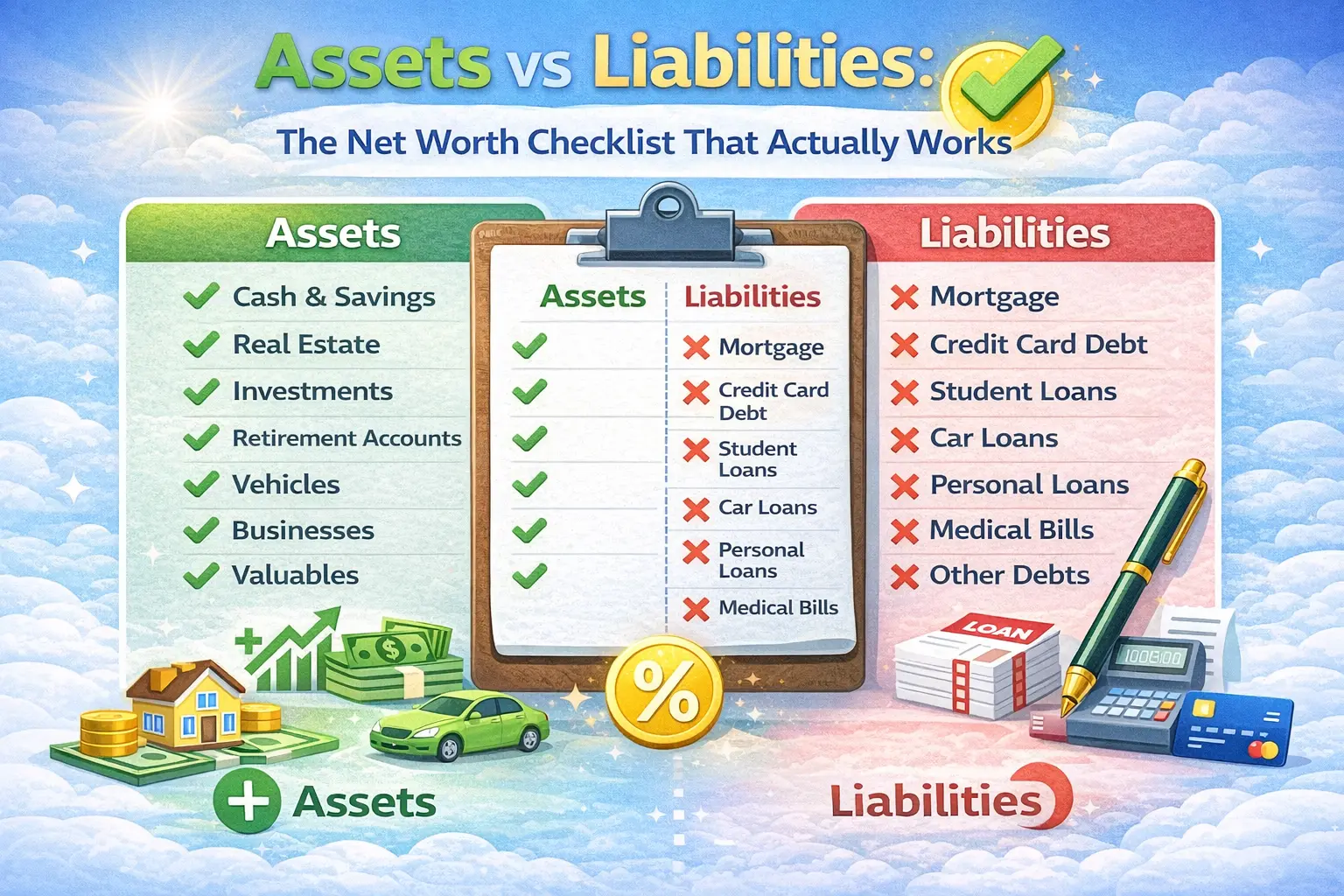
When assets and net worth having same value, it indicates a strict financial reality: an individual or business entity carries zero liabilities, meaning every single dollar of owned property or resources is entirely unencumbered by debt. In personal finance and corporate accounting, net worth is mathematically defined as total assets minus total liabilities. Therefore, a scenario where total assets equal net worth can only occur when total liabilities equal zero. While this represents a pristine balance sheet devoid of mortgages, credit card balances, car loans, or business debts, it is a relatively uncommon state for active consumers and growing enterprises who frequently leverage credit to accelerate wealth acquisition. Examining this unique financial equilibrium requires a close look at accounting equations, the practical implications of carrying zero debt, and the balance between financial security and opportunity cost.
The Fundamental Accounting Equation and Zero Liabilities
To understand why assets and net worth having same value occurs, one must look at the foundational formula of accounting:
$$\text{Assets} - \text{Liabilities} = \text{Net Worth (Equity)}$$
Rearranging this algebraic equation demonstrates the relationship more clearly:
$$\text{Assets} = \text{Net Worth} + \text{Liabilities}$$
For net worth to equal total assets, the liabilities variable must equal zero. If liabilities equal zero, the equation simplifies to:
$$\text{Assets} = \text{Net Worth}$$
In financial statements, assets represent anything of economic value owned by an entity that can be converted to cash or used to generate future economic benefits. This includes cash equivalents, real estate, investment portfolios, vehicles, equipment, and intellectual property. Liabilities, conversely, represent external obligations or debts owed to creditors, such as bank loans, accounts payable, mortgages, and bonds.
When a balance sheet shows zero liabilities, the entity has completely liquidated or never incurred external obligations. Every asset listed is 100% owned outright. For example, if a person owns a home valued at $400,000, a car valued at $20,000, and $30,000 in savings, their total assets equal $450,000. If they have no mortgage, no car loan, and no credit card debt, their liabilities are $0. Consequently, their net worth is exactly $450,000, matching their total assets dollar for dollar.
Common Scenarios Where Assets Equal Net Worth
Achieving a balance where assets and net worth having same value typically happens during specific life stages, minimalist financial movements, or conservative business models. Recognizing these contexts helps clarify whether this financial posture is intentional or merely a temporary snapshot.
1. Early Childhood or Generational Transfers
Young children who receive custodial gifts or inheritance placed entirely in trust accounts often possess assets with zero liabilities. Because minors cannot legally enter into standard debt contracts or mortgages, their balance sheets consist solely of assets gifted by parents or relatives, making their net worth equal to those holdings.
2. Debt-Free Living and the "FIRE" Movement
Adults practicing extreme frugality or participating in the Financial Independence, Retire Early (FIRE) movement often prioritize paying off all debts aggressively. Once a household achieves a state of having no mortgage, no student loans, and no consumer debt, their net worth matches their asset base. Proponents of this lifestyle value the psychological peace of mind that comes with complete financial sovereignty.
3. Pre-Operational or Wind-Down Businesses
In corporate finance, a newly formed startup before taking on operational expenses or lines of credit may consist exclusively of equity capital contributed by founders. Similarly, a business that has successfully sold off its operations, paid every single creditor, and holds only cash before final dissolution will temporarily exhibit a net worth equal to its remaining liquid assets.
Advantages and Disadvantages of Having Zero Liabilities
While having assets and net worth having same value sounds ideal to many consumers, maintaining a zero-debt posture comes with distinct trade-offs in modern financial planning.
| Financial Dimension | Zero-Liability Posture ($0 Debt) | Leveraged Financial Posture (Carrying Debt) |
|---|---|---|
| Default Risk | Practically zero; no risk of foreclosure or bankruptcy due to creditor action. | Higher; market downturns or income loss can threaten solvency if debt service fails. |
| Cash Flow Flexibility | High monthly cash flow because no income goes toward principal and interest payments. | Reduced monthly cash flow due to mandatory debt-servicing obligations. |
| Capital Growth Velocity | Potentially slower; relies strictly on organic savings and compound interest from owned capital. | Potentially faster through leverage (e.g., using a mortgage to buy an appreciating home). |
| Credit Score Impact | May lack an active credit score or show thin file characteristics due to lack of active credit lines. | Robust credit profile established through consistent, timely management of active credit. |
| Psychological Stress | Minimal anxiety related to debt collectors, interest rate hikes, or payment deadlines. | Moderate to high psychological weight associated with long-term financial obligations. |
The Opportunity Cost of Avoiding Leverage
Financial economists often point out that maintaining zero liabilities can introduce an opportunity cost known as the leverage effect. By using prudent debt—such as a low-interest mortgage or a strategic business loan—an individual can acquire income-generating assets sooner than they could by saving cash alone. If the return on the acquired asset outpaces the cost of borrowing, net worth grows faster through leverage than through a strict cash-only accumulation model.
Conversely, aggressive leverage magnifies losses during economic downturns. When asset values drop while fixed debt obligations remain untouched, net worth can plunge rapidly, sometimes turning negative if assets fall below the total debt owed (technical insolvency).
Verifying and Calculating Net Worth Accurately
To determine whether your assets and net worth having same value, you must conduct a thorough personal or corporate audit. Miscalculating either side of the balance sheet can create a false impression of absolute debt freedom.
- Total Asset Valuation
- Liquid Assets (Cash, Checking, Savings)
- Investment Assets (Stocks, Bonds, Retirement Accounts)
- Personal Use Assets (Real Estate, Vehicles, Valuables)
- Total Liabilities Audit
- Secured Debt (Mortgages, Auto Loans)
- Unsecured Debt (Credit Cards, Personal Loans, Student Loans)
- Net Worth Calculation (Assets - Liabilities = Net Worth)
Step 1: Inventory All Assets at Fair Market Value
List everything of value you own. Use current market values rather than purchase prices. For real estate, rely on recent comparable neighborhood sales or professional appraisals. For vehicles, check current trade-off valuations from reputable automotive valuation guides.
Step 2: Sum All Outstanding Liabilities
Compile every financial obligation. Include long-term debts like mortgages and student loans, as well as short-term obligations like credit card balances that must be paid off at the end of the billing cycle. Even if you pay your credit cards in full every month, the current statement balance technically counts as a liability until cleared, meaning strict equality between assets and net worth only exists at precise accounting moments (such as immediately after payment settlement).
Step 3: Subtract Liabilities from Assets
Subtract the sum of Step 2 from Step 1. If the resulting figure matches your total asset sum down to the penny, you have verified that assets and net worth having same value for your specific financial profile.
Common Mistakes in Evaluating Debt-Free Status
When evaluating financial statements, individuals frequently make errors that skew the perception of asset ownership and liability elimination.
- Ignoring Contingent Liabilities: Guaranteeing a loan for a family member or business partner creates a contingent liability. If the primary borrower defaults, that liability becomes yours, instantly disrupting the equality between assets and net worth.
- Confusing Book Value with Liquidity: Owning assets outright does not mean they can be converted to cash instantly without transaction costs or market value penalties.
- Overlooking Tax Liabilities: Unrealized capital gains on investments or pending property taxes represent future claims against assets that reduce true economic net worth.
Frequently Asked Questions
Can net worth ever be higher than total assets?
No. Mathematically, because net worth is calculated by subtracting liabilities from assets, net worth can never exceed total assets as long as liabilities are zero or positive. Net worth only equals assets when liabilities are exactly zero.
Is it financially smart to have zero liabilities?
Having zero liabilities provides exceptional security and eliminates bankruptcy risk. However, many financial planners argue that refusing all debt entirely can limit purchasing power and long-term wealth accumulation through strategic, low-interest leverage.
How often do assets and net worth equal each other in the real world?
This state is rare for working-age adults due to the prevalence of mortgages and consumer credit. It is most commonly found among retirees who have fully paid off their homes and cars, children with custodial accounts, or ultra-high-net-worth individuals who purchase assets entirely with cash.
Does paying off my credit card monthly mean my liabilities are zero?
Technically, any unpaid statement balance is a short-term liability. While paying balances in full avoids interest charges, the revolving balance represents a momentary liability until the transaction clears your bank account.
What happens to net worth if asset values drop while debt is zero?
If you have zero liabilities and asset values decline—such as during a stock market correction or a housing downturn—your net worth decreases by the exact same dollar amount as the asset drop, maintaining direct equality.
Next Actions for Financial Optimization
If you discover that your assets and net worth having same value, evaluate whether your current asset allocation aligns with your long-term goals. While eliminating debt provides psychological freedom, ensure that your liquid and fixed assets are working efficiently to combat inflation. Consult a certified financial planner or tax professional to model how integrating strategic financial tools or adjusting your asset mix might impact your long-term wealth trajectory without compromising your peace of mind.