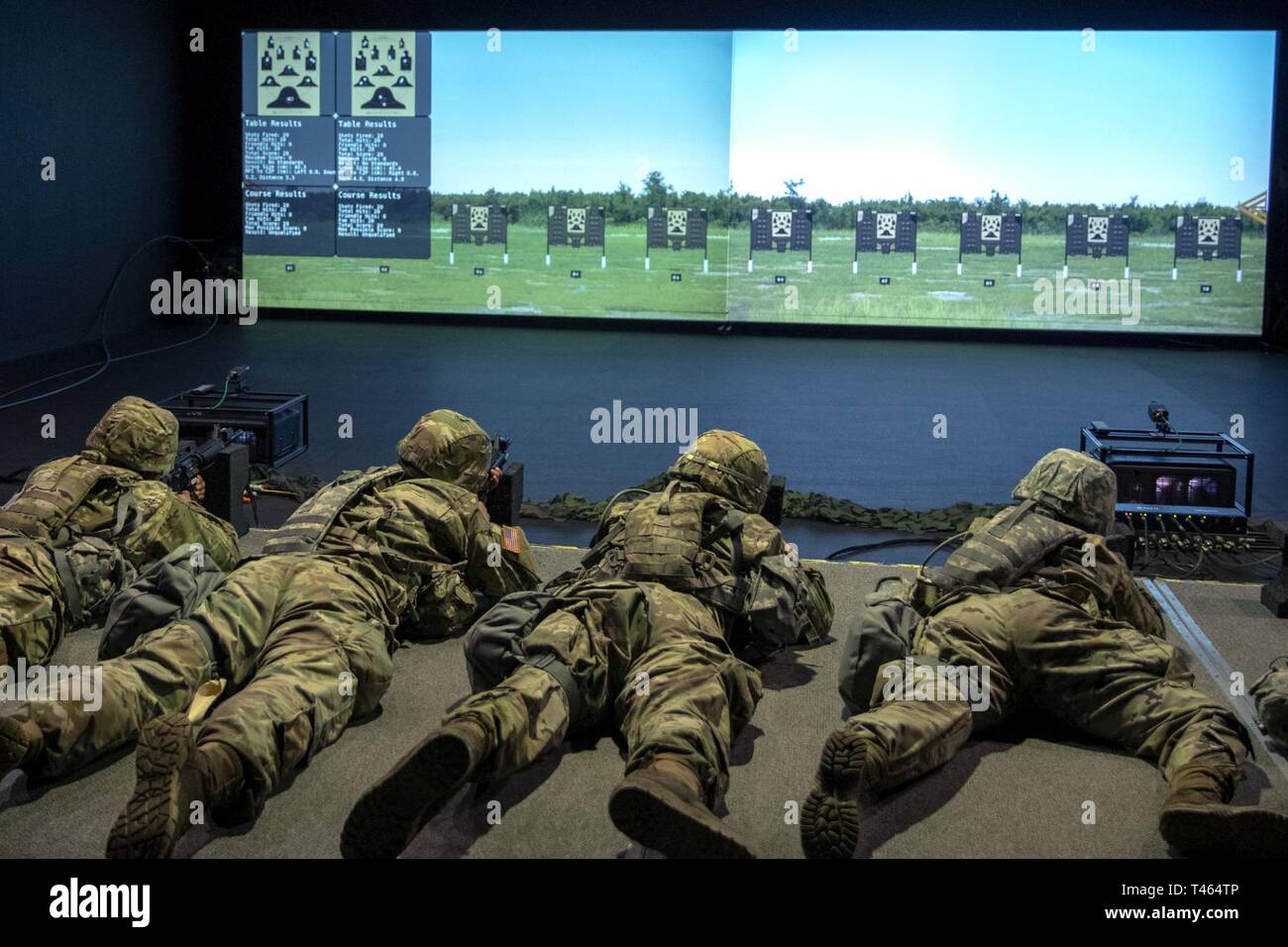
In the United States Army, the acronym EST stands for the Engagement Skills Trainer. It is a high-fidelity, laser-based small arms simulator designed to provide soldiers with initial and remedial marksmanship training. Currently operating in its advanced EST II iteration as of 2026, the system mimics live-fire conditions to improve accuracy, teach squad tactics, and refine split-second decision-making without the high costs or safety risks associated with live ammunition.
The Engagement Skills Trainer is often misunderstood by those outside the military as a mere video game or a simplified training aid. However, for the modern soldier, the EST represents a critical bridge between classroom theory and the live-fire range. It is an intricate ecosystem of hardware, software, and pneumatic systems that provides immediate, data-driven feedback on every aspect of a soldier's performance, from their trigger squeeze to their breathing patterns.
The Evolution of the EST: From 2000 to EST II
To understand the reality of the EST in 2026, one must look at its technological trajectory. The original EST 2000 was a revolutionary step in military simulation, but it had limitations in graphics, ballistics modeling, and weapon variety. The transition to the EST II system, which became the Army’s Program of Record, transformed the experience into a truly immersive tactical environment.
The current system utilizes highly sophisticated ballistics engines that account for wind, elevation, and the specific ballistic coefficients of different ammunition types. Unlike older systems that used simple "hit-scan" logic, the modern EST calculates the flight path of a virtual round in real-time. This means a soldier training on an M4 Carbine at a simulated 300-meter target must account for bullet drop and environmental factors exactly as they would at a physical range.
This evolution was driven by the Army’s need to increase "lethality" while managing shrinking budgets for physical ammunition and range maintenance. By 2026, the EST II has become a mandatory prerequisite for many units before they are even cleared to draw live rounds for annual qualification.
Technical Components: How the Reality is Created
The "reality" behind the acronym is powered by several interconnected technologies that work in unison to provide a seamless training experience.
1. Tethered Weapon Systems
The weapons used in an EST facility are not plastic toys; they are actual demilitarized small arms or high-fidelity replicas that retain the weight, balance, and mechanical feel of the real thing. These weapons are "tethered" to the system via umbilical cables that provide power and data. Inside the weapon, the firing pin is replaced with a precision infrared (IR) laser. When the trigger is pulled, the laser emits a pulse that the system’s cameras detect on the screen.
2. Pneumatic Recoil Simulation
One of the most significant aspects of the EST's realism is the recoil. High-pressure compressed air is fed through the tether into the weapon’s action. When the soldier fires, the air cycles the bolt, creating a physical kick that mimics the muzzle rise and felt recoil of a live round. This forces the soldier to practice "resetting" their sight picture and managing recoil during rapid fire or automatic bursts—skills that are impossible to learn on a static, non-recoiling simulator.
3. The Instructor Operator (IO) Station
The brain of the EST is the Instructor Operator station. From here, an NCO (Non-Commissioned Officer) can control the environment. They can change the weather from a clear day to a blinding snowstorm, adjust the time of day to test night-vision capabilities, and even induce weapon malfunctions. The IO station records every shot, allowing for a "down-range" view where the instructor can show the soldier exactly where their rounds landed and, more importantly, why they missed based on the movement of the barrel before the shot.
The Three Modes of Training
The EST is not a one-size-fits-all tool. Its software is divided into three distinct modes, each serving a different pillar of soldier readiness.
Individual Marksmanship Training (IMT)
This is the foundational layer. IMT focuses on the "Five Essentials of Rifle Marksmanship": stance, grip, sight picture, breathing, and trigger control. In this mode, soldiers fire at standard silhouettes. The reality of this mode in 2026 is its diagnostic capability. The system can track the "trace" of the weapon's barrel leading up to the shot. If a soldier is "jerking" the trigger or "flinching" in anticipation of the recoil, the IO can see the red line of the laser dipping just before the shot is recorded.
Collective Training
Collective training moves beyond the individual and focuses on the squad or platoon. In this mode, multiple soldiers stand on the firing line together, facing a massive panoramic screen. They must work together to engage groups of targets, communicate effectively, and manage "sectors of fire." This mode is critical for teaching fire discipline—ensuring that multiple soldiers don't all shoot at the same target while leaving others unengaged.
Judgemental Training (Shoot/Don't Shoot)
Perhaps the most intense application of the EST is Judgemental Training. This uses high-definition video scenarios involving civilians, journalists, and potential threats. A soldier might be presented with a scenario where an individual is running toward them. They must determine, in a fraction of a second, if the person is carrying a weapon or a camera. The system tracks not just if the soldier hit the target, but if their decision to fire was legally and tactically justified based on the Rules of Engagement (ROE).
Comparing EST Capabilities to Live Fire
While the EST is a powerful tool, it is important to understand where it stands in relation to traditional live-fire training.
| Feature | Engagement Skills Trainer (EST II) | Live-Fire Range |
|---|---|---|
| Ammunition Cost | Zero (Electricity/Air only) | High (Price per round + transport) |
| Safety Risk | Negligible | Moderate to High |
| Weather Dependency | None (Indoor/Climate controlled) | High (Subject to cancellations) |
| Feedback Speed | Instantaneous (Digital playback) | Slow (Manual target checking) |
| Recoil Realism | 80-90% (Pneumatic) | 100% (Chemical propellant) |
| Environmental Stress | Simulated (Sound/Visuals) | Authentic (Noise, heat, dirt) |
| Diagnostic Depth | High (Barrel trace/trigger data) | Low (Impact only) |
The Economic and Operational Reality
In 2026, the fiscal reality of military readiness cannot be ignored. A single day at a live-fire range for an infantry company involves thousands of rounds of 5.56mm and 7.62mm ammunition, thousands of gallons of fuel for transport, the presence of certified Range Safety Officers (RSOs), and a dedicated medical team on standby.
The EST drastically reduces these overheads. A unit can achieve "sustained" readiness by visiting the EST facility weekly. By the time that unit reaches a live-fire range, they have already worked through their "rookie" mistakes in the simulator. This ensures that when expensive live ammunition is finally used, it is used effectively to validate skills already mastered, rather than to learn them from scratch.
Furthermore, the EST allows for the training of heavy weapon systems that are rarely fired due to cost and range restrictions. Soldiers can practice with the M2 .50 Caliber Machine Gun, the MK19 Automatic Grenade Launcher, and even the AT4 Anti-Tank Weapon. The simulated "cost" of missing a shot with an AT4 in the EST is zero; in a live-fire exercise, that missed shot could represent thousands of dollars in wasted munitions.
Addressing the "Video Game" Misconception
A common criticism of the EST is that it feels too much like a game, leading to a potential lack of "fear" or "respect" for the weapon. The Army addresses this "reality gap" through strict discipline within the EST facility.
Soldiers are required to treat the tethered weapons with the same safety protocols as live firearms. Muzzle awareness, clearing procedures, and the use of the safety selector are all enforced by instructors. If a soldier fails to maintain proper form or treats the simulator flippantly, they are often removed from the session. The goal is to build muscle memory that is perfectly transferable to the real world.
Moreover, the high-definition visuals of 2026-era EST systems have moved far beyond the "polygonal" look of early simulators. The environments are rendered with photorealistic textures, dynamic lighting, and spatial audio that mimics the "crack" of rounds passing overhead. This immersion helps induce a level of physiological stress—increased heart rate and adrenaline—that prepares the soldier for the chaos of a real engagement.
Integration with the Synthetic Training Environment (STE)
As of 2026, the EST is no longer an isolated system. It has been integrated into the broader Synthetic Training Environment (STE). This allows the EST to link up with other simulators, such as vehicle trainers or aviation simulators.
In a "linked" exercise, a squad in an EST facility can provide virtual overwatch for a convoy of soldiers in a vehicle simulator miles away. This level of "distributed" training means that the reality behind the acronym is now part of a massive, interconnected virtual battlefield. This integration allows for complex mission rehearsals where every branch of the Army can practice their specific roles in a synchronized, digital environment before ever stepping foot in a combat zone.
Common Mistakes and Troubleshooting in the EST
Despite its sophistication, users often encounter hurdles that can degrade the training value if not addressed.
- Leaning on the Tether: Soldiers sometimes allow the air/data cable to dictate their movement, leading to an unnatural shooting stance. Instructors must ensure soldiers maintain a "combative" stance independent of the cable’s pull.
- Trigger "Slapping": Because there is no mechanical "bang" from a primer, some soldiers develop a habit of slapping the trigger rather than squeezing it. The IO station’s diagnostic tools are essential for catching this before it becomes a permanent habit.
- Over-reliance on the "Reset": In the simulator, "clearing" a malfunction is often a button press or a simple rack of the bolt. In reality, a jammed weapon requires more complex manipulation. Units must supplement EST time with physical "dime-and-washer" drills and mechanical training.
Frequently Asked Questions
Is the EST used for official qualification?
While the EST is a vital training tool, as of 2026, the U.S. Army still requires soldiers to qualify on a live-fire range with physical ammunition to meet their annual requirements. The EST is a "gateway" that prepares them for this qualification, and many units require a "qualifying" score in the EST before allowing a soldier on the live range.
Can the EST simulate night vision?
Yes. Modern EST systems are fully compatible with PVS-14 or ENVG-B night vision goggles. The screen can be adjusted to output IR-sensitive light that is only visible through the goggles, allowing soldiers to practice the difficult task of aiming with lasers and night optics in a dark environment.
Which weapons are currently supported in the EST II?
The system supports a wide array of the Army’s inventory, including the M4/M4A1 Carbine, M9 and M17 pistols, M249 SAW, M240B machine gun, M2 .50 Cal, MK19, and the M110 Semi-Automatic Sniper System (SASS). It even includes shoulder-fired munitions like the M72 LAW and M3 MAAWS (Carl Gustaf).
Does the EST account for wind and elevation?
Absolutely. The ballistics engine in the EST II is highly granular. Instructors can input specific wind speeds and directions, and the software will shift the point of impact accordingly. This is particularly useful for training Designated Marksmen and Snipers in long-range engagements.
How does the EST handle "friendly fire" or civilian casualties?
The Judgemental Training mode is specifically designed to penalize these actions. If a soldier fires on a non-combatant, the system flags the incident immediately, often resulting in an automatic failure of the scenario and a mandatory "after-action review" (AAR) to discuss the failure in judgement.
The Future: Where the EST Goes From Here
The reality of the Engagement Skills Trainer in 2026 is that it is no longer an "optional" or "luxury" training aid. It is the backbone of Army marksmanship. As artificial intelligence continues to integrate into the IO station, we are seeing the rise of "AI Coaches" that can provide personalized, voice-activated feedback to soldiers in real-time, identifying flaws in their technique even faster than a human instructor.
The transition toward Augmented Reality (AR) is also blurring the lines. Some EST facilities are beginning to use AR overlays on the physical screens, allowing soldiers to see virtual "teammates" or "drones" operating alongside them. This constant evolution ensures that the "Engagement" part of the acronym remains as relevant and realistic as possible, keeping the American soldier the most lethal and well-trained force on the planet.