Arizona workers' compensation regulations require nearly all employers with at least one employee to provide insurance coverage regardless of fault. Managed by the Industrial Commission of Arizona (ICA), this "no-fault" system ensures injured workers receive medical care and disability benefits while protecting employers from costly civil litigation arising from workplace accidents.
The Foundation of Arizona’s Workers’ Compensation System
The Arizona workers' compensation system is rooted in the "exclusive remedy" doctrine. Under the Arizona Revised Statutes (A.R.S.) § 23-901, this system functions as a trade-off: employees give up their right to sue their employer for negligence in exchange for guaranteed, prompt medical and financial benefits following a workplace injury.
As of 2026, the Industrial Commission of Arizona (ICA) remains the primary regulatory body responsible for overseeing the administration of these claims. The ICA does not pay benefits directly—unless the employer is illegally uninsured—but rather ensures that private insurance carriers, self-insured employers, and the State Compensation Fund (often managed through third-party providers) comply with state laws.
The "no-fault" nature of the system means that an employee's own negligence generally does not disqualify them from benefits, nor does the employer's lack of negligence exempt them from paying. However, exceptions exist for injuries that are intentionally self-inflicted or those occurring while the employee is in a state of intoxication that contributed to the injury.
Employer Mandates and Coverage Requirements
In Arizona, the requirement to carry workers' compensation insurance is one of the most stringent in the United States. If a business hires even one person—whether full-time, part-time, or a minor—it is legally obligated to provide coverage.
Who is Considered an Employee?
The definition of an "employee" under A.R.S. § 23-901 is broad. It includes every person in the service of an employer, including aliens and minors, whether lawfully or unlawfully employed. In 2026, the distinction between employees and independent contractors remains a frequent point of regulatory scrutiny. Arizona uses a "right to control" test to determine employment status. If the employer controls the method, manner, and means of the work, the individual is likely an employee, regardless of any 1099 tax designation.
Exemptions from Coverage
While the mandate is broad, a few narrow exceptions exist:
- Independent Contractors: True independent contractors who meet the multi-factor legal test are not covered.
- Domestic Servants: Workers employed solely for household domestic purposes are generally exempt.
- Casual Employment: Work that is occasional, incidental, and not in the usual course of the employer's trade or business.
- Sole Proprietors/Partners: Business owners themselves are not required to be covered but may opt-in to a policy.
The Posting Requirement
Employers must conspicuously display the "Notice to Employees" poster provided by the ICA. This document informs workers of their rights and identifies the insurance carrier responsible for claims. Failure to post this notice can lead to administrative penalties and, in some legal contexts, may affect the employer's "exclusive remedy" protections.
Types of Benefits Available in 2026
The Arizona workers' compensation system provides four primary categories of benefits designed to address the immediate and long-term impacts of workplace injuries.
1. Medical Benefits
Injured workers are entitled to all "reasonable and necessary" medical treatment related to the industrial injury. This includes doctor visits, hospital stays, surgeries, medications, and medical devices. In Arizona, the employer generally has the right to direct the employee to a specific doctor for the initial visit. Afterward, the employee may have more flexibility in choosing their physician, subject to ICA regulations and the specific insurance network's rules.
2. Temporary Disability Benefits
If a worker cannot return to work for more than seven days, they become eligible for temporary disability payments.
- Temporary Total Disability (TTD): Paid when the worker is completely unable to work. The rate is typically 66 and 2/3% of the worker’s "average monthly wage" (AMW).
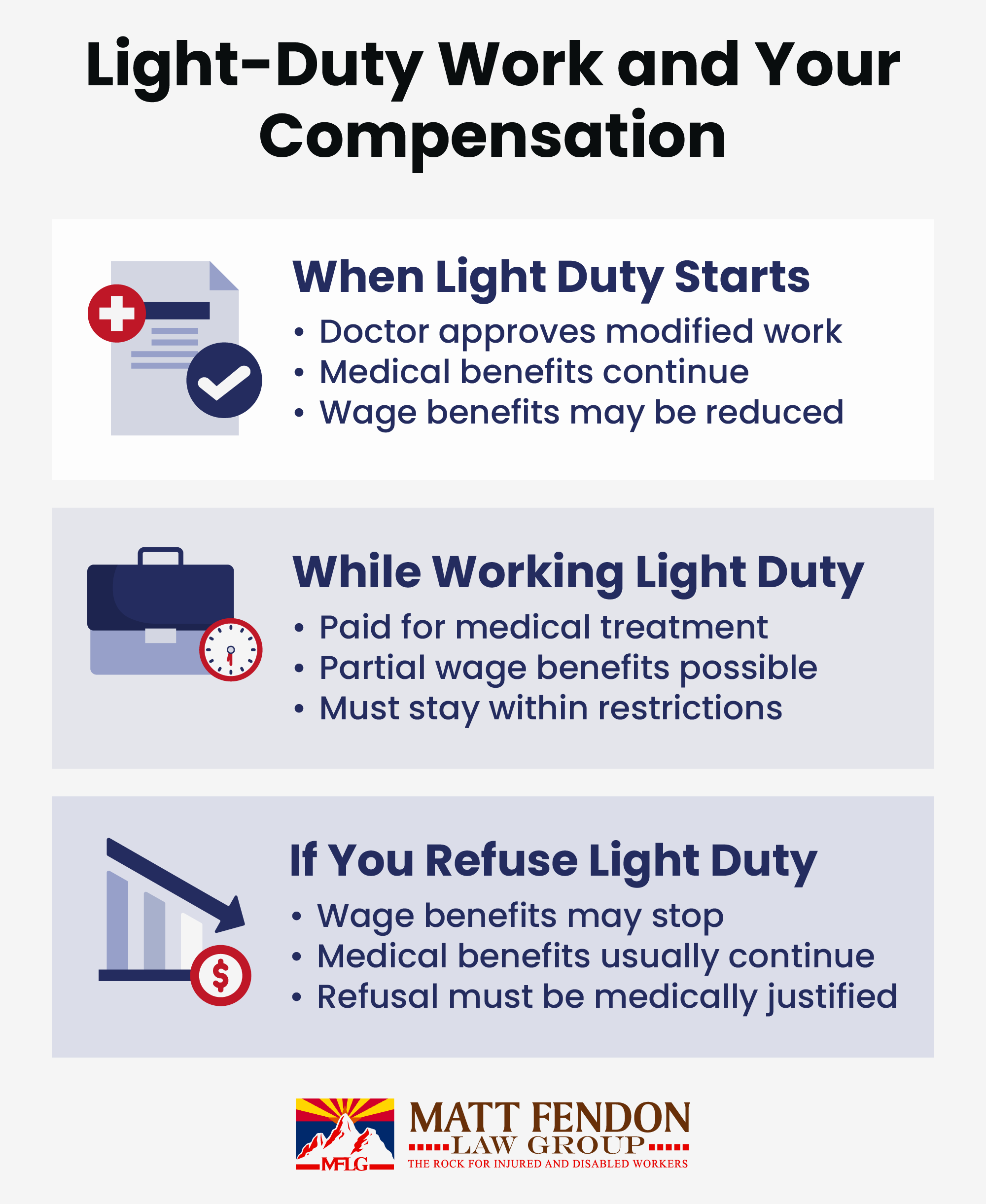
- Temporary Partial Disability (TPD): Paid when the worker returns to light-duty work but earns less than their pre-injury wage. The benefit covers 66 and 2/3% of the difference between the pre-injury AMW and the new earnings.
3. Permanent Disability Benefits
Once a worker reaches Maximum Medical Improvement (MMI), a doctor evaluates whether they have a permanent impairment. Arizona categorizes these into "Scheduled" and "Unscheduled" disabilities.
- Scheduled Injuries: These involve specific body parts like eyes, ears, or limbs. The benefit amount and duration are set by a fixed statutory schedule.
- Unscheduled Injuries: These involve the head, neck, back, or general conditions like occupational diseases or multiple body parts. These benefits are determined by the worker's "loss of earning capacity" (LEC).
4. Death Benefits
In the event of a fatal workplace accident, Arizona law provides for burial expenses (up to a statutory limit) and ongoing financial support for surviving dependents, typically a spouse and children.
Understanding the "Average Monthly Wage" (AMW)
The calculation of the Average Monthly Wage is the most critical factor in determining the dollar amount of disability checks. In 2026, the ICA sets a maximum AMW cap based on state economic data.
| Component | Description | Impact on Benefit |
|---|---|---|
| Base Salary | The regular hourly or monthly pay at the time of injury. | Primary factor in AMW calculation. |
| Overtime/Bonuses | Average overtime and performance bonuses over the previous 30 days or year. | Can significantly increase the AMW. |
| Fringe Benefits | Value of housing, utilities, or meals provided by the employer. | Included in the total wage calculation. |
| Statutory Cap | The maximum wage limit set by the ICA annually. | Limits benefits for high-earning employees. |
For 2026, it is essential for both employers and employees to verify the specific AMW cap, as this number is adjusted to account for inflation and the state's average weekly wage. If a worker earns more than the cap, their benefits are calculated as if they earned exactly the cap amount.
The Claims Process: Steps for Workers and Employers
Efficiency is vital in Arizona workers' compensation to ensure benefits are paid promptly. Both parties have specific legal responsibilities immediately following an incident.
For the Injured Worker
- Report the Injury: Notify the employer immediately. While the law allows for a reporting window, delays often lead to claim denials or investigations.
- Seek Medical Attention: Inform the healthcare provider that the injury is work-related.
- File a Claim (Form 102): The worker must file a formal "Worker’s Report of Injury" with the ICA within one year of the injury. Relying on the employer to file paperwork is a common mistake; the legal burden to initiate a claim with the ICA rests on the employee.
For the Employer
- Provide Medical Directives: Direct the employee to the appropriate medical facility.
- File an Employer’s Report (Form 101): The employer must notify the ICA and their insurance carrier within 10 days of learning about an injury that results in medical treatment or lost work time.
- Maintain Communication: Stay in contact with the insurance carrier to facilitate light-duty return-to-work programs, which can lower the overall cost of the claim.
Permanent Partial Disability: Scheduled vs. Unscheduled
The distinction between scheduled and unscheduled injuries is one of the most complex areas of Arizona's 2026 regulations.
Scheduled injuries are those listed in A.R.S. § 23-1044(B). For example, the loss of a thumb is worth a specific number of months of compensation. These benefits are paid regardless of whether the worker can return to their high-paying job.
Unscheduled injuries fall under A.R.S. § 23-1044(C). If a worker suffers a back injury (unscheduled) and can no longer work as a construction laborer but can work as a desk clerk, the insurance carrier must calculate the "Loss of Earning Capacity." If the worker's new earning potential is lower than their pre-injury wage, they may receive monthly benefits for life or until the condition improves.
Dispute Resolution and the Role of Administrative Law Judges
Not every claim proceeds smoothly. Insurance carriers may deny a claim ("Notice of Claim Status") based on lack of medical evidence, disputes over whether the injury happened at work, or disagreements regarding the AMW.
When a dispute arises, the aggrieved party (usually the worker) must file a Request for Hearing within 90 days of the denial notice. These hearings are conducted by the ICA's Administrative Law Judge (ALJ) Division.
The hearings are formal legal proceedings. Evidence is presented, witnesses are cross-examined, and medical experts often provide testimony. The ALJ then issues a written decision. If a party is dissatisfied with the ALJ's decision, they can request a "Review" and, eventually, appeal to the Arizona Court of Appeals.
Common Pitfalls and Compliance Risks
In 2026, Arizona continues to strictly enforce workers' compensation compliance. Business owners face significant risks if they fail to adhere to these regulations.
- Misclassification of Workers: Labeling an employee as an "independent contractor" to avoid paying premiums is a violation of state law. The ICA can issue "Cease and Desist" orders and impose civil penalties of up to $10,000 for non-compliance.
- The "Uninsured" Trap: If an employee is injured while working for an uninsured employer, the ICA’s Special Fund may pay the benefits. However, the ICA will then seek reimbursement from the employer, including a 10% penalty and potential criminal charges.
- Statute of Limitations: Workers often miss the one-year filing deadline because they believe their employer’s internal report was sufficient. The one-year limit for filing with the ICA is strictly enforced with very few exceptions.
Frequently Asked Questions
Can I choose my own doctor for a work injury in Arizona?
In Arizona, your employer or their insurance carrier can generally choose the doctor for your first visit after an injury. Following that initial evaluation, you may have the right to request a change of doctor through the ICA, provided you follow the specific regulatory procedures. If your employer is self-insured and has a registered medical plan, you may be required to stay within their network.
What happens if my employer doesn't have workers' compensation insurance?
If you are injured while working for an uninsured employer, you should still file a claim with the Industrial Commission of Arizona. The ICA’s Special Fund covers benefits for employees of uninsured businesses. The ICA will then pursue the employer for the costs of the claim, plus significant penalties and interest.
Does workers' comp cover mental health issues or stress?
Arizona law allows for "mental-mental" claims (psychological injury without a physical injury), but the standard of proof is high. The worker must demonstrate that the stressful pressures were "extraordinary and unusual" compared to the pressures experienced by average employees in similar positions. These claims are frequently contested and often require expert psychiatric testimony.
Can I be fired for filing a workers' compensation claim?
Arizona is an at-will employment state, but it is illegal for an employer to retaliate against an employee specifically for filing a workers' compensation claim. If you are terminated solely because you filed a claim, you may have grounds for a wrongful termination lawsuit under the "public policy" exception to at-will employment.
How are pre-existing conditions handled?
A pre-existing condition does not automatically disqualify you from benefits. If a workplace accident aggravates or accelerates a pre-existing condition, the resulting disability is generally compensable. The insurance carrier is responsible for the degree of disability caused by the workplace incident.
Practical Recommendations for 2026
For employers, the most effective strategy is proactive risk management. Ensure all safety protocols are updated to meet 2026 standards, and maintain clear records of all employee classifications. Utilizing a "Return to Work" program can significantly reduce the duration of temporary disability payments and lower your experience rating, eventually reducing insurance premiums.
For employees, the key is documentation and deadlines. Always report an injury in writing, even if it seems minor at the time. Ensure you file your "Worker’s Report of Injury" directly with the Industrial Commission of Arizona rather than assuming your employer’s insurance company has handled it. If a claim is denied or if you are pressured to return to work before you are physically ready, consulting with a legal professional specializing in Arizona labor law is highly recommended.
The Arizona workers' compensation system is designed to be self-executing, but its complexity requires diligence from all parties involved to ensure that the protections it provides are fully realized.