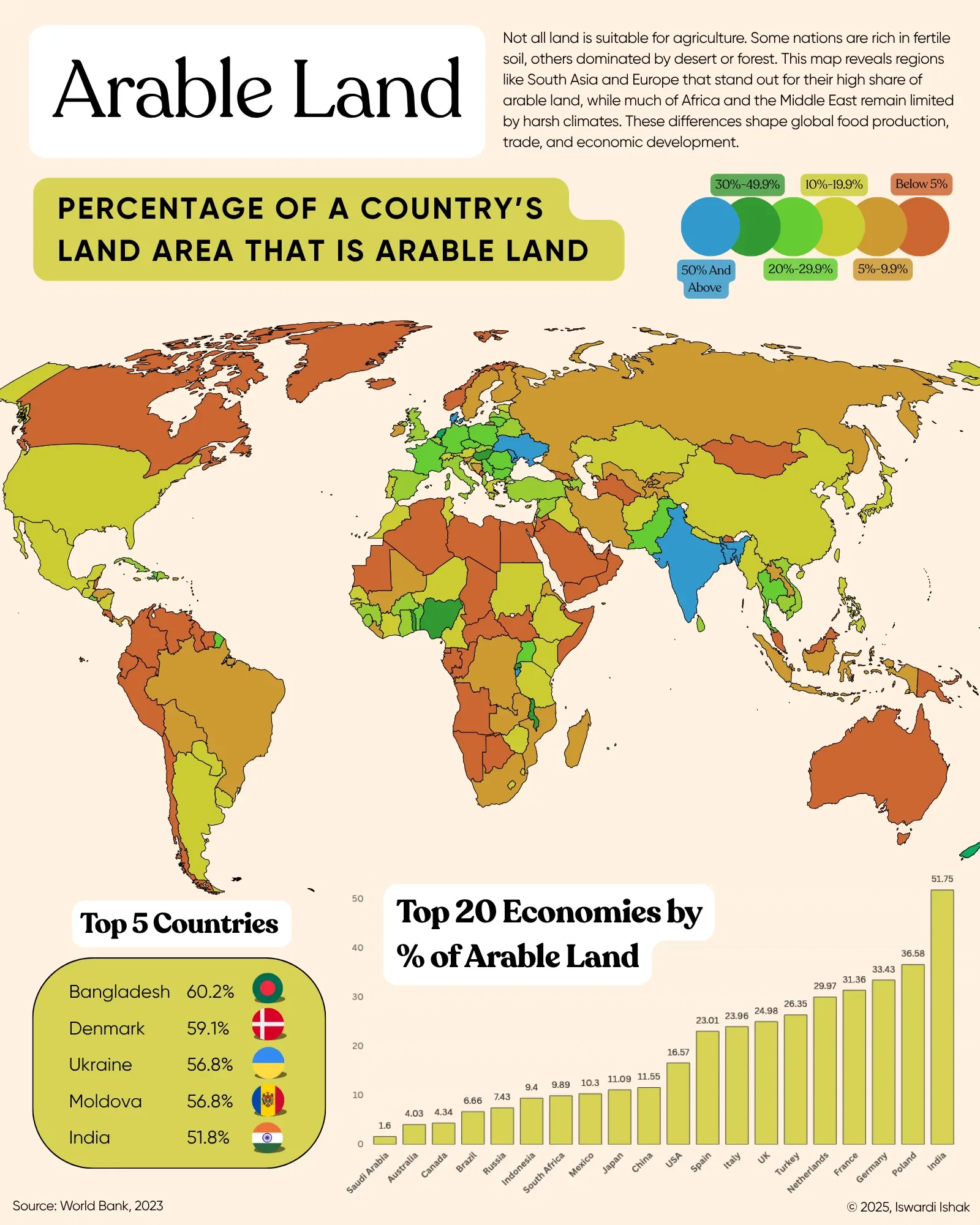
As of 2026, Russia maintains one of the world’s most significant reserves of arable land, characterized by vast expanses of fertile black soil (chernozem) primarily located in the southern and central regions. The country’s agricultural sector continues to leverage these extensive resources to maintain its position as a global leader in grain exports, though production remains influenced by climate variability, infrastructure constraints, and complex land-tenure legislation.
Understanding the Scope of Russian Arable Land
Russia’s agricultural identity is fundamentally tied to its geography. The country holds roughly 10% of the world’s arable land, a massive endowment that underpins its strategic importance in global food security. However, the distribution of this land is highly uneven. The most productive zones are found in the "Black Earth" region (Central and Southern Federal Districts), which includes the North Caucasus. These areas feature deep, humus-rich soil capable of supporting high-yield wheat, corn, and sunflower production without intensive chemical fertilization.
Beyond the fertile south, the landscape shifts toward the Non-Black Earth zone in the northwest and central regions. Here, the soil is generally acidic and requires significant remediation, such as liming, to be viable for large-scale commercial farming. As of 2026, the modernization of agricultural machinery and the adoption of precision farming techniques have allowed some previously abandoned or marginal lands in these northern regions to be brought back into rotation, though the economic viability of these lands remains highly sensitive to market prices for energy and fertilizer.
Land Tenure and Regulatory Framework
For investors, agricultural entities, or researchers looking at Russian arable land, the legal framework is the most critical prerequisite for operation. Land ownership in Russia is governed by a combination of the Land Code of the Russian Federation and various federal laws regulating agricultural land circulation.
Foreign Ownership Constraints
A pivotal constraint for non-residents is that foreign citizens, stateless persons, and foreign legal entities are prohibited from owning agricultural land in Russia. They may only hold land through lease agreements, which are typically subject to specific terms and can be limited in duration. Understanding these boundaries is essential for any entity planning to integrate into the Russian agricultural supply chain.
The Land Consolidation Process
Many agricultural regions in Russia face the challenge of "land share" issues—a legacy of post-Soviet privatization where large collective farms were divided into thousands of small, often undocumented, private shares. Consolidating these shares into a single, commercially viable plot is a complex legal task that often requires:
- Cadastral Surveying: Precise mapping to define boundaries according to the Unified State Register of Real Estate (EGRN).
- Public Notice: Providing legal notice to all share owners to prevent future litigation.
- Registration: Formal filing with the Rosreestr (Federal Service for State Registration, Cadastre and Cartography).
Productivity and Economic Viability
The economic output of arable land in Russia is frequently compared to major global producers like the United States, Brazil, and Ukraine. In 2026, the focus has shifted from mere acreage expansion to increasing yield per hectare.
Regional Yield Variations
The yield potential of Russian land is not uniform. Investors and analysts often categorize land based on its climatic and soil potential:
| Region | Primary Crops | Soil Type | Productivity Level |
|---|---|---|---|
| Southern Federal District | Wheat, Sunflower | Chernozem | High |
| Central Federal District | Corn, Sugar Beet | Forest-Steppe | High-Medium |
| Volga Federal District | Grains, Oilseeds | Steppe/Mixed | Medium |
| Northwestern Russia | Potatoes, Fodder | Podzolic | Low-Medium |
The productivity of these lands is also contingent on access to logistics infrastructure. Proximity to Black Sea ports, such as Novorossiysk or the newer terminals in the Taman Peninsula, significantly increases the net return on land, as transportation costs are a major factor in the competitiveness of Russian grain on the international market.
Challenges to Sustainable Land Use
While the volume of land is vast, it is not immune to degradation. Soil erosion, particularly in the steppe regions, remains a persistent concern. Decades of intensive farming in certain areas have led to nutrient depletion.
Climate Variability
In 2026, the impact of climate change on Russian arable land is a topic of intense study. While warming temperatures have extended the growing season in northern regions (potentially opening new lands to cultivation), they have also increased the frequency and severity of droughts in the traditional breadbasket regions of the south. Irrigation investment is becoming a primary requirement for maintaining stable yields in these high-value zones.
Technological Gaps
The shift toward digital agriculture—using satellite imagery, GPS-guided tractors, and soil sensors—is the primary method being used to address inefficiencies. However, the adoption rate of these technologies is uneven. Large agro-holdings (massive corporate farming operations) lead in the adoption of these tools, whereas smaller independent farms often struggle with the capital expenditure required to modernize.
Comparing Agricultural Land Use Models
The structure of agricultural land management in Russia is unique due to the coexistence of three distinct types of operations:
- Agro-holdings: Large, vertically integrated corporations that control millions of hectares. These entities prioritize economies of scale, standardizing their approach across multiple regions.
- Family/Small-scale Farms (KFH): These are independent, often family-run operations. They are more agile and better at managing local soil conditions but often lack the capital to invest in long-term infrastructure.
- Household Plots (LPH): Small plots typically used for subsistence or local market supply. While individually small, they collectively account for a significant portion of vegetable and potato production in the country.
Frequently Asked Questions
Is all of Russia’s arable land currently being farmed?
No. While there are vast areas of highly fertile land, significant portions remain fallow or are used for low-intensity grazing. Economic factors, such as the high cost of clearing overgrown land or the lack of nearby infrastructure, prevent these areas from being brought back into full-scale crop production.
How does soil quality affect the value of land in Russia?
Soil quality is the primary determinant of land price. Plots in the "Black Earth" regions of the south command the highest prices due to their natural ability to produce high yields with minimal input. Conversely, land in the north requires significant investment in fertilizers and soil conditioning, which reduces its immediate market value.
Can foreign companies participate in Russian agriculture?
Yes, but they cannot own the land. They participate primarily through the formation of Russian legal entities, long-term leasing, or as technology and service providers for local agricultural companies. Any direct land ownership is strictly reserved for Russian entities or citizens.
What is the role of the government in managing agricultural land?
The Russian government plays a central role in land management, particularly through the Ministry of Agriculture. It monitors land use, provides subsidies for large-scale reclamation projects, and regulates land ownership through the federal register. It also implements export quotas and taxes on grain, which indirectly affect the profitability and market value of the land.
What are the main risks for investing in Russian agricultural land?
The primary risks include political and economic shifts, currency volatility affecting the cost of imported machinery and chemicals, and climate-related events such as localized droughts. Legal risk regarding title clarity is also a factor, making thorough due diligence in the cadastral register a mandatory step for any transaction.
Practical Guidance for Engagement
For those evaluating the potential of arable land in Russia, the most effective next step is to conduct a multi-layered site analysis. This begins with verifying the status of the land via the Rosreestr public map, which provides current cadastral numbers and identifies any encumbrances on the land.
Prospective users or investors should avoid relying on generalized regional reports. Instead, focus on soil-testing data from specific plots, as variations in soil chemistry can exist even within the same district. Engage with local agronomists who possess firsthand knowledge of regional microclimates and recent moisture levels. If you are representing an organization, prioritize partnerships with established local entities that understand the intricacies of Russian land law and the logistical realities of moving produce to market.