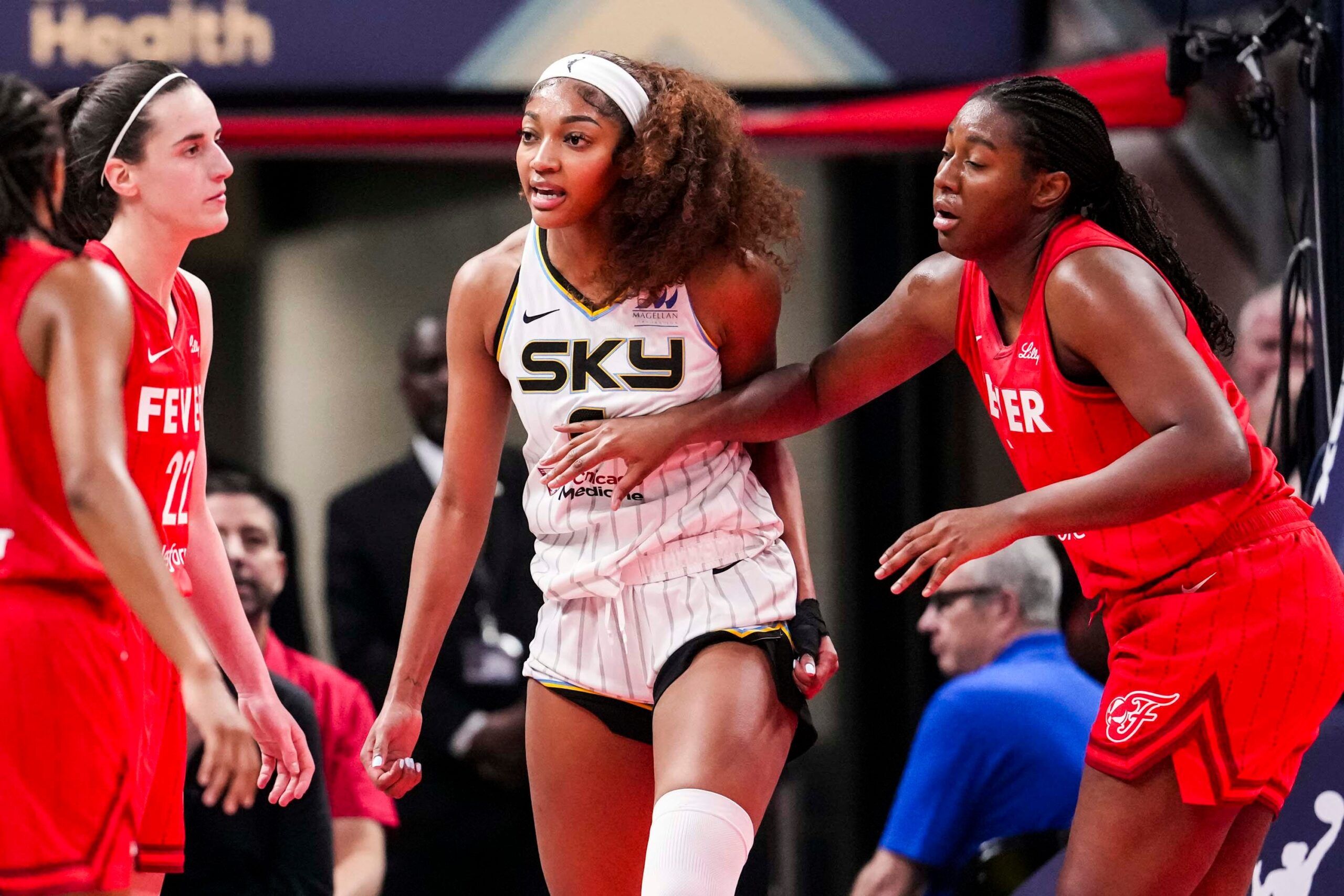
The debate surrounding Angel Reese versus Caitlin Clark highlights two distinct basketball philosophies that transformed the women's game. Clark excels as a perimeter scoring machine and elite facilitator, while Reese dominates inside as a relentless offensive rebounder and defensive presence. Together, their dynamic rivalry drove historic growth in NCAA and WNBA viewership.
The Origins of the Rivalry: From the 2023 NCAA Final to the WNBA
The national narrative surrounding Angel Reese and Caitlin Clark intensified during the 2023 NCAA Women's National Championship game between the LSU Lady Tigers and the Iowa Hawkeyes. On April 2, 2023, LSU secured a 102–85 victory over Iowa to capture the national title. Late in the fourth quarter, Reese directed a "you can't see me" hand gesture toward Clark while pointing to her ring finger, mirroring a gesture Clark had used earlier in the tournament. The moment sparked intense media coverage, polarizing public discourse and elevating women's college basketball into mainstream cultural conversations.
Rather than diminishing interest, the competitive tension fueled unprecedented viewership for their subsequent encounters. When LSU and Iowa met again in the 2024 NCAA Tournament Elite Eight, the game drew an average of 12.3 million viewers on ESPN, setting a women's college basketball broadcast record at the time. Iowa defeated LSU 94–87 behind Clark’s 41 points and nine three-pointers, balancing the collegiate series between the two stars.
The transition to the professional ranks in 2024 brought their rivalry to the WNBA stage. Clark was selected first overall by the Indiana Fever in the 2024 WNBA Draft, while Reese was drafted seventh overall by the Chicago Sky. Their transition instantly transferred college basketball's soaring popularity to professional venues, filling arenas and driving record-breaking television ratings for WNBA broadcasts throughout their debut seasons.
Tale of the Tape: Comparing On-Court Archetypes and Skill Sets
Evaluating Angel Reese and Caitlin Clark requires understanding their fundamentally different positions, responsibilities, and structural impacts on a basketball court. Clark operates as a high-usage point guard and primary ball-handler, whereas Reese plays as a versatile forward focused on frontcourt execution, rebounding, and interior defense.
Caitlin Clark: Perimeter Threat and High-Volume Playmaker
Caitlin Clark’s game is built on extended shooting range, rapid release mechanics, and elite court vision. Operating primarily from the top of the key and in high pick-and-roll actions, Clark exerts unique "spatial gravity." Defenders are forced to pick her up well beyond the traditional 28-foot line, opening wide driving lanes and low-post options for her teammates.
- Deep Perimeter Shooting: Clark routinely attempts and converts pull-up three-pointers several feet behind the WNBA arc, forcing defensive schemes to step out into full-court or extended half-court traps.
- Passing and Floor Mapping: Clark possesses exceptional spatial awareness, enabling her to execute full-court outlet passes, skip-passes across defense zones, and precise pocket passes to rolling bigs.
- Pace Generation: She thrives in high-tempo, open-court transitions where her quick decision-making punishes unsettled defenses before they establish their half-court shape.
However, Clark's high-risk, high-reward style of play comes with trade-offs. Because she frequently attempts high-velocity skip passes and difficult off-dribble executions, her individual turnover numbers remain elevated, demanding a system that accepts occasional errors in exchange for elite offensive output.
Angel Reese: Interior Powerhouse and Glass Cleaner
Angel Reese represents the classic modern interior archetype elevated by extraordinary effort, high basketball IQ, and specialized positioning. Operating predominantly in the low post, short corner, and paint, Reese dominates through physical interior play and relentless offensive rebounding.
- Offensive Rebounding Dominance: Reese uses exceptional timing, body control, and second-jump quickness to secure offensive boards. Rather than waiting for bounces, she actively carves out leverage against boxing-out defenders.
- Defensive Versatility: Possessing lateral quickness and physical strength, Reese can switch onto perimeter wings during pick-and-roll coverage while maintaining enough strength to defend true centers in the post.
- Double-Double Engine: Her consistency in generating second-chance points and securing defensive rebounds allows her to establish reliable double-double production regardless of perimeter shooting slumps.
Reese’s primary area for growth center around interior efficiency and perimeter shooting range. While she creates a massive volume of second-chance opportunities, converting contested interior layups at higher percentages remains a key target for her ongoing development.
Statistical Breakdown: College Dominance to Professional Milestones
Both players achieved extraordinary statistical markers during their college careers and immediately set records during their 2024 WNBA rookie campaigns. Their numbers reflect their disparate roles: Clark leading in scoring volume, distance shooting, and assists, while Reese dominates in rebounding totals, offensive glass percentages, and double-doubles.
The following table details key metrics, collegiate accolades, and debut WNBA records established by both players:
| Metric / Category | Caitlin Clark | Angel Reese |
|---|---|---|
| Primary Position | Point Guard | Power Forward / Center |
| WNBA Draft Selection | 1st Overall (2024, Indiana Fever) | 7th Overall (2024, Chicago Sky) |
| College Program | Iowa Hawkeyes (2020–2024) | Maryland (2020–2022) / LSU (2022–2024) |
| NCAA Championships | Runner-up (2023, 2024) | National Champion (2023) |
| All-Time NCAA Scoring Record | 3,951 Points (All-Time NCAA Division I Leader) | 2,162 Points |
| Signature Strengths | Deep-range shooting, pick-and-roll passing, court vision | Offensive rebounding, interior positioning, defensive switching |
| 2024 WNBA Single-Season Records | Single-season assist record (337 assists), single-game assist record (19) | Consecutive double-doubles record (15 games), offensive rebounds per game |
| 2024 WNBA Awards | Rookie of the Year, All-Star Selection, All-WNBA First Team | All-Star Selection, WNBA All-Rookie Team |
During their 2024 rookie seasons, Clark became the first rookie in WNBA history to record a triple-double, later adding a second before the end of her initial campaign. She finished her debut year averaging over 19 points and 8 assists per game. Conversely, Reese established a WNBA record by securing 15 consecutive double-doubles, surpassing Candace Parker's previous streak, while averaging double-digit rebounds and over 13 points per game before a wrist injury abruptly ended her season in September 2024.
Impact Beyond the Court: Viewership, Media Attention, and WNBA Growth
The simultaneous arrival of Caitlin Clark and Angel Reese generated a measurable economic transformation for women's basketball often referred to in sports business as the "Clark-Reese Effect." Their distinct styles and compelling backstories attracted corporate sponsorship, national broadcast coverage, and record-setting live attendances.
According to official reporting from the WNBA, the 2024 season registered record-breaking growth metrics across television viewership, arena attendance, merchandise sales, and digital engagement:
- Broadcast Ratings: Games featuring Clark or Reese routinely broke linear television viewership records for the WNBA on networks including ESPN, ABC, CBS, and ION. Multiple regular-season games averaged over 1.5 to 2 million viewers, figures previously reserved for historic playoff encounters.
- Attendance Expansion: The Indiana Fever and Chicago Sky led dramatic increases in road arena attendance. Teams hosting Indiana or Chicago frequently moved games to larger NBA venues—such as Washington moving games to Capital One Arena or Las Vegas hosting games at T-Mobile Arena—to accommodate ticket demands exceeding 18,000 fans.
- Merchandise and Sponsorship: Player jersey sales reached unprecedented levels, while corporate brands secured major endorsement deals with both athletes, expanding female athlete representation across national advertising campaigns.
- Charter Travel: The unprecedented public focus and economic influx accelerated long-sought structural changes within the league, including the full implementation of league-wide charter flights for WNBA teams during the 2024 season.
Direct Head-to-Head Matchups and Key Differences in Team Roles
When comparing their direct impact during head-to-head competition, structural context matters significantly. Because Clark operates as a point guard and Reese plays as a power forward, they rarely match up against each other man-to-man on defense. Instead, their head-to-head games highlight contrasting team offensive systems.
In matches between the Indiana Fever and Chicago Sky, Indiana’s offensive strategy hinges on high-octane perimeter flow, exploiting Clark’s deep pull-up threat to force Chicago’s bigs to step up out of the paint. Chicago, by contrast, focuses on leveraging Reese’s physical advantage inside, targeting Indiana’s interior defense to generate second-chance points and create foul trouble for opposing post players.
The tactical battle centers on pace versus control. When Clark successfully pushes the tempo in transition, her teams dictate play and force opponents into track meets. When Reese establishes half-court physical control, dominating the offensive glass and forcing slow-paced half-court possessions, her team controls the rhythm of the game.
Frequently Asked Questions
Did Angel Reese or Caitlin Clark win Rookie of the Year in 2024?
Caitlin Clark won the 2024 WNBA Rookie of the Year award. She received 66 of 67 votes from a national panel of sportswriters and broadcasters following a record-breaking rookie season with the Indiana Fever in which she led the league in total assists and set multiple scoring and playmaking milestones.
How many times did Iowa and LSU play each other during their college careers?
Iowa and LSU met twice during the college careers of Clark and Reese. LSU defeated Iowa 102–85 in the 2023 NCAA National Championship Game, while Iowa defeated LSU 94–87 in the 2024 NCAA Tournament Elite Eight.
What are the main statistical differences between Clark and Reese?
Clark records higher numbers in total points, three-point field goals made, and assists, reflecting her primary role as a perimeter playmaker. Reese posts higher averages in total rebounds, offensive rebounds, and double-doubles, driven by her position as an interior forward.
Did Angel Reese and Caitlin Clark play together on the same team?
Yes. Although they are rivals on opposing WNBA teams, Clark and Reese played as teammates on Team WNBA during the 2024 WNBA All-Star Game in Phoenix, Arizona. Together, they helped lead Team WNBA to a 117–109 victory over the USA Basketball Women’s National Team.
What injuries impacted their 2024 WNBA rookie seasons?
Caitlin Clark played in all regular-season games during her 2024 rookie year. Angel Reese suffered a season-ending wrist injury (a fractured bone in her left wrist) in early September 2024, missing Chicago's final six regular-season games.
Following Their Ongoing Career Trajectories
To track the ongoing progression of Angel Reese and Caitlin Clark, evaluate these key indicators:
- Watch Defensive Schemes: Pay attention to how opposing head coaches adjust pick-and-roll defenses against Clark’s deep shooting versus how frontcourts double-team Reese in the post.
- Monitor Shooting Efficiency: Track Clark’s field-goal percentage inside the arc and turnover-to-assist ratios, alongside Reese’s paint conversion percentage and free-throw accuracy.
- Follow Official League Data: For verified real-time statistics, game schedules, and play-by-play breakdowns, utilize official data hubs provided by Basketball-Reference and the official WNBA statistics portal.