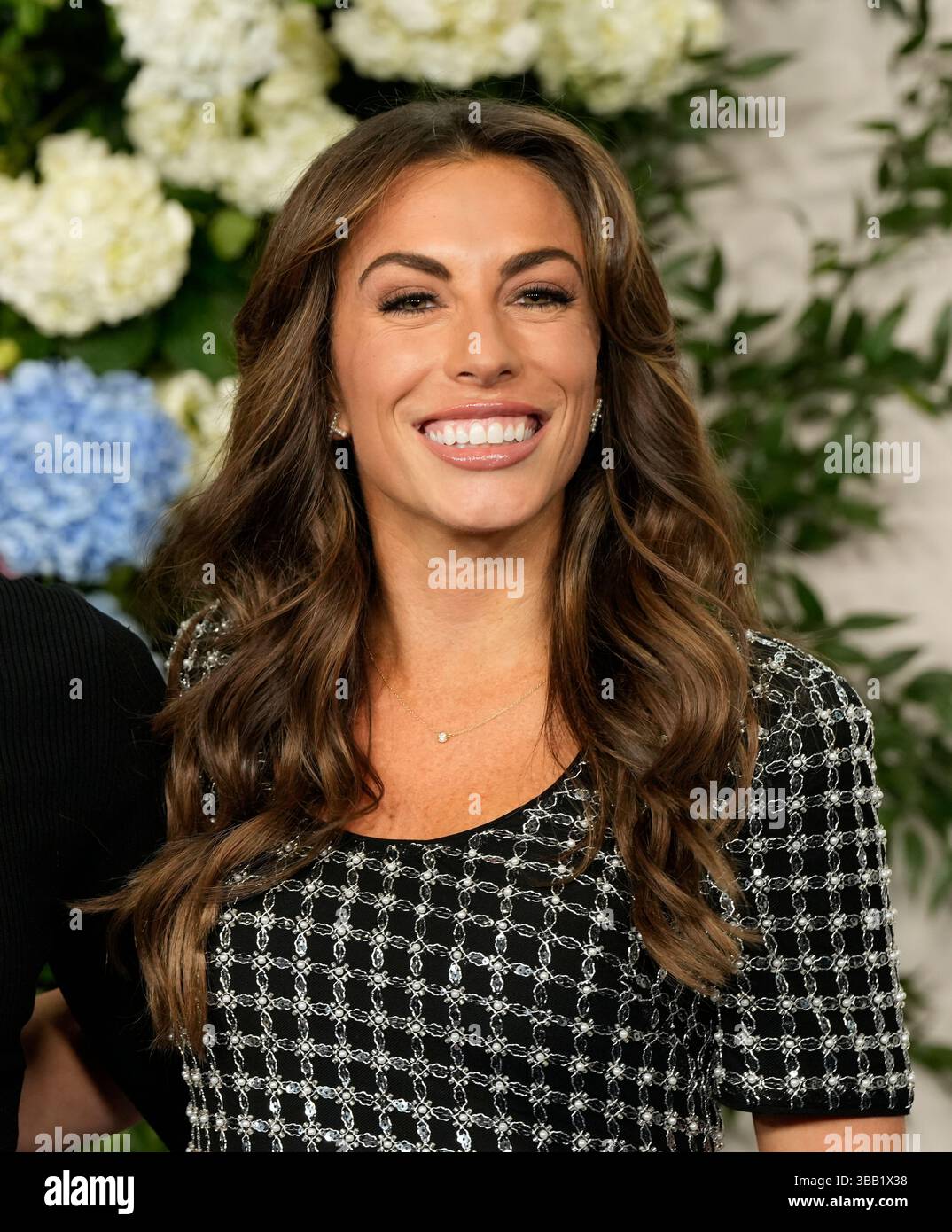
As of 2026, Alyssa Farah Griffin is 37 years old and stands as a prominent American political commentator, television host, and former government official. Currently serving as a co-host on ABC’s The View and a political contributor for CNN, she has successfully transitioned from a high-level Republican strategist to a mainstream media personality known for her critical analysis of the modern political landscape.
Biographical Background and Early Life
Alyssa Alexandra Farah Griffin was born on June 15, 1989, in Los Angeles, California. Growing up in a household deeply immersed in media and political discourse, her career trajectory seemed almost predestined. Her father, Joseph Farah, is a Lebanese-American journalist who founded the conservative news website WorldNetDaily (WND). While her later career would see her distance herself from some of the more fringe elements of the conservative media landscape, these early influences provided her with a foundational understanding of the American political machine.
Griffin’s education played a pivotal role in shaping her professional capabilities. She attended Patrick Henry College, an institution known for its focus on classical liberal arts and its track record of placing graduates in high-level government positions. During her time there, she earned a Bachelor of Arts in Journalism and Government. This dual focus allowed her to master the art of communication while simultaneously gaining a deep understanding of the legal and structural frameworks of the United States government.
Her entry into Washington D.C. politics began shortly after graduation. Like many aspiring staffers, she started with internships and junior roles that allowed her to build a network within the Republican Party. These early years were characterized by a rapid ascent through the ranks of Capitol Hill, where she quickly gained a reputation for being a disciplined and effective communicator.
The Ascent Through Capitol Hill and the Executive Branch
The career of Alyssa Farah Griffin is often categorized by her time serving in the highest levels of the U.S. government. Her trajectory within the executive branch is notable not only for the speed of her promotions but also for the critical nature of the departments she represented.
Press Secretary for Vice President Mike Pence
In 2017, Griffin joined the administration of President Donald Trump, serving as the Press Secretary for Vice President Mike Pence. In this role, she was responsible for managing the Vice President's public image and coordinating communication strategies between the OVP (Office of the Vice President) and the broader White House communications team. Her tenure under Pence was marked by a steady, measured approach to messaging, which stood in contrast to the more volatile communications environment of the West Wing at the time.
Department of Defense (Pentagon)
In September 2019, Griffin transitioned to a more specialized role, becoming the Press Secretary for the United States Department of Defense (DoD). This move was significant as it made her the youngest person to ever hold the position of Top Spokesperson for the Pentagon. In this capacity, she served under Secretary of Defense Mark Esper. Her responsibilities shifted from domestic political messaging to national security and global military operations. Dealing with complex issues ranging from Middle East tensions to cybersecurity, Griffin demonstrated an ability to handle high-stakes briefings and sensitive information.
White House Director of Strategic Communications
By April 2020, Griffin was brought back to the White House to serve as the Director of Strategic Communications. This role placed her at the center of the administration's response to several historic events, including the COVID-19 pandemic and the 2020 Presidential Election. As a senior advisor, she was tasked with long-term messaging and narrative building for the President. However, this period also marked the beginning of her eventual departure from the administration.
The 2020 Resignation and Ideological Pivot
One of the most defining moments in Alyssa Farah Griffin's career snapshot occurred in December 2020. She resigned from her position at the White House, a move that preceded the events of January 6, 2021. Following her departure, Griffin became one of the few high-ranking former Trump officials to publicly criticize the administration's claims regarding election integrity.
This pivot was not merely a change in employment but a fundamental shift in her public persona. She began to speak openly about the internal pressures within the White House and her concerns regarding the direction of the Republican Party. This transition was met with a mix of praise from those who valued her transparency and criticism from former colleagues who viewed her actions as a betrayal.
Her willingness to testify before the House Select Committee on the January 6 Attack further solidified her position as a "dissident" Republican. This cooperation with investigators provided crucial context regarding the inner workings of the White House in the weeks leading up to the transition of power. It also served as a catalyst for her next career phase: professional political commentary.
Media Career: The View and CNN
By 2022, Griffin had transitioned into a full-time media career. Her ability to provide insider perspectives on the GOP while maintaining a critical distance made her a valuable asset for major networks.
Joining The View
In August 2022, ABC announced that Alyssa Farah Griffin would join the long-running talk show The View as a permanent co-host. She was selected to fill the "conservative seat," a role previously held by figures like Elisabeth Hasselbeck and Meghan McCain. Her presence on the show brought a different dynamic; while she remained a conservative on policy issues like fiscal responsibility and national defense, her rejection of the "MAGA" movement created unique points of friction and agreement with her liberal co-hosts. As of 2026, she remains a key fixture on the panel, often acting as a bridge between traditional conservative values and a broader, more moderate audience.
CNN Political Contribution
Parallel to her work on daytime television, Griffin joined CNN as a political commentator. On CNN, she provides technical analysis of election cycles, policy shifts, and the internal mechanics of the Republican Party. Her role there is less about debate and more about expertise, utilizing her years of experience in the Pentagon and the White House to explain why certain political maneuvers are taking place.
Career Timeline and Key Milestones
The following table summarizes the professional evolution of Alyssa Farah Griffin, highlighting her rapid progression through the federal government and her subsequent media success.
| Period | Organization | Role | Key Focus |
|---|---|---|---|
| 2014–2017 | U.S. House of Representatives | Communications Director | Freedom Caucus / Rep. Mark Meadows |
| 2017–2019 | Office of the Vice President | Press Secretary | Vice President Mike Pence's messaging |
| 2019–2020 | Department of Defense | Press Secretary | National security and military briefing |
| 2020 | The White House | Dir. of Strategic Communications | Senior administration messaging |
| 2021–Present | CNN | Political Commentator | National political analysis |
| 2022–Present | ABC (The View) | Co-host | Daytime political debate and social commentary |
Current Influence and Political Standing in 2026
In 2026, Alyssa Farah Griffin occupies a unique niche in American media. She is often categorized as a "Never-Trump Republican" or a "New Guard" conservative. Her influence is largely felt among moderate voters and traditional Republicans who feel alienated by the populist shifts in their party.
Her career snapshot serves as a case study in "political rebranding," though she maintains that her core principles have not changed—only her willingness to call out what she perceives as extremism. This has made her a polarizing figure. To many on the left, she is a former "enabler" who has found a profitable path to redemption. To many on the right, she is a "RINO" (Republican In Name Only). However, her consistent presence on high-rated programs suggests that there is a significant audience interested in her specific brand of GOP-literate criticism.
Beyond television, Griffin is also involved in various advocacy groups and political action committees focused on restoring "civility" and "institutional integrity" to American politics. She frequently speaks at universities and political forums about the importance of objective truth in communications—a theme born directly from her experiences in the 2020 White House.
Analysis of Professional Challenges
Navigating a career that spans both the Trump administration and a lead role on a liberal-leaning talk show is not without its difficulties. Griffin has frequently addressed the "imposter syndrome" or the sense of being an outsider in both worlds.
- The Loyalty Test: In the current political climate, neutrality is often viewed as a lack of conviction. Griffin has had to navigate the "loyalty tests" of the modern GOP, which often result in being cast out of party circles if one does not adhere to the prevailing leadership's narrative.
- Maintaining Conservative Credentials: On The View, Griffin must defend conservative policy positions (such as the Second Amendment or religious freedom) to a skeptical audience and co-host panel. Balancing these views while also being a critic of the party's leadership requires a high level of rhetorical skill.
- Public Scrutiny: Because of her high-profile roles, Griffin’s personal life and past statements are frequently scrutinized. She has had to publicly reckon with her time in the administration, often explaining her decision to stay as long as she did and her decision to eventually leave.
Frequently Asked Questions
How old is Alyssa Farah Griffin now?
As of 2026, Alyssa Farah Griffin is 37 years old. She was born on June 15, 1989. Her age is often a point of discussion because she achieved high-ranking government positions, such as the Pentagon Press Secretary, at an exceptionally young age.
Why did Alyssa Farah Griffin leave the Trump administration?
Griffin resigned in December 2020, citing a desire to pursue new opportunities. However, she later clarified that she could no longer support the administration’s efforts to overturn the 2020 election results and felt that the rhetoric being used was dangerous to the country’s democratic institutions.
Is Alyssa Farah Griffin still a Republican?
Yes, Griffin identifies as a conservative Republican. However, she distinguishes herself from the MAGA movement, frequently advocating for a return to the principles of limited government, strong national defense, and traditional fiscal conservatism.
Who is Alyssa Farah Griffin's husband?
She is married to Justin Griffin, whom she wed in November 2021. Justin Griffin is also involved in the political and business sectors, having worked on various initiatives related to government reform and public policy.
What is her role on The View?
She serves as a permanent co-host, representing a conservative viewpoint on the panel. Her role involves discussing daily news headlines, interviewing guests, and providing a Republican perspective on the social and political issues of the day.
What was her role at the Pentagon?
She served as the Press Secretary for the Department of Defense. She was the primary spokesperson for the U.S. military, responsible for communicating the department’s policies and operations to the global press corps.
Next Steps for Following Her Career
For those interested in tracking Alyssa Farah Griffin’s career developments through 2026 and beyond, the most direct way is to follow her daily contributions on The View. Additionally, her political analysis can be found on CNN’s digital and broadcast platforms. Given her history in strategic communications and her relatively young age, many political analysts speculate that she may eventually return to public service, perhaps in a legislative capacity or as a senior advisor for a future Republican administration that aligns more closely with her traditionalist views.
To verify her past government service or review her official briefings, researchers can access the Department of Defense archives or the White House archives for the 2017–2021 period. These records provide a primary-source look at the messaging strategies she helped develop during her time in the executive branch.