Aluminium prices per ton are determined by the London Metal Exchange (LME) base price combined with regional physical premiums and product-specific surcharges. In 2026, these costs are primarily driven by global energy prices, the availability of low-carbon "green" aluminium, and supply-demand imbalances in key refining hubs such as China and the Middle East.
Understanding the "All-In" Aluminium Price
When manufacturers or investors discuss the price of aluminium per ton, they are rarely referring to a single, static number. Instead, they are discussing the "All-In" price, which is a composite of several distinct financial layers. To navigate the market effectively in 2026, one must understand that the price quoted on financial news tickers is often only the starting point for physical delivery.
The most common formula used in industrial procurement is: All-In Price = LME Base Price + Regional Physical Premium + Product Upcharge (Surcharge)
The LME Base Price represents the underlying value of the metal as traded on the London Metal Exchange. This is the global benchmark for high-grade primary aluminium (minimum 99.7% purity). However, this price assumes the metal is sitting in an LME-approved warehouse. If a company in Ohio needs ten tons of aluminium delivered to their facility, they must pay the Regional Physical Premium (such as the US Midwest Premium) to cover freight, insurance, and local availability. Finally, if the metal needs to be in a specific shape—such as a billet, slab, or wire rod—a Product Upcharge is added to account for the casting and alloying costs.
The Role of the London Metal Exchange (LME)
The London Metal Exchange remains the heart of the global aluminium market. While other exchanges like the Shanghai Futures Exchange (SHFE) and the CME Group’s COMEX provide regional price discovery, the LME’s prompt date structure makes it unique. Unlike most commodity exchanges that use monthly "buckets," the LME allows for daily trading over a three-month window, reflecting the physical industry's need for precise delivery dates.
Cash vs. Three-Month Prices
Investors often see two primary prices on the LME: the "Cash" price and the "3-Month" price.
- Cash Price: The price for immediate delivery (usually within two business days). This reflects the current physical tightness of the market.
- 3-Month Price: The price for delivery three months from today. This is the most actively traded contract and serves as the primary indicator of future market sentiment.
The relationship between these two prices creates two market states: Contango and Backwardation. In a Contango market, the future price is higher than the spot price, often indicating a well-supplied market where the price difference covers storage and insurance costs. In Backwardation, the spot price is higher than the future price, signaling an immediate shortage of metal.
Regional Physical Premiums Explained
The regional premium is perhaps the most volatile component of the aluminium price per ton. It fluctuates based on local logistics, trade policies, and regional supply-demand dynamics. For instance, even if the LME base price drops, the "All-In" price for a consumer might rise if there is a shortage of truck drivers or if a new tariff is implemented.
Major Global Premiums
- US Midwest Premium (MWP): The benchmark for North American consumers. It accounts for the cost of transporting metal from ports or smelters to the industrial heartland of the United States.
- Rotterdam Duty-Paid (DP): The standard for European aluminium that has already cleared customs and is ready for use within the EU.
- Main Japanese Port (MJP): The primary benchmark for Asia, reflecting the cost of shipping metal from major producers (like Australia or the Middle East) to Japanese ports.
In 2026, these premiums have become increasingly sensitive to "green" certifications. Many buyers now pay an additional "Green Premium" for metal produced using renewable energy, which is often tracked as a separate sub-component of the regional physical premium.
Key Factors Influencing Aluminium Prices in 2026
Aluminium is often referred to as "solid electricity" because the smelting process requires immense amounts of power. Consequently, the price per ton is inextricably linked to the global energy landscape.
Energy Costs and Smelter Economics
The production of primary aluminium via the Hall-Héroult process is energy-intensive. Electricity can account for 30% to 40% of the total cost of production. When natural gas or coal prices spike, smelters—particularly those in Europe or high-cost regions—may become "underwater," meaning the cost to produce a ton of aluminium exceeds the LME selling price. This often leads to production curtailments, which tighten supply and drive prices upward.
The Bauxite-Alumina Chain
Before aluminium becomes a metal, it must be mined as Bauxite and refined into Alumina. The rule of thumb in the industry is the 4:2:1 ratio: it takes approximately four tons of bauxite to produce two tons of alumina, which in turn yields one ton of primary aluminium. Disruptions at any stage of this chain—such as mining bans in Guinea or refinery strikes in Australia—will eventually manifest as price volatility in the LME aluminium contract.
Chinese Production Caps
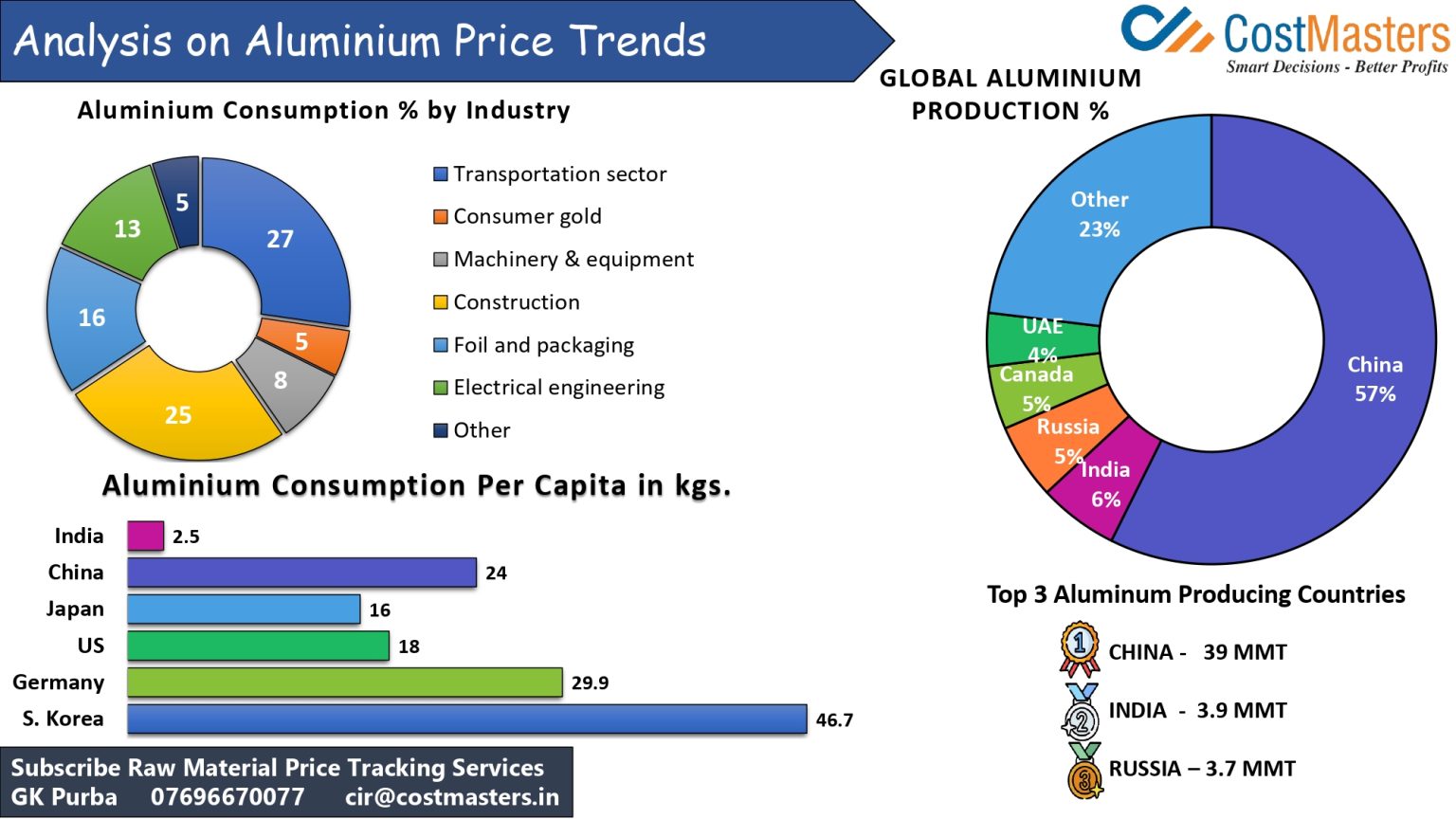
As the world’s largest producer and consumer of aluminium, China’s domestic policy is a massive price driver. In 2026, China continues to enforce a production "ceiling" of approximately 45 million metric tons to meet environmental goals. When Chinese demand exceeds this domestic cap, the country transitions from a net exporter to a net importer, which pulls global LME stocks lower and forces prices higher.
Primary vs. Secondary (Recycled) Aluminium Pricing
The market for recycled aluminium (Secondary) has grown significantly in 2026 due to sustainability mandates. However, the pricing for secondary aluminium does not always move in lockstep with the LME primary price.
| Feature | Primary Aluminium | Secondary (Recycled) Aluminium |
|---|---|---|
| Source | Bauxite/Alumina smelting | Post-consumer and industrial scrap |
| Pricing Base | LME + Premium | LME minus a "Scrap Discount" |
| Energy Usage | 100% (High Intensity) | ~5% of Primary Energy |
| Carbon Footprint | Higher (unless hydro-powered) | Significantly Lower |
| Purity Control | Extremely high (99.7%+) | Depends on scrap sorting quality |
Secondary aluminium is typically priced at a discount to the LME primary price. This discount narrows when scrap is scarce or when "circular economy" regulations force manufacturers to use a minimum percentage of recycled content, driving up the value of high-quality scrap.
Value-Added Products (VAP) and Upcharges
Buying a ton of aluminium on the LME gives you "P1020" ingots. However, most industrial users require specific shapes. The cost of transforming raw ingots into these shapes is the Value-Added Product (VAP) upcharge.
- Billets: Used for extrusion (window frames, car parts). Billets require alloying with elements like magnesium and silicon, followed by a casting process.
- Slabs/Rolling Ingots: Used for rolling into sheets or foil (soda cans, aircraft skins).
- Foundry Alloys: Specialized ingots used for die-casting complex automotive components.
In 2026, the upcharges for these products have risen due to increased labor and specialized machinery costs. A buyer looking for the price per ton of 6061-series aluminium billet will pay the LME price, the regional premium, and a billet upcharge that reflects the current casting capacity of the smelters.
How to Track and Forecast Prices
For those managing a budget or an investment portfolio, tracking the "spot" price is only half the battle. Professional traders use several tools to forecast where the price per ton is headed.
- Inventory Levels (LME Stocks): Declining warehouse stocks often signal an impending price rally, as it suggests demand is outstripping production.
- The US Dollar Index (DXY): Since aluminium is priced in USD globally, a stronger dollar usually makes the metal more expensive for buyers using other currencies, which can dampen demand and lower the price.
- PMI Data: The Purchasing Managers' Index (PMI) for manufacturing is a "canary in the coal mine." High manufacturing activity in the US, China, and the Eurozone correlates strongly with increased aluminium consumption.
- Technical Analysis: Many traders use moving averages (such as the 200-day MA) and Relative Strength Index (RSI) levels to identify entry and exit points in the futures market.
FAQ
Why is there such a large difference between the LME price and what I pay at a local distributor?
The LME price is for wholesale, "unwrought" metal in massive quantities (typically 25-ton lots). Local distributors add costs for "breaking bulk" (selling smaller amounts), warehousing, local transport, and their own profit margin. Additionally, the distributor's price includes the regional premium and any specific alloy or shape surcharges.
What is "Green Aluminium" and why does it cost more?
Green aluminium is produced using renewable energy sources like hydropower, wind, or solar, rather than coal-fired power. In 2026, many companies are willing to pay a "Green Premium" to reduce their Scope 3 carbon emissions. This premium can range from $10 to $50 per ton depending on the specific carbon-intensity certification.
How do trade tariffs affect the price per ton?
Tariffs, such as Section 232 in the United States, act as a direct tax on imported metal. These are typically absorbed into the Regional Physical Premium. When a tariff is introduced, the premium usually rises by an equivalent amount to ensure that it remains profitable for international producers to ship metal into that protected market.
Can I buy one ton of aluminium directly from the LME?
No. The LME is a wholesale terminal market. The minimum contract size for aluminium is 25 metric tons. Individual tons must be purchased through physical metal merchants, distributors, or service centers, who use the LME as their pricing basis.
What is the difference between "Duty-Paid" and "Duty-Unpaid" pricing?
In regions like Europe, aluminium may be stored in "bonded" warehouses where import duties have not yet been paid. "Duty-Unpaid" (DU) prices are lower but require the buyer to pay the applicable customs taxes upon removal. "Duty-Paid" (DP) prices include all taxes and are ready for immediate domestic use.
Recommendation for Industrial Buyers
When managing aluminium price risk in 2026, it is vital to move beyond simply watching the LME ticker. We recommend that procurement officers utilize hedging strategies, such as fixed-price swaps or call options, to lock in the LME base price. However, because regional premiums and energy surcharges are often not easily hedgable on an exchange, maintaining diversified supplier relationships across different geographic regions is the best defense against localized price spikes. Always request a "price build-up" in quotes to see exactly how much you are paying for the base metal versus the premium and the fabrication costs.