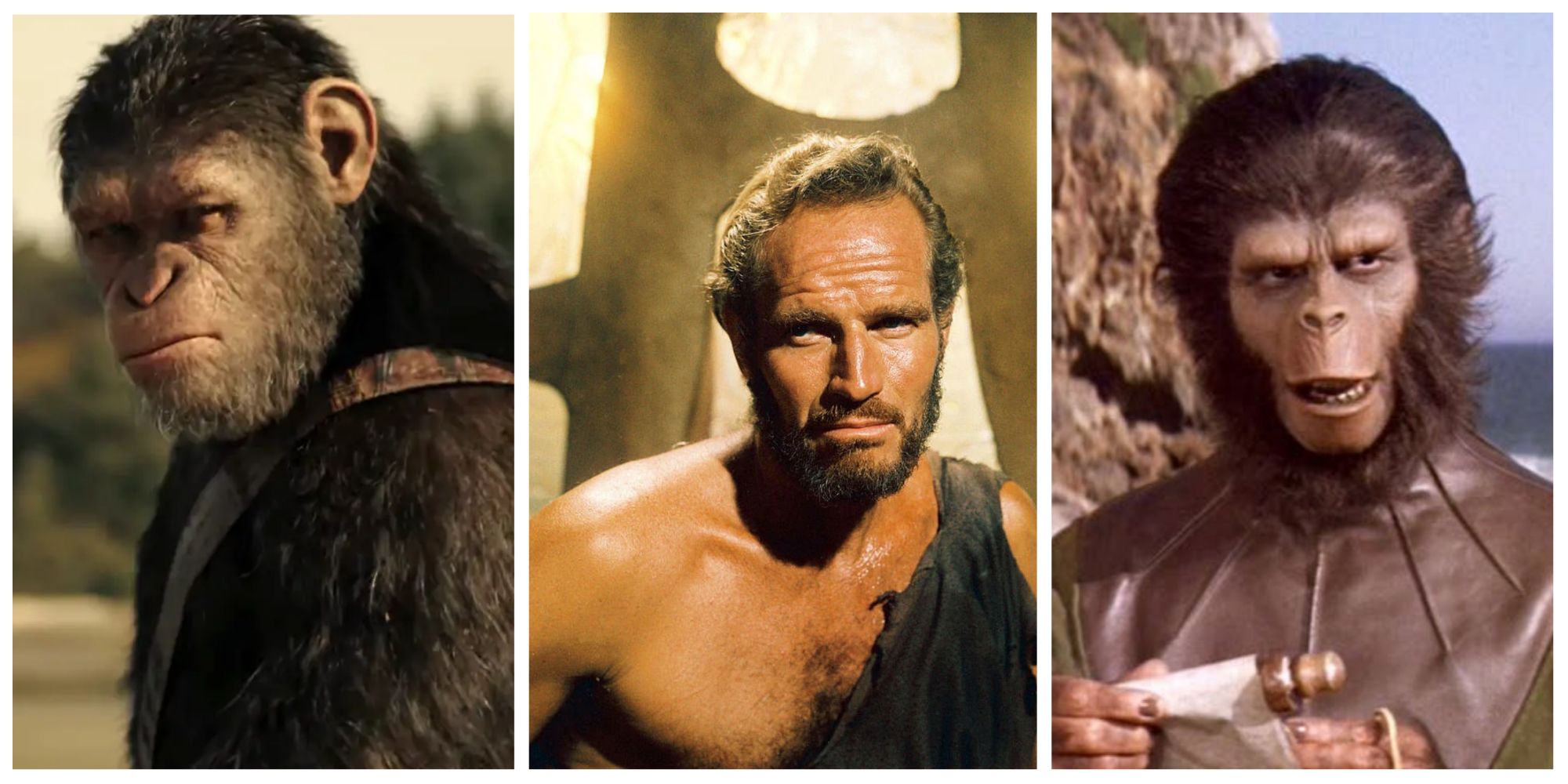
As of 2026, the Planet of the Apes franchise consists of 10 feature-length films spanning over five decades of cinematic history. These movies are divided into three distinct continuities: the original pentalogy (1968–1973), the 2001 standalone remake, and the modern reboot era that began in 2011 with the Caesar trilogy and continued into the 2024 expansion, Kingdom of the Planet of the Apes.
The Planet of the Apes series remains one of the most enduring and philosophically rich franchises in science fiction history. Based originally on the 1963 novel La Planète des singes by Pierre Boulle, the film series has evolved from a satirical cautionary tale of the Cold War era into a technical marvel of performance-capture storytelling. Navigating the series requires an understanding of its complex timelines, shifting social allegiances, and the technological leaps that transformed actors into photorealistic primates.
The Original Pentalogy (1968–1973)
The original series of films is celebrated for its ambitious narrative structure, which utilizes a circular time loop to tell a sprawling story of human downfall and simian rise. These films were groundbreaking for their use of prosthetic makeup, designed by John Chambers, which earned an honorary Academy Award.
Planet of the Apes (1968)
The film that started it all stars Charlton Heston as George Taylor, an astronaut who crash-lands on a mysterious planet in the distant future where intelligent, talking apes rule over primitive, mute humans. The film is a masterclass in social commentary, exploring themes of religion vs. science and class hierarchy. The legendary twist ending—revealing the "alien" planet to be a post-apocalyptic Earth—remains one of the most iconic moments in cinema history.
Beneath the Planet of the Apes (1970)
Picking up immediately after the first film, this sequel introduces a second astronaut, Brent, sent to rescue Taylor. It explores the subterranean ruins of New York City, inhabited by telepathic, mutant humans who worship a nuclear bomb. The film concludes with a nihilistic finale that saw the destruction of the entire planet, a bold narrative choice that initially seemed to end the franchise.
Escape from the Planet of the Apes (1971)
To continue the story after the world's destruction, writers utilized time travel. The intelligent chimpanzees Zira and Cornelius travel back to 1973 Los Angeles in Taylor's salvaged spacecraft. This film shifts the tone toward social satire and tragedy, as the apes transition from celebrities to perceived threats, eventually leading to the birth of their son, Milo (later renamed Caesar).
Conquest of the Planet of the Apes (1972)
Set in a "future" 1991, Earth has become a police state where cats and dogs have died off, and apes are kept as slaves. Caesar, the grown son of Zira and Cornelius, leads a violent revolution against his human oppressors. This entry is notably darker and draws heavy inspiration from the civil unrest and racial tensions of the early 1970s.
Battle for the Planet of the Apes (1973)
The final chapter of the original run attempts to break the cycle of violence. Years after the revolution, Caesar tries to maintain a fragile peace between his ape community and a group of irradiated human survivors. The film concludes with a more hopeful, though ambiguous, outlook on whether apes and humans can coexist without destroying one another.
The 2001 Standalone Remake
Directed by Tim Burton, the 2001 Planet of the Apes was an attempt to "re-imagine" the original concept rather than provide a direct sequel or remake. Starring Mark Wahlberg, the film features impressive practical makeup effects by Rick Baker, which many argue remain the pinnacle of prosthetic ape design.
Despite its commercial success, the film was met with mixed critical reception, largely due to its convoluted plot and a confusing twist ending that deviated significantly from the 1968 original. Because of this reception, the planned sequels were scrapped, leaving the 2001 film as a standalone entry in the wider franchise. It serves as an interesting "what if" scenario but does not connect to the original or the modern reboot timelines.
The Modern Reboot Era (2011–Present)
In 2011, 20th Century Fox (now 20th Century Studios) successfully revived the franchise by grounding the story in biological realism and cutting-edge visual effects. This era moved away from prosthetics in favor of performance capture, pioneered by Wētā FX and actor Andy Serkis.
Rise of the Planet of the Apes (2011)
Directed by Rupert Wyatt, this film serves as an origin story for a new version of Caesar. A genetically enhanced chimpanzee raised in a human household, Caesar gains high intelligence from an experimental Alzheimer's drug (ALZ-112). After experiencing human cruelty, he leads an uprising of laboratory and zoo apes, retreating to the Muir Woods while a deadly "Simian Flu" begins to decimate the human population.
Dawn of the Planet of the Apes (2014)
Directed by Matt Reeves, the sequel is set ten years after the viral outbreak. A thriving colony of apes led by Caesar encounters a small group of human survivors in San Francisco. The film is a tragic Shakespearean drama focusing on the internal politics of both species and the inevitable march toward war, fueled by the mutual distrust of characters like Koba (the scarred bonobo) and human militants.
War for the Planet of the Apes (2017)
The conclusion of Caesar's personal journey sees the apes locked in a desperate conflict with a rogue military faction led by "The Colonel" (Woody Harrelson). The film is a blend of a Western and a biblical epic, detailing Caesar’s struggle to retain his morality while leading his people to a promised land. It finalized Caesar's legacy as a foundational "messiah" figure for ape-kind.
Kingdom of the Planet of the Apes (2024)
Set several generations after the death of Caesar, the world has entered a "Bronze Age" for apes, while humans have regressed into a feral state. Directed by Wes Ball, the story follows a young chimpanzee named Noa, who must contend with a tyrannical ape leader, Proximus Caesar, who perverts Caesar’s original teachings to build an empire. This film marks the beginning of a new chapter for the franchise, exploring how legends are distorted over centuries.
Comparison of Film Eras and Technical Specifications
The following table outlines the progression of the franchise, highlighting the shift in leadership and technological approach.
| Film Title | Release Year | Era | Lead Character | VFX Methodology |
|---|---|---|---|---|
| Planet of the Apes | 1968 | Original | George Taylor | Practical Prosthetics |
| Beneath the Planet of the Apes | 1970 | Original | Brent | Practical Prosthetics |
| Escape from the Planet of the Apes | 1971 | Original | Zira / Cornelius | Practical Prosthetics |
| Conquest of the Planet of the Apes | 1972 | Original | Caesar (Milo) | Practical Prosthetics |
| Battle for the Planet of the Apes | 1973 | Original | Caesar | Practical Prosthetics |
| Planet of the Apes | 2001 | Remake | Leo Davidson | Advanced Prosthetics |
| Rise of the Planet of the Apes | 2011 | Reboot | Caesar | Performance Capture |
| Dawn of the Planet of the Apes | 2014 | Reboot | Caesar | Performance Capture |
| War for the Planet of the Apes | 2017 | Reboot | Caesar | Performance Capture |
| Kingdom of the Planet of the Apes | 2024 | Reboot | Noa | Performance Capture |
Viewing Orders: Chronological vs. Release Date
When approaching "all Planet of the Apes movies," viewers typically choose between two primary methods. Each offers a different perspective on the narrative's cyclical nature.
1. Release Date Order (Recommended)
This is the most common way to experience the franchise. It allows viewers to appreciate the evolution of the special effects and the social contexts in which the films were made.
- Order: 1968, 1970, 1971, 1972, 1973, 2001, 2011, 2014, 2017, 2024.
- Pros: Preserves the "Big Twist" of the original film and follows the natural progression of the filmmaking craft.
2. The "Ultimate" Chronological Order
This order is more complex because it involves three separate timelines. However, if one were to follow the logic of the "Ape World" progression, it would look like this:
- The Modern Origins: Rise, Dawn, War, Kingdom. (This establishes how the world fell and the apes rose).
- The Classic Future: Planet of the Apes (1968), Beneath the Planet of the Apes. (This shows the ultimate end of that progression).
- The Time Loop: Escape, Conquest, Battle. (These films show how the future apes accidentally created their own past).
- The Outlier: The 2001 film can be viewed at any point as an alternate universe story.
Technical Evolution: From Latex to Pixels
A critical aspect of the franchise is its commitment to pushing the boundaries of what is possible on screen. In 1968, the challenge was to create masks that allowed actors to emote. John Chambers invented a new type of foam latex that moved with the actors' facial muscles. This was so revolutionary that the Academy of Motion Picture Arts and Sciences gave him an honorary Oscar, as a dedicated category for makeup did not yet exist.
By the time Rise of the Planet of the Apes was in production, the goal was total immersion. Wētā FX utilized head-mounted cameras and infrared sensors to track the minute movements of actors like Andy Serkis. Unlike traditional CGI, performance capture ensures that every flicker of an eye or twitch of a lip from the human actor is translated into the digital ape model. This technology reached such a peak in War for the Planet of the Apes and Kingdom of the Planet of the Apes that the digital characters are often more expressive and relatable than their human counterparts.
FAQ: Understanding the Apes Franchise
Are the 1968 movies and the 2011 movies in the same timeline?
No, they are separate continuities. The 2011 reboot series (Rise, Dawn, War, Kingdom) reimagines the origin of the intelligent apes through a viral and genetic lens (the Simian Flu), whereas the original 1968 series utilized a time-travel loop to explain the rise of the apes. However, the reboot films include many "Easter eggs" and references to the original series, such as news reports about a lost spaceship named Icarus.
Do I need to watch the original 1960s movies to understand the new ones?
While the 2011–2024 films stand perfectly well on their own, watching the original 1968 film provides significant context for the world-building. The modern films frequently reference the "Lawgiver," the names of original characters (like Nova and Maurice), and the philosophical conflicts first established in the 1960s.
Which movie is considered the best entry point for new fans?
Most critics and fans recommend starting with either the 1968 original for the classic sci-fi experience or 2011's Rise of the Planet of the Apes for a modern, emotionally driven story. Starting with Rise is often easier for younger audiences who prefer modern visual effects and a linear narrative.
How many "Caesars" are there in the movies?
There are two primary characters named Caesar. In the original pentalogy, Caesar is the son of Zira and Cornelius (introduced in Escape and Conquest). In the reboot series, Caesar is the chimpanzee raised by Will Rodman (James Franco) who becomes the first leader of the ape civilization. In Kingdom of the Planet of the Apes, the name is used as a title of royalty by various ape factions, similar to the historical use of "Caesar" or "Tsar."
Summary of Next Actions for Viewers
To fully appreciate the scope of the Planet of the Apes franchise, start by viewing the 2011 reboot trilogy (Rise, Dawn, and War) to understand the modern foundation of the series. Once completed, revisit the 1968 original to witness the masterpiece that defined the genre. For those interested in the most current developments as of 2026, Kingdom of the Planet of the Apes serves as the essential bridge into the franchise's ongoing future, establishing the status of Earth centuries after the time of Caesar.