Align Loans offers Michigan residents sophisticated conventional home lending solutions tailored to the state’s diverse real estate market. In 2026, these loans remain the primary choice for borrowers with stable credit, providing flexible down payment options as low as 3% and the ability to cancel private mortgage insurance once 20% equity is reached.
Understanding Conventional Home Lending with Align Loans
Conventional home lending refers to any mortgage that is not backed or insured by a federal government agency, such as the Federal Housing Administration (FHA), the Department of Veterans Affairs (VA), or the Department of Agriculture (USDA). Instead, these loans are typically "conforming," meaning they adhere to the financing limits and underwriting standards set by the Federal National Mortgage Association (Fannie Mae) and the Federal Home Loan Mortgage Corporation (Freddie Mac).
For Michigan residents, working with Align Loans for a conventional mortgage provides a pathway to homeownership that balances lower long-term costs with rigorous but fair eligibility standards. Unlike government-backed loans, conventional lending in Michigan often moves faster through the appraisal process, as the property standards are generally less restrictive than FHA requirements. This advantage is particularly relevant in Michigan's competitive urban markets like Grand Rapids and Ann Arbor, where sellers often favor conventional offers due to their perceived stability and fewer administrative hurdles.
Align Loans specializes in navigating the nuances of the Michigan market, from the seasonal fluctuations of the "Up North" secondary home market to the primary residential zones of Metro Detroit. By acting as a bridge between the borrower and the complex secondary mortgage market, Align Loans ensures that Michigan homeowners receive terms that reflect the current 2026 economic landscape, characterized by stabilized interest rates and localized property value appreciation.
Why Choose a Conventional Loan in Michigan for 2026?
The decision to pursue conventional financing over government-insured alternatives often comes down to the total cost of borrowing and the flexibility of the loan terms. In 2026, the Michigan real estate market has seen a continued emphasis on equity growth, making the conventional loan's treatment of Private Mortgage Insurance (PMI) a significant selling point.
One of the primary benefits is the cancellation of PMI. Unlike FHA loans, which typically require mortgage insurance premiums for the life of the loan if the down payment was less than 10%, conventional loans allow for the removal of PMI once the borrower reaches a 78% to 80% loan-to-value (LTV) ratio. For Michigan homeowners in appreciating areas like Royal Oak or Traverse City, this milestone may be reached faster through a combination of regular payments and natural market growth.
Furthermore, conventional loans through Align Loans offer higher loan limits than those available in previous years. As of 2026, the Federal Housing Finance Agency (FHFA) has adjusted conforming limits to reflect the increased cost of housing across the Great Lakes State. This allows borrowers to finance more expensive properties without necessarily triggering the higher interest rates and stricter requirements of a "Jumbo" loan.
Eligibility and Requirements for Michigan Borrowers
Securing a conventional loan in Michigan requires meeting specific financial benchmarks. Align Loans evaluates several key factors to determine eligibility, focusing on the borrower’s ability to manage long-term debt.
Credit Score Benchmarks
While the absolute minimum credit score for a conforming conventional loan is typically 620, Align Loans emphasizes that the most favorable interest rates in 2026 are reserved for those with scores of 740 or higher. In Michigan, where economic diversity is high, a higher credit score acts as a buffer against market volatility, signaling to lenders that the borrower is a low-risk candidate. Those with scores between 620 and 700 may still qualify but should expect higher PMI rates and slightly elevated interest percentages.
Debt-to-Income (DTI) Ratios
The DTI ratio is a calculation of your monthly debt payments divided by your gross monthly income. For a conventional loan in Michigan, Align Loans generally looks for a DTI of 43% or lower. However, in some cases involving significant cash reserves or a high credit score, "compensating factors" may allow for a DTI up to 50%. Michigan borrowers should account for state-specific costs, such as high property taxes in certain jurisdictions, when calculating their projected DTI.
Down Payment Options
The "20% down" rule is a common misconception in 2026. Align Loans provides conventional options for first-time homebuyers with as little as 3% down. For repeat buyers, the minimum is typically 5%. While a lower down payment increases the monthly cost due to PMI, it allows Michigan residents to enter the market sooner, capturing equity that might otherwise be lost to rising home prices.
2026 Conforming Loan Limits in Michigan
Loan limits are determined annually based on average home price increases. In Michigan, these limits are generally uniform across the state, though "high-cost" areas in other states may have different thresholds.
| Property Type | 2026 Conforming Limit (Estimate) | Minimum Down Payment |
|---|---|---|
| Single-Family Home | $810,000 | 3% - 5% |
| Two-Unit Property | $1,030,000 | 15% |
| Three-Unit Property | $1,245,000 | 20% |
| Four-Unit Property | $1,550,000 | 20% |
Note: Limits are subject to annual FHFA adjustments and may vary slightly by county if a specific Michigan county is designated as high-cost.
The Align Loans Application Process
The journey to securing a conventional home loan in Michigan involves several structured steps. Align Loans utilizes a streamlined digital-first approach while maintaining local expertise to guide borrowers through the 2026 lending environment.
- Pre-Approval: This is the critical first step. Align Loans reviews your credit, income, and assets to provide a pre-approval letter. In Michigan's 2026 market, a pre-approval is often required before a real estate agent will even show a home, as it proves the buyer’s financial viability.
- Home Search and Purchase Agreement: Once a property is identified and an offer is accepted, the purchase agreement is sent to the lender to begin the formal loan processing.
- Loan Processing and Underwriting: During this phase, Align Loans verifies all documentation. This includes W-2s, tax returns, and bank statements. The underwriter ensures that the loan meets both Align Loans' internal standards and the conforming guidelines of Fannie Mae or Freddie Mac.
- Appraisal: A Michigan-certified appraiser will visit the property to determine its fair market value. For conventional loans, the appraiser focuses primarily on value and major structural integrity, rather than the more granular "health and safety" checklists required by the FHA.
- Closing: Once "Clear to Close" is issued, the borrower signs the final documents. In Michigan, closing typically involves a title company. Borrowers should be prepared to pay closing costs, which in Michigan often range from 2% to 5% of the purchase price.
Costs and Fees Associated with Michigan Conventional Mortgages
Borrowers must look beyond the interest rate to understand the true cost of a conventional loan. Align Loans maintains transparency regarding the fees associated with Michigan real estate transactions.
- Origination Fees: These are the costs charged by the lender for processing the loan. They typically range from 0.5% to 1% of the total loan amount.
- Michigan Transfer Taxes: Michigan imposes a state transfer tax (typically $3.75 per $500 of value) and a county transfer tax ($0.55 per $500 of value in most counties). While these are often paid by the seller, they are a critical component of the local transaction landscape.
- Title Insurance: This protects the lender and the buyer against disputes over property ownership. In Michigan, it is standard practice for the seller to provide an owner’s policy, while the buyer pays for the lender’s policy.
- Private Mortgage Insurance (PMI): For those putting down less than 20%, PMI is a monthly cost. The rate is determined by your credit score and the size of your down payment.
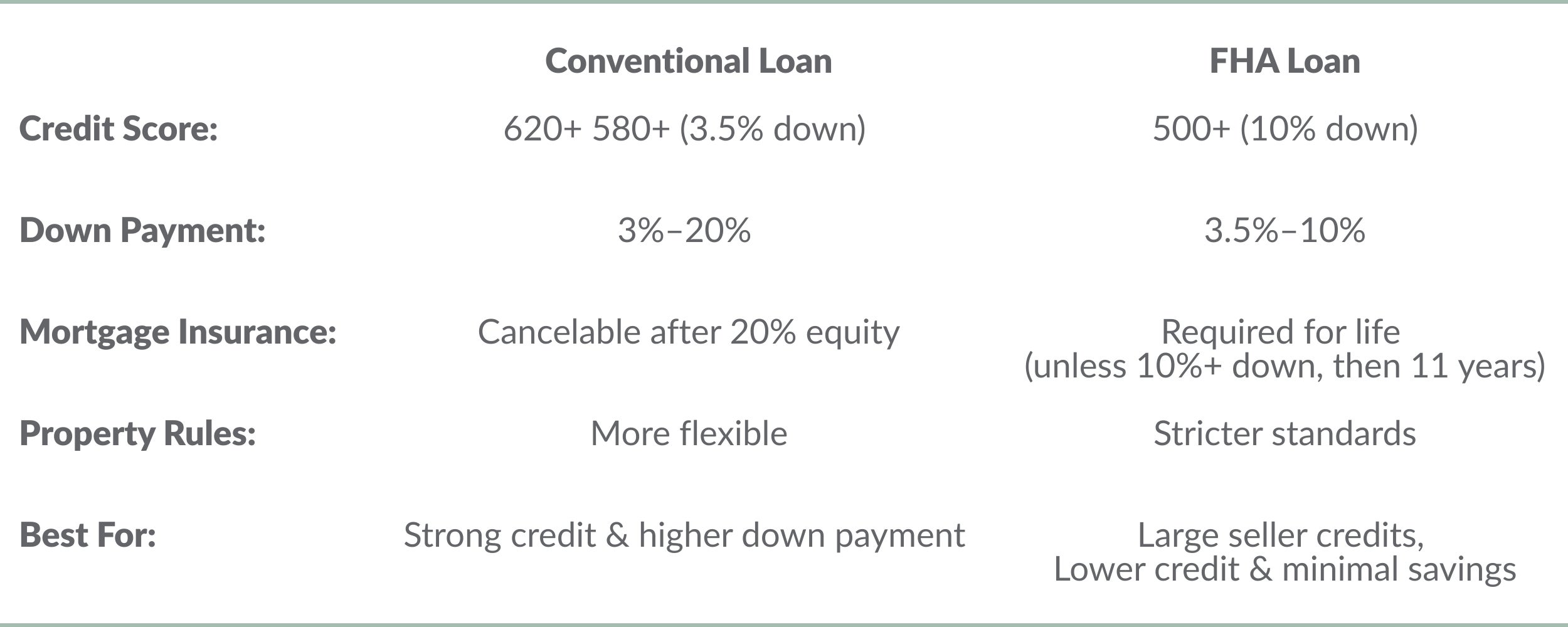
Comparison: Conventional vs. FHA Loans in Michigan
Choosing the right loan type depends on the borrower's specific financial profile. The following comparison highlights why a conventional loan from Align Loans might be preferable for certain Michigan buyers.
| Feature | Conventional Loan (Align Loans) | FHA Loan |
|---|---|---|
| Min. Credit Score | 620 | 500 (with 10% down) or 580 |
| Min. Down Payment | 3% (First-time) or 5% | 3.5% |
| Mortgage Insurance | Can be cancelled at 80% LTV | Usually for the life of the loan |
| Property Standards | Standard / Flexible | Strict / Safety-focused |
| Loan Limits | Higher (Conforming) | Lower (Regional limits) |
| Seller Preference | High | Moderate |
Strategic Benefits for Michigan Homebuyers
The Michigan landscape offers unique opportunities for those using conventional financing. For instance, the Michigan State Housing Development Authority (MSHDA) often provides down payment assistance programs that can be paired with conventional loans. Align Loans helps borrowers navigate these combinations to minimize out-of-pocket expenses.
Additionally, Michigan's property tax structure involves a "taxable value" and a "state equalized value" (SEV). When a home is purchased, the taxable value "uncaps" and resets to the SEV, often resulting in a significant tax increase the year following the purchase. Align Loans' conventional lending experts assist borrowers in calculating these future costs to ensure the monthly mortgage payment remains affordable long-term.
Another strategic advantage in 2026 is the use of appraisal waivers. For well-qualified borrowers putting down a significant amount, Fannie Mae and Freddie Mac’s automated underwriting systems may sometimes waive the requirement for a physical appraisal. This can save the borrower $500 to $800 and shave a week off the closing timeline, a major benefit in the fast-moving markets of Grand Rapids or the Detroit suburbs.
Frequently Asked Questions
Can I get a conventional loan from Align Loans with a 620 credit score?
Yes, 620 is the industry-standard minimum for a conventional conforming loan. However, at this score level, you should expect to pay a higher interest rate and a higher monthly PMI premium compared to a borrower with a 740 score. Align Loans can provide a breakdown of how your credit score specifically impacts your monthly payment in Michigan.
How does Michigan property tax "uncapping" affect my conventional loan?
In Michigan, the property taxes you pay are based on the "taxable value," which is limited in how much it can rise each year for a current owner. When you buy a home, that limit is removed (uncapped), and the taxes reset to 50% of the home's market value. Align Loans factors this anticipated increase into your escrow calculations to prevent a "sticker shock" in your second year of homeownership.
Is it possible to avoid PMI without a 20% down payment?
While the standard way to avoid PMI is a 20% down payment, some "Lender-Paid Mortgage Insurance" (LPMI) programs allow you to trade a slightly higher interest rate for the elimination of the monthly PMI charge. Align Loans can help you run a break-even analysis to see if this option saves you money over the expected duration of your Michigan residency.
Are there specific conventional loan limits for different Michigan counties?
In 2026, most of Michigan follows the standard national conforming loan limit. Unlike states with massive price disparities like California, Michigan’s housing market is generally served by the base limit. However, Align Loans monitors FHFA updates specifically for any Michigan counties that may be reclassified as "high-cost" to ensure borrowers have access to the maximum possible financing.
How long does the conventional loan process take with Align Loans?
On average, a conventional loan in Michigan takes 30 to 45 days from the time a purchase agreement is signed to the day of closing. Factors that can influence this include the responsiveness of the borrower in providing documents, the workload of local Michigan appraisers, and the complexity of the property’s title history.
Practical Recommendation
For Michigan residents looking to purchase or refinance a home in 2026, a conventional loan through Align Loans is often the most cost-effective long-term solution, provided your credit score is above 620. If you have the ability to put down at least 3% to 5% and your credit is in the "good to excellent" range, the ability to eventually cancel mortgage insurance and the higher loan limits make conventional financing superior to FHA options. Your next step should be to secure a formal pre-approval from Align Loans, which will provide a clear picture of your borrowing power and allow you to shop with confidence in the Michigan real estate market.