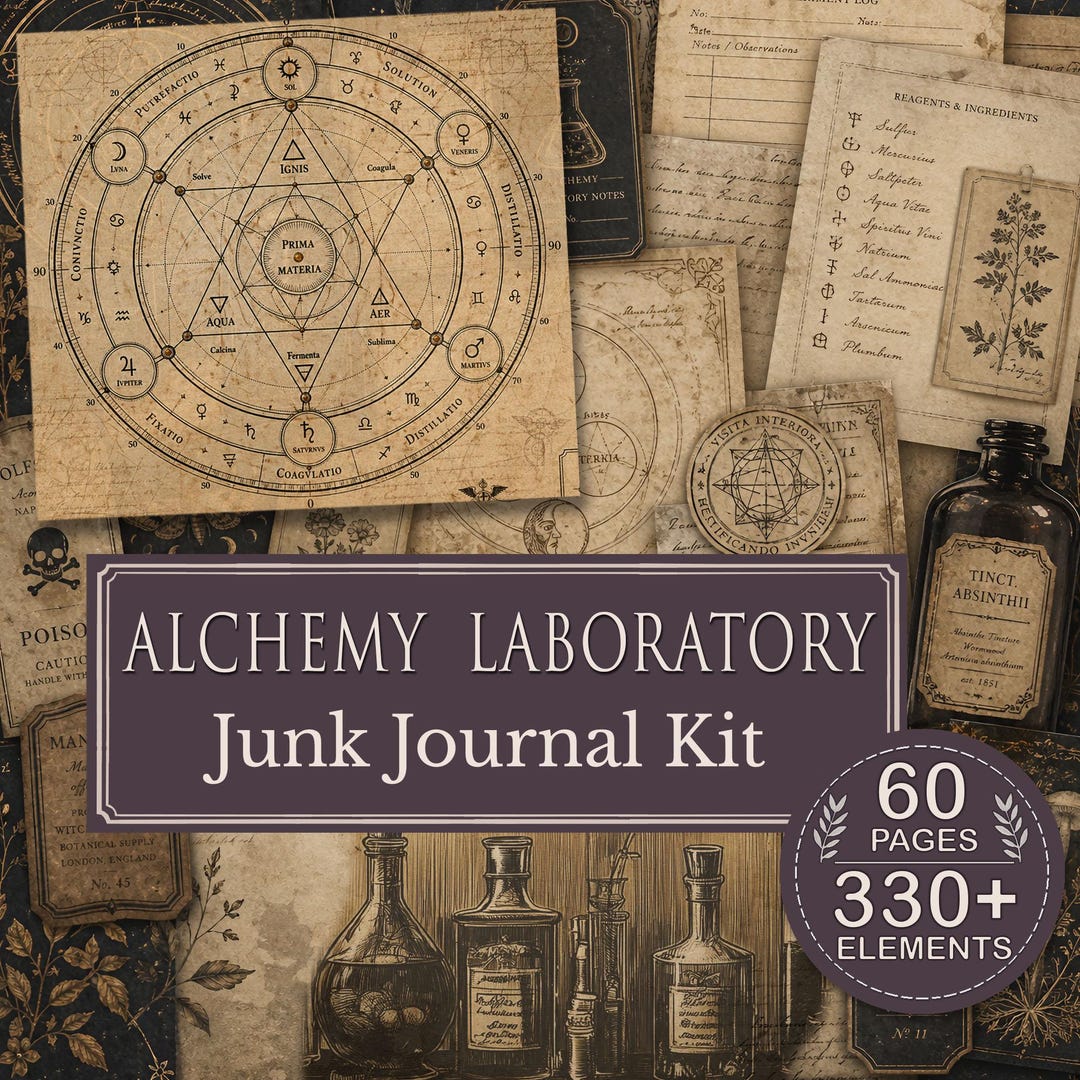
An alchemist journal is a specialized record used to document the "Great Work" (Magnum Opus), encompassing both practical laboratory experiments and internal spiritual transformations. In 2026, these journals serve as essential tools for practitioners to track the stages of transmutation—Nigredo, Albedo, Citrinitas, and Rubedo—while bridging the gap between historical Hermetic traditions and modern psychological or chemical exploration.
The Purpose of the Alchemist Journal: Beyond Simple Note-Taking
To understand the alchemist journal, one must first distinguish it from a standard diary or a modern laboratory notebook. While a diary records external events and a lab notebook records empirical data, the alchemist’s record-keeping is inherently dualistic. It follows the Hermetic maxim "As above, so below; as within, so without." This means that every entry regarding a physical substance or botanical extraction is expected to mirror a shift in the practitioner’s own consciousness.
Historically, alchemists utilized journals to preserve their "recipes" while simultaneously obscuring them from the uninitiated. This led to a rich tradition of Decknamen (cover names) and elaborate symbolism. In the current year 2026, the resurgence of interest in artisanal crafts and esoteric philosophy has transformed the alchemist journal into a structured framework for personal development. Whether the practitioner is working with "spagyrics" (plant alchemy) or "chrysopoeia" (the transmutation into gold, often viewed metaphorically), the journal acts as the "Vessel of Hermes," containing the volatile thoughts of the mind until they can be "fixed" into permanent wisdom.
The journal serves three primary functions:
- Verification of Process: Ensuring that experiments (physical or meditative) are repeatable and that variables—such as planetary timing or temperature—are controlled.
- Psychological Mapping: Providing a mirror for the "Shadow Work" associated with the early stages of alchemy.
- Symbolic Synthesis: Acting as a space where abstract symbols (The Green Lion, The Red King) are decoded into actionable personal or chemical insights.
The Two Paths: Laboratory and Oratory
The tradition of alchemy is split into two complementary environments: the Laboratorium (the physical workspace) and the Oratorium (the space for prayer, meditation, and inner work). A comprehensive alchemist journal must address both.
The Laboratorium: Technical Records
For those focused on practical alchemy or spagyrics, the journal requires high technical depth. This includes tracking the Calcination of minerals, the Distillation of spirits, and the Fermentation of organic matter. By 2026, many practitioners have integrated modern precision tools with ancient timing. A typical technical entry might include:
- Menstruum Ratios: The solvents used to extract the "sulfur" or "mercury" of a plant.
- Thermal Logs: Maintaining specific temperatures for "the heat of a brooding hen" (gentle digestion).
- Botanical Sourcing: Documentation of where and when herbs were harvested, specifically noting the lunar phase.
The Oratorium: Inner Transmutation
The spiritual alchemist views the journal as a map of the psyche. This path, popularized by Carl Jung’s analysis of alchemical texts, treats the "base metal" as the ego and the "gold" as the realized Self. Entries here are less about fluid ounces and more about dream analysis, active imagination, and the identification of personal "impurities" that must be purged. In 2026, this often takes the form of "Self-Inquiry" documentation, where the practitioner records their reactions to external stressors as if they were chemical reactions in a flask.
Essential Components of an Alchemist Journal
Constructing a functional journal requires more than just blank pages; it requires a structural methodology that respects the tradition’s history.
The Three Primes (Tria Prima)
Every entry should ideally categorize the state of the work based on the Three Primes identified by Paracelsus:
- Salt (The Body/Fixity): What physical actions were taken? What was the tangible result?
- Sulfur (The Soul/Oil): What was the "energy" or "passion" behind the work? What internal drive was present?
- Mercury (The Spirit/Volatility): What insights or communications were received? How did the "mind" of the work shift?
Planetary Hours and Astrological Timing
In classical alchemy, the "influence of the heavens" was considered a literal ingredient. A high-quality journal includes headers for the Planetary Hour and the current zodiacal position of the Moon. For example, works involving the "Metal of Saturn" (Lead/Melancholy) were traditionally recorded on Saturdays or during Saturnian hours to align the work with the cosmic archetypes associated with restriction and structure.
Symbolic Encoding
Many practitioners still use the 17th-century chemical shorthand for brevity and to maintain the "sacredness" of the record. Using the symbol for Antimony or Sublimation isn't merely for aesthetic reasons; it trains the mind to think in archetypes rather than literal descriptions, facilitating deeper subconscious processing.
The Four Stages of the Great Work (Magnum Opus)
The most effective way to organize an alchemist journal is by the stages of transmutation. Each stage represents a distinct phase of both the physical and spiritual process.
| Stage | Color | Psychological State | Physical Process | Journal Focus |
|---|---|---|---|---|
| Nigredo | Black | Putrefaction, Shadow Work, Grief | Calcination, Ashing | Recording failures, identifying ego-attachments, and "black" moods. |
| Albedo | White | Purification, Clarity, Intuition | Washing, Distillation | Recording dreams, moments of peace, and the removal of "dross." |
| Citrinitas | Yellow | Awakening, Solar Light, Wisdom | Digestion, Solarizing | Recording "Aha!" moments, spiritual confidence, and energy shifts. |
| Rubedo | Red | Rebirth, Integration, Sovereignty | Coagulation, Fixation | Final synthesis, documenting the "Philosopher’s Stone" (the integrated self). |
Choosing the Right Vessel: Physical vs. Digital in 2026
The debate between physical and digital journaling is particularly poignant in alchemy. As of 2026, there is a distinct trend toward hybridization.
The Case for Physical Journals
Traditionalists argue that the act of writing by hand is a "magical" act—an energetic transfer from the brain through the hand and onto the page. Using high-quality vellum or acid-free paper reflects the "Salt" (the permanence) of the work. Many modern practitioners use hand-bound leather journals to signify the importance of the Great Work, treating the book itself as a sacred object that accumulates the "materia" of their life.
The Case for Digital Platforms
Conversely, the "Digital Alchemist" utilizes encrypted databases or specialized apps to manage the sheer volume of data. The benefit of digital journaling in 2026 lies in its searchability and linking. Using a "Zettelkasten" or networked-thought method (like Obsidian or Notion) allows an alchemist to link a dream from three years ago to a chemical reaction they observed yesterday, revealing patterns that would be invisible in a linear paper notebook.
How to Start Your Alchemist Journal: A Step-by-Step Guide
For those beginning the path in 2026, the following steps provide a foundation for a rigorous and meaningful practice.
Step 1: Define Your "Prima Materia"
Before writing, identify what you are working on. Are you trying to heal a specific physical ailment through spagyric tinctures? Are you trying to overcome a deep-seated behavioral pattern? This "First Matter" is the subject of your journal.
Step 2: Establish Your Code
Decide on your level of encryption. Will you use standard English, or will you adopt alchemical symbols for common terms? Establishing a "Key" at the beginning of the journal is vital for future review. Ensure you have clear symbols for the seven classical metals and the four elements (Earth, Air, Fire, Water).
Step 3: The Daily Log
Each entry should begin with the "Conditions of the Vessel." This includes your physical health, the weather, the lunar phase, and your current mood. These variables often affect the "volatility" of the work. If you are performing a physical distillation, record the starting weight of your plant material and the volume of your solvent.
Step 4: The Reflection and Synthesis
At the end of each week, review your entries. This is the Coagulation phase of journaling. Look for recurring themes. Did your lab equipment break during a week when you felt particularly frustrated? This synchronicity is the "gold" the alchemist seeks to document.
Common Mistakes in Alchemical Record-Keeping
Even experienced practitioners can fall into traps that render their journals less effective.
- Over-Aestheticization: Spending more time on calligraphy and drawings than on actual observation. An alchemist journal is a tool, not just a scrapbooking project.
- Ignoring Failures: In alchemy, the "failed" experiment (the caput mortuum or dead head) often contains more information than the success. Documenting what didn't happen is crucial for purification.
- Lack of Consistency: The Great Work requires a "constant fire." Gaps in documentation lead to a loss of the thread of the process, making it impossible to see the slow maturation of the "Stone."
- Literalism: Taking ancient texts too literally without considering the symbolic or chemical context. Your journal should reflect your own findings, not just parrot historical books.
The Role of Modern Science and History
While the alchemist journal is a personal document, it is often grounded in historical and scientific reality. Organizations like the Science History Institute provide extensive archives of historical alchemical manuscripts, such as those of Robert Boyle and Isaac Newton. Newton, famously, left behind over a million words on alchemy—most of which were contained in his private journals and notebooks.
In 2026, we recognize that these journals were precursors to the modern scientific method. However, they retained a "soul" that modern science often excludes. By maintaining an alchemist journal today, you are participating in a 2,000-year-old tradition of "Psychochemistry," where the observer and the observed are inextricably linked.
FAQs About Alchemist Journals
Do I need to be a chemist to keep an alchemist journal?
No. While some practitioners focus on laboratory work (spagyrics), many use the journal entirely for "Inner Alchemy." This involves applying alchemical metaphors to psychology, meditation, and personal growth. The only requirement is a commitment to observing the process of change.
What are the most important symbols to include?
At a minimum, you should learn the symbols for the Three Primes (Salt, Sulfur, Mercury), the Four Elements, and the Seven Planetary Metals (Gold/Sun, Silver/Moon, Copper/Venus, Iron/Mars, Tin/Jupiter, Mercury/Mercury, Lead/Saturn). These act as a shorthand for complex archetypal energies.
Is an alchemist journal the same as a "Book of Shadows"?
While they share similarities, a Book of Shadows is generally associated with Wicca or witchcraft and focuses on spells and rituals. An alchemist journal is specifically focused on the transmutation of substances or the self, emphasizing a structured process of refinement, separation, and synthesis.
Can I share my journal with others?
Historically, alchemists were very secretive, often writing in cipher to protect their work. Today, the decision is personal. Many find that keeping the journal private preserves the "internal heat" of the work, while others share their findings within "Hermetic circles" or study groups.
How do I handle the "Nigredo" phase in my writing?
The Nigredo phase often involves documenting intense emotions, "dark nights of the soul," or physical decay. It is important to write honestly during this time without judgment. The goal is to "calcine" these experiences through observation until only the essential truth remains.
Next Steps for the Aspiring Alchemist
To truly master the alchemist journal, one must begin the practice of "Daily Distillation." Set aside fifteen minutes each evening to record the "Salt, Sulfur, and Mercury" of your day. Begin identifying which "metal" your current life circumstances represent—are you currently in the heavy, restrictive state of Lead, or the volatile, communicative state of Mercury?
By documenting these shifts with the precision of a scientist and the intuition of a mystic, you transform your journal from a mere book into a living reflection of your own evolution. As you move through 2026, let your journal be the catalyst for your own Great Work, remembering that the true "Philosopher's Stone" is not found in the pages of another's book, but in the laboratory of your own lived experience.