Air medevac is a specialized emergency service that utilizes fixed-wing or rotary-wing aircraft equipped with intensive care technology to transport critically ill or injured patients. In 2026, it serves as a literal lifeline when ground transport is hindered by distance, time-sensitivity, or complex medical requirements, ensuring patients reach specialized trauma or tertiary care centers safely.
The necessity of air medical evacuation (medevac) arises when the conventional healthcare infrastructure cannot meet a patient’s immediate needs. Whether it is a victim of a high-velocity trauma in a remote area or a cardiac patient requiring a sub-specialized surgical team hundreds of miles away, the "flight as a lifeline" concept emphasizes that the aircraft is more than a vehicle—it is a mobile intensive care unit (ICU) that bridges the gap between an emergency and life-saving intervention.
The Critical Role of Air Medevac in 2026 Healthcare
By 2026, the integration of air medical services into regional trauma systems has become more sophisticated, yet the core mission remains unchanged: reducing the time to definitive care. The medical community continues to adhere to the "Golden Hour" principle, which suggests that outcomes for trauma and stroke patients are significantly improved if they receive specialized treatment within 60 minutes of the insult. In many geographic regions, ground ambulances simply cannot navigate traffic or terrain fast enough to meet this window.
Air medevac services are generally categorized into two operational types: High-Acuity Emergency Medical Services (HEMS), typically using helicopters for short-range scene responses, and fixed-wing air ambulances for long-distance repatriations or inter-facility transfers. For patients in rural or underserved areas, these flights represent the only viable path to surviving conditions like intracranial hemorrhages, acute myocardial infarctions, or multi-system organ failure.
Clinical Indications: When Is an Air Medevac Necessary?
Not every medical emergency requires a flight. The decision to launch an air medevac is based on a clinical risk-benefit analysis conducted by on-site paramedics, emergency physicians, or specialized transfer centers. The primary considerations include the patient’s stability, the projected time savings, and the level of care required during transit.
Time-Sensitive Pathologies
Certain conditions are considered "time-is-tissue" emergencies. For instance, in the case of an ischemic stroke, every minute results in the loss of approximately 1.9 million neurons. If a local community hospital lacks a comprehensive stroke center with endovascular capabilities, an air medevac becomes the lifeline that allows for mechanical thrombectomy within the viable window. Similarly, STEMI (ST-Elevation Myocardial Infarction) patients benefit from air transport to reach a cardiac catheterization lab when ground transport exceeds 60 to 90 minutes.
Specialized Level of Care
In many instances, the "lifeline" aspect refers to the equipment on board rather than just the speed of the aircraft. Patients requiring Extracorporeal Membrane Oxygenation (ECMO), continuous renal replacement therapy, or advanced mechanical ventilation often cannot be moved by standard ground units. Air medevac teams in 2026 are frequently staffed with clinicians trained in these sub-specialties, allowing for the transport of the most "unstable" patients who would otherwise be considered non-transportable.
Geographic and Environmental Barriers
In regions with mountainous terrain, islands, or extreme weather conditions that wash out roads, air medevac is the only method of extraction. For offshore oil rig workers or cruise ship passengers, a fixed-wing or long-range hoist-equipped helicopter is the sole redundant system for medical emergencies.
The Technical Ecosystem: Inside the Flying ICU
To understand how a flight functions as a lifeline, one must examine the technical specifications of the aircraft and the medical equipment integrated into the airframe. These are not standard planes or helicopters; they are highly regulated medical environments.
Advanced Life Support (ALS) and ICU Equipment
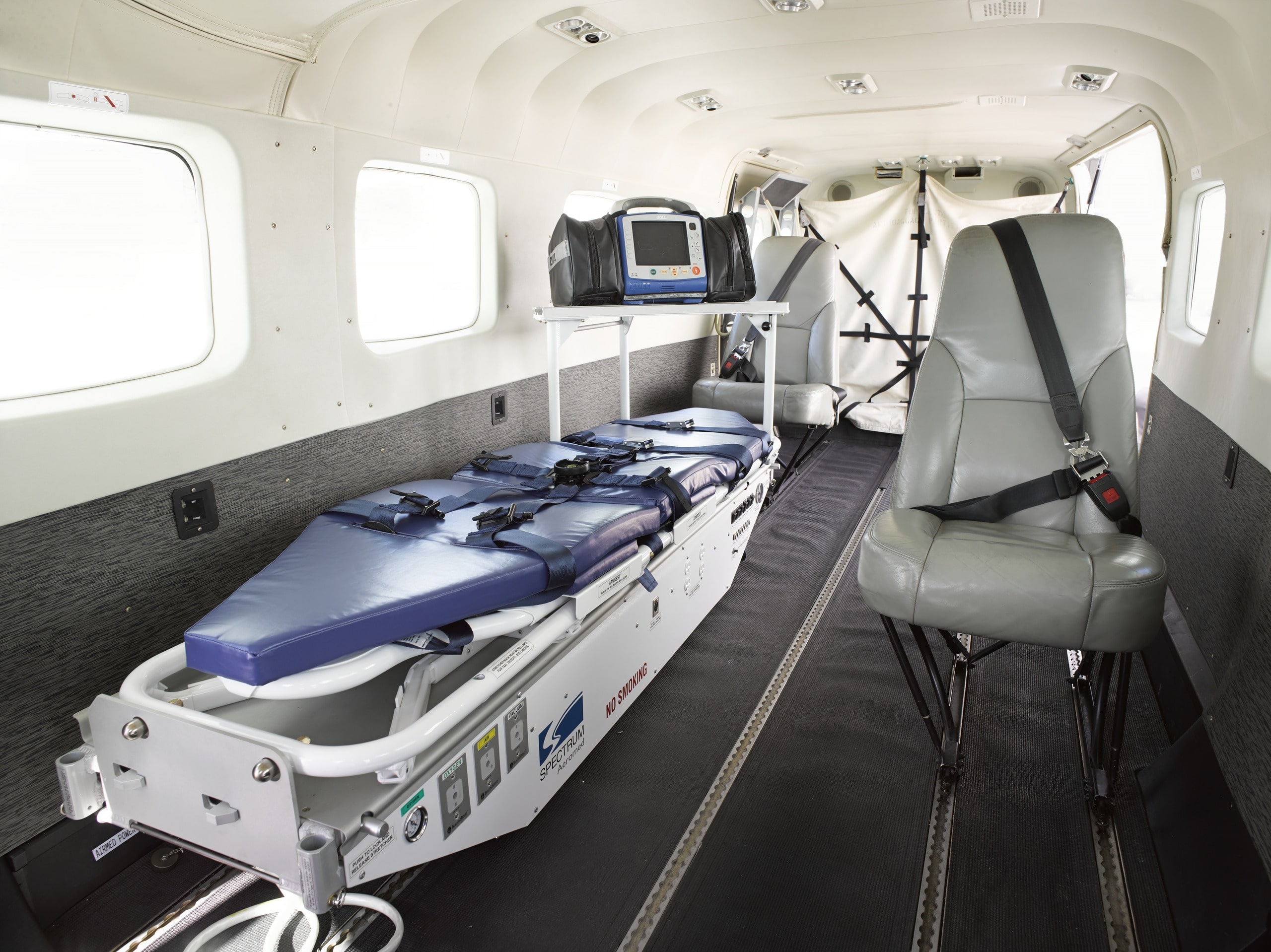
The medical interior of a 2026 air medevac aircraft mirrors a modern hospital ICU. Standard equipment includes:
- Multi-parameter Monitors: Capable of tracking invasive arterial blood pressure, EtCO2, and 12-lead ECGs.
- Turbine-Driven Ventilators: Units like the Hamilton-T1 that provide high-end respiratory support, including protective lung ventilation strategies for ARDS patients.
- Point-of-Care Testing (POCT): Devices that allow flight crews to check blood gases, electrolytes, and hemoglobin levels mid-flight.
- Blood Products: Many 2026 HEMS programs carry "Low-Titer O-Whole Blood" or packed red blood cells and plasma, allowing for "hemostatic resuscitation" at the scene of an accident.
Fixed-Wing vs. Rotary-Wing Capabilities
The choice of aircraft depends heavily on the distance and the patient's condition. While helicopters offer the advantage of landing directly at accident scenes or on hospital helipads, fixed-wing aircraft (jets and turboprops) offer pressurized cabins, which are essential for patients with pneumothorax or those requiring precise oxygen titration at high altitudes.
| Feature | Rotary-Wing (Helicopter) | Fixed-Wing (Air Ambulance Jet) |
|---|---|---|
| Typical Range | 100–150 miles | 500–3,000+ miles |
| Launch Time | 5–10 minutes | 30–60 minutes |
| Landing Requirement | Helipad or open clearing | Designated airport runway |
| Cabin Pressurization | No (Ambient pressure) | Yes (Sea-level adjustment possible) |
| Common Use Case | Trauma scenes, short hospital transfers | International repatriation, long-distance ICU transfers |
| Staffing | Flight Nurse, Flight Paramedic | Flight Nurse, Paramedic, sometimes a Physician |
Staffing and Expertise: The Human Element
A flight is only a lifeline if the personnel on board can manage the patient’s deteriorating condition. In 2026, the standard for air medevac staffing remains high. Most crews consist of a Critical Care Registered Nurse (CCRN/CFRN) and a Flight Paramedic (FP-C). These individuals typically have a minimum of 3-5 years of experience in high-volume ICUs or ERs before ever stepping onto an aircraft.
The training for these professionals involves mastery of "flight physiology," which focuses on how altitude, vibration, and G-forces affect the human body. For example, gas expands as barometric pressure decreases (Boyle’s Law). A flight crew must understand that a small pocket of air in a patient’s chest (pneumothorax) could expand and become a life-threatening tension pneumothorax as the aircraft climbs, requiring immediate needle decompression or chest tube placement in a cramped, noisy cabin.
Navigating the Logistics of an Emergency Air Transfer
Organizing an air medevac is a multi-step process that involves medical, aviation, and administrative coordination. For a family or a local hospital, the process generally follows this trajectory:
- Medical Necessity Determination: A physician determines that the patient’s current facility cannot provide the required care and that the patient is stable enough for flight but too critical for ground transport.
- Securing a Receiving Bed: An air medevac cannot launch until a "receiving physician" at the destination hospital accepts the patient. This ensures the lifeline leads to a definitive solution.
- The "Bed-to-Bed" Concept: Most reputable providers offer a bed-to-bed service. This means the flight team arrives at the patient’s current bedside, manages the transfer to the airport via ground ambulance, monitors the patient during the flight, and stays with them until they are tucked into the bed at the destination hospital.
- Aviation Clearance: Dispatchers and pilots assess weather, weight and balance, and fuel requirements. In 2026, safety is the absolute priority; "Pilot Pressure" is mitigated by ensuring pilots are not told the medical status of the patient, so their decision to fly is based purely on safety and weather.
Financial Considerations and Insurance in 2026
The cost of air medevac remains one of the most complex aspects of the service. Prices can range from $20,000 for a short domestic helicopter flight to over $150,000 for an international fixed-wing transport with a full medical team.
The "No Surprises Act" Impact
In the United States, the No Surprises Act, which went into effect in 2022 and remains the standard in 2026, has significantly changed how patients are billed for emergency air medical services. It prohibits providers from sending "balance bills" for the difference between the provider’s charges and the insurance allowed amount for out-of-network emergency air services. Patients are generally only responsible for their in-network cost-sharing amounts.
International Repatriation and Travel Insurance
For international flights, the "lifeline" often depends on whether the patient has adequate travel insurance with a medevac provision. Without insurance, these flights often require "payment in full" before the aircraft can be dispatched. Families should verify if their policy covers "Medical Evacuation to the Nearest Center of Excellence" or "Repatriation to Home Country," as these are two very different benefits.
Choosing a Provider: Accreditation and Safety Standards
When the flight is the lifeline, there is no room for error. Selecting an air medevac provider requires looking beyond the price tag to verify safety and clinical quality.
The gold standard for accreditation is the Commission on Accreditation of Medical Transport Systems (CAMTS). A CAMTS-accredited provider has undergone a rigorous voluntary audit of their safety protocols, medical equipment, and staff training. In Europe and other international regions, EURAMI (European Aeromedical Institute) provides a similar level of oversight.
According to the National Transportation Safety Board (NTSB), the safety record of air medical services has improved over the last decade due to better Night Vision Goggles (NVG), Terrain Awareness and Warning Systems (TAWS), and stricter duty-time regulations for pilots.
Frequently Asked Questions
Can a family member fly with the patient during an air medevac?
In many cases, yes, but it is not guaranteed. On fixed-wing aircraft, there is usually room for one or two passengers. However, on helicopters (HEMS), space is extremely limited, and weight/balance constraints often prevent passengers from joining. The final decision rests with the pilot and the medical crew based on safety and the patient’s acuity.
How is the medical team determined for a flight?
The medical team is tailored to the patient's needs. A standard crew is a nurse and a paramedic. However, for neonatal transports, a neonatal nurse and a respiratory therapist are used. For complex cardiac cases involving a balloon pump or ECMO, a specialized perfusionist or a physician may be added to the manifest.
Does air medevac operate in bad weather?
Aviation safety standards are strict. If there is heavy fog, severe thunderstorms, or icing conditions that exceed the aircraft’s capabilities, the flight will be declined. This is known as a "weather turn-down." In such cases, the medical team must coordinate with ground transport or wait for a weather window.
Is air medevac covered by Medicare or Medicaid?
Medicare and Medicaid do cover air ambulance services, but only when it is deemed "medically necessary." This means that the patient’s condition required immediate and rapid transport that ground options could not provide, and that the patient was being transported to the nearest appropriate facility.
What is the difference between "Air Medevac" and "Flight Escort"?
Air medevac involves a dedicated medical aircraft (a "Flying ICU"). A "Flight Escort" or "Medical Escort" is a service where a medical professional accompanies a stable patient on a scheduled commercial airline flight, often in business or first class, using portable medical equipment. Escorts are significantly cheaper but are only suitable for non-critical patients.
Practical Recommendation: Planning for the Unexpected
While no one plans for a medical emergency, understanding the mechanics of air medevac is vital for those traveling to remote areas or living with chronic, high-risk conditions. If you are an administrator or a family member facing a transfer, prioritize providers with CAMTS accreditation and ensure that a clear "bed-to-bed" protocol is in place.
For travelers, the most practical action is to purchase a dedicated medical evacuation membership or insurance policy. Ensure the policy covers "Hospital of Choice" rather than just the "Nearest Adequate Facility." This distinction is the difference between being stabilized in a foreign country or being flown back to your primary medical team at home. In 2026, when the flight is the lifeline, the speed of coordination is just as important as the speed of the aircraft.