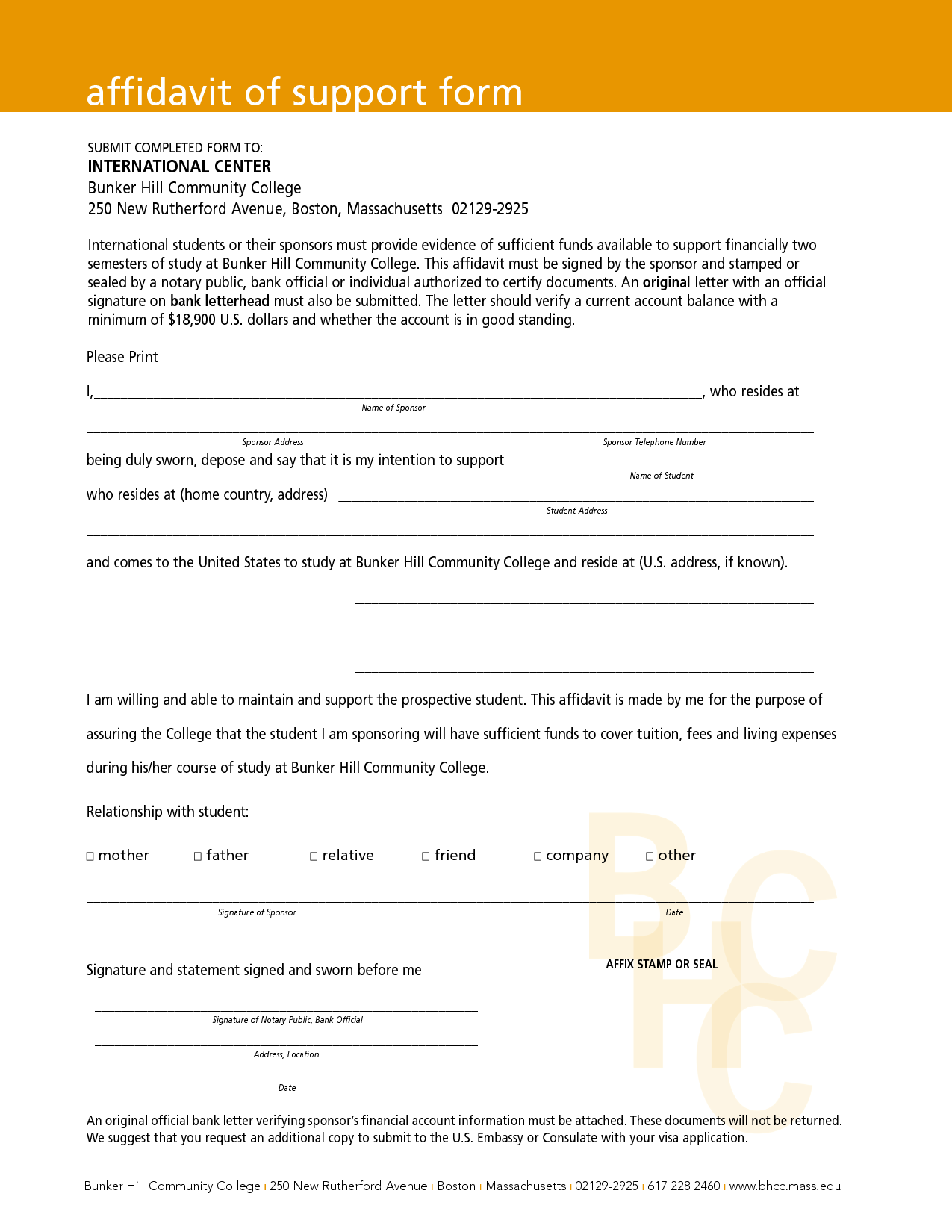
An affidavit of support for a visitor visa is a formal document, typically Form I-134 in the United States, where a sponsor pledges to financially support a foreign traveler during their stay. It provides evidence to consular officers that the applicant has sufficient financial backing and will not become a public charge.
The process of obtaining a visitor visa, such as the B-1 (business) or B-2 (tourism) visa, requires the applicant to prove they have strong ties to their home country and the financial means to support their travel. When an applicant cannot cover the full cost of their trip, a third party—usually a relative or friend residing in the destination country—can step in as a sponsor. In 2026, the scrutiny regarding financial self-sufficiency remains high, making the affidavit of support a cornerstone of many successful visa applications.
The Purpose of Form I-134: Declaration of Financial Support
While the term "affidavit of support" is frequently used as a general label, in the context of U.S. visitor visas, it refers specifically to Form I-134, Declaration of Financial Support. It is essential to distinguish this from the I-864, which is used for immigrant visas and carries significantly more legal weight and long-term obligation.
The primary goal of the I-134 is to overcome the "public charge" ground of inadmissibility. Under U.S. immigration law, any alien who is likely at any time to become a public charge is inadmissible. By signing the I-134, the sponsor declares they have the income and assets to ensure the visitor does not require government-funded public assistance.
Legal Weight and Sponsor Responsibility
Unlike the I-864 used for green card sponsorships, the I-134 is generally considered a "non-binding" contract in many jurisdictions, meaning the government cannot easily sue the sponsor to recover costs if the visitor uses public benefits. However, providing false information on the form is a federal offense, and the presence of a signed I-134 is a heavy factor in the consular officer’s discretionary decision. If a visitor overstays or violates their status, the sponsor's credibility with the Department of Homeland Security (DHS) may be permanently tarnished, affecting future sponsorship attempts.
Eligibility Requirements for Sponsors in 2026
To act as a sponsor for a visitor visa, an individual must meet specific criteria regarding their legal status and financial standing. The requirements are designed to ensure the sponsor is a stable resident of the country and has enough surplus income to facilitate another person's stay.
Legal Status and Residency
In 2026, a sponsor must typically be one of the following:
- A U.S. Citizen.
- A Lawful Permanent Resident (LPR), commonly known as a Green Card holder.
- In some specific cases, a non-immigrant with a long-term, stable work visa (such as an H-1B or L-1) who can demonstrate sufficient longevity to cover the duration of the visitor’s stay.
The sponsor must be physically present in the country and maintain a primary residence there. They cannot sponsor a visitor if they are living abroad indefinitely, as their income and assets must be accessible within the domestic financial system.
Income Thresholds and Poverty Guidelines
Financial eligibility is usually measured against the Federal Poverty Guidelines, which are updated annually by the Department of Health and Human Services (HHS). For an I-134 to be considered effective, the sponsor’s household income should generally meet or exceed 100% to 125% of the poverty line for their total household size, including the visitor(s).
For example, if a sponsor has a family of four and is sponsoring one visitor, their income must support a household of five. If the sponsor’s income is borderline, they may include significant assets such as savings accounts, stocks, or bonds to bolster the application. However, liquid income (salary) is always weighted more heavily than stagnant assets like real estate.
Essential Documentation and Evidence
An affidavit is only as strong as the evidence supporting it. Consular officers are trained to look for inconsistencies and signs of "manufactured" financial standing. Therefore, the sponsor must provide a comprehensive evidence package.
1. Employment Verification
The sponsor should provide a letter on official company letterhead from their employer. This letter must state:
- The date and nature of employment.
- The annual salary or hourly wage.
- Whether the position is temporary or permanent.
2. Tax Returns and W-2s
Current standards in 2026 require the most recent federal income tax return (Form 1040). While only the most recent year is strictly required, providing the last three years of transcripts from the IRS demonstrates financial stability over time. W-2 forms or 1099s are also necessary to verify the income reported on the returns.
3. Bank Records
A letter from an officer of the bank or financial institution where the sponsor has accounts is vital. This letter should specify:
- The date the account was opened.
- The total amount deposited during the past year.
- The current balance.
Consular officers look for "seasoned" funds. Large, sudden deposits made just weeks before the visa interview are often flagged as "loaned" money intended to deceive the consulate and may lead to a visa denial.
4. Proof of Legal Status
A copy of the sponsor’s U.S. passport, birth certificate, or Green Card (both sides) must be included to verify that the sponsor has the legal standing to sign the declaration.
Comparing the I-134 and I-864 Affidavits
It is a common mistake for applicants to use the wrong form. Using an immigrant visa affidavit (I-864) for a visitor visa can lead to confusion and delays.
| Feature | Form I-134 (Visitor Visa) | Form I-864 (Immigrant Visa) |
|---|---|---|
| Primary Use | B-1/B-2, K-1, and other non-immigrant visas. | Family-based and some employment-based Green Cards. |
| Legal Nature | A declaration of intent and financial capacity. | A legally binding contract with the U.S. Government. |
| Enforceability | Generally not enforceable for benefit reimbursement. | Fully enforceable; sponsor is liable for the visitor's use of public benefits. |
| Duration | Lasts for the duration of the temporary visit. | Lasts until the immigrant becomes a citizen or works 10 years. |
| Income Requirement | Typically 100-125% of Poverty Guidelines. | Strictly 125% of Poverty Guidelines (100% for military). |
How to Complete the Affidavit of Support
Completing the I-134 requires precision. Any discrepancy between the I-134 and the visitor’s own DS-160 (the online visa application) can result in a rejection under Section 214(b) for failure to prove non-immigrant intent.
Step 1: Identifying the Beneficiary
The sponsor must provide the exact name, date of birth, and address of the visitor. This must match the visitor’s passport exactly. If multiple family members are visiting, a separate I-134 is often recommended for each person, though children can sometimes be included on a parent's form depending on specific consulate instructions.
Step 2: Detailing Financial Contributions
The sponsor must be specific about what they are paying for. Will they provide "room and board"? Will they cover "round-trip airfare"? Will they provide a "stipend of $2,000 for personal expenses"? Being specific shows the consular officer that the sponsor has actually calculated the costs and is prepared for the financial reality of the visit.
Step 3: The Statement of Intent
There is a section for the sponsor to explain why they are supporting the visitor. A strong statement might say: "I am sponsoring my mother's visit for three weeks so she can attend my daughter’s graduation. I am covering all costs to ensure her personal savings remain intact for her retirement in her home country." This reinforces the idea that the visitor has a reason to return home.
Step 4: Signing and Notarization
As of 2026, USCIS and the Department of State generally accept Form I-134 signed under penalty of perjury without a notary's seal. However, many practitioners still recommend notarization if the local consulate has a history of being particularly strict, or if the sponsor’s financial situation is complex.
Common Mistakes and Rejection Risks
Even with a high-income sponsor, a visitor visa can be denied. The affidavit of support is only one piece of the puzzle.
- Over-Sponsorship: If a sponsor with a modest income tries to sponsor five different friends in one year, the consulate will likely doubt their ability to support them all.
- The "Substitution" Fallacy: Many applicants believe that an affidavit of support replaces their own need to show ties to their home country. This is incorrect. If the applicant has no job, no property, and no family in their home country, an affidavit of support from a wealthy U.S. relative might actually make the officer suspect the applicant intends to stay in the U.S. permanently.
- Incomplete Evidence: Sending a signed form without the bank letters or tax returns is a guaranteed way to have the document ignored.
- Inconsistent Dates: If the I-134 says the visitor is staying for two weeks, but the visitor tells the officer they are staying for six months, the discrepancy will likely lead to a denial.
The Impact of the "Public Charge" Rule in 2026
The "Public Charge" ground of inadmissibility remains a significant factor in 2026. Consular officers are directed to look at the "totality of the circumstances." This means they evaluate the applicant’s age, health, family status, assets, resources, financial status, education, and skills.
While the I-134 helps, it is not a "get out of jail free" card. If a visitor is elderly and has significant medical issues, the consular officer may worry that they will seek expensive medical treatment in the U.S. and fail to pay, even with a sponsor. In such cases, the sponsor should also include evidence of travel medical insurance purchased for the visitor to show that potential healthcare costs are covered.
Practical Recommendations for a Strong Application
To maximize the effectiveness of the affidavit of support, follow these tactical steps:
- Match the DS-160: Ensure all information regarding the sponsor’s name, address, and occupation on the visitor’s DS-160 matches the I-134 exactly.
- Provide a "Sponsor Letter": In addition to the official form, the sponsor should write a personal invitation letter to the visitor. This letter should detail the itinerary and the emotional reason for the visit, which helps establish the legitimacy of the trip.
- Organize Chronologically: When the visitor goes to the interview, the financial documents should be organized in a clear folder. The I-134 should be on top, followed by the employer letter, then tax returns, then bank statements.
- Update Documents: Financial documents should be "fresh." Bank statements and employer letters should be dated within 30 to 60 days of the visa interview. Using a year-old tax return is acceptable in the early months of the year, but by mid-2026, the 2025 return is expected.
FAQs
Can a friend sponsor a visitor visa, or does it have to be a relative?
A friend can certainly sponsor a visitor visa. U.S. immigration regulations do not restrict sponsorship to family members. However, a friend may face a higher burden of proof to show why they are willing to spend thousands of dollars on the applicant's behalf. Consular officers may be more skeptical of "friendships" that appear to be a front for unauthorized employment or marriage schemes.
Does an affidavit of support guarantee visa approval?
No, it does not. The most common reason for visitor visa denial is Section 214(b)—failure to prove "non-immigrant intent." An affidavit of support only proves the applicant has money; it does not prove the applicant will return home. In some cases, a very strong affidavit from a U.S. relative can actually hurt an application by highlighting that the applicant has a strong reason to stay in the U.S.
Is there a filing fee for Form I-134?
As of 2026, there is no filing fee charged by USCIS for Form I-134. It is a document that the sponsor completes and sends directly to the visa applicant, who then presents it at the U.S. embassy or consulate during their interview. Note that third-party services or attorneys may charge a fee to help prepare the document, but the government does not.
Can there be more than one sponsor?
Yes. If one sponsor does not meet the income requirements, the applicant can present affidavits from multiple sponsors. For example, a brother and a sister can both submit I-134s to support their mother’s visit. Each sponsor must provide the full suite of supporting documentation (tax returns, bank letters, etc.).
What happens if the sponsor's income is below the poverty line?
If the sponsor's income is below the 100-125% threshold, the affidavit will likely be deemed insufficient. In this scenario, the sponsor can use assets (savings, stocks, real estate) to make up the difference, or a co-sponsor with higher income must be found. Assets are usually valued at a fractional rate (often 5:1) compared to annual income for sponsorship purposes.
Next Actions for Sponsors and Applicants
The most immediate next step is for the sponsor to gather their most recent tax transcripts and a formal letter from their employer. These documents often take the longest to secure. Once gathered, the sponsor should download the most recent version of Form I-134 from the official USCIS website.
Applicants should ensure they have their interview scheduled and that they also have their own evidence of ties to their home country—such as employment contracts, property deeds, or school enrollment—to complement the sponsor’s financial declaration. A balanced approach that shows both the ability to pay (via the sponsor) and the intent to return (via the applicant) is the most effective path to securing a visitor visa in 2026.