Learning Python offers a clear advantage through its clean syntax, extensive standard library, and massive ecosystem, making it the premier language for beginners and advanced developers alike in data science, web development, automation, and artificial intelligence.
Introduction to the Python Programming Ecosystem
Selecting a programming language to master is a critical decision for anyone entering the technology sector or looking to expand their engineering skill set. Among the myriad options available, Python consistently ranks as one of the most widely adopted and fastest-growing programming languages in the world. Created by Guido van Rossum and first released in 1991, Python was designed with a philosophy that prioritizes code readability and simplicity. Over the decades, it has evolved from a simple scripting tool into a dominant force powering everything from local automation scripts to massive distributed architectures at major technology enterprises.
For aspiring developers, data scientists, and system administrators, understanding the advantages of learning Python requires looking beyond simple hype. This language has secured its position due to concrete technical merits: an approachable learning curve, a vibrant global community, vast cross-industry applicability, and a rich ecosystem of third-party packages. This guide explores the multifaceted benefits of learning Python, providing an objective analysis of why it remains an essential tool in modern software engineering.
Readability and Expressiveness as Core Advantages
One of the most immediate benefits developers encounter is Python's clean and readable syntax. In many traditional programming languages, syntax rules require excessive boilerplate code, complex punctuation, and explicit memory management structures that obscure the logic of the program. Python was explicitly engineered to resemble human-readable English, enforcing indentation rules that make the code structural layout transparent and uniform across different teams.
This emphasis on readability translates directly into reduced development time. When code is easy to read, it is significantly easier to debug, maintain, and hand over to other engineers. For learners, this means less time fighting compiler errors or trying to decipher arcane syntax rules and more time focusing on fundamental computer science concepts, algorithmic thinking, and problem-solving strategies. By minimizing cognitive load, Python allows developers to express complex ideas in fewer lines of code than would be required in languages like C++ or Java.
Versatility Across Diverse Technical Domains
Unlike languages that are pigeonholed into a single niche, Python is a general-purpose language used across a vast spectrum of technology sectors. This versatility means that learning a single language opens doors to multiple career paths without requiring a complete re-tooling of one's skill set.
- Python Application Domains
- Data Science & AI
- Pandas, NumPy
- TensorFlow, PyTorch
- Web Development
- Django, Flask
- FastAPI
- System Automation
- Scripting, DevOps
- Task Orchestration
- Data Science & AI
Data Science, Machine Learning, and Artificial Intelligence
Python is the undisputed lingua franca of data science and artificial intelligence. The availability of specialized libraries and frameworks has transformed how data is processed, analyzed, and modeled.
- Data Manipulation: Libraries like NumPy and Pandas provide high-performance array handling and data frame structures capable of cleaning and transforming millions of data points efficiently.
- Visualization: Tools such as Matplotlib and Seaborn allow engineers and analysts to generate publication-grade charts and interactive dashboards.
- Machine Learning: Frameworks like Scikit-Learn, TensorFlow, and PyTorch abstract complex mathematical and statistical operations, enabling developers to build sophisticated neural networks and predictive models with minimal boilerplate code.
Web Development and API Engineering
While languages like JavaScript dominate the client-side browser environment, Python is heavily utilized on the backend server side.
- Django: A high-level Python web framework that encourages rapid development and clean, pragmatic design, adhering to the "batteries-included" philosophy by providing built-in authentication, ORM database management, and administrative panels.
- Flask: A lightweight micro-framework that gives developers maximum flexibility, allowing them to construct custom web applications and microservices using only the extensions they require.
- FastAPI: A modern, high-performance web framework designed for building RESTful APIs rapidly, leveraging Python type hints for automatic interactive documentation generation.
Automation, Scripting, and DevOps
Routine, repetitive tasks consume valuable human resources across organizations. Python excels at writing automation scripts that interact with operating systems, file systems, and network protocols. System administrators and DevOps engineers use Python to parse log files, automate server deployments, interact with cloud provider APIs (such as AWS Boto3), and orchestrate complex CI/CD pipelines.
Rich Ecosystem and the Python Package Index
The true power of Python extends far beyond its core syntax; it lies in its massive, decentralized ecosystem hosted primarily on the Python Package Index (PyPI). PyPI hosts hundreds of thousands of third-party software packages created and maintained by a collaborative global community.
Instead of reinventing the wheel or writing complex algorithms from scratch, developers can leverage pre-built, thoroughly tested packages for almost any conceivable task. Whether an application requires parsing JSON data, interacting with an obscure database engine, scraping web pages, or encrypting user communications, a specialized library is almost certainly available via a simple package manager command (pip install). This modularity accelerates time-to-market for software products and allows solo developers to build enterprise-grade applications rapidly.
Career Opportunities and Market Demand
From an economic and professional standpoint, mastering Python offers substantial returns. The global demand for Python-fluent engineers remains consistently high across startups, mid-sized firms, and Fortune 500 technology giants. Because the language spans multiple high-growth industries—such as artificial intelligence, cloud computing, fintech, and cybersecurity—professionals who possess Python skills enjoy high job mobility and competitive compensation packages.
Furthermore, Python serves as an exceptional gateway skill. Once a developer masters core programming paradigms (such as object-oriented programming, functional programming principles, and algorithmic optimization) through Python, transitioning to other languages like Go, Rust, JavaScript, or C# becomes significantly less daunting.
| Feature / Metric | Python | C++ | Java | JavaScript |
|---|---|---|---|---|
| Syntax Complexity | Low (Readable, English-like) | High (Pointers, manual memory) | Medium (Strict typing, verbose) | Medium (Asynchronous paradigms) |
| Primary Domains | Data Science, AI, Backend, Automation | Systems, Game Development, Embedded | Enterprise Software, Android | Web Frontend, Node.js Backend |
| Execution Speed | Interpreted (Slower raw execution) | Compiled (Extremely fast) | Compiled to bytecode (Fast) | Just-In-Time compiled (Fast) |
| Learning Curve | Gentle for beginners | Steep | Moderate | Moderate |
| Ecosystem Size | Massive (PyPI) | Fragmented | Vast (Maven) | Massive (npm) |
Performance Considerations and Limitations
While the advantages of learning Python are substantial, an objective assessment must also acknowledge its limitations. Understanding where Python falls short helps developers make informed architectural decisions.
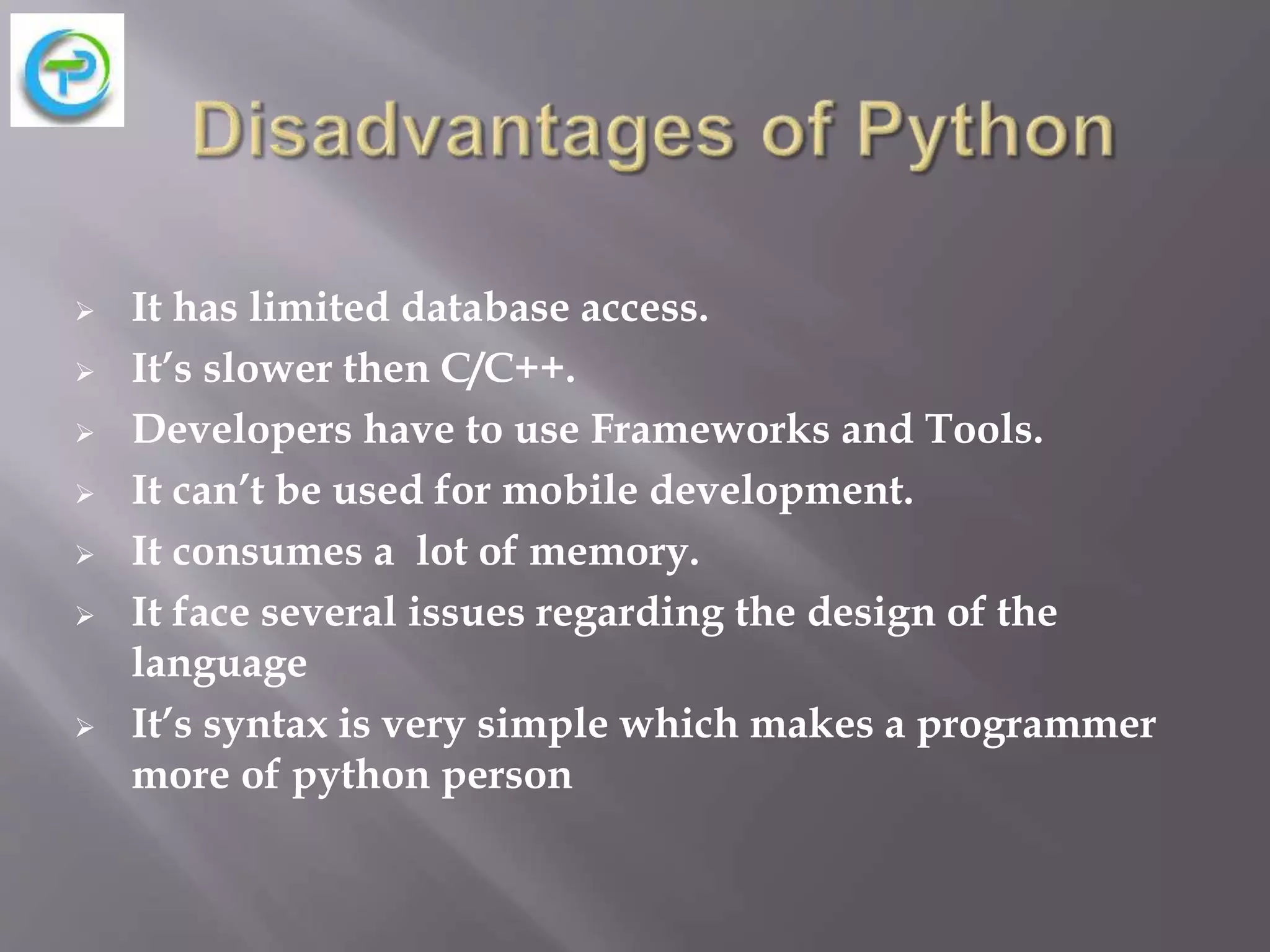
- Execution Speed: As an interpreted language whose reference implementation (CPython) executes bytecode via a virtual machine, Python is generally slower in raw computational benchmarks than compiled languages like C, C++, or Rust. For CPU-bound tasks, this latency can be a bottleneck, though it is often mitigated by writing performance-critical routines in C or utilizing specialized libraries that leverage underlying compiled C code (such as NumPy).
- Global Interpreter Lock (GIL): CPython utilizes a Global Interpreter Lock, which prevents multiple native threads from executing Python bytecodes at once. While this simplifies memory management and thread safety for standard scripts, it limits true multithreading performance in CPU-bound multi-core scenarios. Developers overcome this limitation by utilizing multi-processing libraries or asynchronous programming paradigms.
- Mobile Development: While Python excels in desktop, server, and cloud environments, it is not the native language for mobile application development on iOS or Swift (where Swift and Objective-C dominate) or Android (where Kotlin and Java are standard). Although frameworks like Kivy exist, mobile development is not Python's strongest domain.
Frequently Asked Questions
Is Python difficult to learn for someone with zero programming experience?
No, Python is widely considered the best programming language for absolute beginners. Its syntax eliminates unnecessary curly braces and semicolons, replacing them with clean whitespace indentation. This allows learners to focus immediately on core computational logic rather than complex compilation rules.
Can Python be used for large-scale enterprise applications?
Yes. Major technology platforms such as Instagram, Spotify, Netflix, and Dropbox rely heavily on Python to handle billions of requests, process massive data pipelines, and power complex backend microservices at scale.
How does Python compare to JavaScript for a first language?
Python and JavaScript are both excellent first languages, but they serve different primary goals. Choose Python if your interests lean toward data science, artificial intelligence, backend engineering, or system automation. Choose JavaScript if you want to build interactive user interfaces and full-stack web applications for browsers.
Do I need a strong background in mathematics to learn Python?
No advanced mathematical background is required for general programming, web development, or automation in Python. However, if you plan to specialize in machine learning, deep learning, or quantitative data analysis, a foundational understanding of linear algebra, calculus, and statistics becomes necessary.
Practical Next Steps for Learners
Transitioning from theoretical knowledge to practical proficiency requires a structured approach. Prospective developers should begin by installing the latest stable release of Python and a robust integrated development environment (IDE) such as Visual Studio Code or PyCharm.
Rather than passively watching video tutorials, learners should focus on project-based learning: build a simple command-line utility, develop a personal portfolio website using Flask or Django, or analyze a public dataset using Pandas. Engaging with communities on platforms like GitHub, Stack Overflow, and local user groups will accelerate skill acquisition and integrate you into the broader software engineering ecosystem.