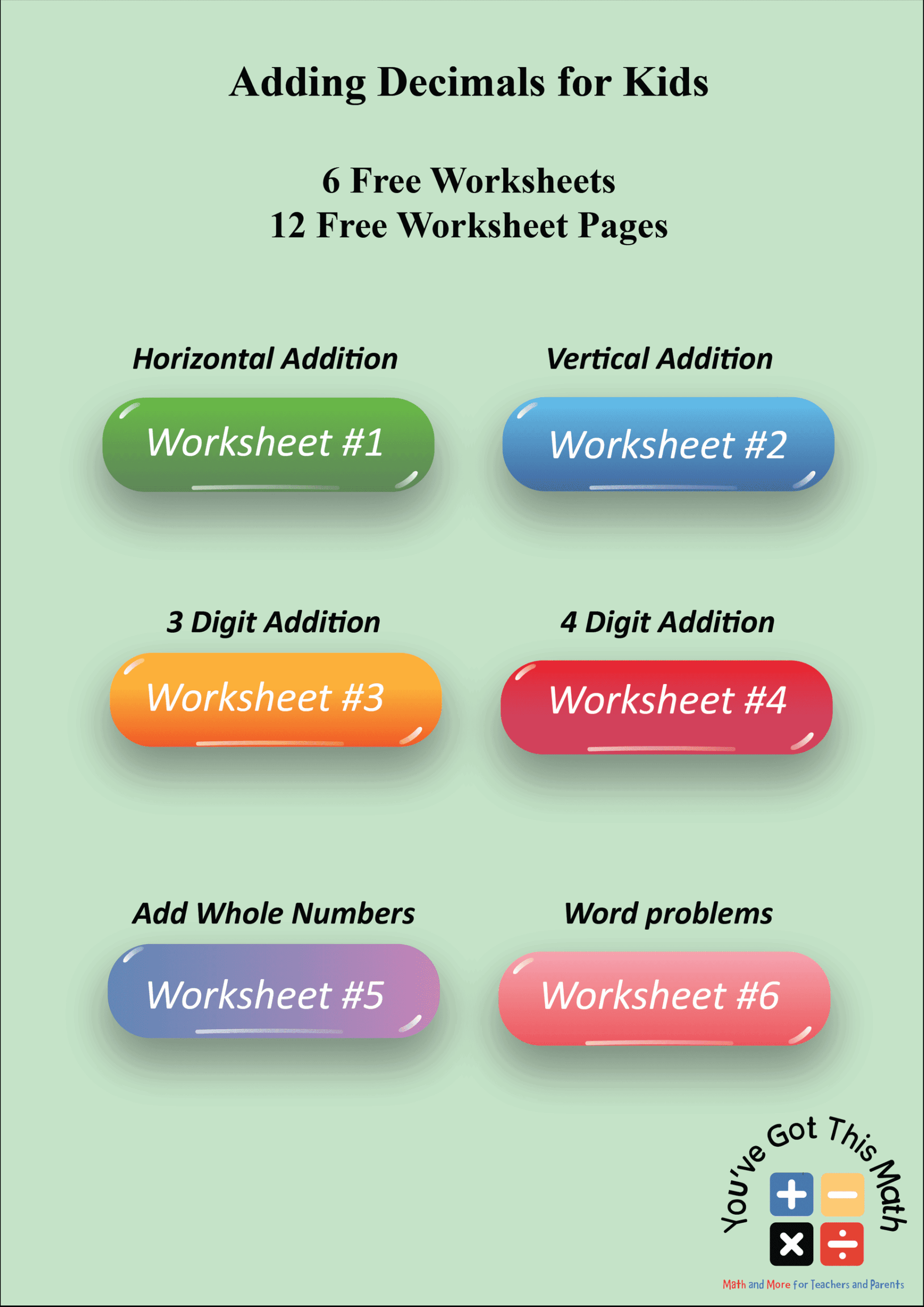
Adding decimals worksheets serve as fundamental pedagogical tools designed to help students transition from whole-number arithmetic to the more precise realm of base-ten fractions. By providing structured practice in aligning decimal points and managing place value, these worksheets enable learners to build the computational fluency required for advanced mathematics, scientific measurements, and financial literacy. Whether you are a parent supporting home education or an educator designing a curriculum, mastering the use of these materials is essential for developing decimal proficiency.
The primary objective of using these worksheets is to reinforce the mechanical process of vertical addition while ensuring students understand the magnitude of the numbers involved. Decimal addition requires a disciplined approach, specifically the rigid alignment of decimal points, which functions as the anchor for the entire calculation. When students practice with well-structured worksheets, they learn to treat digits in the tenths, hundredths, and thousandths places with the same conceptual rigor applied to ones, tens, and hundreds. This guide explores the methodology behind these worksheets, the prerequisites for success, and the strategies to overcome common challenges in decimal computation.
Prerequisites for Adding Decimals
Before a student begins formal exercises involving decimal addition, they must possess a solid foundation in two key areas: place value notation and whole-number addition. Without a firm grasp of how numbers grow in power of ten, adding decimals becomes an abstract, error-prone task rather than a logical progression of arithmetic.
Understanding Place Value
The decimal system is built entirely on the concept of place value. Students must recognize that the position of a digit relative to the decimal point determines its value. For example, in the number 12.345, the "3" resides in the tenths place, representing 3/10, while the "5" occupies the thousandths place, representing 5/1000.
Worksheets often begin with visual aids such as base-ten blocks or grid paper to help students "see" these fractional parts. Before moving to abstract numeric problems, students should be able to identify that 0.1 is greater than 0.01. If a student struggles to distinguish between these values, they are likely to encounter significant difficulties when asked to align numbers of different lengths, such as 4.5 and 4.56.
Mastery of Whole-Number Addition
The algorithm for adding decimals is identical to the algorithm for adding whole numbers, with the added requirement of managing the decimal point. If a student is still struggling with carrying numbers (regrouping) in whole-number addition, they should master that skill first. Attempting to manage the decimal alignment while simultaneously struggling with basic addition facts will lead to cognitive overload, resulting in frustration and a higher rate of errors.
The Mechanical Process of Adding Decimals
To effectively utilize adding decimals worksheets, both educators and students must adhere to a specific, repeatable process. This systematic approach ensures accuracy even when dealing with increasingly complex multi-digit decimals.
1. Vertical Alignment
The most common mistake in decimal addition occurs when students align numbers to the right as they would with whole numbers. Instead, students must vertically align the decimal points themselves. When the decimal points are stacked in a straight column, the place values (tenths under tenths, hundredths under hundredths) naturally fall into their correct positions.
2. Filling Empty Place Values
When adding decimals of different lengths, such as 12.7 + 0.456, students may find it difficult to keep columns straight. A recommended strategy is to use "placeholder zeros." By rewriting 12.7 as 12.700, the student creates a uniform structure that prevents the numbers from shifting during the addition process. This practice bridges the gap between simple exercises and advanced work where precision is non-negotiable.
3. The Role of the Decimal Point
The decimal point in the sum should be placed directly below the decimal points in the addends. This is a simple but critical rule. Beginners often treat the decimal point as an afterthought; however, emphasizing its placement as the first step after writing the problem can significantly reduce errors in the final result.
Types of Adding Decimals Worksheets
Not all worksheets are created for the same stage of learning. To maximize their effectiveness, it is necessary to select or create worksheets that match the specific developmental level of the learner.
Conceptual Development Worksheets
These worksheets utilize visual models, such as number lines or grids, to demonstrate what occurs when two decimals are combined. These are best for introductory lessons where the goal is to establish the "why" behind the operation. They often involve simpler numbers that do not require complex regrouping.
Procedural Fluency Worksheets
Once the concept is understood, the goal shifts to speed and accuracy. These worksheets contain long lists of problems without visual aids, forcing the student to rely on the algorithmic process. They are essential for building the muscle memory needed to solve problems reliably.
Real-World Application Worksheets
The most effective way to solidify decimal skills is to move away from naked numbers and toward word problems. These worksheets involve context, such as adding prices from a store receipt, measuring lengths in centimeters, or calculating weights in kilograms. Contextual problems require students to extract the relevant data and determine which decimals need to be added to find a solution.
Comparison of Worksheet Types
| Worksheet Type | Primary Goal | Best For | Typical Format |
|---|---|---|---|
| Visual/Conceptual | Understanding | Beginners | Grids, blocks, number lines |
| Procedural | Speed/Accuracy | Intermediate | Vertical columns of numbers |
| Applied | Contextualization | Advanced | Word problems, price lists |
Addressing Common Pitfalls and Troubleshooting
Even with consistent practice, students often encounter recurring obstacles. Understanding these challenges is the first step toward effective remediation.
The "Right-Alignment" Trap
As previously mentioned, students frequently align numbers to the right-hand side, treating the decimal point as a hurdle to be ignored. If you notice this pattern, the most effective corrective action is to have the student use graph paper. By placing one digit per square, the student is physically forced to keep the decimal point in its own column, which provides a visual boundary that prevents misalignment.
Regrouping Errors
Students often forget to carry the "one" when their sum in a specific column exceeds ten. This is usually a carryover issue from whole-number addition. If regrouping is the primary source of error, the student should practice whole-number addition with larger numbers to ensure the mechanics of carrying are automatic before returning to decimals.
The Placeholder Zero Hesitation
Some students feel that adding a zero to the end of a number (e.g., changing 0.5 to 0.50) is "cheating" or mathematically incorrect. It is crucial to explain that these are "equivalent decimals." Providing a brief lesson on why 0.5 and 0.50 have the same value—perhaps by showing them as fractions (5/10 vs 50/100)—can resolve this conceptual barrier and encourage the use of placeholders as a tool for accuracy.
Incorporating Technology and Verification
While paper-based worksheets remain the gold standard for developing handwriting and procedural fluency, they can be complemented by technological tools.
Verification Tools
In 2026, students have access to various digital calculators and educational software. While the calculator should not be used as a replacement for learning the algorithm, it can be a powerful tool for self-verification. Students can complete a set of problems on a worksheet and then use a calculator to check their answers. If there is a discrepancy, the student must rework the problem by hand to find the error, rather than simply copying the result. This feedback loop is essential for internalizing the process.
Strategic Use of Time
Worksheets should not be treated as a test of endurance. Short, focused sessions of 15–20 minutes are generally more effective than hour-long drill sessions. By breaking practice into manageable segments, the learner stays engaged and avoids the fatigue that leads to careless mistakes.
Educational Next Steps: Beyond Addition
Once a student achieves consistent success with adding decimals worksheets, they are prepared for the next logical steps in the curriculum:
- Subtracting Decimals: The logic of alignment and place value carries over directly to subtraction, though borrowing (regrouping across the decimal) introduces new complexity.
- Multiplying Decimals: This operation requires a different set of rules regarding decimal placement, which is often confusing if addition skills are not rock-solid.
- Decimal-Fraction Conversion: Understanding how decimals relate to common fractions (e.g., 0.25 = 1/4) deepens the learner's overall number sense.
Frequently Asked Questions
How can I help my child if they struggle to align the decimals?
Encourage the use of graph paper. The physical constraints of the grid cells make it nearly impossible to misalign the columns. Additionally, teach them to "drop the decimal point" into the answer line immediately after writing the addends, before they even begin the addition.
Why do some worksheets require placeholder zeros?
Placeholder zeros make the decimal numbers the same length. This is a scaffolding technique that helps prevent errors when adding decimals with different numbers of digits, such as 4.2 and 4.258. It ensures that the tenths, hundredths, and thousandths remain perfectly aligned.
Should students use calculators for these worksheets?
Calculators should only be used as a secondary check after the work has been completed by hand. Using a calculator during the learning phase prevents the student from developing the necessary cognitive connections regarding place value and regrouping.
Are there specific age guidelines for these worksheets?
While most students are introduced to decimals in the late elementary grades, age is less important than prior mathematical proficiency. Ensure the student has mastered multi-digit whole-number addition before introducing decimal-specific worksheets.
How do I know when a student is ready to stop using worksheets?
A student is ready to move beyond repetitive worksheets when they can solve multi-step word problems involving decimals with a high degree of accuracy and speed. At this point, the focus should shift to applying these skills in complex algebraic or scientific contexts.
Recommendation for Success
To achieve the best results, start by assessing the student's current comfort level with place value. If the foundation is shaky, use visual-based worksheets for a few sessions. Once the concept is clear, transition to procedural worksheets and mandate the use of graph paper to enforce alignment. Finally, integrate real-world word problems to ensure the skill is functional rather than merely theoretical. Consistent, low-pressure practice will yield the highest long-term retention.