An absolute triangle is a specialized geometric configuration defined within absolute geometry—a foundational system encompassing both Euclidean and hyperbolic geometry without relying on Euclid's parallel postulate. This concept allows mathematicians and physicists to study structural properties and angle sums that remain entirely independent of whether lines can be infinitely parallel or strictly intersecting.
Introduction to Absolute Geometry and the Triangle
To understand what an absolute triangle represents, one must first step back from standard Euclidean geometry taught in primary classrooms. Euclidean geometry relies heavily on the fifth postulate, which states that through a given point not on a line, exactly one line can be drawn parallel to the given line. However, during the 19th century, mathematicians like Carl Friedrich Gauss, Nikolai Lobachevsky, and János Bolyai independently discovered that consistent geometries could be constructed without this parallel postulate. This broader framework is known as absolute geometry.
Within absolute geometry, an absolute triangle is simply a standard polygon possessing three straight sides and three angles, but its properties are derived solely using neutral theorems. Neutral theorems are propositions proven without assuming any specific axiom regarding parallel lines. As a result, any theorem that applies to an absolute triangle holds true in both Euclidean space and hyperbolic space. This makes the absolute triangle a crucial analytical tool for proving foundational relationships before branching off into specific geometric paradigms.
Core Properties of the Absolute Triangle
The investigation of absolute triangles relies on a strict hierarchy of logical proofs. Because the parallel postulate is omitted, certain intuitive assumptions from Euclidean geometry—such as the sum of angles in a triangle always equaling precisely 180 degrees—must be re-evaluated.
The Angle Sum Theorem in Absolute Geometry
One of the most profound discoveries in the study of absolute triangles is the relationship governing their interior angles. In neutral geometry, it can be proven that the sum of the interior angles of any triangle is less than or equal to two right angles (180 degrees or $\pi$ radians).
$$\alpha + \beta + \gamma \le 180^\circ$$
This upper bound divides geometry cleanly into distinct possibilities based on which specific system you adopt:
- Euclidean Geometry: The angle sum of every triangle is always exactly 180 degrees.
- Hyperbolic Geometry: The angle sum of every triangle is always strictly less than 180 degrees, with the difference known as the triangle's "defect."
Because an absolute triangle must satisfy theorems valid in both systems, it cannot assume an angle sum of 180 degrees universally; it can only guarantee that the sum will not exceed 180 degrees. This property forms the bedrock for testing the curvature of spaces in differential geometry and general relativity.
Exterior Angle Inequality
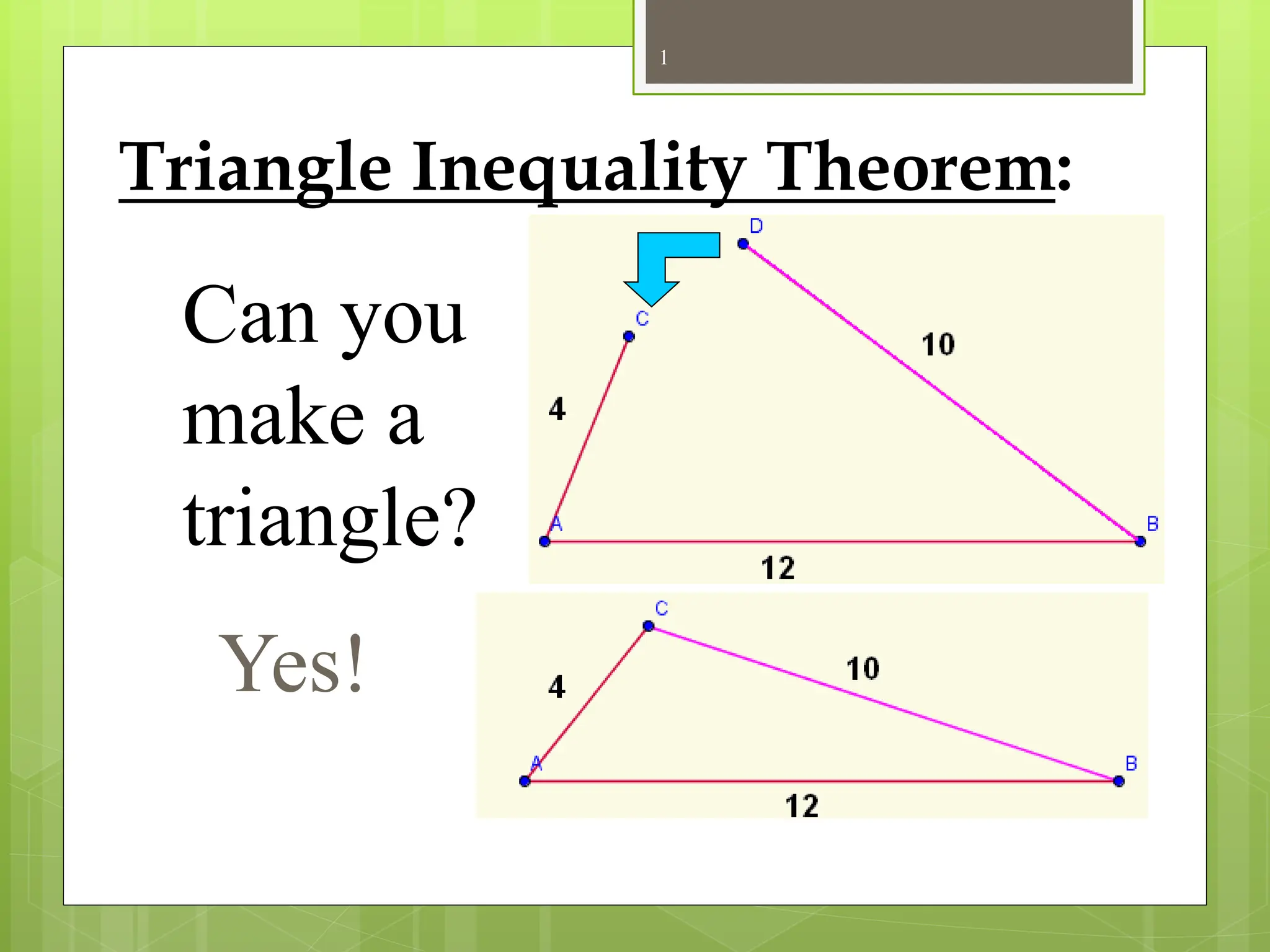
Another vital characteristic preserved in the absolute triangle is the Exterior Angle Theorem. This theorem states that the measure of an exterior angle of a triangle is strictly greater than either of the opposite interior angles. In absolute geometry, this is proven using the properties of line segments and midpoint constructions without ever invoking parallel lines. Consequently, symmetric relationships regarding side lengths and opposite angles—such as the fact that longer sides are opposite larger angles—remain fully intact.
Comparison of Triangle Properties Across Geometries
To appreciate the constraints placed upon an absolute triangle, it is helpful to contrast how triangles behave under different geometric frameworks. The table below outlines these structural variations.
| Geometric System | Parallel Postulate Assumption | Angle Sum of a Triangle | Relationship Between Area and Angle Sum |
|---|---|---|---|
| Absolute Geometry | None (Neutral) | $\le 180^\circ$ | Undetermined or variable until a specific geometry is chosen |
| Euclidean Geometry | Exactly one parallel line | Exactly $180^\circ$ | Area can be scaled independently of the fixed angle sum |
| Hyperbolic Geometry | Infinitely many parallel lines | Strictly $< 180^\circ$ | Area is directly proportional to the angle defect ($Area = K \times Defect$) |
Applications in Advanced Mathematics and Physics
While the absolute triangle may sound like an abstract exercise for theoreticians, its underlying principles have profound implications for modern physics. When Albert Einstein formulated general relativity, he described spacetime not as a flat Euclidean plane, but as a dynamic, curved Riemannian manifold.
Physicists and astronomers measuring the geometry of the universe often look at large-scale cosmic triangles formed by distant stars or galaxy clusters. By measuring the sum of the interior angles of these cosmic triangles, scientists can determine whether space on a macro scale is flat (Euclidean), positively curved (elliptic), or negatively curved (hyperbolic). Understanding the neutral baseline provided by absolute triangles ensures that these calculations do not mistakenly rely on unproven assumptions about parallel lines in deep space.
Common Misconceptions Regarding Absolute Triangles
When studying non-Euclidean systems, students and researchers frequently encounter conceptual stumbling blocks regarding absolute triangles.
- Misconception 1: An absolute triangle is a specific shape. Many assume that an absolute triangle is a unique, unchangeable figure. In reality, it is a general classification for any three-sided polygon analyzed under neutral geometry rules.
- Misconception 2: Angle sums can exceed 180 degrees. Because spherical (elliptic) geometry allows angle sums greater than 180 degrees, some believe absolute geometry does too. However, absolute geometry excludes the elliptic parallel assumption, capping angle sums at 180 degrees.
- Misconception 3: Congruence theorems change. Fundamental congruence criteria—such as Side-Angle-Side (SAS) and Angle-Side-Angle (ASA)—remain fully valid in absolute geometry because they can be proven through rigid motions without parallel postulates.
Troubleshooting Proofs in Neutral Geometry
Working with absolute triangles requires strict adherence to valid neutral proofs. A common error in advanced geometry assignments is inadvertently utilizing the parallel postulate when attempting to prove a neutral theorem.
- Check Your Axioms: Ensure that any lemma used in your proof does not rely on Euclid's fifth postulate or the concept of equidistant parallel lines, which fails in hyperbolic space.
- Examine Angle Relationships: If a proof assumes that the alternate interior angles formed by a transversal are equal, verify that this is established via neutral theorems rather than Euclidean assumptions.
- Utilize Saccheri-Legendre Theorem: Rely on established neutral foundations, such as the Saccheri-Legendre theorem, which proves that the angle sum of a triangle cannot exceed two right angles.
Next Actions and Further Exploration
For those looking to deepen their understanding of absolute triangles and absolute geometry, studying classic texts such as Euclid's Elements alongside modern treatments of hyperbolic geometry provides the necessary mathematical rigor. Focus next on mastering neutral geometry theorems, exploring hyperbolic models such as the Poincaré disk, and investigating how non-Euclidean metrics alter trigonometric functions.