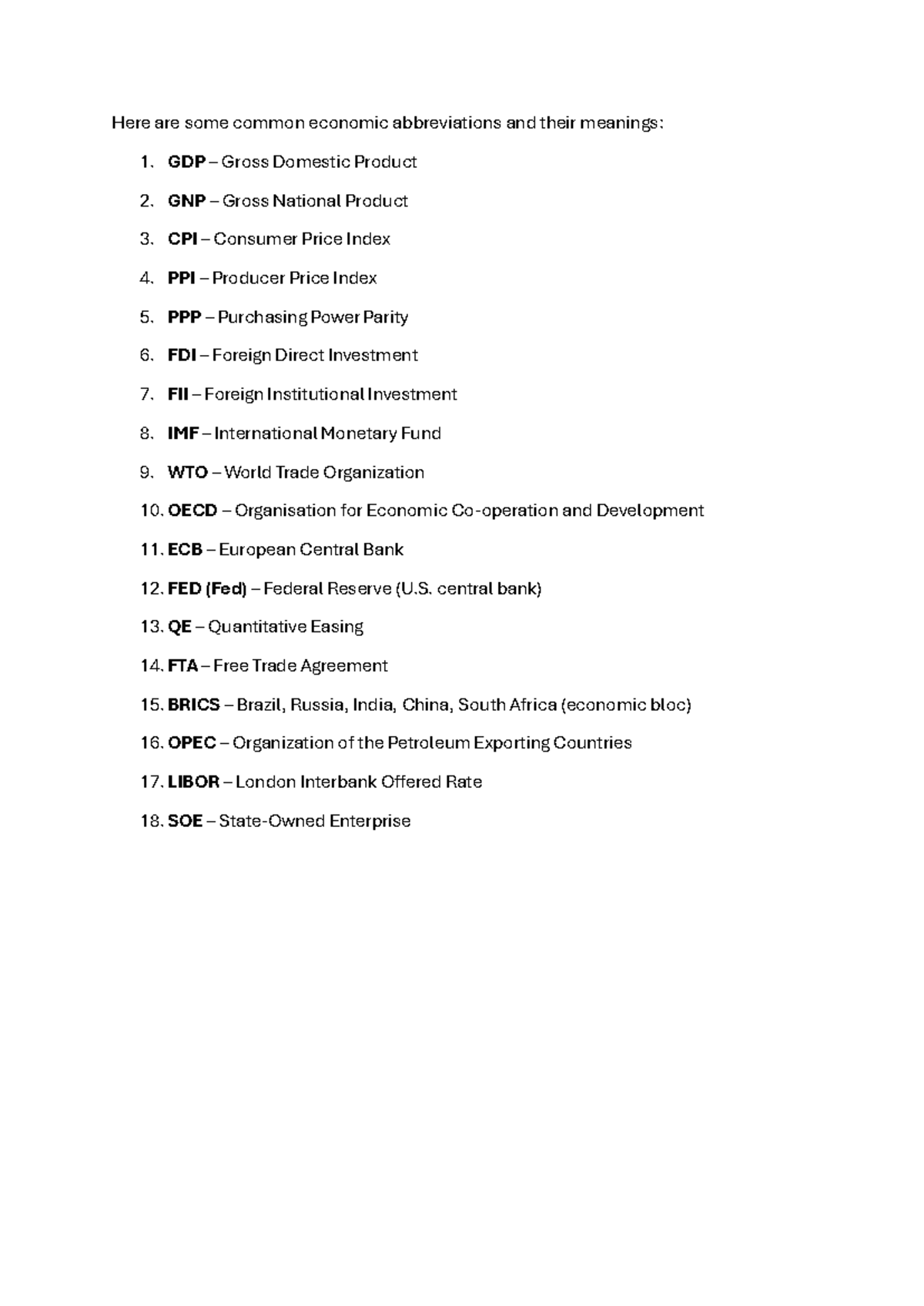
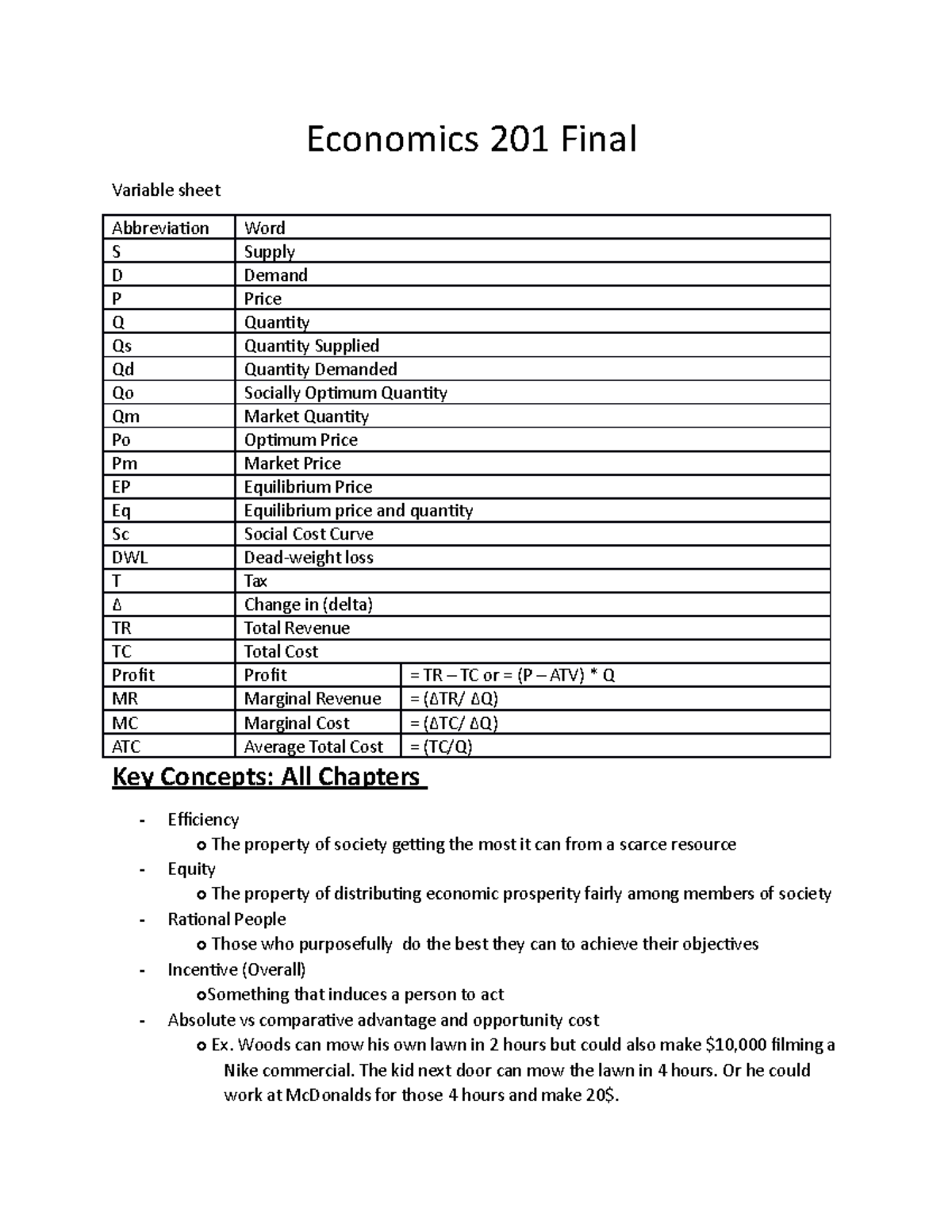
Abbreviations in economics streamline complex financial metrics, econometric models, monetary policy frameworks, and international trade mechanisms into standardized terms. Economists, market analysts, policymakers, and researchers rely on these short forms—ranging from inflation gauges like CPI and PCE to structural modeling acronyms like IS-LM—to communicate quantitative data precisely and efficiently.
Understanding economic abbreviations requires looking beyond the acronyms themselves to grasp their underlying methodology, policy implications, and mathematical context. Whether analyzing central bank policy decisions, modeling macroeconomic fluctuations, or evaluating microeconomic market structures, mastering this nomenclature is essential for interpreting financial literature and economic reports.
Why Economic Abbreviations Matter in Policy, Markets, and Research
Economic discourse depends on standardized abbreviations to reduce friction when presenting empirical data, mathematical proofs, and policy guidelines. A single economic report from an organization such as the U.S. Bureau of Economic Analysis (BEA) or the International Monetary Fund (IMF) may feature dozens of acronyms representing multi-variable calculations, institutional bodies, and statistical indices.
Using acronyms incorrectly or misinterpreting them can lead to significant errors in financial modeling and policy evaluation. For instance, confusing nominal metrics with real (inflation-adjusted) variables, or substituting one price index for another, alters econometric outputs and distorts risk assessments.
Economic abbreviations generally fall into five distinct operational domains:
- Macroeconomic Performance & National Accounting: Gauges measuring growth, inflation, output gaps, and national income.
- Monetary Policy & Central Banking: Frameworks, interest rate benchmarks, and liquidity operations managed by monetary authorities.
- Microeconomics & Industrial Organization: Variable cost equations, market concentration ratios, and consumer behavior metrics.
- Econometrics & Quantitative Methods: Statistical techniques, model specifications, and estimation procedures.
- International Economics & Trade: Global exchange rate frameworks, capital flows, balance-of-payments accounts, and multilateral institutions.
Macroeconomic Indicators and National Income Accounting
Macroeconomics studies aggregate output, price dynamics, employment levels, and national financial flows. National income accounting relies on specific initialisms to categorize economic activity across public and private sectors.
- Gross Domestic Product (GDP)
- Less: Capital Depreciation (CCA)
- Net Domestic Product (NDP)
- Plus: Net Foreign Factor Income
- Net National Product (NNP)
Key Output and National Income Acronyms
- GDP (Gross Domestic Product): The total market value of all final goods and services produced within a country's physical borders during a specific period. It can be measured via the Expenditure Approach ($GDP = C + I + G + (X - M)$), Income Approach, or Output (Value-Added) Approach.
- GNP (Gross National Product): The aggregate value of output produced by a nation’s residents and domestic corporations, regardless of physical location. It adjusts GDP by adding net income earned from abroad ($GNP = GDP + \text{Net Factor Income from Abroad}$).
- GVA (Gross Value Added): The economic productivity generated by an individual producer, industry, or sector. GVA measures gross output minus intermediate consumption, providing the baseline for GDP calculation before net taxes and product subsidies are applied.
- NDP (Net Domestic Product): Domestic output adjusted for the consumption of fixed capital (depreciation). $NDP = GDP - \text{Capital Consumption Allowance (CCA)}$.
- NNP (Net National Product): Total national output after accounting for capital depreciation. $NNP = GNP - \text{Depreciation}$.
Inflation and Price Level Indicators
Measuring price fluctuations requires specialized index acronyms. The choice of index directly impacts indexation clauses, social security adjustments, and central bank inflation targeting.
- CPI (Consumer Price Index): Published by agencies like the U.S. Bureau of Labor Statistics (BLS), CPI measures the average change over time in prices paid by urban consumers for a fixed basket of consumer goods and services. Core CPI excludes volatile food and energy components.
- PPI (Producer Price Index): A family of indices measuring average changes in selling prices received by domestic producers for their output. PPI reflects supply-side cost pressures before they pass through to end consumers.
- PCE (Personal Consumption Expenditures Price Index): The Federal Reserve's preferred measure of consumer inflation. Unlike the fixed-weight CPI, the PCE uses a dynamic chain-weighted Fisher index formula that accounts for consumer substitution behavior when relative prices change.
- GDP Deflator: A broad price index calculated as $(\text{Nominal GDP} / \text{Real GDP}) \times 100$. It reflects price changes across all domestically produced goods and services in an economy, excluding imported items.
Structural Frameworks and Labor Metrics
- IS-LM Model (Investment Savings – Liquidity Preference Money Supply): A macroeconomic foundation created by John Hicks and Alvin Hansen. The IS curve models equilibrium in the goods market, while the LM curve models equilibrium in the money market, illustrating how national income and interest rates interact.
- AD-AS Model (Aggregate Demand – Aggregate Supply): The primary analytical model for illustrating real GDP determination and price level movements across short-run and long-run macroeconomic balances.
- NAIRU (Non-Accelerating Inflation Rate of Unemployment): The specific rate of unemployment at which inflation remains stable. If unemployment drops below NAIRU, labor market tightness typically forces wages and consumer inflation upward.
- LFP / LFPR (Labor Force Participation Rate): The percentage of the civilian non-institutional population aged 16 and older who are either employed or actively seeking employment.
Monetary Policy, Central Banking, and Financial Economics
Central banks use specific terminology to describe operational tools, benchmark interest rates, and policy directives designed to manage liquidity, control inflation, and maintain financial stability.
| Conventional Operations | Unconventional Policies |
|---|---|
| • OMO (Open Market Operations) | • QE (Quantitative Easing) |
| • EFFR (Effective Federal Funds Rate) | • QT (Quantitative Tightening) |
| • ON RRP (Overnight Reverse Repos) | • ZIRP / NIRP (Zero/Negative Rates) |
Governing Institutions and Committees
- FOMC (Federal Open Market Committee): The branch of the Federal Reserve System responsible for setting national monetary policy, primarily by targeting the Federal Funds Rate and directing open market operations.
- ECB (European Central Bank): The central bank responsible for monetary policy across the Eurozone countries.
- BOJ (Bank of Japan): Japan's central bank, known historically for pioneering unconventional policy frameworks like Yield Curve Control (YCC).
- BOE (Bank of England): The central bank of the United Kingdom, governed by its Monetary Policy Committee (MPC).
Monetary Operations and Policy Regimes
- QE (Quantitative Easing): An unconventional monetary policy where a central bank purchases large quantities of long-term government securities and agency bonds to inject liquidity directly into the commercial banking system and lower long-term interest rates.
- QT (Quantitative Tightening): The reverse of QE. The central bank shrinks its balance sheet by allowing assets to mature without reinvestment, or by selling securities directly, to drain excess system liquidity.
- ZIRP (Zero Interest Rate Policy): A policy regime where nominal central bank target interest rates are held at zero to stimulate economic borrowing during deep downturns.
- NIRP (Negative Interest Rate Policy): An extreme monetary stance where central banks set nominal policy rates below zero, effectively charging commercial banks interest on excess reserves to incentivize lending over cash hoarding.
- OMO (Open Market Operations): Central bank purchases or sales of financial securities in the open market to regulate the monetary base and steer short-term liquidity.
- ON RRP (Overnight Reverse Repurchase Agreement): A key tool used by monetary authorities (such as the Federal Reserve Board) to absorb overnight cash surpluses from money market funds, establishing an effective floor under short-term interest rates.
Benchmark Rates and Yield Terms
- SOFR (Secured Overnight Financing Rate): The primary benchmark interest rate for dollar-denominated derivatives and loans, which replaced the London Interbank Offered Rate (LIBOR). SOFR is calculated using actual transactions in the Treasury repurchase market.
- EFFR (Effective Federal Funds Rate): The volume-weighted median rate of unsecured overnight borrowing among commercial depository institutions in the U.S.
- APR (Annual Percentage Rate): The annualized simple interest rate charged on borrowing or earned on investments, excluding compounding effects.
- APY (Annual Percentage Yield): The real rate of return earned on an account or charged on debt, accounting for the effect of interest compounding over a given period.
Microeconomics, Firm Behavior, and Market Structure
Microeconomics focuses on individual decision-makers, households, firm cost functions, market equilibrium, and industrial efficiency.
- Cost / Price ($) vs. Quantity (Q)
- Price (P): Average Revenue (AR) = Demand
- Marginal Cost (MC)
- Marginal Revenue (MR)
- Profit-Maximizing Output (MR = MC)
Marginal and Total Cost Functions
- TR (Total Revenue): The total financial receipts derived from product sales: $TR = P \times Q$ (Price multiplied by Quantity).
- TC (Total Cost): The sum of fixed costs ($FC$) and variable costs ($VC$) incurred by a firm during production: $TC = FC + VC$.
- MR (Marginal Revenue): The additional revenue earned from producing and selling one more unit of output: $MR = \frac{dTR}{dQ}$.
- MC (Marginal Cost): The additional cost incurred from producing one additional unit of output: $MC = \frac{dTC}{dQ}$. In competitive markets, profit maximization occurs where $MR = MC$.
- AR (Average Revenue): Total revenue divided by total units sold ($AR = \frac{TR}{Q} = P$), which reflects the market demand curve faced by the firm.
Welfare and Surplus Concepts
- WTP (Willingness to Pay): The maximum price a consumer is willing to pay for a given unit of a good, representing their gross reservation price.
- WTA (Willingness to Accept): The minimum cash compensation a seller requires to forfeit a good or service.
- CS (Consumer Surplus): The net welfare gained by consumers, calculated as the difference between their total Willingness to Pay and the actual market price paid.
- PS (Producer Surplus): The net welfare earned by firms, calculated as the difference between total market revenue received and minimum production cost (marginal cost curve integration).
- DWL (Deadweight Loss): The net loss of total economic surplus ($CS + PS$) that occurs when a market operates away from competitive equilibrium, often due to price controls, monopoly pricing, or distortionary taxation.
Elasticity Measures and Market Concentration
- PED (Price Elasticity of Demand): A measure of how sensitive consumer demand is to changes in price: $$\text{PED} = \frac{% \Delta Q_d}{% \Delta P}$$
- YED (Income Elasticity of Demand): The percentage change in quantity demanded divided by the percentage change in consumer income, used to distinguish normal goods ($YED > 0$) from inferior goods ($YED < 0$).
- XED (Cross-Price Elasticity of Demand): A metric that measures how quantity demanded for one product shifts when the price of a related product changes, identifying complements ($XED < 0$) and substitutes ($XED > 0$).
- HHI (Herfindahl-Hirschman Index): A market concentration index calculated by summing the squared market shares of all firms in an industry: $$\text{HHI} = \sum_{i=1}^{n} s_i^2$$ An HHI below 1,500 indicates a competitive market, while an HHI above 2,500 indicates a highly concentrated industry.
- CR4 (Four-Firm Concentration Ratio): The combined percentage of total market share controlled by the four largest firms in an industry.
Econometrics, Quantitative Modeling, and Statistical Estimation
Econometrics applies mathematical and statistical methods to test economic theories, evaluate public policy interventions, and forecast financial variables.
Estimation Methods and Structural Models
- OLS (Ordinary Least Squares): The foundational optimization technique for linear regressions. OLS estimates unknown parameters by minimizing the sum of squared vertical residuals between observed real-world data points and the linear fitted model.
- WLS (Weighted Least Squares): An extension of OLS used to estimate model parameters when error terms exhibit non-constant variance (heteroskedasticity).
- IV (Instrumental Variables): An estimation strategy used when an explanatory variable is correlated with the regression error term (endogeneity). The instrument must affect the independent variable without directly influencing the dependent variable.
- 2SLS (Two-Stage Least Squares): An IV estimation method used for structural linear models. The first stage regresses the endogenous variable on the instrument; the second stage uses those predicted values to estimate the main outcome model.
- GMM (Generalized Method of Moments): A flexible estimation framework that uses sample moment conditions to derive consistent parameter estimates, widely used in financial econometric modeling.
Time-Series Forecasting Acronyms
- ARIMA (Autoregressive Integrated Moving Average): A time-series analysis model that combines autoregressive terms ($p$), differencing operations ($d$) to achieve stationarity, and moving average components ($q$).
- VAR (Vector Autoregression): A multi-equation stochastic model used to capture linear interdependencies among several dynamic time-series variables simultaneously.
- VECM (Vector Error Correction Model): A restricted VAR model designed for non-stationary variables that are cointegrated, modeling both short-run dynamics and long-run equilibrium relationships.
- GARCH (Generalized Autoregressive Conditional Heteroskedasticity): An econometric technique designed to model and forecast dynamic volatility clusters in financial market data.
Statistical Diagnostic Metrics
- BLUE (Best Linear Unbiased Estimator): Under the Gauss-Markov assumptions, the OLS estimator is BLUE—meaning it offers the lowest sampling variance among all linear unbiased estimators.
- RMSE (Root Mean Square Error): A standard diagnostic metric used to measure the average magnitude of prediction errors in model forecasts: $$\text{RMSE} = \sqrt{\frac{1}{n}\sum_{t=1}^{n}(y_t - \hat{y}_t)^2}$$
International Trade, Development, and Foreign Exchange
International economics studies foreign exchange dynamics, trade policies, cross-border capital flows, and multilateral economic architecture.
- Balance of Payments (BOP)
- Current Account (CA)
- Trade Balance (X - M)
- Net Income from Abroad
- Net Unilateral Transfers
- Financial/Capital Account
- FDI (Direct Investment)
- FPI (Portfolio Capital)
- Central Bank Reserves
- Current Account (CA)
Global Trade and Financial Institutions
- WTO (World Trade Organization): The international body that establishes global trade rules, facilitates multilateral trade negotiations, and resolves commercial disputes between member nations.
- IMF (International Monetary Fund): A global financial institution focused on promoting international monetary stability, preventing balance-of-payments crises, and providing emergency financial assistance.
- WBG (World Bank Group): An international development institution focused on reducing global poverty by granting long-term loans and funding infrastructure projects in low- and middle-income countries.
- OECD (Organisation for Economic Co-operation and Development): An intergovernmental organization of high-income economies focused on researching public policy, setting standards, and analyzing structural economic data.
Cross-Border Flows and Balance of Payments
- BOP (Balance of Payments): A comprehensive accounting record of all financial transactions conducted between domestic residents and the rest of the world over a given period, consisting of the Current Account (CA) and Capital/Financial Account (KA).
- FDI (Foreign Direct Investment): Cross-border investment made by an entity to establish a lasting, controlling interest (typically defined as 10% or more of voting equity) in a business operating in another country.
- FPI (Foreign Portfolio Investment): Investments in foreign financial assets—such as stocks, bonds, or money market instruments—without acquiring operational management control or a lasting strategic stake.
Foreign Exchange and Parity Metrics
- PPP (Purchasing Power Parity): An economic theory and exchange rate metric that compares different currencies using a standard basket of goods. It measures the exchange rate adjustments needed for equal purchasing power across countries.
- NEER (Nominal Effective Exchange Rate): An unadjusted weighted average index of a domestic currency's relative value against a trade-weighted basket of foreign currencies.
- REER (Real Effective Exchange Rate): The nominal effective exchange rate adjusted for consumer price differential changes across trading partners: $$\text{REER} = \text{NEER} \times \left(\frac{P_{\text{domestic}}}{P_{\text{foreign}}}\right)$$ A rising REER indicates a loss in a country's international trade competitiveness.
Reference Table: Key Economic Abbreviations Across Major Domains
The table below presents essential economic acronyms, their technical domains, core analytical roles, and underlying formulas or definitions.
| Abbreviation | Standard Term | Core Subfield | Policy / Analytical Significance | Key Formula or Definition |
|---|---|---|---|---|
| GDP | Gross Domestic Product | Macroeconomics | Primary indicator of national economic output | $GDP = C + I + G + (X - M)$ |
| PCE | Personal Consumption Expenditures | Inflation Analysis | Fed's benchmark metric for inflation targeting | Chain-weighted Fisher price index |
| SOFR | Secured Overnight Financing Rate | Monetary Policy | Baseline overnight borrowing benchmark | Transaction-based Treasury repo median |
| NAIRU | Non-Accelerating Inflation Rate | Labor Economics | Structural threshold for wage-push inflation | Equilibrium point where $\Delta \text{Inflation} = 0$ |
| HHI | Herfindahl-Hirschman Index | Industrial Organization | Regulatory gauge for market concentration | $\text{HHI} = \sum s_i^2$ |
| OLS | Ordinary Least Squares | Econometrics | Standard linear parameter estimation method | $\min \sum e_i^2$ |
| REER | Real Effective Exchange Rate | International Finance | Indicator of trade competitiveness | $\text{NEER} \times (P_{\text{dom}} / P_{\text{for}})$ |
| FDI | Foreign Direct Investment | International Trade | Physical asset investment and ownership abroad | Equity stake $\ge 10%$ with managerial control |
| 2SLS | Two-Stage Least Squares | Econometrics | Method for resolving endogeneity bias | Instrumental variable linear regression |
| DWL | Deadweight Loss | Welfare Microeconomics | Total loss in social welfare from market distortions | Area of lost $CS + PS$ relative to equilibrium |
Avoiding Common Pitfalls and Misinterpretations in Economic Terminology
Mistaking similar economic terms can compromise quantitative modeling and distort policy analysis. Identifying subtle differences in how these metrics are calculated helps prevent costly analytical errors.
- CONSUMER INFLATION METRICS
- Consumer Price Index (CPI)
- Fixed Laspeyres basket
- Focuses on out-of-pocket spending
- Higher housing/shelter weight (~34%)
- PCE Price Index
- Dynamic Fisher chain-weighting
- Includes third-party health spending
- Lower housing weight (~15%)
- Consumer Price Index (CPI)
CPI vs. PCE Inflation Measures
While both measure changes in consumer prices, their methodologies differ significantly:
- Formula Differences: CPI uses a fixed-basket Laspeyres-type index, which can overestimate inflation by ignoring consumer substitution away from higher-priced goods. PCE uses a chain-weighted Fisher index formula that dynamically adjusts for changing consumption patterns.
- Scope & Coverage: CPI tracks out-of-pocket expenses paid directly by urban households. PCE covers a broader scope by incorporating goods and services purchased on behalf of households, such as employer-funded health insurance and Medicare/Medicaid contributions.
- Weighting Distributions: CPI assigns a substantially higher weight to shelter costs (roughly 34%) compared to the PCE index (roughly 15%). As a result, shifts in housing costs impact CPI far more heavily than PCE.
Real vs. Nominal Variables
In economic analysis, confusing nominal figures (uncorrected for price level changes) with real values (adjusted using an inflation deflator) distorts economic comparisons over time.
$$\text{Real Variable} = \frac{\text{Nominal Variable}}{\text{Price Deflator}} \times 100$$
According to the Fisher Equation, the nominal interest rate ($i$) equals the real interest rate ($r$) plus expected inflation ($\pi^e$):
$$i \approx r + \pi^e$$
When inflation rises, high nominal growth figures can mask stagnant or declining real economic output.
Rates, Levels, and Basis Points
Precision is essential when reporting adjustments to interest rates, inflation numbers, and output metrics:
- Levels vs. Rates: A declining rate of inflation (disinflation) means price levels are still rising, just at a slower rate. Deflation, by contrast, indicates a drop in the actual price level (negative inflation).
- Percentage Points vs. Percent Change: If an interest rate increases from 4.0% to 5.0%, it has risen by 1.0 percentage point, which equals a 25% relative increase.
- Basis Points (bps): Standard notation in central banking and money markets, where 1 basis point equals 0.01% (0.0001). A rate hike of 50 bps represents an increase of 0.50 percentage points.
Frequently Asked Questions
What is the difference between CPI and PCE in macroeconomic analysis?
CPI measures out-of-pocket expenditures for urban consumers using a relatively fixed basket of goods, published by the BLS. PCE, calculated by the BEA, covers a broader range of expenses (including employer-provided healthcare) and uses a dynamic chain-weighted formula that accounts for consumer substitution. The Federal Reserve focuses primarily on core PCE inflation when setting monetary policy.
How does SOFR differ from the historical LIBOR benchmark?
LIBOR relied on panel bank estimates of unsecured interbank borrowing costs, leaving it vulnerable to market manipulation and structural liquidity shortages. SOFR is an empirical rate calculated by the Federal Reserve Bank of New York based on actual transactions in the Treasury repurchase (repo) market, making it a robust, collateralized benchmark.
What does NAIRU signify in monetary policy decisions?
NAIRU (Non-Accelerating Inflation Rate of Unemployment) represents the structural equilibrium rate of unemployment. If central bank policy lowers unemployment below NAIRU, labor market competition tends to drive up nominal wages, triggering broader inflation. Central banks monitor NAIRU estimates to evaluate whether the economy is running above or below its productive capacity.
What is the operational distinction between FDI and FPI?
Foreign Direct Investment (FDI) involves purchasing physical assets, building facilities, or acquiring a controlling equity stake ($\ge 10%$) in a foreign enterprise, representing a long-term strategic investment. Foreign Portfolio Investment (FPI) consists of passive holdings of stocks, bonds, or money market instruments traded on international exchanges without direct management control.
How do OLS and 2SLS differ in econometric modeling?
Ordinary Least Squares (OLS) minimizes the sum of squared residuals to estimate relationships, assuming that independent variables are completely uncorrelated with the model's error term. When an independent variable is endogenous (correlated with the error term), OLS estimates become biased and inconsistent. Two-Stage Least Squares (2SLS) uses instrumental variables to isolate exogenous variation, yielding consistent parameter estimates.
Strategic Recommendations for Economic Analysis
To apply economic abbreviations accurately in research, financial modeling, or policy analysis, consider the following best practices:
- Verify Index Calculations: When citing inflation, explicitly state whether you are using CPI-U, Core CPI, PCE, or the GDP Deflator, as their weighting methodologies produce different quantitative results.
- Standardize Nominal and Real Inputs: Ensure that econometric variables match across your analysis—pair real GDP with real interest rates, or nominal financial flows with nominal rates.
- Clarify Econometric Assumptions: When presenting econometric models, specify the estimation method (e.g., OLS, 2SLS, GMM) along with diagnostic checks for serial correlation, endogeneity, and heteroskedasticity.
- Use Official Primary Sources: Consult original releases from institutions like the National Bureau of Economic Research (NBER), Federal Reserve System, OECD, BEA, and BLS to verify current definitions, seasonal adjustments, and index base years.