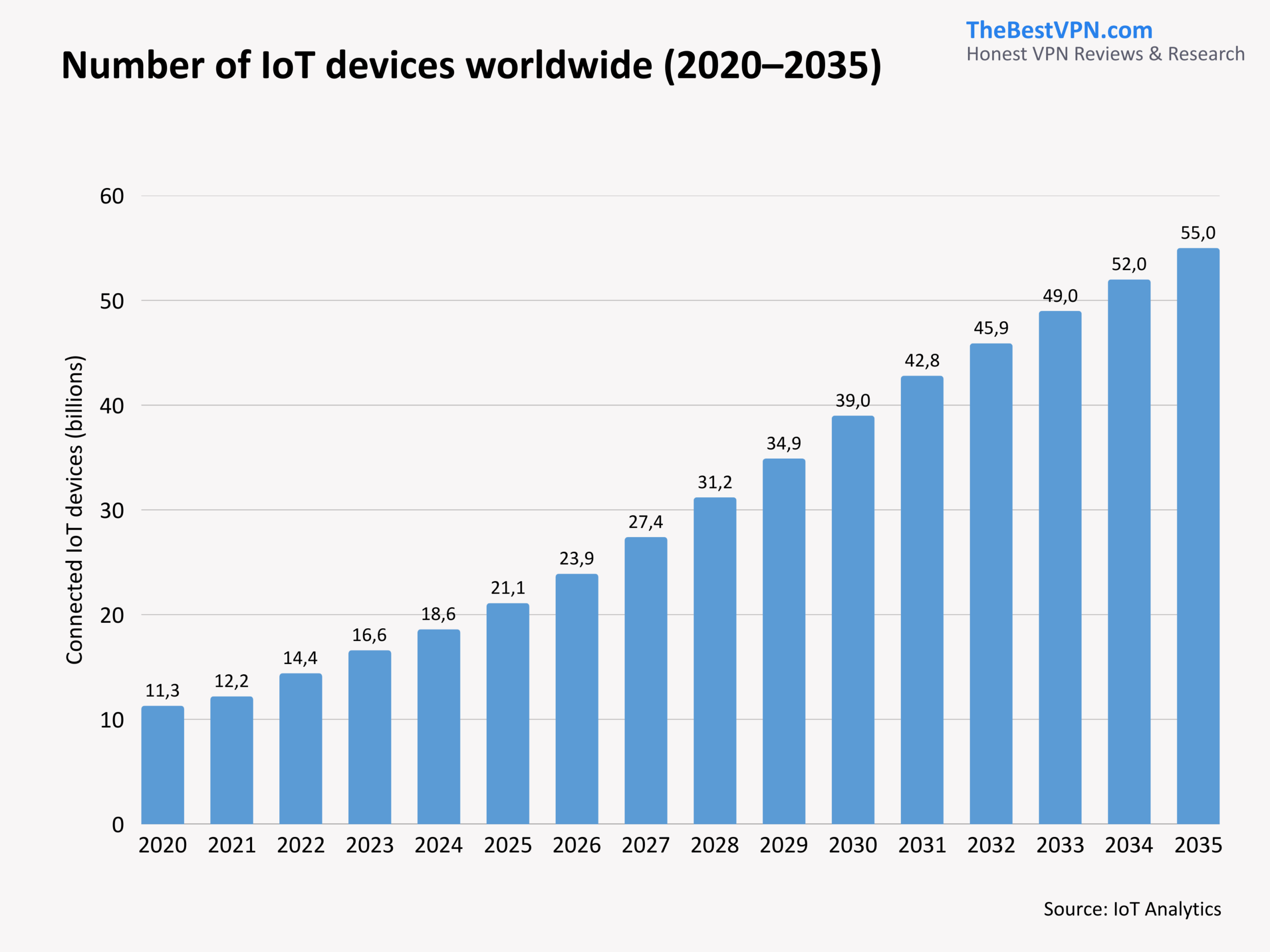
Operating and securing an ecosystem that spans 18 billion active Internet of Things (IoT) devices requires a fundamental shift in network topology, data processing paradigms, device identity management, and power consumption strategies. As massive device deployments transition from isolated edge deployments to globally integrated web infrastructure, organizations must navigate intense bandwidth constraints, distributed security vectors, and lifecycle management complexities that break traditional cloud-computing models.
The Paradigm Shift of 18 Billion Connected Devices
The sheer volume of 18 billion connected devices changes the economics and engineering of digital infrastructure. When individual deployments scale from thousands of nodes to multi-billion-device architectures, centralized cloud servers face extreme ingestion bottlenecks.
From Centralized Cloud to Edge Dominance
Historically, enterprise architectures relied on sending raw telemetry from edge sensors directly to a centralized data center or hyperscale cloud provider for storage and analytics. At an 18-billion-device scale, this model fails due to:
- Bandwidth Saturation: Transmitting continuous, raw data streams from billions of sensors over cellular, satellite, and fixed-line networks would overwhelm global backbone infrastructures.
- Network Latency: Round-trip times to centralized cloud endpoints introduce unacceptable delays for mission-critical applications like industrial automation, vehicle-to-everything (V2X) communication, and smart grid balancing.
- Cost Inefficiencies: Egress, ingestion, and storage fees for petabytes of redundant or low-value telemetry render centralized storage economically unsustainable.
To solve these challenges, architects implement distributed edge computing. Data is filtered, aggregated, and processed locally at the network perimeter—using gateways, local servers, or on-device micro-controllers—before sending only actionable insights or compressed summaries upstream.
Heterogeneity and Interoperability
An ecosystem of 18 billion endpoints is inherently heterogeneous. It incorporates legacy industrial programmable logic controllers (PLCs), modern smart-home appliances utilizing low-power wireless protocols, autonomous agricultural sensors, and high-performance medical monitoring units.
Designing for this scale requires strict adherence to open standards and protocol translation layers. Devices running on constrained microcontrollers with proprietary firmware must communicate seamlessly with modern cloud platforms through standardized messaging schemas.
| Protocol / Standard | Primary Use Case | Power Consumption | Typical Range |
|---|---|---|---|
| MQTT-SN | Sensor networks, low-bandwidth telemetry | Ultra-Low | Variable (Mesh/Gateway) |
| CoAP | Constrained RESTful web services | Low | Local / IP-based |
| LoRaWAN | Long-range agricultural and industrial tracking | Very Low | Up to 15 km |
| Zigbee / Thread | Smart home device mesh networks | Low | 10 to 100 meters |
| Cellular (NB-IoT/LTE-M) | Wide-area asset tracking and smart meters | Moderate | Cellular Tower Range |
Architectural Pillars for Massive IoT Deployments
Managing millions or billions of active connections requires purpose-built architectural patterns that emphasize autonomy, resilience, and horizontal scalability.
Decentralized Message Brokers and MQTT Brokers
At an 18-billion-device scale, message brokers cannot run as single monolithic instances. MQTT (Message Queuing Telemetry Transport) and its constrained variant MQTT-SN serve as the industry standard for lightweight publish-subscribe messaging.
Enterprise architectures deploy globally distributed, clustered message brokers. These clusters use partition keys and geographic load balancing to route client connections to the nearest regional ingestion point. If a regional broker fails, edge devices automatically fail over to secondary nodes without data loss, maintaining persistent sessions through quality of service (QoS) levels 0, 1, and 2.
Device Identity and Zero-Trust Security
Security at scale cannot rely on manual credential provisioning or static, hardcoded passwords. Compromising a single master key in an unmanaged fleet can expose billions of devices to remote takeover.
Implementing a zero-trust architecture for billions of devices involves:
- Hardware-Based Roots of Trust: Leveraging Secure Elements (SE) or Trusted Platform Modules (TPM) embedded in silicon to store cryptographic keys securely.
- Public Key Infrastructure (PKI): Issuing unique, cryptographically verifiable X.509 certificates to every device during manufacturing or via secure automated enrollment protocols like EST (Enrollment over Secure Transport) or SCEP.
- Mutual TLS (mTLS): Enforcing cryptographic validation on both the client (device) and server (cloud) sides for every communication session, ensuring end-to-end data integrity and confidentiality.
Network Constraints and Connectivity Strategies
No single network technology can support 18 billion devices uniformly. Network architects must blend multiple connectivity mediums based on power availability, data throughput requirements, and physical deployment geography.
Cellular IoT: NB-IoT and LTE-M
Narrowband IoT (NB-IoT) and LTE-M (Enhanced Machine Type Communication) operate within licensed cellular spectrums, offering deep indoor and underground penetration alongside low power consumption. These standards allow devices to sleep for extended periods, waking up only briefly to transmit small packets of telemetry.
Low-Power Wide-Area Networks (LPWAN)
For deployments spanning remote geographies—such as oil pipelines, forestry monitoring, or smart cities—LPWAN technologies like LoRaWAN provide unlicensed spectrum alternatives. By utilizing sub-gigahertz radio frequencies, these networks achieve multi-kilometer transmission ranges while running on coin-cell batteries for years.
Local Mesh Networking
Smart buildings and industrial plants often rely on local mesh topologies (such as Thread or Zigbee) routed through border routers. Devices act as relay nodes, hopping data across multiple nodes to reach an internet gateway. This self-healing architecture ensures that if a single node fails, traffic automatically reroutes through neighboring devices.
Firmware Lifecycles, Over-The-Air Updates, and Maintenance
Deploying hardware to remote fields, utility poles, and consumer homes means physical access for maintenance is virtually impossible. A robust Over-The-Air (OTA) update strategy is mandatory for patching vulnerabilities, adding features, and fixing software bugs across an 18-billion-device footprint.
Safe OTA Deployment Strategies
Pushing an unverified update to billions of devices simultaneously risks widespread bricking if a software bug causes kernel panics or connection drops. Engineers mitigate this risk through staged rollouts:
- Canary Deployments: Releasing updates to an internal testing cohort or 0.1% of the total device fleet.
- Regional Ringing: Gradually expanding the update to specific geographic regions or hardware revisions over weeks.
- Dual-Bank Flash Memory: Utilizing microcontrollers equipped with dual memory banks. While the system runs on Bank A, Bank B receives the new firmware image. If the verification checksum fails or the device fails to ping the confirmation server after rebooting, the bootloader automatically rolls back to Bank B.
Frequently Asked Questions
How do billions of IoT devices communicate without crashing global networks?
They utilize lightweight, asynchronous publish-subscribe protocols like MQTT over optimized transport layers, coupled with edge computing that filters and compresses data locally before it ever reaches central servers.
What is the primary security vulnerability in massive IoT deployments?
Weak default credentials, lack of encrypted storage for cryptographic keys, and unpatched legacy firmware represent the most common vectors exploited in large-scale botnet attacks.
How is power managed for devices deployed in remote locations?
Engineers rely on duty cycling—putting devices into deep sleep states for 99% of their operational life—combined with energy-harvesting technologies like solar panels, kinetic motion sensors, and thermal generators.
Why is edge computing necessary for large-scale IoT?
Edge computing reduces backhaul bandwidth costs, eliminates the latency of round-trip cloud communication, and ensures that local control loops continue functioning even if internet connectivity drops.
Next Steps and Implementation Recommendations
Organizations scaling their IoT operations toward massive deployments must prioritize foundational infrastructure before deploying hardware at volume. Begin by standardizing device identity management through automated PKI enrollment, selecting lightweight protocols suited to hardware constraints, and establishing a rigorous, automated OTA firmware update pipeline equipped with fail-safe rollback mechanisms.