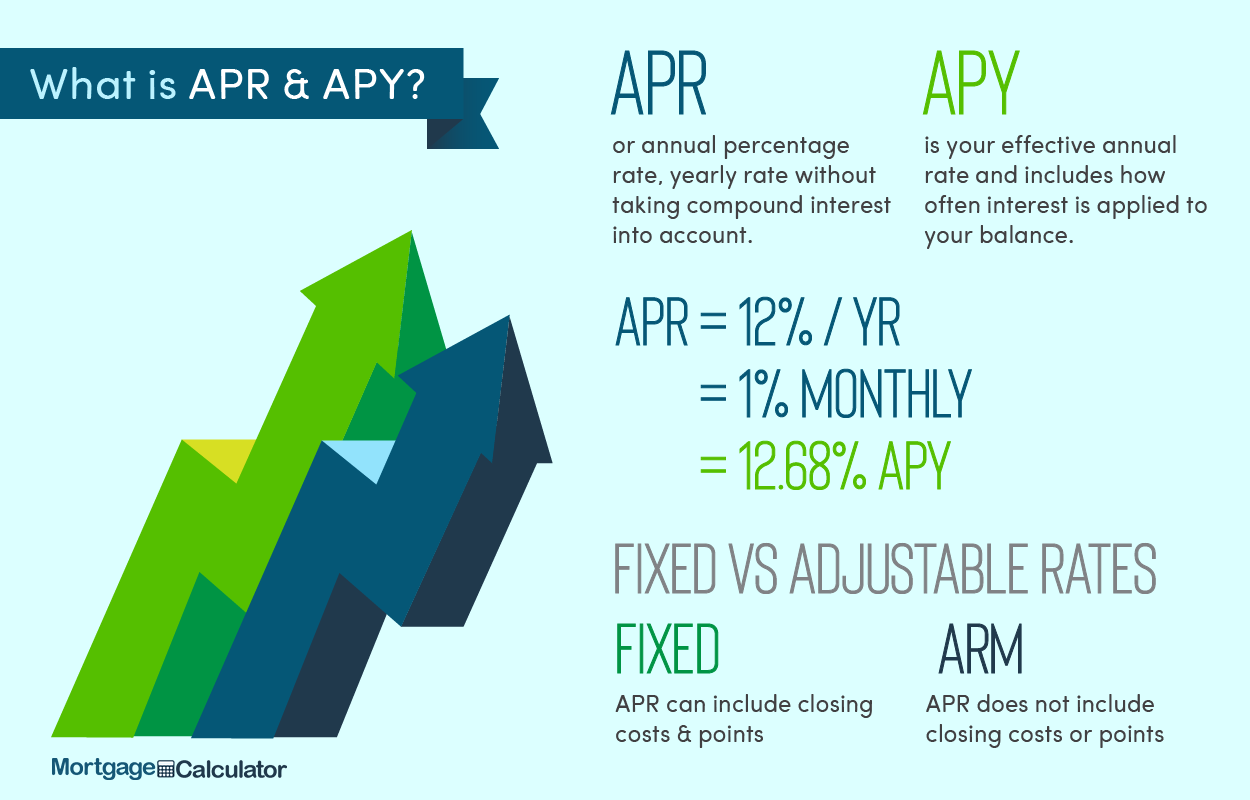
The Annual Percentage Rate (APR) on a mortgage represents the total annual cost of borrowing money, expressed as a percentage. Unlike the base interest rate, APR incorporates the interest rate plus lender fees, points, and other mandatory charges required to close the loan, providing a more accurate tool for comparing different mortgage offers.
Understanding the distinction between a mortgage interest rate and the APR is one of the most critical steps in the home-buying process. While the interest rate determines your monthly principal and interest payment, the APR reflects the "effective" rate you pay when all setup costs are factored in. In 2026, with evolving digital lending platforms and updated regulatory disclosures from the Consumer Financial Protection Bureau (CFPB), grasping these nuances is essential for any prospective homeowner or those looking to refinance existing debt.
The Fundamental Difference Between Interest Rate and APR
To understand APR, one must first isolate the base interest rate. The nominal interest rate is the percentage charged by the lender for the use of the principal amount. This rate is what you see prominently advertised on lender websites and is used to calculate the specific dollar amount of interest that accrues on your balance each month.
The Annual Percentage Rate (APR) is a broader measure. It includes the interest rate but also accounts for the "prepaid" costs of the loan. Because these costs are paid upfront or rolled into the loan balance, they effectively increase the cost of the money you are receiving. Federal law, specifically the Truth in Lending Act (TILA), requires lenders to disclose the APR so that consumers are not misled by a low interest rate that is offset by exorbitantly high closing fees.
Why the APR is Usually Higher Than the Interest Rate
In almost every mortgage scenario, the APR will be higher than the base interest rate. This gap exists because the APR treats upfront fees as if they were interest spread out over the life of the loan. If a lender offers a 5.5% interest rate but charges $5,000 in origination fees, your APR might be 5.75%. This tells you that, economically, you are paying the equivalent of 5.75% interest when those upfront costs are amortized.
What Charges Are Included in the Mortgage APR?
Not every fee associated with a real estate transaction is included in the APR calculation. Generally, only the fees that are paid directly to the lender or are required as a condition of obtaining credit are included. These are often referred to as finance charges.
Standard Inclusions
- Discount Points: These are optional fees paid to the lender at closing to "buy down" the interest rate. Since this is a direct cost of credit, it is a primary component of the APR.
- Origination Fees: The administrative costs charged by the lender for processing, underwriter review, and preparing the loan.
- Mortgage Insurance Premiums (PMI or MIP): If you put down less than 20%, you likely pay mortgage insurance. Because this is a cost required by the lender to mitigate their risk, it is included in the APR.
- Prepaid Interest: The interest that builds up between the date you close on your home and the end of that calendar month.
- Loan Processing Fees: Charges for the administrative handling of the loan file.
- Underwriting Fees: The cost for the lender to evaluate your creditworthiness and the risk of the loan.
Fees Typically Excluded from APR
Fees that are considered "third-party" costs—charges you would likely pay regardless of which lender you chose or even if you paid cash—are generally excluded from the APR.
- Appraisal Fees: The cost of having a professional estimate the home's value.
- Home Inspection Fees: Costs for checking the physical condition of the property.
- Title Insurance and Title Search: Fees paid to ensure the property title is clear of liens.
- Credit Report Fees: The small fee charged to pull your credit history.
- Document Preparation Fees (Non-Lender): Charges from an attorney or escrow company.
- Transfer Taxes: Government-mandated taxes for the transfer of property.
How the APR is Calculated
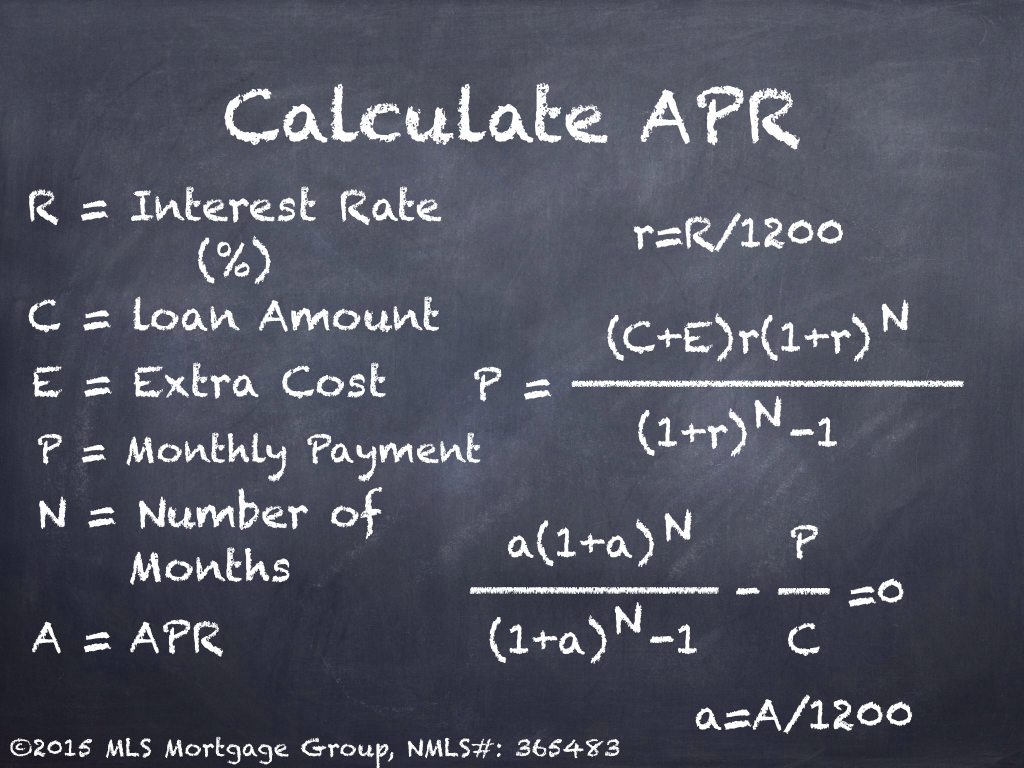
The mathematical formula for APR is more complex than simple interest because it must account for the declining principal balance over time (amortization). To calculate the APR, the lender takes the total amount of the finance charges, adds them to the total interest paid over the life of the loan, and then maps that total cost against the loan term.
Essentially, the formula solves for the interest rate that would result in the same monthly payment if the loan amount were reduced by the amount of the prepaid finance charges. For example, if you take out a $300,000 loan but pay $6,000 in included fees, the APR is calculated as if you only received $294,000 but still had to make payments based on the full $300,000 at the stated interest rate.
The Impact of Loan Duration on APR
It is vital to recognize that the APR assumes you will keep the mortgage for its entire term (e.g., 30 years). This is one of the primary "traps" for uninformed borrowers. If you pay $10,000 in points to get a lower rate, the APR will look attractive over 30 years. However, if you sell the house or refinance in five years, the "effective" rate you paid was actually much higher because you didn't have enough time to recoup that $10,000 investment through lower monthly payments.
Comparing Mortgage Offers: A Practical Example
When comparing "Loan Estimates" from different banks, the APR is your most reliable "apples-to-apples" comparison tool. A lower interest rate does not always mean a cheaper loan.
| Feature | Lender A (Low Fee) | Lender B (High Fee) | Lender C (Discount Points) |
|---|---|---|---|
| Loan Amount | $400,000 | $400,000 | $400,000 |
| Interest Rate | 6.25% | 6.00% | 5.75% |
| Origination Fees | $1,200 | $4,500 | $1,500 |
| Discount Points | $0 | $0 | $6,000 |
| Total Finance Charges | $1,200 | $4,500 | $7,500 |
| Approx. APR | 6.28% | 6.12% | 5.95% |
In this scenario, Lender C has the highest upfront cost ($7,500) but the lowest APR (5.95%). If you plan to stay in the home for a long time, Lender C is the most cost-effective choice. However, if you plan to move in three years, Lender A might actually be better despite the higher APR, because you save $6,300 in upfront cash that you wouldn't have time to recover through the lower interest rate of Lender C.
The Nuance of APR in Different Loan Types
The complexity of APR increases depending on the structure of the loan. Fixed-rate mortgages are straightforward, but other products require more scrutiny.
Adjustable-Rate Mortgages (ARMs)
For an ARM, the APR is particularly complex—and sometimes misleading. Because the interest rate changes after an initial period (e.g., 5 or 7 years), the lender must "guess" what the future rates will be based on current market indexes. The APR for an ARM is a composite of the initial fixed rate and the projected future rates. Borrowers should look closely at the margin and the index specified in the CFPB's Consumer Handbook on Adjustable-Rate Mortgages to understand the long-term risk.
15-Year vs. 30-Year APR
Interestingly, if two loans have the exact same interest rate and the exact same dollar amount of fees, the 15-year loan will have a higher APR than the 30-year loan. This is because those upfront fees are being amortized (spread out) over a shorter period. Do not be alarmed by a slightly higher APR on shorter-term loans; it is a mathematical byproduct of the shorter timeframe, not necessarily an indication of a "worse" deal.
Negative Points (Lender Credits)
In some cases, you might see an APR that is very close to or even slightly lower than the interest rate. This happens when a lender provides a lender credit. This is essentially "negative points," where the lender pays some of your closing costs in exchange for charging you a higher interest rate. This is common for "no-closing-cost" mortgages.
Legal Requirements and Disclosures
As of 2026, the primary document for understanding your APR is the Loan Estimate (LE), which lenders are legally required to provide within three business days of receiving your application.
- Page 3 of the Loan Estimate: This is where the APR is explicitly listed. It is located in the "Comparisons" section.
- Accuracy Tolerance: Under the Truth in Lending Act, the disclosed APR is considered "accurate" if it is within 0.125% (1/8th of a percentage point) of the actual cost for a regular fixed-rate loan. If the rate changes by more than this before closing, the lender must provide a new disclosure and wait an additional three business days before you can close.
- The Closing Disclosure (CD): At least three days before you sign your final paperwork, you receive the CD. You must compare the APR on the CD to the original Loan Estimate. If the APR has jumped significantly without a corresponding change in your loan terms (like switching from a 30-year to a 15-year), you should demand an explanation.
More information on these disclosure requirements can be found through the Office of the Comptroller of the Currency (OCC).
Potential Limitations of Using APR
While APR is a powerful tool, it is not flawless. Borrowers should be aware of its limitations to avoid making a decision based on incomplete data.
- The Time Horizon Problem: As mentioned, APR assumes you keep the loan for its full duration. Most Americans move or refinance every 7 to 10 years. This renders the "30-year APR" somewhat theoretical. If you are a short-term owner, focus more on the total "Cash to Close" than the APR.
- Inconsistency in Calculation: While the law specifies what must be included, some lenders have slightly different interpretations of "administrative fees." This can lead to minor discrepancies in APRs between two different banks even if their costs are identical.
- Exclusion of Third-Party Fees: Because title insurance and appraisal fees are excluded, a loan with a low APR could still have very high "non-finance" closing costs. Always look at the Total Closing Costs on Page 2 of your Loan Estimate alongside the APR.
Expert Strategies for Managing APR
To get the best possible APR in the 2026 market, follow these strategic steps:
1. Optimize Your Credit Score
While the APR includes fees, the biggest driver of the APR is the base interest rate. Improving your credit score by even 20 points can lower your interest rate significantly, which in turn drops the APR.
2. Negotiate Lender Fees
Many of the fees included in the APR are negotiable. Loan application fees, processing fees, and underwriting fees are set by the lender and can often be waived or reduced if you have a competing offer.
3. Calculate Your "Break-Even" Point
If you are paying discount points to lower your APR, divide the cost of the points by the monthly savings. For example, if points cost $4,000 and save you $100 a month, your break-even point is 40 months. If you plan to stay in the home for 10 years (120 months), paying those points to lower your APR is a wise financial move.
4. Watch Out for "Junk" Fees
Review the "Services You Can Shop For" and "Services You Cannot Shop For" sections of the Loan Estimate. If you see high "administrative" or "courier" fees, ask the lender to justify them. These inflate the APR without providing value to you.
Summary of Key Takeaways
The APR is the most comprehensive metric for understanding the cost of a mortgage, but it must be used in context. It combines the interest rate with the mandatory costs of getting the loan. By comparing APRs across different lenders, you can see past "teaser" interest rates and identify which loan truly leaves more money in your pocket over the long term.
Frequently Asked Questions
Does a lower interest rate always mean a lower APR?
No. A lender might offer a very low interest rate but charge high "origination fees" or "discount points." These upfront costs are factored into the APR, which could result in a higher APR than a loan with a higher interest rate but lower fees. Always check both numbers.
Is the APR the same as my monthly payment?
No. Your monthly payment is calculated using the interest rate and the principal balance. The APR is an accounting tool used to show the total cost of the loan including fees. You do not "pay" the APR directly in your monthly check; you pay the interest rate, having already paid the fees that make up the rest of the APR at closing.
Why is the APR on a 15-year mortgage often higher than a 30-year mortgage?
If the fees are the same, a 15-year mortgage will have a higher APR because those upfront fees are being "spread out" over 180 months instead of 360 months. Mathematically, this makes the annual cost of those fees appear higher, even though the total interest paid over the life of a 15-year loan is significantly lower.
Should I always choose the loan with the lowest APR?
Generally, yes, if you plan to stay in the home for a long time. However, if you plan to sell or refinance within a few years, a loan with a slightly higher APR but much lower upfront closing costs might be the better financial decision.
Are appraisal and title fees included in the APR?
In most cases, no. Under federal guidelines, fees for services that are required for a real estate closing regardless of the specific lender (like appraisals, title insurance, and government recording fees) are not considered finance charges and are excluded from the APR.
Next Steps: When you receive your Loan Estimates, go to the "Comparisons" section on Page 3. Highlight the APR and the "Total Interest Percentage" (TIP). Use these numbers to compare at least three different lenders to ensure you are receiving a competitive rate for the 2026 housing market.