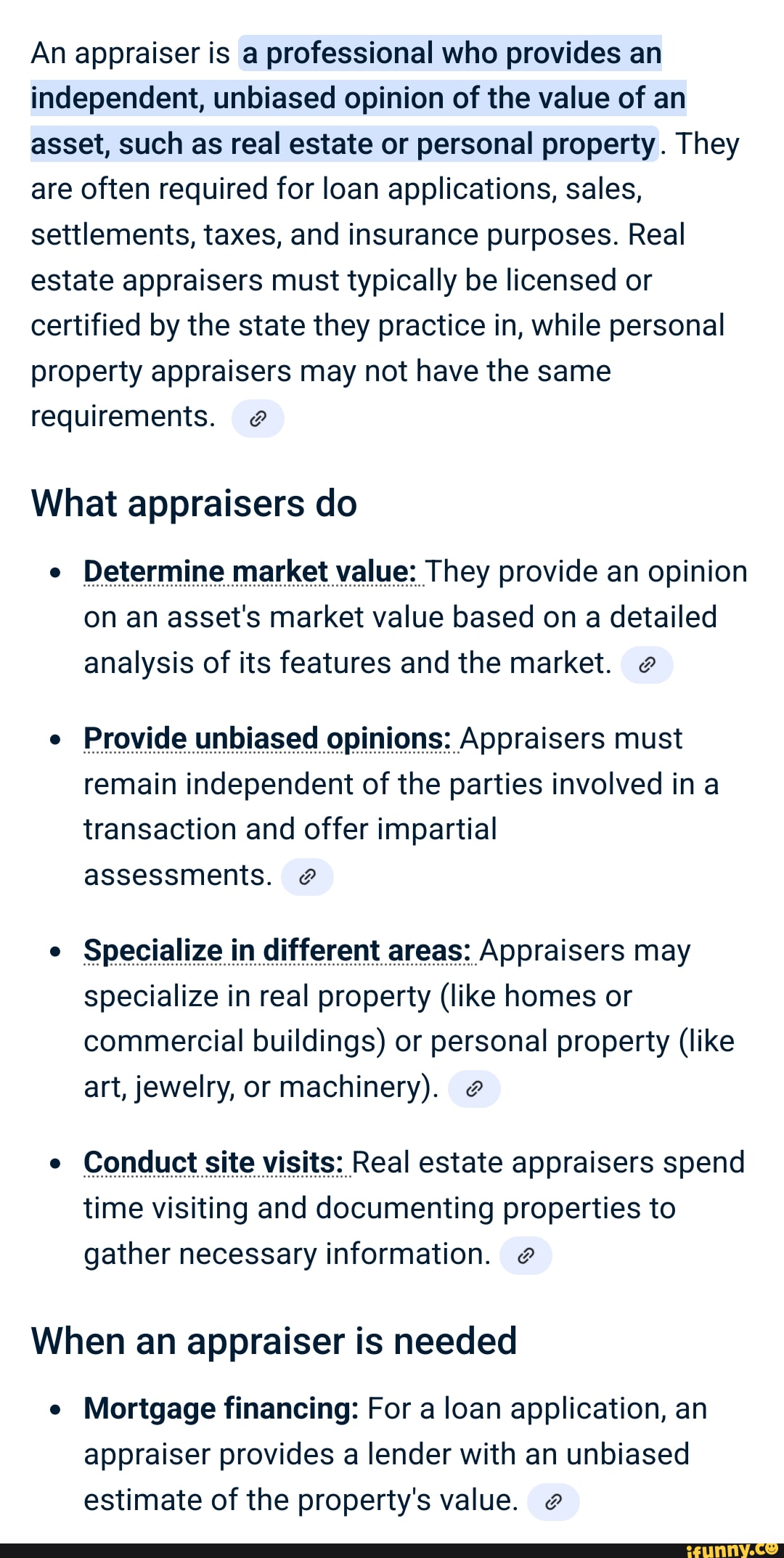
An asset appraiser is a certified professional responsible for determining the objective financial value of physical, financial, or intangible property. Appraisers conduct rigorous inspections, analyze market data, and apply standardized valuation methodologies to establish values for commercial lending, tax compliance, corporate mergers, insurance coverage, estate planning, and legal proceedings.
What Is an Asset Appraiser?
An asset appraiser is an independent valuation expert tasked with estimating the monetary worth of specific property or asset portfolios at a defined point in time. Unlike general real estate agents or liquidators who estimate listing prices based on sales goals, a qualified asset appraiser follows strict industry standards to produce unbiased, legal-grade valuation reports.
Asset appraisal spans multiple asset classes, including commercial real estate, industrial machinery, business enterprise value, inventory, intellectual property, and high-value personal property. Appraisers evaluate properties under specific standard-of-value definitions, such as Fair Market Value (FMV), Liquidation Value, or Replacement Cost New (RCN), ensuring the valuation aligns directly with the client's legal or financial context.
The valuation profession is governed by rigorous regulatory frameworks and technical guidelines. In the United States, professional appraisers typically adhere to the Uniform Standards of Professional Appraisal Practice (USPAP) promulgated by The Appraisal Foundation. Globally, international engagements often follow the International Valuation Standards (IVS) established by the International Valuation Standards Council (IVSC).
Disclaimer: This guide provides general educational information regarding asset valuation principles and standards. Appraisal rules and tax requirements vary by jurisdiction and asset type. Consult a credentialed appraiser, certified public accountant (CPA), or financial attorney for advice specific to your business or legal situation.
Key Asset Categories Evaluated by Appraisers
Asset appraisers specialize by category because each type of asset presents unique valuation challenges, depreciation curves, and market dynamics.
1. Commercial Real Estate and Fixed Improvements
Real estate asset appraisers evaluate tangible real property, including land, industrial facilities, office buildings, retail centers, and multi-family residential complexes. These appraisals account for physical condition, zoning laws, environmental factors, spatial utility, and regional economic indicators.
2. Machinery, Equipment, and Industrial Assets
Machinery and Equipment (M&E) appraisers focus on yellow-iron construction equipment, manufacturing production lines, medical technology, transport fleets, and specialized tooling. Valuing M&E requires deep technical knowledge of capital equipment markets, residual values, secondary market demand, and asset-specific physical deterioration.
3. Inventory and Working Capital
Inventory valuation is vital for asset-based lending (ABL) and corporate audits. Appraisers assess raw materials, work-in-process (WIP), and finished goods. They calculate Net Realizable Liquidation Value (NRLV) by accounting for inventory turn rates, seasonality, holding costs, shelf life, and potential channel disruption during liquidations.
4. Intangible Assets and Intellectual Property
Valuing non-physical assets requires specialized economic analysis. Intangible asset appraisers evaluate patents, trademarks, proprietary software, customer relationships, brand equity, and non-compete agreements. These appraisals frequently support corporate acquisition accounting, tax reporting under GAAP/IFRS, or patent infringement litigation.
5. Fine Art, Antiques, and Personal Property
Personal property appraisers evaluate high-value individual items or private collections, including fine art, jewelry, rare coins, classic automobiles, and historical artifacts. Valuations rely heavily on provenance research, physical authenticity inspections, gallery records, and specialized auction indices.
Core Valuation Approaches Used by Asset Appraisers
Professional asset appraisers rely on three universally accepted approaches to value. Depending on the asset category, market data availability, and engagement scope, an appraiser may apply one or more of these methods to reach a final reconciled value.
- Valuation Methodology Framework
- Cost Approach
- Replacement Cost New
- Less Physical Deterioration
- Less Functional Obsolescence
- Less Economic Obsolescence
- Market Data Approach
- Comparable Sales Analysis
- Asset Condition Adjustments
- Market Timing & Volume
- Verification of Arms-Length
- Income Approach
- Direct Capitalization
- Discounted Cash Flow (DCF)
- Relief-from-Royalty (IP)
- Excess Earnings Method
- Cost Approach
The Cost Approach
The Cost Approach estimates value by calculating the current cost to recreate or replace the asset, subtracting accrued depreciation from all causes. The fundamental equation is:
$$\text{Value} = \text{Replacement Cost New (RCN)} - \text{Accrued Depreciation}$$
Accrued depreciation is broken down into three distinct forms:
- Physical Deterioration: Wear and tear resulting from routine operational use, age, exposure to elements, and maintenance history.
- Functional Obsolescence: Loss in value due to technological advancements, outdated layout, poor design, or operational inefficiencies relative to newer alternatives.
- Economic (External) Obsolescence: Depreciation caused by external economic factors, such as shifts in industry demand, unfavorable zoning changes, regulatory burdens, or rising raw material costs.
The Cost Approach is particularly effective for specialized industrial machinery, newly constructed facilities, or unique assets with limited secondary market sales data.
The Market Data (Sales Comparison) Approach
The Market Data Approach estimates an asset's value by analyzing recent arm's-length transactions involving similar assets. The appraiser identifies comparable market sales ("comps") and applies quantitative or qualitative adjustments for key differences, including:
- Age, physical condition, and hour/mileage usage
- Capacity, size, and technical features
- Transaction timing, market supply-demand balance, and geographic region
- Sales terms and transaction conditions (e.g., forced auction vs. orderly private sale)
This approach serves as the primary standard for liquid assets, commercial real estate in active markets, standardized machinery, and automotive or transportation fleets.
The Income Approach
The Income Approach establishes an asset's value based on the present worth of the future monetary stream or cash flows it is expected to generate. This approach is standard for income-producing real estate, complete business enterprises, and revenue-generating intellectual property.
Key techniques include:
- Direct Capitalization: Converting a single year's expected net operating income (NOI) into a value estimate using a market-derived capitalization rate ($V = \frac{\text{NOI}}{R}$).
- Discounted Cash Flow (DCF) Analysis: Projecting multi-year cash flows and discounting them to present value using a risk-adjusted discount rate (weighted average cost of capital or required rate of return).
- Relief-from-Royalty Method: Used primarily for intangible assets, this method estimates value based on the royalty payments a company saves by owning the intellectual property rather than licensing it from a third party.
When Is an Asset Appraisal Required?
Businesses, financial institutions, legal advisors, and individuals engage asset appraisers across numerous operational and compliance scenarios:
Common Appraisal Triggers
| Commercial Finance | Tax & Accounting | Corporate & Legal |
|---|---|---|
| • Asset-Based Loans | • Purchase Allocations | • M&A Transactions |
| • Refinancing | • Form 8283 Donations | • Bankruptcy/Restruct. |
| • Equipment Leases | • Estate/Gift Tax | • Partner Buyouts |
| • Loan Restructuring | • Asset Impairments | • Litigation/Divorce |
1. Asset-Based Lending and Commercial Finance
Commercial banks and private lenders require independent asset appraisals before issuing asset-based loans (ABL) or equipment credit lines. Lenders use the appraised Net Operating Liquidation Value (NOLV) or Orderly Liquidation Value (OLV) to calculate borrowing base caps and loan-to-value (LTV) ratios.
2. Mergers, Acquisitions, and Divestitures
In corporate transactions, buyers and sellers rely on appraisals to establish fair purchase prices, negotiate deal terms, and satisfy financial reporting requirements under GAAP (e.g., ASC 805 for purchase price allocation) or IFRS 3.
3. Tax Compliance and Charitable Gifts
The Internal Revenue Service (IRS) and international tax authorities require qualified appraisals for non-cash charitable donations exceeding specific monetary thresholds (such as filing IRS Form 8283 in the U.S.). Appraisals are also mandated for estate tax filings, gift tax determinations, and step-up basis calculations upon an owner's death.
4. Insurance Coverage and Claim Verification
Accurate appraisals prevent both under-insurance and over-insurance. In catastrophic losses (fire, flood, industrial accidents), an up-to-date replacement cost appraisal serves as primary evidence during insurance claim adjustments.
5. Litigation, Bankruptcy, and Restructuring
Appraisers provide expert witness testimony and formal appraisal reports in corporate bankruptcies, partnership breakups, marital dissolutions, and tax disputes. Courts rely on certified appraisers to establish accurate valuation baselines for asset distribution or reorganization plans.
Comparative Overview: Valuation Standards and Asset Types
Selecting the correct standard of value depends on the intended use of the appraisal report. The table below outlines how valuation standards apply across different asset categories and business contexts:
| Standard of Value | Definition | Primary Use Case | Primary Asset Classes | Preferred Valuation Approach |
|---|---|---|---|---|
| Fair Market Value (FMV) | Price at which property would change hands between a willing buyer and willing seller, neither being under compulsion. | Tax filings (IRS), estate planning, charitable donations, shareholder disputes. | Real estate, IP, fine art, business equity. | Market Data Approach / Income Approach |
| Fair Value (Financial Reporting) | An exit price estimate under GAAP/IFRS standards evaluating orderly transactions between market participants. | Financial statement reporting, purchase price allocation (ASC 805). | Intangible assets, goodwill, corporate entity assets. | Income Approach (DCF, Relief-from-Royalty) |
| Orderly Liquidation Value (OLV) | Gross dollar amount realized from an asset sale with a reasonable period to locate buyers, seller under compulsion. | Asset-based lending, corporate debt restructuring, workout groups. | Machinery & equipment, industrial inventory. | Cost Approach / Market Sales Comparison |
| Forced Liquidation Value (FLV) | Gross amount realized at a properly advertised public auction held under severe time constraints. | Bankruptcy proceedings, immediate asset recovery, court-ordered sales. | Heavy equipment, commercial inventory, fleet vehicles. | Auction Market Data / Recovery Percentage |
| Replacement Cost New (RCN) | Current cost to duplicate or replace an asset with an exact replica or modern equivalent using current materials. | Commercial property insurance policies, risk management analysis. | Special-purpose structures, manufacturing plants. | Cost Approach (Depreciated Cost Method) |
Professional Standards and Accreditation Bodies
Because financial institutions and tax courts rely heavily on appraisal accuracy, appraisers must operate under strict standards and maintain recognized professional credentials.
Governing Appraisal Standards
- USPAP (Uniform Standards of Professional Appraisal Practice): Developed by the Appraisal Standards Board of The Appraisal Foundation, USPAP outlines ethics, competency standards, and reporting requirements for appraisers operating in the U.S.
- IVS (International Valuation Standards): Maintained by the International Valuation Standards Council, IVS provides a global framework to ensure consistency and transparency across cross-border valuations.
Recognized Credentialing Organizations
When retaining an asset appraiser, look for certifications awarded by established professional organizations:
- American Society of Appraisers (ASA): Grants the Accredited Senior Appraiser (ASA) designation across disciplines such as Machinery & Technical Specialties, Business Valuation, Real Property, and Personal Property.
- Royal Institution of Chartered Surveyors (RICS): A global credentialing body issuing the Chartered Surveyor (MRICS/FRICS) designation, recognized worldwide for real estate and infrastructure valuation.
- Appraisal Institute (AI): Offers the MAI and SRA designations, representing specialized expertise in commercial and residential real estate valuation.
- National Association of Certified Valuators and Analysts (NACVA): Specializes in business valuation and financial litigation analysis, awarding the Certified Valuation Analyst (CVA) designation.
The Step-by-Step Asset Appraisal Process
Understanding how an appraisal engagement unfolds helps business owners, attorneys, and financial managers prepare efficiently.
The Five-Stage Appraisal Process
- Stage 1: Engagement Scope & Definition of Value
- Identify asset scope, intended use, valuation date, and standard.
- Stage 2: Inspection & Data Collection
- Physical site visits, maintenance logs, operational audit, titles.
- Stage 3: Market Analysis & Economic Research
- Analyze industry trends, comparable sales, replacement supply chains.
- Stage 4: Application of Valuation Methodologies
- Calculate values using Cost, Market, and/or Income approaches.
- Stage 5: Reconciliation & Formal Report Delivery
- Reconcile variance across methods; publish USPAP/IVS compliant report.
Stage 1: Engagement Scope and Definition
The appraiser and client establish the scope of work. This includes specifying the asset list, the intended user of the report, the valuation date (current, historical, or prospective), and the required standard of value (e.g., Fair Market Value vs. Forced Liquidation Value).
Stage 2: Physical Inspection and Data Collection
The appraiser conducts on-site inspections to assess asset condition, serial numbers, operational efficiency, maintenance history, and physical wear. For real estate, this includes verifying property boundaries and building systems. For business valuations or IP, this stage involves examining financial statements, balance sheets, patent filings, and licensing agreements.
Stage 3: Market Data Collection and Research
The appraiser collects external market data, analyzing secondary equipment markets, recent real property comps, interest rate environments, macroeconomic factors, and industry-specific demand trends.
Stage 4: Valuation Methodology Application
The appraiser selects and applies the appropriate valuation methodologies (Cost, Market, or Income). Mathematical calculations, depreciation schedules, capitalization rates, and discount rates are applied to calculate preliminary value estimates.
Stage 5: Value Reconciliation and Final Report Delivery
If multiple valuation approaches are applied, the appraiser reconciles the resulting values, explaining why specific methods were weighted more heavily. The final deliverable is a comprehensive narrative or restricted-use appraisal report complying with USPAP or IVS guidelines.
Critical Factors That Influence Asset Appraisals
Several underlying variables directly impact the final appraised value of an asset:
- Asset Age and Effective Usage: Two machines manufactured in the same year can have radically different values based on operational hours, duty cycles, and routine preventive maintenance schedules.
- Technological Progression: The rapid development of automation, energy-efficient designs, or software systems can cause immediate functional obsolescence in older machinery or proprietary software tools.
- Secondary Market Liquidity: Assets with deep, global secondary markets (such as standardized CNC machines or commercial aircraft) retain liquidity better than highly customized production lines built for niche manufacturing processes.
- Regulatory Compliance and Environmental Exposure: Changes in environmental protection rules, emission standards, or safety codes can degrade asset utility or require capital expenditures that lower net value.
- Macroeconomic Conditions: Interest rate movements, inflation rates, supply chain lead times, and global trade tariffs impact replacement costs and buyer demand directly.
How to Select and Hire a Qualified Asset Appraiser
Hiring an uncredentialed or inexperienced appraiser can result in rejected loan applications, audit penalties from tax authorities, or challenged court testimony. Follow this checklist when evaluating valuation professionals:
Appraiser Vetting Checklist
- Verified Professional Credentials (e.g., ASA, MRICS, MAI, CVA)
- Demonstrated Experience in Specific Asset Class and Industry Focus
- Compliance Guarantee with USPAP or IVS Standards
- Independence Declaration (No Financial Stake in Appraised Asset)
- Defense Record in Tax Courts, Audits, or Judicial Proceedings
- Clear Written Fee Structure (Fixed Project Fee vs. Hourly Rate)
- Verify Relevant Credentials: Confirm that the appraiser holds an active designation from an accredited body such as the ASA, AI, or RICS.
- Match Industry Experience: Ensure the appraiser has specific experience evaluating your specific asset type. A real estate specialist should not appraise complex industrial manufacturing lines or patent portfolios.
- Confirm Standards Compliance: Require written assurance that the valuation report will comply fully with USPAP, IVS, or applicable local statutory standards.
- Inspect Independence Declarations: An appraiser must remain a disinterested third party. Avoid appraisers who charge contingency fees based on a percentage of the final asset value, as this violates professional ethics rules.
- Evaluate Expert Testimony Experience: If the appraisal supports litigation, divorce, or a tax dispute, verify that the appraiser has successfully defended their reports in deposition or court hearings.
Frequently Asked Questions
What is the difference between an asset appraisal and an accounting audit?
An accounting audit reviews financial statements for accuracy and compliance with accounting rules (such as GAAP or IFRS), tracking historical costs and book values. An asset appraisal determines the current market worth or replacement cost of specific physical or non-physical assets based on active market conditions and physical inspections.
How long is an asset appraisal valid?
An asset appraisal represents value as of a specific effective date. Because market conditions, physical wear, and economic factors change over time, financial institutions and tax authorities generally require an appraisal report to be updated if it is more than 6 to 12 months old at the time of a loan closing, acquisition, or tax filing.
Can an appraiser evaluate both real estate and equipment in a single business?
While some multi-disciplinary firms employ licensed specialists across different domains, individual appraisers typically specialize in one area—such as commercial real estate or machinery and equipment. For multi-asset appraisals, firms often assign a team of accredited specialists to handle each respective asset class within a consolidated report framework.
What is the difference between Fair Market Value and Liquidation Value?
Fair Market Value (FMV) assumes a willing buyer and seller operating in an open market without time constraints or distress. Liquidation Value assumes a compelled seller operating under time constraints (such as a forced auction or rapid bank workout), resulting in a lower valuation due to reduced exposure time to the market.
How much does a professional asset appraisal cost?
Appraisal fees vary widely based on asset complexity, geographic location, report depth, and travel requirements. Simple equipment line or individual property appraisals may cost between $1,500 and $5,000, while complex industrial plants, enterprise valuations, or corporate IP portfolios can range from $10,000 to $50,000 or more. Qualified appraisers charge flat engagement fees or hourly rates rather than percentages of appraised value.
Strategic Recommendations and Next Steps
When preparing for an asset appraisal, advanced preparation saves time and reduces project costs. Take the following proactive steps before engaging an appraisal firm:
- Compile Comprehensive Asset Records: Gather fixed asset ledgers, original purchase invoices, equipment serial numbers, maintenance logs, site plans, and relevant title deeds into a centralized digital folder.
- Define the Intended Purpose Early: Clarify whether the report is intended for commercial lenders, IRS reporting, corporate accounting, or litigation. The intended use dictates the standard of value, reporting format, and technical scope required.
- Issue a Clear Request for Proposal (RFP): Solicit proposals from at least two accredited appraisal firms. Compare their professional designations, sample report formats, project timelines, and fee structures before executing an engagement letter.