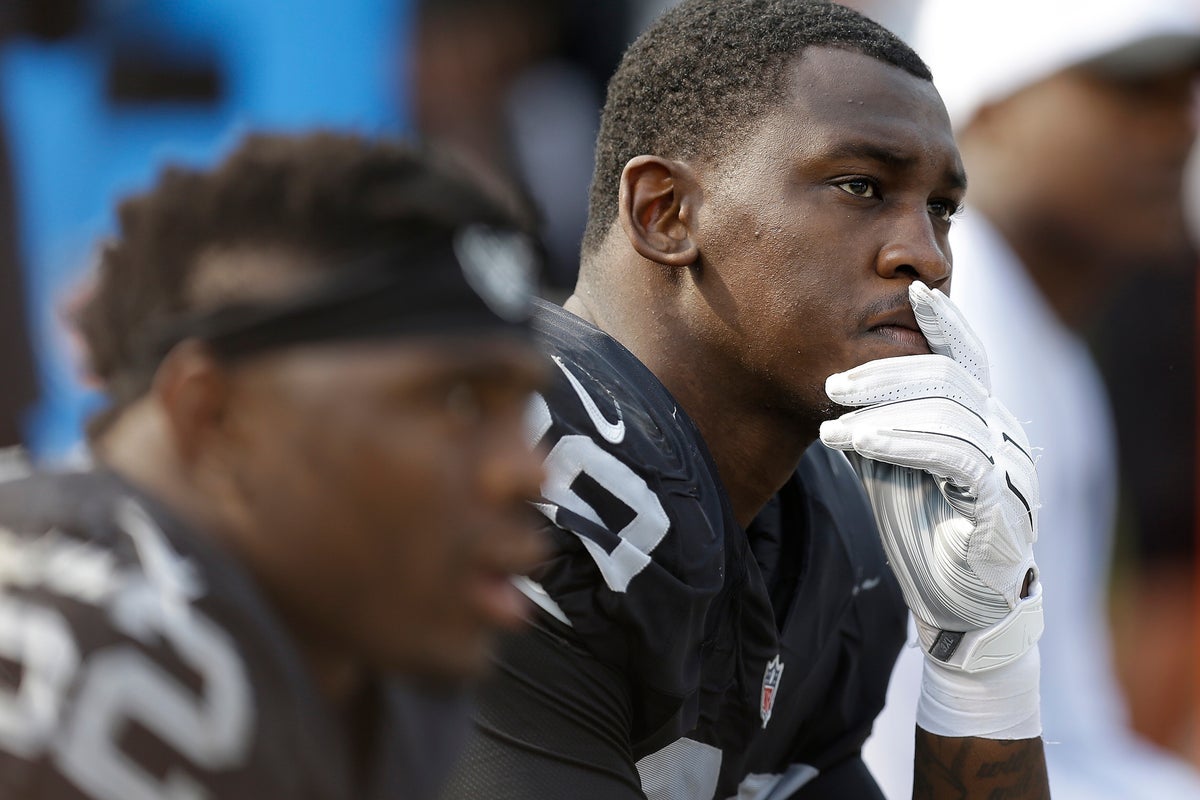
Aldon Smith stands at an official height of 6 feet 4 inches (193 cm) and maintained a playing weight of approximately 265 pounds (120 kg) throughout the majority of his NFL career. These metrics, combined with his extraordinary 35 3/8-inch arm length, created one of the most formidable physical profiles for an edge rusher in the modern era of professional football.
The physical dimensions of a professional athlete often dictate their ceiling in the NFL, but in the case of Aldon Smith, his height and weight were perfectly calibrated for the specific demands of the "Elephant" linebacker and defensive end roles. To understand why Smith was able to record 33.5 sacks in his first two seasons—a record-breaking pace—one must look beyond the basic numbers and into the biomechanical advantages his frame provided. As we evaluate his legacy from the perspective of 2026, his physical profile remains a blueprint for scouts searching for the "ideal" pass-rushing specimen.
Official Measurements: The NFL Combine Foundation
When Aldon Smith entered the 2011 NFL Scouting Combine, scouts were primarily focused on his raw length. While his height and weight were impressive, they were the baseline for a set of measurements that suggested an elite athletic ceiling.
The official 2011 Combine data recorded:
- Height: 6' 4 3/8"
- Weight: 263 lbs
- Arm Length: 35 3/8"
- Hand Size: 9 3/4"
- 40-Yard Dash: 4.74 seconds
These measurements placed Smith in a rare category. A 6'4" frame is often considered the "sweet spot" for defensive ends. It is tall enough to provide the necessary vision and reach to bat down passes at the line of scrimmage, yet compact enough to maintain a lower center of gravity than the "giant" rushers who stand 6'7" or taller. For Smith, the 263-pound weigh-in was particularly significant because it proved he had the frame to carry the bulk required for the NFL without sacrificing the explosive "get-off" speed necessary to beat elite offensive tackles.
The Significance of the 6-Foot-4 Frame
In the physics of the NFL trenches, height is a double-edged sword. A player who is too tall often struggles with "leverage"—the ability to get underneath the pads of an offensive lineman to drive them backward. However, Aldon Smith’s 6'4" stature allowed him to maintain a natural leverage advantage against the massive offensive tackles of the NFC West, who often stood 6'6" or 6'7".
Leverage and Torque
By standing 6'4", Smith was able to dip his shoulder and "run the arc" around tackles. If he were taller, his hips would naturally sit higher, making it harder to bend around the edge. If he were shorter, he might have struggled to disengage from the long-reaching arms of tackles. Smith used his height to create a tripod of stability, allowing him to convert speed to power with exceptional efficiency.
Passing Lane Obstruction
One of the most underrated benefits of Smith's height was his impact on the "quick game." Quarterbacks attempting three-step drops often found their passing lanes obscured by Smith’s frame. When a rusher is 6'4" and possesses the vertical leap Smith displayed, they effectively become a 9-foot wall once their arms are extended. This forced quarterbacks to alter their throwing motions or loft the ball, leading to tipped passes and interceptions for the secondary.
Weight Management: The 265-Pound Balance
Throughout his stints with the San Francisco 49ers, Oakland Raiders, and Dallas Cowboys, Smith’s weight fluctuated slightly depending on the defensive scheme. In a 3-4 defense (like the one run by Vic Fangio in San Francisco), he often played closer to 260 pounds to prioritize lateral agility and pass coverage duties. In 4-3 schemes, he occasionally bulked up toward 275 pounds to better handle the "wash" of inside run plays.
Strength vs. Explosiveness
The 265-pound mark is critical for a "tweener"—a player who occupies the space between a traditional linebacker and a defensive end. At this weight, Smith possessed enough mass to hold his ground against a 315-pound offensive tackle in the run game. However, because his body fat percentage was remarkably low, that weight was almost entirely functional muscle, allowing for the "twitch" response required to change direction instantly.
The Impact of Layoffs on Physical Condition
During Smith's various absences from the league, maintaining this specific weight was a constant challenge. In 2020, when he made a comeback with the Dallas Cowboys after a four-year hiatus, observers noted he looked "bigger" yet still possessed the signature burst. Reports at the time suggested he had used the time away to focus on heavy strength training, arriving at camp near 275 pounds while maintaining the lean profile of a younger player. This ability to carry varying weights spoke to his elite genetic makeup.
The "X-Factor": Arm Length and Wingspan
You cannot discuss Aldon Smith’s height and weight without addressing his 35 3/8-inch arms. In the NFL, arm length is often more predictive of pass-rushing success than raw weight. Smith's arms were essentially "lever arms" that allowed him to strike an offensive lineman's chest before the lineman could reach his shoulder pads.
The First-Contact Advantage
In pass rushing, the player who "lands" their hands first usually wins the rep. With arms significantly longer than the average NFL tackle, Smith could initiate contact, control the blocker’s jersey, and shed the block while the tackle was still reaching for air. This effectively made him play "longer" than his 6'4" height would suggest, giving him the reach of a man who was 6'7" or 6'8".
The "Long Arm" Bull Rush
Smith perfected the "long arm" technique, where he would place one hand in the center of a tackle’s chest and use his 265-pound frame to drive all his power through that single point. Because his arm was so long, the tackle could not reach Smith’s body to stop the momentum. This move became his signature, allowing him to walk Pro Bowl tackles directly back into the quarterback’s lap.
Comparative Analysis: Smith vs. His Peers
To put Aldon Smith’s physical dimensions in perspective, it is helpful to compare him to other elite edge rushers of his era and those who followed.
| Player | Height | Weight | Arm Length | Career High Sacks (Season) |
|---|---|---|---|---|
| Aldon Smith | 6'4" | 265 lbs | 35 3/8" | 19.5 |
| Von Miller | 6'3" | 250 lbs | 33 1/2" | 18.5 |
| J.J. Watt | 6'5" | 290 lbs | 34" | 20.5 |
| Khalil Mack | 6'3" | 269 lbs | 33 1/4" | 15.0 |
| Myles Garrett | 6'4" | 272 lbs | 35 1/4" | 16.0 |
As shown in the table, Smith’s arm length exceeded even J.J. Watt, who was an inch taller and significantly heavier. This unique combination of height and reach is what made Smith a "unicorn" prospect. While Von Miller relied on "ghost" rushes and elite bend, and J.J. Watt relied on sheer power and hand-fighting, Smith occupied a middle ground where he could out-reach the technicians and out-speed the power rushers.
Biomechanics of the 19.5-Sack Season
In 2012, Aldon Smith nearly broke the single-season sack record, finishing with 19.5. This season was the ultimate manifestation of his physical gifts. Working alongside Justin Smith (a 300-pound defensive tackle), Aldon was able to use his 265-pound frame to "loop" inside on stunts.
Because he was 6'4", he had the stride length to cover ground quickly during these stunts. A shorter player would have had to take more steps to clear the "A-gap," giving the offensive line more time to recover. Smith’s height allowed for a "long-striding" efficiency that caught interior linemen off guard. When he collided with guards or centers, his 265 pounds—accelerated by his speed—generated immense force (Force = Mass x Acceleration), often resulting in him simply running through the blocker.
Training and Diet for a 265-Pound Elite Rusher
Maintaining a 265-pound frame with elite speed requires a rigorous nutritional and training regimen. While Smith’s career was marked by personal challenges, his pure physical preparation when active was often cited by teammates as top-tier.
Caloric Intake
For an athlete of Smith's size and activity level, a daily intake of 5,000 to 6,000 calories was standard during the season. The focus was on "clean bulk"—high-protein sources like grilled chicken, lean steak, and fish to support muscle repair, combined with complex carbohydrates like sweet potatoes and brown rice to fuel the explosive movements required on the field.
Strength Profile
Smith's training emphasized "explosive power" rather than just bodybuilding mass. This included:
- Power Cleans: To develop the hip hinge and "pop" needed to explode out of his stance.
- Weighted Pull-ups: To strengthen the back and lats, which are essential for pulling an offensive lineman's hands away.
- Sprints and Plyometrics: To ensure that his 265-pound weight didn't become "dead weight," keeping his vertical and broad jump numbers in the elite percentiles.
The Evolution of the Edge Rusher Archetype
Looking back from 2026, we can see how Aldon Smith’s height and weight influenced the "prototypical" scout's card. In the early 2000s, there was a trend toward smaller, "speed only" rushers. Smith helped swing the pendulum back toward the "long and strong" model.
Modern stars like Myles Garrett and Travon Walker share many of the same physical traits as Smith: the 6'4" to 6'5" frame, the 260-275 pound weight range, and—most importantly—the massive wingspan. Smith proved that you didn't have to be a 240-pound linebacker to have an elite first step; you could be a 265-pound force of nature and still be the fastest person on the field for the first ten yards.
Frequently Asked Questions
Did Aldon Smith’s height and weight change after his long hiatus?
When Aldon Smith returned to the NFL in 2020 with the Dallas Cowboys, he was visibly more muscular. He weighed in around 275 pounds, roughly 10-12 pounds heavier than his 2011 Combine weight. Despite the added mass, he retained much of his signature speed, recording five sacks and 14 quarterback hits that season.
How did his arm length compare to offensive tackles?
Surprisingly, Smith often had longer arms than the men assigned to block him. Many NFL offensive tackles have arm lengths between 33 and 34 inches. Smith’s 35 3/8-inch reach gave him a "first-strike" advantage in nearly every matchup, allowing him to control the distance between himself and the blocker.
Is 265 pounds light for a defensive end?
In a 4-3 defense, 265 pounds is considered slightly on the lighter side for a defensive end, where many players are 275-285 pounds. However, for a 3-4 outside linebacker (the position Smith primarily played in San Francisco), 265 pounds is quite large, providing a significant power advantage over smaller 240-pound "speed" linebackers.
How tall is Aldon Smith in centimeters?
Aldon Smith is approximately 193 cm tall. This height is ideal for maintaining eye contact with the quarterback over the heads of interior linemen while maintaining a low enough profile to "bend" under the arms of offensive tackles.
What was Aldon Smith's body fat percentage during his peak?
While official team data is rarely public, scouts and trainers estimated Smith’s body fat to be in the 10-12% range during his peak years with the 49ers. This is exceptionally lean for a 265-pound athlete and accounts for his visible muscle definition and "twitch" athleticism.
Final Perspective on a Physical Phenom
Aldon Smith’s height and weight were the foundation of a career that, while complicated, reached heights few players ever touch. His 6'4", 265-pound frame was a masterpiece of athletic engineering—perfectly balanced for speed, power, and leverage. When combined with his generational arm length, he became a "blueprint" player that NFL front offices still use today to evaluate edge-rushing talent. Whether he was speed-rushing around the corner or using his length to bull-rush a tackle, his physical profile was the primary engine behind his historic production on the field.