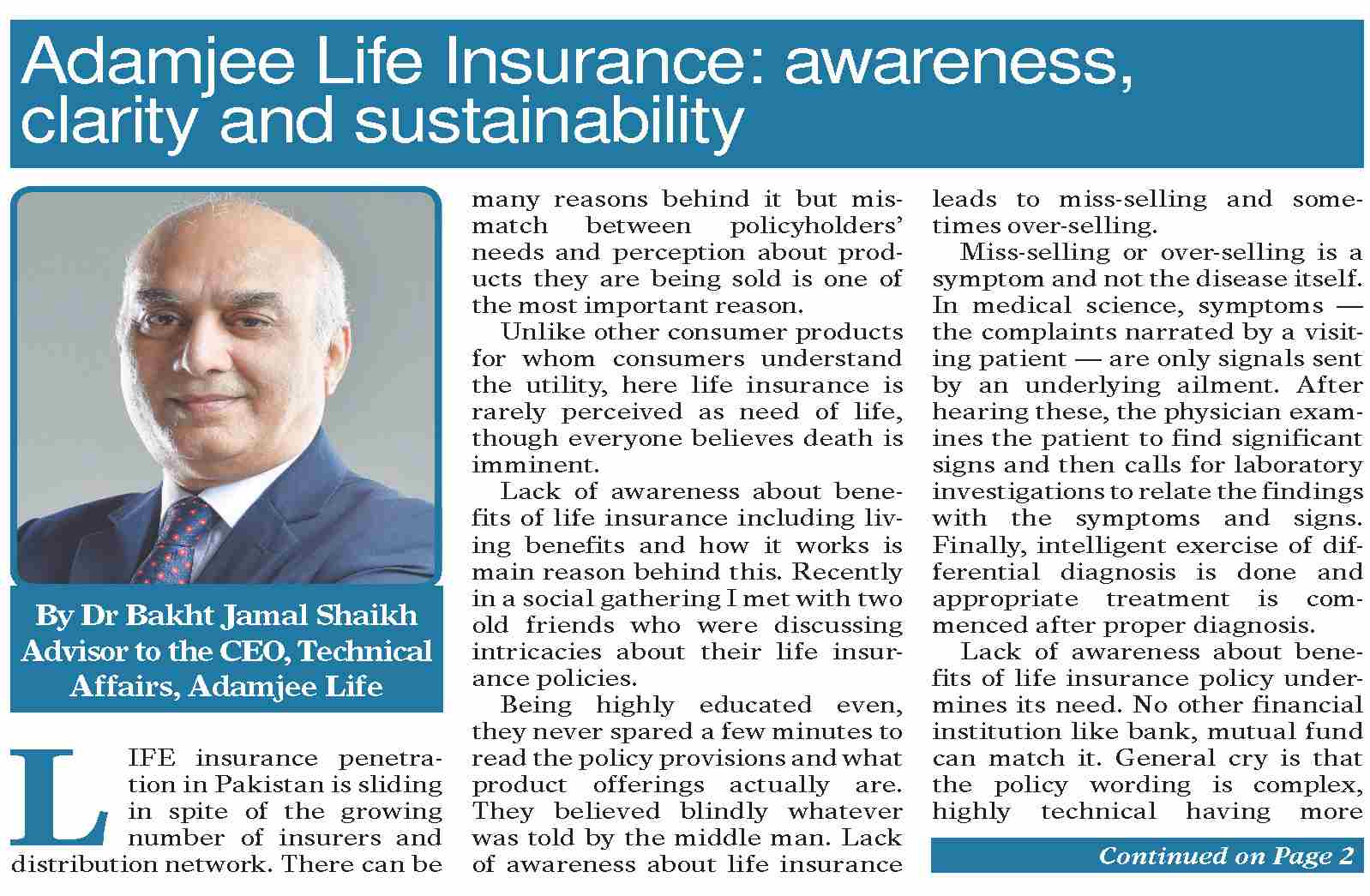
Adamjee Life Assurance Company Limited is a leading private sector life insurance provider in Pakistan, operating under the financial backing of the Nishat Group. Regulated by the Securities and Exchange Commission of Pakistan (SECP), the company maintains top-tier Insurer Financial Strength (IFS) ratings from the Pakistan Credit Rating Agency (PACRA). It specializes in unit-linked investment plans, Family Takaful products, and corporate group coverage distributed primarily through bancassurance partnerships and a dedicated agency sales network.
Corporate Structure and Market Positioning
Adamjee Life Assurance Company Limited entered the Pakistani life insurance market to capitalize on the growing demand for private life insurance and investment-oriented protection products. As part of the Nishat Group—one of Pakistan's prominent business conglomerates with deep interests in banking, textiles, cement, and power generation—Adamjee Life leverages substantial corporate infrastructure and institutional financial backing.
In the national marketplace, life insurance is broadly split between the public sector operator, State Life Insurance Corporation of Pakistan, and major private sector insurers, including Adamjee Life, Jubilee Life Insurance, and EFU Life Assurance. Private insurers primarily differentiate themselves through market-linked investment products, bancassurance distribution channels, and Shariah-compliant Takaful alternatives.
- Securities & Exchange Commission of Pakistan (SECP)
- Adamjee Life Assurance Company Limited
- Conventional Operations (Unit-Linked Policies)
- Window Family Takaful (Shariah Board Oversight)
- Adamjee Life Assurance Company Limited
The regulatory architecture governing Adamjee Life’s operations stems from the Insurance Ordinance, 2000 and the Insurance Rules, 2017, enforced by the SECP. This statutory framework dictates minimum solvency margins, paid-up capital requirements, statutory fund management protocols, and policyholder protection standards.
PACRA assigns Insurer Financial Strength (IFS) ratings to evaluate an insurer’s capacity to meet policyholder obligations. Adamjee Life consistently holds high-grade IFS ratings (typically in the AA+ category), signifying strong capital adequacy, effective risk management practices, and robust institutional support from the Nishat Group.
Portfolio Analysis: Products and Services
Adamjee Life’s commercial portfolio is divided into two operational pillars: Conventional Unit-Linked Life Insurance and Window Family Takaful Operations. Both structures cater to individual protection, education planning, retirement savings, and institutional group plans.
1. Unit-Linked Life Insurance Products
The majority of individual policies sold by Adamjee Life are unit-linked investment plans. In these policies, the premium paid by the policyholder is split into two distinct components:
- Protection Component: Pays for the cost of life insurance cover (the sum assured) and administrative charges.
- Investment Component: Allocated to purchase units in investment funds managed by Adamjee Life’s investment committee.
Policyholders choose their preferred fund allocation based on their personal risk tolerance:
- Aggressive / Growth Funds: Heavily weighted toward equities listed on the Pakistan Stock Exchange (PSX), aiming for long-term capital appreciation accompanied by higher short-term price volatility.
- Balanced Funds: Allocate assets across PSX equities, government securities (such as Pakistan Investment Bonds and Treasury Bills), and corporate debt instruments (Sukuks and Term Finance Certificates).
- Conservative / Income Funds: Focus almost entirely on sovereign debt, high-grade bank deposits, and fixed-income securities to prioritize capital preservation over high yields.
The policy’s cash value fluctuates according to the Net Asset Value (NAV) of the chosen fund, which is calculated and published on a regular basis.
2. Window Family Takaful Solutions
To address the growing demand for Shariah-compliant financial products, Adamjee Life operates a Window Family Takaful operation under the SECP Takaful Rules. Governed by an independent Shariah Supervisory Board, Takaful replaces traditional insurance contracts with a mutual indemnity model based on Islamic principles.
Policyholder Contribution
- Participant Takaful Fund (PTF - Risk / Tabarru Pool)
- Pays Claims & Protection Benefits to Members
- Participant Investment Fund (PIF - Investment Pool)
- Shariah-Compliant Funds (Sukuks, Islamic Equities)
- Participant Takaful Fund (PTF - Risk / Tabarru Pool)
Participant Takaful Fund (PTF): A common risk pool where policyholders contribute a portion of their premium as Tabarru (charitable donation). Claims for death or disability are paid out directly from this pool.
Participant Investment Fund (PIF): The investment pool where the remainder of the contribution is invested in Shariah-compliant assets (e.g., Sukuk bonds, Islamic equity funds, and Meezan Islamic Bank deposits).
Operational Contracts: The company acts as a Wakil (agent) managing the fund for a predefined fee (Wakalah fee), and as a Mudarib (investment manager) sharing in the profits generated by the PIF investments based on a pre-agreed ratio.
3. Supplementary Riders and Covers
Both conventional and Takaful policies permit the attachment of optional riders to expand coverage. Key riders offered include:
- Critical Illness Rider: Provides a lump-sum payout upon diagnosis of specified major medical conditions, such as cancer, stroke, or severe coronary surgery.
- Accidental Death and Disability Rider (AD&D): Pays an additional benefit if the policyholder dies or suffers permanent total or partial disability due to an accident.
- Hospitalization Cash Benefit: Reimburses daily hospital expenses during inpatient stays.
- Waiver of Premium Rider: Waives future premium payments if the policyholder suffers total and permanent disability, keeping the policy active until maturity.
4. Group Life and Corporate Schemes
For corporate clients, employers, and financial institutions, Adamjee Life designs group life, group health, and credit life products:
- Group Term Life: Lump-sum death benefits provided to employees of client corporations.
- Group Credit Life: Protects lending institutions (such as commercial banks and microfinance institutions) by clearing the outstanding balance of a loan or mortgage if the borrower dies or becomes permanently disabled.
Distribution Channels and the Role of Bancassurance
The distribution landscape for life insurance in Pakistan has undergone a major shift over the past two decades, transitioning from traditional direct sales forces to bank-led distribution models.
- Adamjee Life Distribution
- Bancassurance Channel
- MCB Bank, Faysal Bank, etc.
- High conversion rates
- Integrated banking platform
- Direct Agency Sales Force
- Regional Branch Networks
- Agent-led relationship selling
- Directly managed by Adamjee
- Bancassurance Channel
Bancassurance Dominance
Bancassurance remains Adamjee Life's dominant growth driver. Through official partnerships with major commercial banks—most notably MCB Bank Limited (also a Nishat Group entity), Faysal Bank, Habib Metropolitan Bank, and others—Adamjee Life markets its products directly to bank account holders.
- Advantages for Consumers: Seamless premium deduction directly from bank accounts, simplified underwriting for existing bank customers, and access to financial planning at bank branch locations.
- Considerations: Bank staff sell policies on behalf of the insurer. Customers must carefully read the policy documents rather than relying solely on verbal branch presentations, ensuring they understand premium allocation rates, fund options, and policy surrender terms.
Agency Sales and Digital Channels
Beside bancassurance, Adamjee Life maintains a network of branch offices staffed by direct sales agents across primary urban centers, including Karachi, Lahore, Islamabad, Rawalpindi, Multan, and Faisalabad. Additionally, the company offers digital self-service portals and mobile applications, allowing policyholders to check unit values, view payment schedules, download tax certificates, and initiate basic service requests online.
Fee Structures, Allocations, and Early Surrender Mechanics
A complete understanding of any unit-linked policy requires examining its premium allocation schedule, expense deductions, and surrender value rules. Early termination of a unit-linked policy often results in financial loss due to heavy front-loaded costs.
Premium Allocation Schedule
In the initial years of a unit-linked life policy, only a portion of the paid premium is allocated toward purchasing investment units. The remaining percentage covers front-end sales commissions, underwriting costs, policy issuance fees, and initial setup charges.
A standard allocation schedule generally follows this pattern:
| Policy Year | Typical Premium Allocation % | Non-Allocated Fee % | Key Cost Drivers |
|---|---|---|---|
| Year 1 | 25% – 50% | 50% – 75% | Distribution commissions, medical underwriting, administrative setup |
| Year 2 | 70% – 85% | 15% – 30% | Renewal commissions, ongoing administration |
| Year 3 | 85% – 90% | 10% – 15% | Standard management expenses |
| Year 4 & Onward | 100% (or plus allocation bonuses) | 0% (excluding regular fees) | Full investment allocation, potential persistence bonuses |
Note: Allocation rates vary by specific product line, premium size, and distribution channel. Policyholders must review their specific Illustration Document for exact percentages.
Ongoing Charges
Beyond initial allocation deductions, policies incur recurring expenses:
- Fund Management Fee (FMF): Typically between 1.5% and 2.0% per annum of the fund's net asset value, deducted directly before publishing the NAV.
- Administrative Fee: A nominal monthly charge (indexed to inflation) deducted via unit redemption to cover policy maintenance.
- Cost of Insurance (COI) / Mortality Charges: Deducted monthly by encashing units to cover the risk of sum assured payouts. This fee increases as the policyholder ages.
Surrender Penalties and Liquidity
Unit-linked life policies are long-term commitments, ideally held for 10 to 20 years.
- Early Surrender (Years 1 to 3): Surrendering a policy during the first three years typically yields little to no cash value because the early premiums went primarily toward non-allocated charges rather than unit accumulation.
- Partial Surrender: Most policies permit partial unit withdrawals after completing a minimum period (usually 2 to 3 years), provided a minimum cash balance remains in the account.
Market Comparison: Adamjee Life vs. Major Competitors
To evaluate Adamjee Life's relative standing in the Pakistani insurance market, it is useful to compare its key structural features against its primary private-sector competitors: Jubilee Life Insurance and EFU Life Assurance.
| Feature / Metric | Adamjee Life Assurance | Jubilee Life Insurance | EFU Life Assurance |
|---|---|---|---|
| Parent Group / Backing | Nishat Group | Aga Khan Fund for Economic Development (AKFED) | JS Group / EFU Group |
| Primary Distribution Channel | Bancassurance (Strong MCB synergy) & Agency Network | Bancassurance (HBL, Habib Bank, etc.) & Agency Network | Agency Sales Force & Bancassurance |
| Regulatory Supervision | SECP | SECP | SECP |
| Takaful Offerings | Window Family Takaful Operations | Window Family Takaful Operations | Window Family Takaful Operations |
| Investment Options | Equity, Balanced, Income Funds | Equity, Managed, Conservative Funds | Growth, Guaranteed, Capital Strategy Funds |
| PACRA/VIS Financial Rating | High Investment Grade (AA+ category) | High Investment Grade (AA+ category) | High Investment Grade (AA+ category) |
| Core Target Market | Mass-affluent bank customers, corporate groups, individual investors | High-net-worth bank clients, individual retail, corporate groups | Retail insurance buyers, mass-market agency clients |
Disclaimer: Financial ratings and fund metrics are subject to periodic review by rating agencies and independent auditors. Prospective buyers should consult updated PACRA or VIS reports.
Claim Settlement Process and Verification
The ultimate measure of an insurance company is its capacity and reliability in settling claims. SECP regulations mandate strict guidelines for claim processing timelines and insurer conduct.
- Notice of Claim
- Submission of Required Documents (Policy Bond, CNIC, Death Cert, Medical Records)
- Verification & Assessment by Adamjee Claims Dept.
- Approval & Fund Disbursement to Beneficiary
Step-by-Step Claim Procedure
- Notification: The beneficiary or policyholder must formally notify Adamjee Life of the claim event (death, critical illness, or disability) through a branch office, customer service helpline, or online portal.
- Document Submission: The claimant must provide verified supporting documentation:
- Original policy document (Policy Bond).
- Claimant and insured’s Computerized National Identity Cards (CNIC).
- Official Death Certificate issued by NADRA / Union Council (for death claims).
- Attending Physician’s Report and complete hospital records detailing the cause of death or illness.
- Police report and post-mortem examination report (mandatory for accidental death cases).
- Assessment and Verification: The internal underwriting and claims committee evaluates the submitted evidence against policy terms, verifying that the cause of death or event is not covered under policy exclusions (e.g., pre-existing conditions not disclosed at sign-up, self-inflicted injuries, or participation in illegal activities).
- Disbursement: Upon successful verification, the claim sum—comprising the Sum Assured plus accumulated investment cash values (depending on policy design)—is issued to the designated beneficiary via cross-cheque or direct bank transfer.
Dispute Resolution and Legal Recourse
If a claim is delayed or unfairly denied, policyholders and beneficiaries in Pakistan have access to formal legal remedies:
- Internal Appeals Committee: Claimants can first request a secondary review by Adamjee Life’s senior management.
- Federal Insurance Ombudsman (FIO): If the internal appeal fails, the claimant can file a complaint with the Insurance Ombudsman. The FIO operates as an independent statutory body that resolves disputes between policyholders and insurance companies without requiring expensive court litigation.
- SECP Insurance Complaints Cell: Direct regulatory complaints can also be registered with the SECP's Insurance Division.
Critical Factors Before Purchasing an Adamjee Life Policy
Before signing a proposal form or transferring funds, prospective policyholders should complete the following due diligence steps:
- Determine the Insurance Needs Gap: Calculate family financial commitments, outstanding debts, children’s future higher education expenses, and household living costs before selecting a Sum Assured. Do not view a life policy solely as a short-term bank deposit.
- Review the Policy Illustration: Insist on reading the complete Benefit Illustration. Check the projected values at assumed growth rates (e.g., 6%, 8%, 10%) and inspect the exact unit allocation percentages for Years 1 through 5.
- Evaluate Medical and Health Disclosures: Ensure complete disclosure of all pre-existing medical conditions, smoking habits, and family medical histories during underwriting. Failure to disclose material health facts can lead to claim repudiation later.
- Verify Takaful vs. Conventional Preference: If Shariah compliance is essential, verify that the application specifies a Window Family Takaful contract rather than a conventional unit-linked plan. Confirm that the policy's underlying fund is managed under the direction of the Shariah Board.
- Understand Inflation Impact: Because long-term inflation can erode real purchasing power over a 15- to 20-year horizon, evaluate policies offering Indexation Riders, which automatically increase the premium and sum assured annually by a fixed percentage to hedge against inflation.
Frequently Asked Questions
What is the primary difference between traditional life insurance and Adamjee's unit-linked policies?
Traditional life insurance policies offer a fixed sum assured with guaranteed non-forfeiture benefits or discretionary bonuses declared by the insurer. In contrast, Adamjee’s unit-linked policies invest a portion of your premium into market-backed funds (equity, income, or balanced). The final payout of a unit-linked policy depends directly on the Net Asset Value (NAV) of those underlying investment funds at policy maturity, combined with the insurance sum assured.
How does Takaful differ from conventional insurance at Adamjee Life?
Adamjee Family Takaful operates on Shariah-compliant mutual assistance principles rather than a conventional commercial insurance contract. Premium contributions are divided into a risk pool (Participant Takaful Fund) used for charitable assistance to members in need, and an investment pool (Participant Investment Fund) invested strictly in Shariah-compliant financial instruments. An independent Shariah Board oversees all Takaful investments and operational mechanics.
What happens if I stop paying premiums after two years?
If you stop paying premiums after two years, your policy may enter a "paid-up" status or lapse entirely depending on its accumulated cash value. Because early-year allocation rates prioritize insurance charges and setup costs, the cash value in Year 2 may not be sufficient to cover ongoing monthly administration and mortality fees. If the cash value drops to zero, the policy lapses and coverage terminates. Always review the policy's surrender clause for exact details.
How can policyholders track the performance of their investment funds?
Policyholders can track fund performance by checking the daily or weekly Net Asset Values (NAV) published on the official Adamjee Life website, viewing updates via the mobile app, or reviewing annual policy statements sent by the company. These statements detail the total units credited to the policy, current fund prices, allocated premiums, and deducted charges.
Are premiums paid toward Adamjee Life policies eligible for tax credits in Pakistan?
Under the applicable provisions of the Income Tax Ordinance of Pakistan, individual taxpayers may be eligible for a tax credit on life insurance or Takaful premiums paid during the tax year, subject to statutory caps based on taxable income and maximum investment limits. Tax laws are subject to annual legislative amendments; policyholders should consult a qualified tax advisor to verify current tax deduction limits.
Actionable Next Steps
If you are considering purchasing an Adamjee Life policy or evaluating an existing contract, take these practical steps:
- Conduct an Allocation Audit: Request a formal sample illustration from an authorized representative. Compare the allocation percentages in Years 1–3 against your long-term liquidity requirements.
- Verify Representative Credentials: Ensure that any agent or bank officer presenting a policy is an authorized representative registered with the SECP.
- Match Fund Selection to Horizon: Align your fund choice with your investment timeframe. Select growth or equity funds primarily for horizons exceeding 10 years, and shift toward income or conservative funds as you approach policy maturity to lock in accumulated gains.
- Maintain Records: Keep duplicate copies of your signed proposal form, medical declaration forms, initial payment receipts, and the original Policy Bond in a secure location, ensuring designated beneficiaries know how to locate them.
Financial Advice Disclaimer: This article is provided strictly for educational and informational purposes and does not constitute formal legal, financial, or tax advice. Insurance products and regulatory environments in Pakistan are subject to change. Consult a licensed financial advisor, tax specialist, or the Securities and Exchange Commission of Pakistan (SECP) for personal advice suited to your individual financial situation.