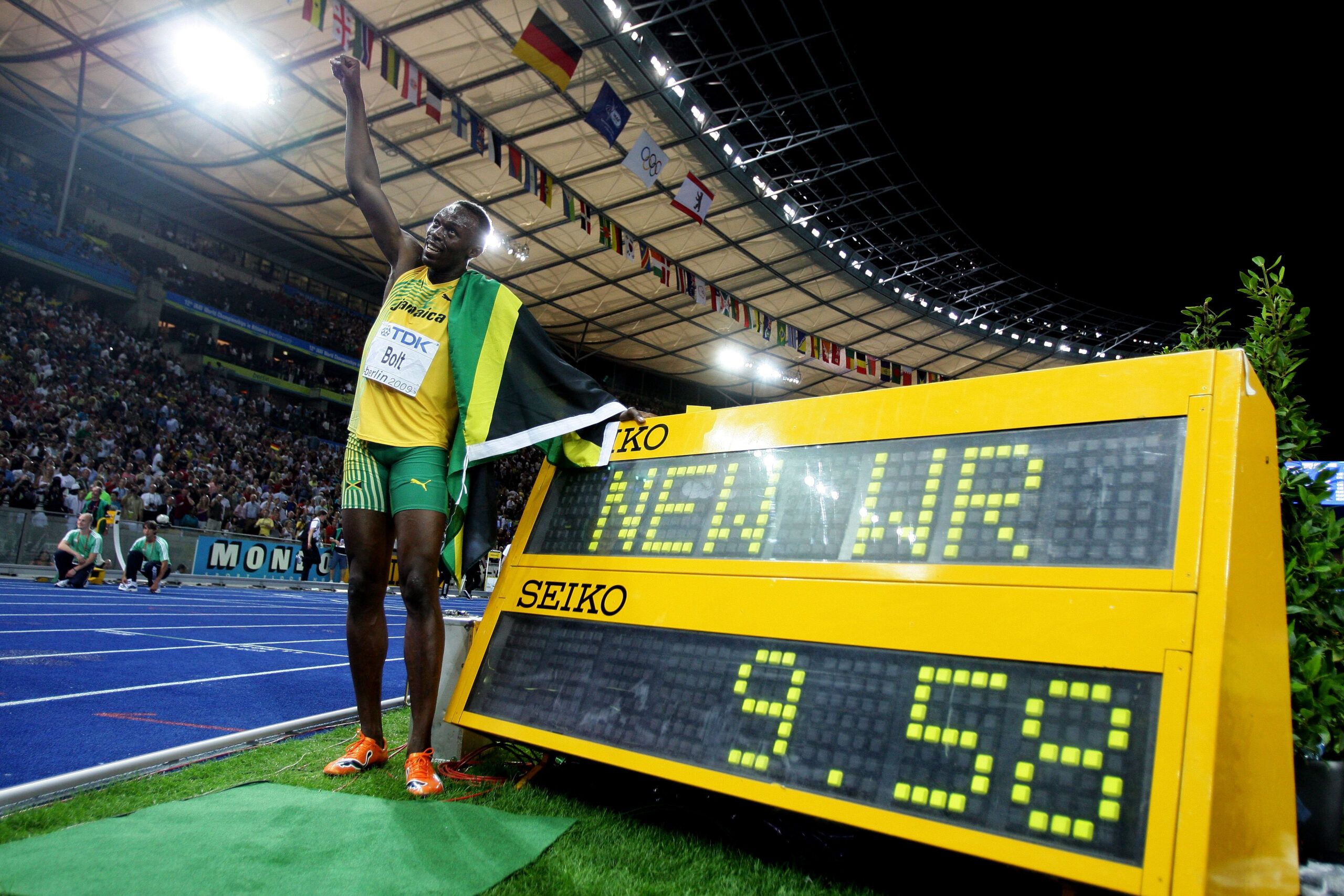
Usain Bolt set the 100m world record of 9.58 seconds on August 16, 2009, during the World Athletics Championships in Berlin. This achievement was characterized by a reaction time of 0.146 seconds, a peak velocity of 44.72 km/h (27.78 mph), and a total of only 41 strides over the 100-meter distance.
The Context of the Berlin 2009 World Championships
To understand the magnitude of the 9.58-second record, one must look at the atmosphere of the 12th IAAF World Championships in Athletics. Held at the Olympic Stadium in Berlin—the same venue where Jesse Owens made history in 1936—the stage was set for a monumental showdown. By the summer of 2009, Usain Bolt was already a global superstar, having shattered the world record twice in 2008, culminating in a 9.69-second performance at the Beijing Olympics.
The narrative leading into Berlin was centered on the rivalry between Bolt and the American sprinter Tyson Gay. Gay arrived in Berlin as the defending triple world champion and had clocked a wind-aided 9.75 seconds earlier that season. Unlike the Beijing Olympics, where Bolt famously celebrated before crossing the finish line, the pressure from Gay in Berlin ensured that Bolt ran at full throttle for the entire 100 meters. This competitive tension is widely cited by sports historians as the catalyst that pushed Bolt to a time that remains untouched as of 2026.
The track itself, a distinctive blue polyurethane surface manufactured by Regupol, was engineered for high energy return. Conditions on the night of August 16 were nearly perfect: the temperature was approximately 26°C (79°F), and the tailwind was measured at +0.9 meters per second. While any tailwind up to +2.0 m/s is legal for record purposes, the +0.9 m/s reading meant that Bolt’s time was a "pure" display of speed, not overly reliant on atmospheric assistance.
Breaking Down the Phases of the 9.58-Second Sprint
A 100-meter sprint is often viewed as a single explosion of energy, but for elite athletes, it is a sequence of distinct technical phases. Bolt’s 9.58-second run is frequently studied by biomechanists because it redefined how a tall sprinter (Bolt stands 6'5" or 195 cm) could master the start and acceleration phases.
The Reaction and Start (0–10 Meters)
Historically, taller sprinters struggle with the "drive phase" because their higher center of gravity makes it difficult to generate the necessary leverage from the starting blocks. In Berlin, Bolt’s reaction time was 0.146 seconds. While not the fastest in the field—Richard Thompson and Dwain Chambers reacted slightly quicker—it was exceptionally efficient for a man of his stature. He covered the first 10 meters in 1.89 seconds, placing him virtually even with his shorter, more explosive competitors.
The Acceleration Phase (10–60 Meters)
This is where Bolt typically separates himself from the field. Between 10 and 20 meters, he clocked a split of 0.99 seconds, and he continued to drop his split times as he transitioned into an upright running position. By the 40-meter mark, Bolt had achieved a state of "maximum acceleration," moving into the phase of the race where his long levers (his legs) began to cover massive amounts of ground. His 20m to 40m split was a staggering 1.76 seconds.
Top End Velocity (60–80 Meters)
The "peak" of the 9.58-second record occurred between the 60m and 80m marks. Biomechanical data released by the IAAF (now World Athletics) confirmed that Bolt reached a top speed of 44.72 km/h (27.78 mph) during this interval. He covered the 10-meter segment from 60m to 70m in just 0.81 seconds. This is the fastest 10-meter segment ever recorded in human history. During this phase, Bolt’s stride length reached its maximum, averaging approximately 2.44 meters per step.
Speed Maintenance and Finish (80–100 Meters)
Most sprinters begin to decelerate significantly in the final 20 meters as anaerobic energy stores deplete. Bolt’s advantage in Berlin was his ability to minimize this deceleration. Even in the final 10 meters, he maintained a split of 0.83 seconds. Unlike his performance in Beijing, where his form broke as he started to celebrate at 85 meters, in Berlin, he maintained his "knees high, toes up" mechanics through the finish line, stopping the clock at 9.58.
The Physics of a 9.58: Power, Drag, and Stride
The technical brilliance of the 9.58 record is rooted in the physics of Bolt’s unique physiology. A 2013 study published in the European Journal of Physics by researchers from the National Autonomous University of Mexico analyzed the run in detail. They found that Bolt’s massive frame was actually a disadvantage regarding aerodynamic drag, yet his power output compensated for it.
Stride Efficiency
The average elite sprinter requires 44 to 45 steps to complete a 100-meter race. In his 9.58-second run, Usain Bolt completed the distance in exactly 41 strides. This efficiency is a result of his height and the force with which his feet hit the track. Because he takes fewer steps, he spends less time in the "air" and less time in the transition between strides, provided he can maintain a high stride frequency (cadence). In Berlin, he managed to combine the stride length of a giant with the turnover frequency of a much smaller man.
Force Production
To reach 44.72 km/h, Bolt had to exert an incredible amount of force into the ground. It is estimated that during his peak velocity, Bolt was producing a peak force of nearly 1,000 pounds per stride. Because his contact time with the ground was only about 0.08 seconds per step, the rate of force development (RFD) was the true secret to the 9.58.
Aerodynamics and Drag
The 2013 study calculated that Bolt’s drag coefficient was actually higher than the average human because of his width and height. According to the researchers, less than 8% of the energy produced by his muscles was used for motion, while the remaining 92% was used to overcome air resistance. This suggests that if Bolt had the same physical profile as a smaller, more aerodynamic sprinter but retained his power, he could have theoretically run even faster.
Comparative Analysis: 9.58 vs. Other World Records
To appreciate why the 9.58 record is so significant, it is helpful to compare it to the progression of the 100m world record over time. For much of the 20th century, the record was broken by hundredths of a second. Bolt, however, took the record from 9.74 (held by Asafa Powell) to 9.58 in just over a year—a jump of 0.16 seconds.
| Metric | Usain Bolt (9.58s - 2009) | Usain Bolt (9.69s - 2008) | Tyson Gay (9.71s - 2009) |
|---|---|---|---|
| Reaction Time | 0.146s | 0.165s | 0.144s |
| 0-20m Split | 2.88s | 2.87s | 2.89s |
| 20-40m Split | 1.76s | 1.78s | 1.79s |
| 40-60m Split | 1.65s | 1.67s | 1.69s |
| 60-80m Split | 1.63s | 1.69s | 1.67s |
| 80-100m Split | 1.66s | 1.68s | 1.67s |
| Wind Speed | +0.9 m/s | 0.0 m/s | +0.9 m/s |
| Total Strides | 41 | 41.2 | 45.5 |
The table highlights that Tyson Gay's performance in the same race (9.71s) would have been a world record at almost any other point in history. Bolt’s 9.58 was not just a victory; it was a statistical outlier that pushed the boundaries of human potential.
Why Hasn't the Record Been Broken by 2026?
As we stand in 2026, the 9.58-second mark remains the gold standard of athletics. Several factors contribute to the longevity of this record. First is the rare "genetic lottery" of Usain Bolt himself—a man with the height of a basketball player and the fast-twitch muscle fibers of a sprinter. Most athletes of Bolt’s height do not possess the coordination or the neural drive to move their limbs at such high frequencies.
Second, the "perfect storm" of 2009 has been difficult to replicate. This includes the track technology of the time, the specific atmospheric conditions in Berlin, and the presence of a prime Tyson Gay to push Bolt to his limits. While shoe technology has advanced significantly since 2009—with "super spikes" featuring carbon plates and specialized foams—even these technological gains have not yet compensated for the sheer raw power Bolt displayed in Berlin.
Current stars of the 2020s, such as Noah Lyles and various emerging talents, have flirted with the 9.7 and 9.6 ranges, but the 0.1-second gap to 9.58 remains a formidable barrier. In the world of sprinting, a tenth of a second is an eternity, often representing several meters of distance on the track.
Common Misconceptions About the 9.58 Record
Was the Wind Illegal?
A common question is whether the wind assisted Bolt unfairly. Under World Athletics Rule 163.8, a world record is valid if the following wind does not exceed 2.0 meters per second. Bolt’s wind was +0.9 m/s, which is well within the legal limit. In fact, had the wind been a full +2.0 m/s, some statistical models suggest Bolt might have run a 9.52 or 9.53.
Did He Slow Down at the End?
Unlike the 2008 Beijing Olympics, where Bolt famously dropped his arms and slapped his chest before the line, he ran through the finish in Berlin. While his last 10-meter split (0.83s) was slightly slower than his peak 10-meter split (0.81s), this was due to natural physiological deceleration, not a lack of effort.
Is the Record "Unbreakable"?
Statisticians and sports scientists often debate the "absolute limit" of human speed. A study by Mark Denny of Stanford University suggested that the ultimate human limit for the 100m could be around 9.48 seconds. While 9.58 is not theoretically unbreakable, it requires a near-perfect athlete to perform under near-perfect conditions.
FAQ: Understanding the 9.58 Record
What was Usain Bolt's max speed in mph during the 9.58?
During the 100m world record sprint, Bolt reached a top speed of 27.78 mph (44.72 km/h). This occurred between the 60-meter and 80-meter marks of the race.
How many steps did Bolt take in his 9.58-second run?
Usain Bolt completed the 100m in exactly 41 strides. For comparison, most elite sprinters take between 44 and 47 strides to cover the same distance.
What shoes did Bolt wear for the record?
Bolt wore the Puma Yaam, a custom-designed track spike. The shoes were notable for their bright orange color and a streamlined design that lacked a traditional "tongue" to reduce weight and improve aerodynamics.
Who came in second in the 9.58 race?
Tyson Gay of the United States finished second with a time of 9.71 seconds. Asafa Powell of Jamaica took third with a time of 9.84 seconds.
Was the 9.58 record set at the Olympics?
No, the 9.58-second record was set at the 2009 World Athletics Championships in Berlin, Germany. Bolt's Olympic record is 9.63 seconds, set at the 2012 London Games.
Practical Recommendations for Aspiring Sprinters
While few humans will ever approach a 9.58-second 100m, the mechanics of Bolt’s run offer valuable lessons for athletes at all levels.
- Prioritize Stride Length without "Overstriding": Bolt’s speed came from his ability to cover ground. However, he didn't reach forward with his feet; he applied massive downward force, which naturally propelled him further. Focus on vertical force production rather than "reaching."
- Master the Transition: The most impressive part of the 9.58 run was Bolt’s transition from the blocks to upright running. Practice staying low for the first 20–30 meters to build "horizontal" velocity before moving into your top-end speed phase.
- Speed Endurance Training: Bolt won because he decelerated less than his rivals. Incorporate "fly-in" sprints where you maintain top speed for 20–30 meters to train your nervous system to handle peak velocities.
- Analyze the Data: If you are a competitive athlete, use video analysis to count your strides and calculate your own 10-meter splits. Understanding where you lose time—whether in the start or the finish—is the first step toward improvement.
The 9.58-second record stands as a testament to what is possible when elite genetics, rigorous training, and perfect competition converge. Even in 2026, it remains the definitive benchmark for human speed.