Identifying the five best wildlife photographs requires evaluating technical mastery, emotional resonance, and long-term impact on global conservation. Images like Sergey Gorshkov’s "The Embrace" and Paul Nicklen’s "The Big O" are widely considered the pinnacle of the craft, having fundamentally shifted public perception of endangered species through unprecedented intimacy and technical innovation.
The Evolution of Excellence in Wildlife Photography
Defining the "best" in any artistic medium is inherently subjective, but in wildlife photography, greatness is often measured by the difficulty of the capture and the narrative the image conveys. As of 2026, the industry has seen a massive influx of high-resolution imagery, yet the most iconic photographs remain those that captured a "first" or a "final" moment for a species. These images serve as more than just visual records; they are calls to action that have influenced international policy and protected vast tracts of wilderness.
To reach the status of "best," a photograph must survive three rigorous filters. First is technical execution: the perfect balance of light, composition, and focus under unpredictable conditions. Second is narrative power: the ability to tell a story about animal behavior or environmental change without words. Third is conservation impact: the measurable effect the image had on the survival of its subject or habitat. The following five photographs have met these criteria more effectively than any others in the history of the medium.
1. "The Embrace" by Sergey Gorshkov (2020)
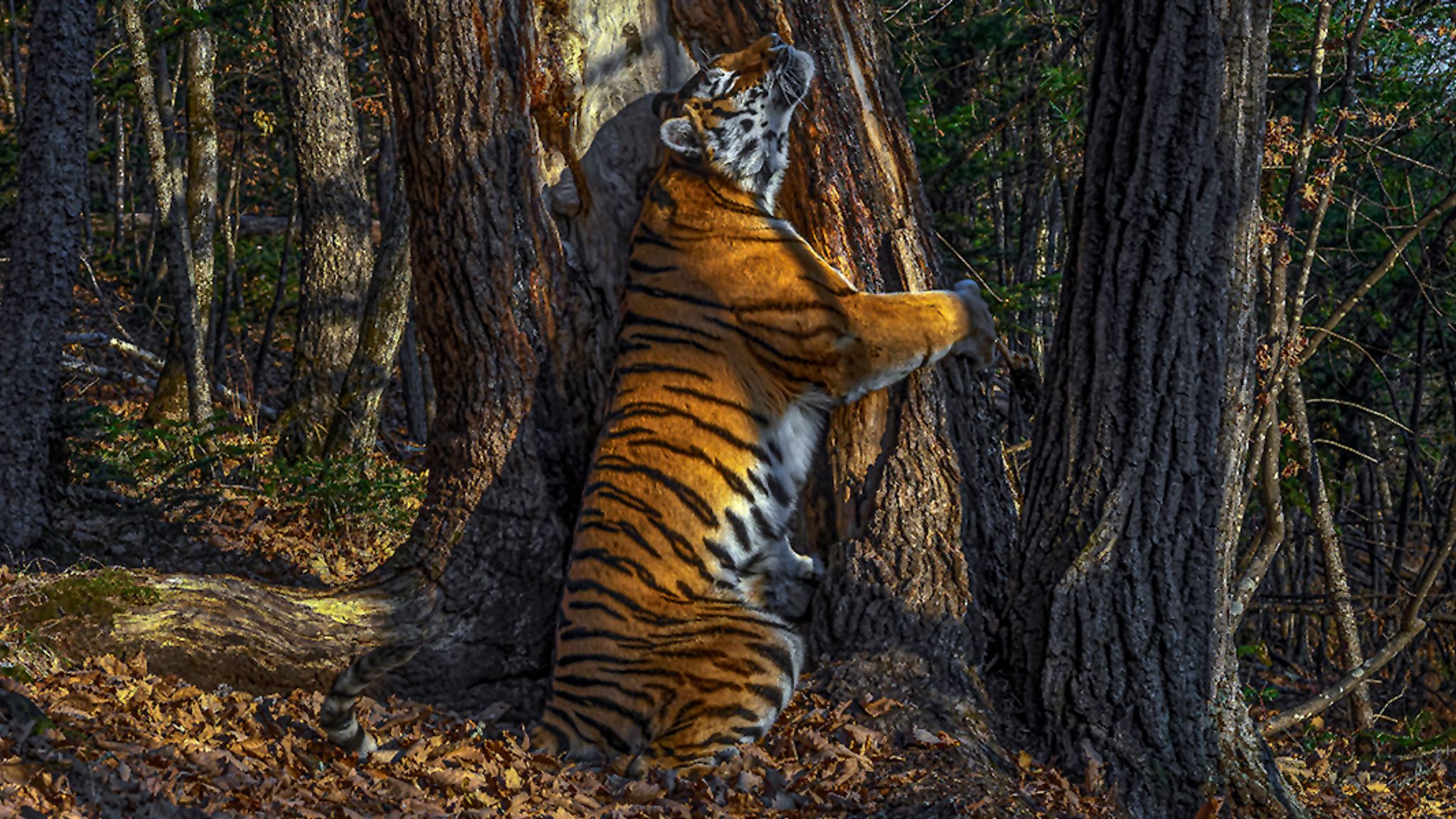
Captured in the Land of the Leopard National Park in the Russian Far East, Sergey Gorshkov’s "The Embrace" is frequently cited by curators and naturalists as the most significant wildlife photograph of the 21st century. The image depicts a rare Amur (Siberian) tiger wrapping its paws around an ancient Manchurian fir tree, its eyes closed in a moment of apparent ecstasy or marking.
The Technical Challenge
Gorshkov spent over eleven months attempting to capture this specific animal. Amur tigers are notoriously elusive, with a range that spans hundreds of miles of dense, rugged forest. Traditional stalking was impossible. Gorshkov utilized camera trap technology, but unlike the low-quality grain typically associated with surveillance, he set up a professional-grade DSLR system with motion sensors. The challenge lay in predicting the exact path and height of a tiger that might only pass that specific tree once every few months.
The Narrative and Impact
This photograph humanized a predator that had long been viewed through the lens of fear. The tiger’s posture—standing on its hind legs, cheek pressed against the bark—suggests a deep, symbiotic connection with the forest. It transformed the Amur tiger from a "man-eater" into a "forest spirit" in the public imagination. Following its publication, international attention on the Amur tiger’s dwindling population (estimated at fewer than 600 in the wild) surged, leading to increased funding for anti-poaching units in the Primorsky Krai region.
2. "The Golden Couple" by Marsel van Oosten (2018)
Marsel van Oosten’s portrait of a pair of Qinling snub-nosed monkeys in China’s Qinling Mountains redefined what is possible with natural lighting in a forest canopy. The image features a male and female monkey sitting on a branch, their vivid orange fur contrasting sharply against the cool, misty greens of the background.
Why It Stands Out
The "Golden Couple" is celebrated for its compositional harmony. The male’s gaze is directed slightly away from the camera, giving him a regal, contemplative air, while the female’s smaller stature adds a sense of domesticity and social complexity. The lighting is ethereal, captured during a brief window when the sun pierced through the mountain fog to illuminate the golden guard hairs of the monkeys’ coats.
Scientific Significance
Beyond its beauty, the photograph brought global awareness to a species that few outside of specialized primatology circles knew existed. The Qinling snub-nosed monkey is a high-altitude specialist, surviving in conditions that would kill most other primates. Van Oosten’s work highlighted the fragility of their habitat, which is under constant pressure from tourism and climate-related shifts in vegetation.
3. "A Tale of Two Foxes" by Don Gutoski (2015)
In a stark, haunting image taken in Wapusk National Park, Canada, Don Gutoski captured a Red fox standing in the snow, clutching the carcass of an Arctic fox in its jaws. This photograph is often described as one of the most visually arresting and disturbing images in the history of the Wildlife Photographer of the Year competition.
The Climate Change Narrative
This is not merely a "predator and prey" shot. It is a document of habitat overlap caused by global warming. As the tundra warms, the larger Red fox is moving further north, encroaching on the territory of the smaller Arctic fox. Gutoski waited for hours in sub-zero temperatures to capture the moment of the Red fox pausing to look at the camera. The contrast between the vibrant red fur, the pristine white snow, and the limp, white body of the smaller fox creates a powerful metaphor for the displacement of species.
Visual Composition
The "S-curve" of the Red fox’s body and the way the tail of the Arctic fox drags in the snow leads the viewer’s eye through the frame in a way that feels cinematic yet tragically real. It remains a primary reference point for climate scientists when discussing the biological consequences of a changing North.
4. "The Face of the Forest" by Tim Laman (2016)
Tim Laman’s wide-angle shot of a Bornean orangutan climbing a thick liana high above the rainforest floor changed how photographers approach arboreal subjects. Rather than shooting from the ground up—which often results in "belly shots"—Laman climbed the canopy himself, setting up remote cameras 30 meters above the forest floor.
Revolutionary Perspective
By using a wide-angle lens rather than a traditional telephoto, Laman was able to capture the orangutan’s face in sharp detail while also showing the vast, disappearing rainforest of Gunung Palung National Park in the background. This "animal in its environment" approach provides a sense of scale and vulnerability that a tight portrait cannot achieve. The orangutan looks back at the camera with a sense of intelligence and curiosity that bridges the gap between species.
Conservation Context
Borneo’s rainforests have been decimated by palm oil plantations. Laman’s body of work, culminating in this image, has been instrumental in the "Save the Orangutan" movement. It visualizes exactly what is at stake: not just an individual animal, but a vertical world that is being systematically dismantled.
5. "The Big O" by Paul Nicklen (2011)
Paul Nicklen’s encounter with a female leopard seal in the Antarctic is the stuff of photographic legend. While most explorers feared leopard seals as aggressive monsters, Nicklen’s image of a massive seal with its mouth wide open—not in an attack, but in an attempt to feed Nicklen a penguin—shattered stereotypes.
Technical Mastery Underwater
Shooting in 29-degree (Fahrenheit) water requires extreme physical endurance and specialized housing for camera gear. Nicklen’s ability to remain calm while a 1,000-pound predator put his head in its mouth is a testament to the psychological requirements of elite wildlife photography. The resulting image is crisp, with incredible detail in the seal’s whiskers and the texture of its palate.
Changing Perceptions
This photograph is widely credited with changing the "villain" narrative surrounding leopard seals. It showed a side of their behavior—nurturing and curious—that had never been documented. Nicklen’s work for National Geographic on this assignment remains the gold standard for polar underwater photography.
Technical Comparison of Masterpiece Captures
The following table outlines the technical specifications and conditions behind these iconic photographs. This data highlights the shift from traditional long-lens photography to more immersive, technology-driven methods.
| Photograph Title | Photographer | Location | Primary Gear Used | Key Technique |
|---|---|---|---|---|
| The Embrace | Sergey Gorshkov | Russia | DSLR + Motion Sensors | Long-term Camera Trapping |
| The Golden Couple | Marsel van Oosten | China | Nikon D850 / 800mm | Backlighting & Mist Control |
| A Tale of Two Foxes | Don Gutoski | Canada | Canon EOS-1D X | Extreme Cold Endurance |
| The Face of the Forest | Tim Laman | Borneo | GoPro/Remote DSLR | Canopy Climbing & Wide Angle |
| The Big O | Paul Nicklen | Antarctica | Canon EOS-1N (Film/Digital) | Specialized Underwater Housing |
The Ethics and Future of Wildlife Photography
As we move through 2026, the ethics of capturing these "best" images have come under intense scrutiny. The rise of AI-generated imagery and drone technology has forced a re-evaluation of what constitutes a "real" wildlife photograph.
Ethical Boundaries
Top-tier competitions and publications now require RAW file verification and detailed "Ethics Statements" to ensure that animals were not baited, harassed, or stressed for the sake of a shot. The five photos listed above are celebrated not just for their beauty, but for the integrity of their creation. For instance, Sergey Gorshkov’s use of a camera trap ensured zero human disturbance to the tiger’s natural behavior.
Technological Shifts
In 2026, we are seeing the emergence of:
- Global Shutter Sensors: Eliminating motion distortion in fast-moving birds and predators.
- AI-Enhanced Autofocus: Capable of tracking the eye of an insect or a bird through thick brush with 99% accuracy.
- Remote Submersibles: Allowing for Nicklen-style underwater shots without the risk to human divers or the intrusive presence of bubbles.
Essential Advice for Aspiring Wildlife Photographers
To capture an image that might one day join this list, a photographer must move beyond the "trophy" mindset. The most successful modern wildlife photographers are those who become biological experts on their subjects.
- Research Before Reach: Spend more time studying the behavior, mating cycles, and migration patterns of your subject than you do looking at gear reviews. Knowledge allows you to predict where an animal will be before it arrives.
- Master the "Quiet" Moments: While action shots of hunts are popular, the industry is currently trending toward "intimate portraits" (like "The Embrace") that show the animal's personality or its relationship with the environment.
- Invest in Stability, Not Just Glass: A $12,000 lens is useless if your tripod or gimbal head cannot handle the weight in a gale-force wind. In the field, stability equals sharpness.
- Tell a Conservation Story: The "best" photos in the 2020s are those that highlight an environmental issue. Whether it’s plastic pollution or habitat loss, an image with a message has a much higher chance of achieving longevity.
Frequently Asked Questions
Which wildlife photography competition is the most prestigious?
The Wildlife Photographer of the Year (WPY), owned by the Natural History Museum in London, is considered the "Oscars" of the industry. Winning the Grand Title is the highest honor a wildlife photographer can achieve. Other notable competitions include the GDT European Wildlife Photographer of the Year and the Nature’s Best Photography Windland Smith Rice Awards.
What is the most expensive wildlife photograph ever sold?
While most wildlife photos are sold as limited edition prints, Peter Lik’s "Phantom" (a landscape shot with wildlife elements) reportedly sold for $6.5 million, though this is debated. In the documentary wildlife world, high-end prints from photographers like Nick Brandt or Marsel van Oosten can fetch between $20,000 and $150,000 at auction.
Do professional wildlife photographers use AI to edit their photos?
As of 2026, the use of AI for "generative" purposes (adding or removing animals/elements) is strictly banned in all major wildlife competitions and editorial outlets. However, AI-driven denoising and sharpening tools (like Topaz Photo AI or Adobe’s Enhance features) are widely accepted as part of a standard digital darkroom workflow, provided they do not alter the biological reality of the subject.
Is it still possible to discover "new" subjects for wildlife photography?
Yes. Deep-sea photography and macro photography of rare insects still offer "frontier" opportunities. With the development of new lighting and pressure-resistant housings in 2026, we are seeing the first clear images of species living in the Hadal zone (deeper than 6,000 meters).
How long does it typically take to get a world-class wildlife shot?
The images on this list often represent years of work. Sergey Gorshkov waited 11 months for "The Embrace." Paul Nicklen spent weeks in the water for a single usable frame of a leopard seal. Mastery in this field is a game of patience and high-frequency failure.
Final Recommendation
For those looking to see these masterpieces in person, the Natural History Museum in London hosts a permanent collection and an annual touring exhibition of the world's best wildlife photography. If you are a photographer aiming to reach this level, prioritize long-term projects over single-day outings. Choosing a specific species or habitat and documenting it over several seasons will always yield more profound results than chasing "the big five" on a standard safari.