At age 41, a healthy net worth is generally considered to be approximately three to four times your annual salary. As of 2026, the estimated median net worth for individuals aged 40 to 44 in the United States is roughly $165,000, while the average (mean) net worth sits significantly higher at approximately $620,000 due to wealth concentration in the top percentiles.
Understanding your financial standing at 41 requires more than a single number. This age represents a critical "mid-point" in a traditional career arc—a time when many individuals are entering their peak earning years while simultaneously balancing the "sandwich generation" pressures of supporting both children and aging parents. In the economic landscape of 2026, where inflation has stabilized but the cost of housing and education remains high, benchmarking your progress is essential for securing a viable retirement path.
Defining Net Worth in the 2026 Economic Context
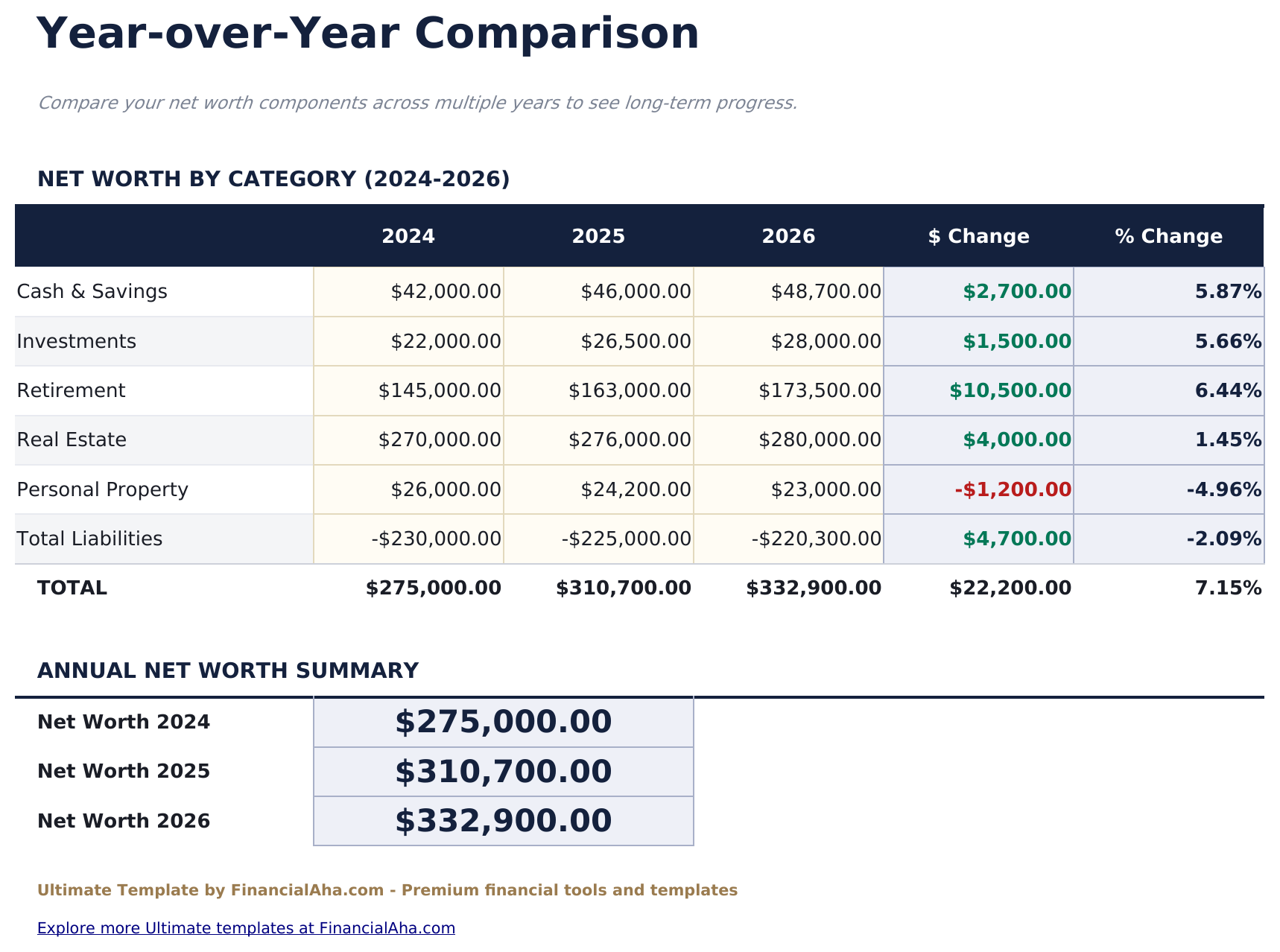
Net worth is the most comprehensive measure of financial health because it accounts for both what you own and what you owe. The formula remains constant: Total Assets minus Total Liabilities equals Net Worth. However, at age 41, the composition of these assets and liabilities is often more complex than it was in your 30s.
The Role of Assets
For most 41-year-olds, assets are divided into three primary categories:
- Liquid Assets: Cash, savings accounts, and money market funds. These provide the necessary "emergency fund" buffer, which should ideally cover six months of expenses in 2026’s economy.
- Invested Assets: Retirement accounts (401(k), IRA), brokerage accounts, and HSA balances. By 41, the power of compounding should begin to show significant results, often outpacing annual contributions.
- Use Assets: The most prominent being home equity. While a primary residence is an asset, it is illiquid. In 2026, many 41-year-olds find a large portion of their net worth tied up in real estate due to the appreciation cycles of the early 2020s.
The Impact of Liabilities
Liabilities at 41 typically include mortgage balances, auto loans, and potentially remaining student debt or credit card balances. At this age, the goal is "debt optimization." High-interest consumer debt is a net-worth killer, whereas low-interest mortgage debt is often viewed as a strategic tool. The 2026 financial environment rewards those who have refinanced or maintained fixed-rate debt, as variable rates have seen more volatility in recent years.
Benchmarking Net Worth: Median vs. Average
When evaluating your progress, it is vital to distinguish between the "average" and the "median." The average net worth is often skewed by the ultra-wealthy, making it a difficult benchmark for the typical household. The median—the literal middle point—provides a more realistic picture of where the "average" 41-year-old stands.
| Wealth Percentile | Estimated Net Worth (Age 40-44) | Financial Characteristics |
|---|---|---|
| Bottom 25% | Under $25,000 | Often high student debt or late career starts. |
| Median (50%) | $165,000 | Significant home equity; modest retirement savings. |
| Top 25% | $450,000 | Diversified portfolios; 10+ years of consistent 401(k) growth. |
| Top 10% | $1,200,000 | Multiple properties or business equity; maximized tax-advantaged accounts. |
| Top 1% | $6,500,000+ | Significant private equity, inheritance, or high-scale entrepreneurship. |
These 2026 figures reflect the cumulative impact of the market recoveries and the inflationary adjustments of the past several years. If your net worth is significantly lower than the median, it is often a sign that debt service is consuming too much of your monthly cash flow.
The "Salary Multiplier" Rule
A popular and practical way to measure net worth without relying on national averages is the salary multiplier rule. Financial institutions like Fidelity suggest that by age 40, you should have three times your annual salary saved for retirement. By age 41, that benchmark moves toward four times your salary.
For example, if you earn $100,000 per year at age 41, a target net worth (focused on investable assets) would be between $300,000 and $400,000. This rule is particularly effective because it scales with your lifestyle. If you have a high income but low net worth, it suggests you are "income rich but wealth poor," a condition often caused by lifestyle creep.
Key Factors Influencing Wealth at Age 41
Several variables can cause a 41-year-old’s net worth to deviate from the standard benchmarks. Recognizing these factors can help you contextualize your own numbers.
Geography and Cost of Living
A net worth of $200,000 in a low-cost-of-living (LCOL) area may represent a higher standard of living and better retirement readiness than $500,000 in a high-cost-of-living (HCOL) city like San Francisco or New York. In 2026, the "Remote Work Dividend" continues to influence these numbers, as many in their early 40s have migrated to LCOL areas while retaining HCOL salaries, significantly boosting their ability to save.
Household Composition
Single-income households often face a steeper climb toward high net worth benchmarks compared to dual-income households. Furthermore, the "cost of children" peaks in the early 40s for many, as childcare costs transition into extracurricular and early college-savings pressures.
Career Trajectory
Many professionals hit their peak earning years between 40 and 55. If you spent your 20s and early 30s in higher education (medical, legal, or doctoral programs), you may have a lower current net worth but a much higher "human capital" value. At 41, the focus for these individuals is a rapid transition from debt repayment to aggressive asset accumulation.
Strategic Moves to Increase Net Worth After 40
If you find yourself behind the benchmarks in 2026, the 40s are not too late to course-correct. In fact, this decade is often the most productive for wealth building.
1. Maximize Tax-Advantaged Accounts
At 41, you are still nearly 20 years away from standard retirement age. Maxing out 401(k) or 403(b) contributions—especially if there is an employer match—is the most efficient way to build wealth. In 2026, the contribution limits have adjusted upward for inflation, allowing for greater annual tax-deferred growth.
2. Focus on "The Big Three" Expenses
To move the needle on net worth, you must address housing, transportation, and taxes.
- Housing: Avoid over-improving a home beyond its neighborhood value.
- Transportation: In 2026, the average cost of a new vehicle remains high. Keeping a reliable car for 10+ years instead of financing new ones can add six figures to your net worth over a decade.
- Taxes: Utilize Health Savings Accounts (HSAs) and tax-loss harvesting in brokerage accounts to minimize the "tax drag" on your investments.
3. Home Equity Utilization
While home equity is part of net worth, it doesn't pay the bills. If a large percentage of your wealth is in your home, consider whether you are "over-housed." Downsizing or moving to a more affordable market is a common 2026 strategy for those looking to "unlock" their net worth for retirement.
The Danger of Lifestyle Creep
As salaries increase at age 41, there is a natural tendency to increase spending—nicer cars, luxury vacations, or larger homes. This "lifestyle creep" is the primary reason high earners often fail to meet net worth benchmarks. To combat this, many financial planners recommend "reverse budgeting": automating your savings and investments first, and only spending what remains.
Common Mistakes to Avoid at 41
- Neglecting the Emergency Fund: With the 2026 labor market showing shifts in AI-driven automation, career stability is not guaranteed. Carrying too much illiquid wealth without a cash buffer can lead to high-interest debt during a job transition.
- Over-Prioritizing College Savings: Many parents at 41 sacrifice their 401(k) contributions to fund their children's 529 plans. Remember: your child can get a loan for college, but you cannot get a loan for retirement.
- Underestimating Inflation: 2026 retirees and pre-retirees must account for the long-term erosion of purchasing power. Keeping too much of your net worth in "safe" cash or bonds can result in a net loss of value over time.
Frequently Asked Questions
What is a "good" net worth for a 41-year-old?
A "good" net worth is subjective, but generally, having a net worth that is 3x to 4x your annual salary indicates you are on track. If you earn $80,000, a net worth of $240,000 to $320,000 is considered excellent.
Does my primary residence count toward my net worth?
Yes, in a technical sense, your home equity (Market Value minus Mortgage Balance) is a major component of net worth. However, for retirement planning, many experts prefer to look at "investable net worth," which excludes the home you live in, as you will always need a place to stay.
I have a negative net worth at 41. Am I in trouble?
A negative net worth at 41 is a serious signal that requires immediate action, usually involving debt restructuring or a significant lifestyle change. However, if the negative value is due to high-potential debt (like medical school loans) and your income is high, your "net worth" is likely to swing positive very quickly.
How much should I have in my 401(k) specifically by age 41?
By 41, a common goal is to have roughly 3x your salary in retirement accounts. If you started late, you should aim to contribute at least 15-20% of your gross income to catch up.
How do 2026 interest rates affect my net worth?
Higher interest rates increase the "cost" of your liabilities (if they are variable) but increase the "yield" on your cash and bonds. In 2026, savers are seeing better returns on HYSA (High-Yield Savings Accounts) than in previous decades, making cash a more viable part of a net worth strategy than it was in the 2010s.
Practical Next Action
To get a true sense of where you stand, perform a 2026 Net Worth Audit. List every asset (bank accounts, retirement, home value, vehicles) and every debt (mortgage, student loans, credit cards). Update this every six months. If your net worth is not increasing even as you work, your focus should shift from "saving" to "expense reduction" or "income diversification."