For the 2025 tax year, the New York State (NYS) standard deduction amounts are $8,000 for single individuals who cannot be claimed as a dependent, $16,050 for married couples filing jointly, and $11,200 for heads of household. These amounts remain consistent with recent years, as New York State does not automatically adjust these figures for inflation.
As we move through 2026 and finalize filings or adjustments for the 2025 tax period, understanding these fixed amounts is critical for accurate liability projection. Unlike the federal government, which adjusts standard deductions annually based on the Consumer Price Index (CPI), New York State requires legislative action to alter these base figures. Consequently, the gap between the federal standard deduction and the New York State standard deduction continues to influence how taxpayers choose between standard and itemized deductions on their state returns.
Core 2025 NYS Standard Deduction Figures by Filing Status
The New York State Department of Taxation and Finance sets the standard deduction based on your filing status and whether you can be claimed as a dependent on another person's return. These figures apply to the IT-201 (Resident) and IT-203 (Nonresident and Part-Year Resident) forms.
| Filing Status | 2025 NYS Standard Deduction |
|---|---|
| Single (cannot be claimed as a dependent) | $8,000 |
| Single (can be claimed as a dependent) | $3,100 |
| Married Filing Jointly | $16,050 |
| Married Filing Separately | $8,000 |
| Head of Household (with qualifying person) | $11,200 |
| Qualifying Surviving Spouse | $16,050 |
These amounts represent the portion of your income that the state does not tax, effectively lowering your New York Adjusted Gross Income (NYAGI) to arrive at your New York taxable income.
The Strategic Importance of the NYS Standard Deduction
In the current 2026 tax landscape, the 2025 NYS standard deduction serves as a "floor." If your allowable New York itemized deductions do not exceed these amounts, taking the standard deduction is the most tax-efficient route. However, New York is unique because it allows taxpayers to itemize on their state return even if they chose the standard deduction on their federal return.
This "decoupling" of state and federal elections is a vital strategy for New Yorkers. Since the federal standard deduction for 2025 was significantly higher (e.g., $15,000 for singles), many taxpayers found that while they couldn't exceed the federal threshold, they could exceed the $8,000 New York threshold.
Why NYS Deduction Amounts Remain Static
New York tax law, specifically Tax Law § 614, dictates these amounts. Unlike the federal Tax Cuts and Jobs Act (TCJA) of 2017, which nearly doubled the federal deduction, New York’s legislature has opted to keep state deduction amounts stable while focusing tax relief on other areas, such as the Middle Class Tax Cut credits and the STAR (School Tax Relief) program. For taxpayers, this means that as wages rise with inflation, a larger percentage of income technically becomes subject to state tax unless other credits are utilized.
Deep Dive: Filing Status and Eligibility Requirements
Choosing the correct filing status is the first step in claiming the correct 2025 deduction amount. Misclassification can lead to audits or underpayment penalties.
Single Taxpayers and Dependents
For most single individuals, the $8,000 deduction is straightforward. However, the $3,100 amount for dependents is a frequent point of confusion. If a taxpayer—such as a college student or a teenager with a part-time job—can be claimed on their parents' return, they are limited to this lower amount. Even if the parents choose not to claim them, the mere fact that they can be claimed usually triggers the lower deduction limit under NYS rules.
Head of Household (HoH)
To qualify for the $11,200 deduction, you must meet the federal requirements for Head of Household status. This generally involves being unmarried at the end of the year and paying more than half the cost of keeping up a home for a qualifying person (usually a child or relative) for more than half the year. New York strictly follows federal eligibility for this status.
Married Filing Separately
When a married couple files separately in New York, both must usually follow the same path. If one spouse itemizes, the other is often required to itemize as well, or they may both take the $8,000 standard deduction. This prevents couples from "doubling up" on tax benefits in a way that the law does not intend.
Standard vs. Itemized Deductions: The New York Decoupling
One of the most technical aspects of New York tax law is the use of Form IT-196, New York Resident, Nonresident, and Part-Year Resident Itemized Deductions.
Because the 2025 NYS standard deduction of $8,000 (single) is much lower than the federal standard deduction (which was $15,000 for the 2025 tax year), many residents benefit from itemizing for state purposes only. This is beneficial if your total New York itemized deductions—such as charitable contributions, mortgage interest, and state/local taxes (subject to limits)—fall between $8,000 and $15,000.
Common Itemized Deductions on Form IT-196:
- Medical and Dental Expenses: Only the portion that exceeds 7.5% of your federal adjusted gross income.
- Interest Paid: Primarily home mortgage interest.
- Charitable Contributions: Gifts to qualified 501(c)(3) organizations.
- Casualty and Theft Losses: Related to federally declared disasters.
It is important to note that New York has its own limitations on high-income taxpayers. If your NYAGI exceeds certain thresholds (starting at $100,000), your total allowed itemized deductions may be reduced by a percentage.
Impact for Nonresidents and Part-Year Residents
If you lived in New York for only part of 2025, or if you lived in another state but earned income in New York (such as commuting to NYC), the standard deduction process changes. You must file Form IT-203.
Nonresidents and part-year residents do not get the full standard deduction to apply against their New York income. Instead, the deduction is prorated. You calculate your tax as if you were a full-year resident using the full standard deduction, and then you multiply that tax by a fraction. The numerator is your New York source income, and the denominator is your federal income. This ensures that you only receive a tax benefit proportional to the income earned within the state's jurisdiction.
Interaction with NYS Tax Brackets
The standard deduction is the first line of defense against the New York progressive tax rate. For 2025, New York continues its multi-year phase-in of lower tax rates for middle-income earners.
By subtracting the $8,000 or $16,050 standard deduction from your NYAGI, you might drop into a lower tax bracket. For example, if a single filer earns $30,000, the $8,000 standard deduction reduces their taxable income to $22,000. In New York's bracket system, this shift can mean the difference between paying a 5.50% marginal rate versus a 5.25% marginal rate, depending on the specific bracket thresholds for that year.
Common Mistakes When Applying the 2025 Deduction
As tax professionals review 2025 data in 2026, several recurring errors have been identified regarding these deduction amounts:
- Using Federal Amounts for State Returns: This is the most frequent error. Taxpayers often assume that if the federal standard deduction is $15,000, the state amount must be similar. Applying the federal amount to an NYS return will trigger an automatic correction notice from the Department of Taxation and Finance, often resulting in an unexpected bill for the difference.
- Incorrect Dependent Filing: High school and college students earning more than $3,100 often forget to use the reduced deduction amount. If they claim the full $8,000, their return will likely be flagged when the state cross-references their Social Security number with their parents' return.
- Failing to Itemize on State Returns: Many taxpayers see they didn't qualify to itemize on their federal return and assume they shouldn't bother for New York. As established, because the NYS standard deduction is so much lower, it is often worth the extra effort to fill out Form IT-196.
Verification and Documentation
The New York State Department of Taxation and Finance (DTF) maintains the official record of these amounts. For historical verification or to check for any mid-year legislative amendments, taxpayers should refer to the NYS DTF official website. Specifically, the instructions for Form IT-201 provide the updated worksheets for calculating the deduction if your situation is non-standard (such as for those who are blind or over age 65, though New York, unlike the IRS, does not provide an extra standard deduction for age or blindness).
Frequently Asked Questions
Does NYS have an extra standard deduction for seniors?
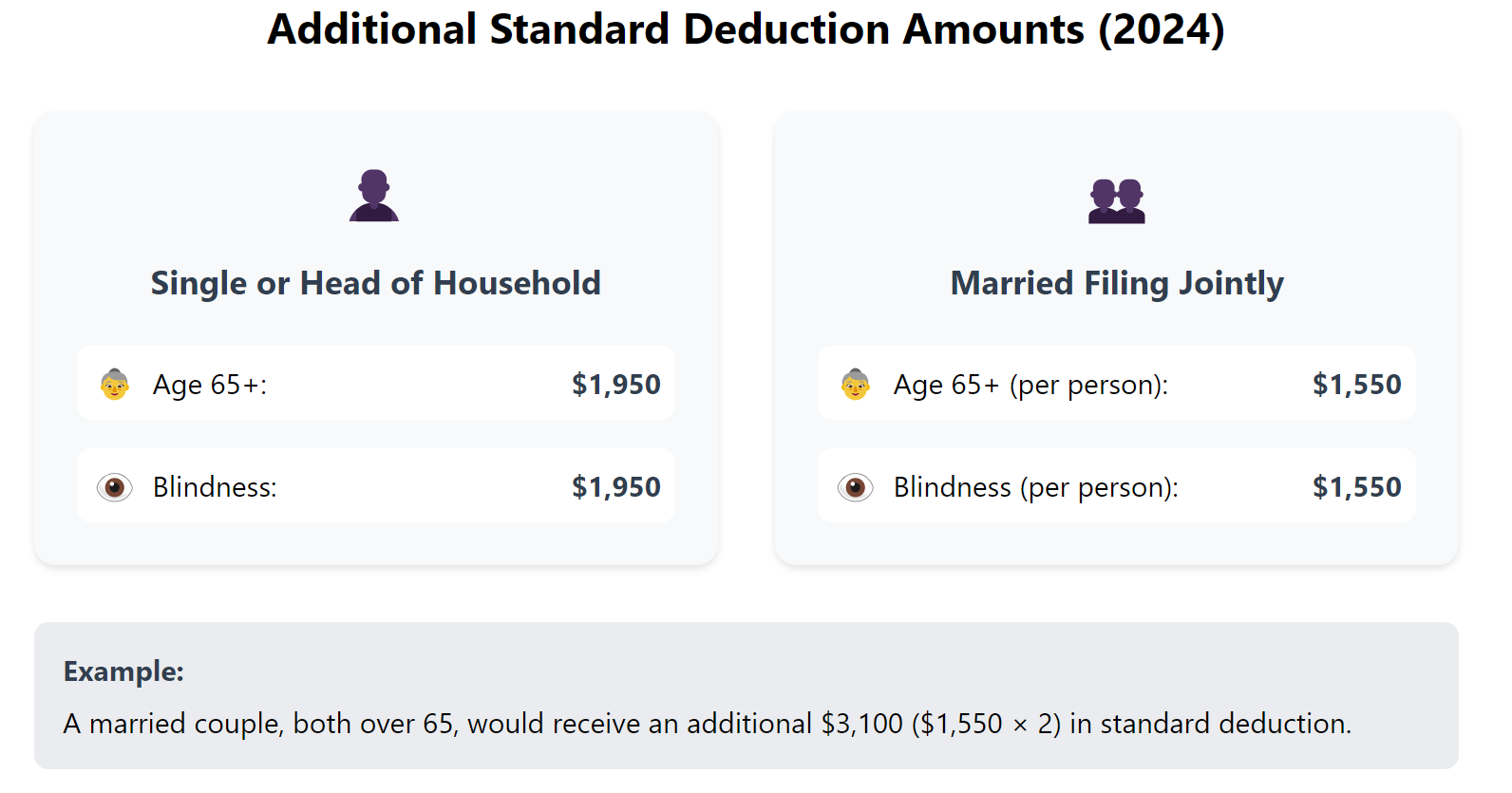
No. Unlike the federal government, which provides an additional standard deduction amount for taxpayers who are 65 or older or blind, New York State does not offer a higher standard deduction for these groups. The amounts remain $8,000, $16,050, or $11,200 regardless of age. However, New York does offer other benefits for seniors, such as the exclusion of up to $20,000 in pension and annuity income.
Can I change from the standard deduction to itemized after I file?
Yes, you can generally amend your New York return using Form IT-201-X within three years of the original filing deadline. If you realize that your itemized deductions on Form IT-196 would have been higher than your 2025 standard deduction, filing an amendment could result in a refund.
What if I am a part-year resident who moved out of NY in 2025?
You will use Form IT-203. Your standard deduction amount ($8,000 for singles, etc.) is used to calculate a "base tax" on all your income. That tax is then reduced based on the percentage of your income that was earned while you were a resident of New York or from New York sources. You do not simply take a "half deduction" because you lived there for six months.
How do I know if I should itemize for NYS but not for federal?
You should total your allowable New York itemized deductions (charitable gifts, mortgage interest, etc.). If that total is greater than your NYS standard deduction ($8,000 for single, $16,050 for joint) but less than your federal standard deduction, you should take the standard deduction for your federal return and itemize for your New York return.
Are these amounts expected to change for the 2026 tax year?
Unless the New York State Legislature passes a new budget bill that specifically increases the amounts in Tax Law § 614, the figures are expected to remain the same for 2026. New York does not have a "COLA" (Cost of Living Adjustment) for its standard deduction.
Practical Next Steps for Taxpayers
If you are finalizing your 2025 tax obligations in 2026, take the following actions:
- Compare your totals: Before selecting the standard deduction, calculate your potential itemized deductions using Form IT-196. Even if you don't have a mortgage, significant charitable contributions or high medical expenses can often push you over the $8,000 threshold.
- Check for Dependent Status: If you are a young adult or student, confirm whether your parents are claiming you. If they are, ensure you only use the $3,100 deduction amount to avoid penalties.
- Review IT-201 Instructions: The IT-201-I instructions provide the most granular detail on how the standard deduction interacts with other state-specific subtractions.
- Consult a Professional: Because of the decoupling between federal and NYS rules, tax software sometimes defaults to the same choice (standard vs. itemized) for both. Ensure your software or preparer is specifically looking at the benefit of itemizing only for the state.
Professional Disclaimer: This information is provided for educational purposes and is based on New York State tax laws for the 2025 tax year as understood in 2026. Tax laws are subject to change by legislative action. For specific legal or financial advice regarding your personal tax situation, consult with a qualified CPA or tax attorney.